

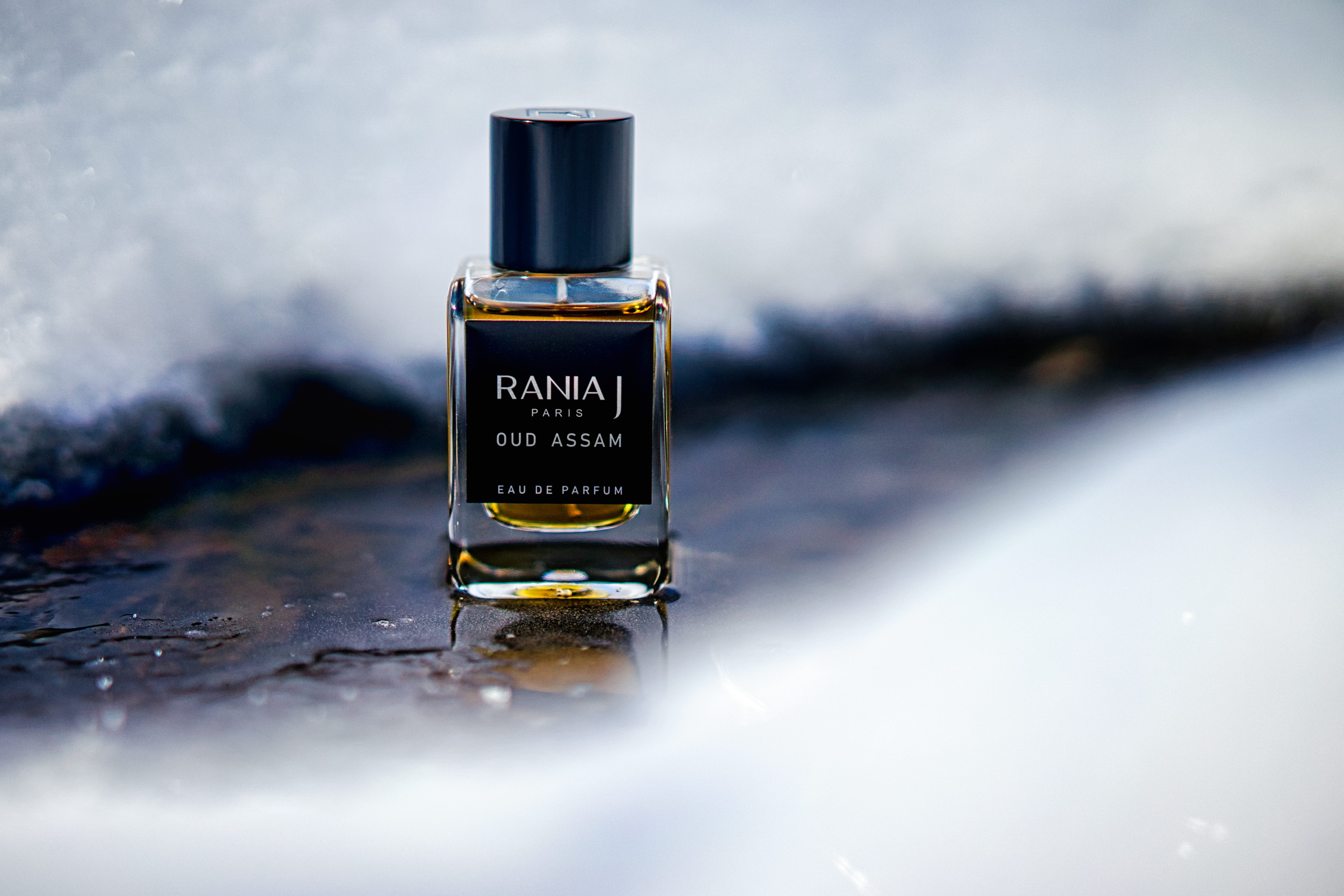
Perfume is often spoken of as an ornament, a final gesture before departure, a veil cast lightly to suggest intention. It is treated as language worn externally, a chosen dialect of desire. Yet there are rarer compositions that do not behave as adornment at all. They do not sit upon the skin so much as awaken from within it. In such cases, fragrance is not worn but revealed. Oud Assam by Rania J belongs to this other order. From the first encounter, it suggests that something ancient has been drawn upward through hidden channels of the self, as though the body were an alembic and the soul its slow-burning fire.
At its core lies the eponymous ingredient itself, a philosophy of transformation in liquid form. Oud, born of infection and time, speaks in paradox. Its darkness is not absence but saturation. Its richness carries the memory of decay, yet this decay is fertile, almost luminous in its depth. One senses damp soil turned by unseen hands, the quiet labor of fungi weaving life through what has been relinquished. It is a scent that unsettles before it seduces, one that resists easy admiration. For the uninitiated, it may feel overwhelming, even confrontational. Yet there is a strange gravity to it, an inward pull of recognition.
Each note emerges as though coaxed from a hidden reservoir, shaped by patience and pressure. Cedarwood rises as a sign of things to come. Vetiver hums beneath it, anchoring the composition in a quiet persistence. Incense threads through the air with a contemplative hush, while black pepper flickers like a brief, sharp thought. Tonka bean softens the edges, lending warmth without sentimentality. Musk lingers as a kind of echo, intimate and elusive. Then there is the brightness of bergamot, sweet orange, and bitter orange: a secret aperture through which light refracts and dissolves.
The experience unfolds not in stages but in spirals. Each return reveals a new inflection. The scent feels suspended between states, neither wholly anchored nor entirely airborne.
What most profoundly distinguishes this fragrance is its refusal to remain separate from the wearer. Many perfumes act as barriers, polished surfaces that reflect an image outwardly. Oud Assam erodes that boundary. It does not shield. It permeates. One must be continuous with it. The skin ceases to be a site of application and becomes one of emergence instead.
Even before the first droplet touches flesh, there is awareness of what is to come. Absorption is not the right word. Emanation comes closer, though even that feels incomplete. Either way, Oud Assam is a process caught in the subtle architecture of being alive.
Perhaps this is why it feels so inevitable. Not because it is simple, but because it reveals what was already there, waiting to be drawn out. It asks nothing except a willingness to encounter oneself without embellishment.
And in that encounter lies a peculiar exhilaration. One begins to sense that identity is not fixed but constantly in flux, shaped by unseen processes, refined by time, and altered by contact with the world. To wear such a scent is to participate in such processes, to recognize that transformation is not an event but a state of being, and to understand, perhaps with a quiet thrill, that what emerges from the depths is never entirely known, yet always somehow our own.
 Between Sound and Space: ECM Records and Beyond