

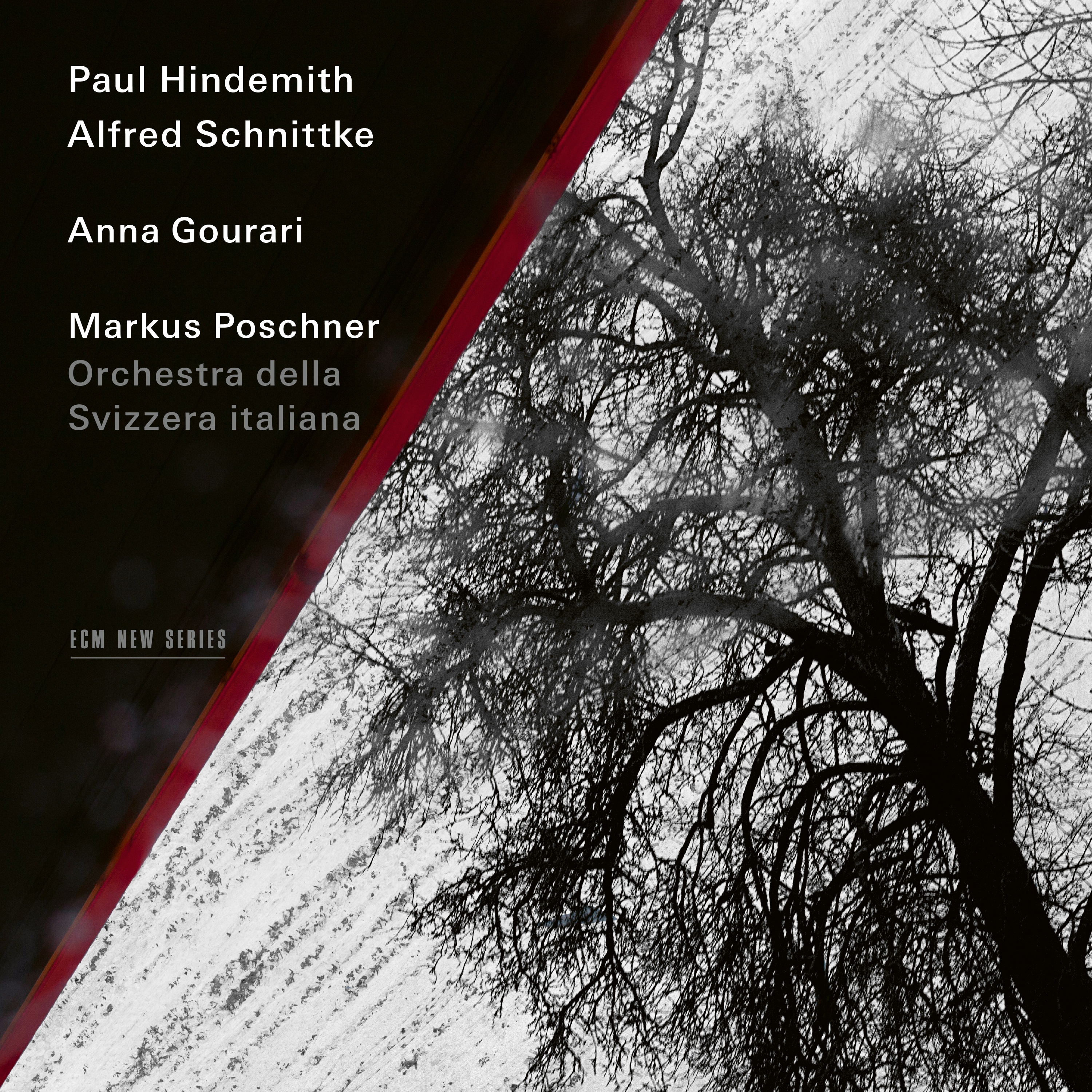
Anna Gourari: Paul Hindemith/Alfred Schnittke (ECM 2752 NS)

Anna Gourari
Paul Hindemith/Alfred Schnittke

Anna Gourari piano
Orchestra della Svizzera italiana
Markus Poschner
 conductor
Recorded December 2021, Auditorio Stelio Molo RSI, Lugano
Engineer: Wolfgang Müller (RSI)
Mixed January 2023 by Wolfgang Müller and Manfred Eicher
Cover photo: Fotini Potamia
Produced by Manfred Eicher
Release date: June 14, 2024

Since making her ECM debut with Canto Oscuro in 2012, Tatarstan-born pianist Anna Gourari has tread a distinct path. On that and two subsequent solo recitals, the breadth of her vision as a musician is matched only by her choice of repertoire, spanning the gamut from Bach and Chopin to Medtner and Kancheli. For the present program, she gives deference to two beacons whose light has often shined at her fingertips.

The Composers

In this program notes, Roman Brotbeck describes Alfred Schnittke (1934-1998) as a listener above all. As “one of the most idiosyncratic and enigmatic composers of the 20th century,” he was a resolute soul who didn’t so much search for sounds that were new but rather expressive of a higher power. In addition to his symphonies, choral works, and various configurations for orchestras and soloists, he wrote prolifically for film, seesawing throughout his life between his German roots and Russian upbringing, all the while examining a deepening Orthodox faith. As well versed in idioms as he was in subverting them, he operated like a linguist parsing morphemes to explore how they might be connected across seemingly insurmountable barriers of genre, style, and historicity. From his early days at the Moscow Conservatory to his later years in Hamburg, Germany, he was as much a polyglot as a polystylist who organically defied categorization.

“The reactions music evokes are not feelings, but they are the images, memories of feelings.” So wrote Paul Hindemith (1895-1963) in his 1952 collection of lectures, A Composer’s World. Like Schnittke, music was a field where he planted two sacred ideas for every secular. He was also a concert violinist/violist, an author, and a committed teacher. His composing was as much a reflection of extroversion as his daily life was of privacy. After studying at the Hoch Conservatory in Frankfurt, he served in the Imperial German Army, diving headlong into composing upon his return to civilian life. Fleeing the scourge of Nazism, he founded the Ankara State Conservatory at the behest of the Turkish government, thereafter arriving in America in 1940, where he taught at Yale and Cornell, among other institutions of higher learning, before living out the rest of his life in Switzerland and his native Germany. Throughout his steadfast career, he explored the tonal landscape with fortitude and creative boldness. He also greatly influenced the young Schnittke, whose side of the Venn diagram overlaps Hindemith’s by 29 years.

The Music

Schnittke’s Concerto for Piano and Strings (1979) has a special place in my heart. As a teenager, I discovered his music through the BIS recording label. This piece was featured on my favorite of the series (CD-377), where it was paired with the Concerto Grosso I of 1977 and the Concerto for Oboe, Harp, and String Orchestra of 1971. It wasn’t long before I learned of his death via my local classical radio station.

The opening piano of this gargantuan piece is an exercise not in contrasts but in constructs; the gentle stirrings morphing into giant broken triads and the ethereal entrance of strings are as cohesive as they are episodic. Over 23 minutes, this mashup of, in the composer’s words, “surrealistic shreds of sunrise from orthodox church music” and “a false burst of Prokofievian energy and a blues nightmare” succeeds with an uncanny beauty. As the orchestra attempts to engulf the piano in an almost Purcell-like wave of drama, the struggle feels as real as rain. In the end, the B-A-C-H motif emerges like a blush of red across bare skin, a comet frozen in time, a scar where the light of God shows through.

During the second half of his composing career, Hindemith became firmly entrenched in robust harmonic structures that overshadowed the expressionism of his youth even as they drew from it. In response to Hitler’s growing shadow, he wrote his opera, Mathis der Maler, in which the titular protagonist, Renaissance painter Matthias Grünewald, sought refuge in his art from the German Peasants’ War of 1524-25. During that period, Grünewald painted the Isenheim Altarpiece in Colmar, and it was this Hindemith expressed in musical form in this symphonic distillation from 1934. First is the “Angel Concert,” which takes the medieval song “Es sungen drei Engel” (Three angels were singing”) as its central motif. Its tripartite structure is just one echo of the Trinity. Like Schnittke’s own angelic concert, the music is richly varied yet utterly cohesive, if more accessible to lay ears. Next is the “Grablegung” (Entombment), which depicts the mother Mary, Mary Magdalene, and the apostle John mourning the death of their Savior. But that darkness is short-lived as the glory of Christ’s resurrection crashes into the foreground. Lastly, the “Versuchung des heiligen Antonius” (Temptation of Saint Anthony) nestles the patron saint from Padua (and contemporary of St. Francis) in a gaggle of monstrous creatures. Dissonance makes itself known, rendering the marching valiance of its unfolding all the more powerful. Brotbeck notes the significance of this movement’s subtitle (“Where were you, good Jesus, where were you? Why were you not there to heal my wounds?”) as painted into Grünewald’s portrait of Antonius: “Hindemith’s reference to this exclamation shows the autobiographical aspect of the symphony, as Antonius, who withdraws from society and is exposed to satanic temptations as a desert hermit, also reflects Hindemith’s personal situation in Nazi Germany.” Said temptations play out with churning drama.

After fleeing to the US, Hindemith came to write his ballet score, The Four Temperaments, in 1940 for George Balanchine. However, this theme and variations for piano and string orchestra never received its intended premiere, as the sinking of the Hood of Britain by the Bismarck of Germany cast a pall over composers of the latter persuasion. Nevertheless, we find another space in which politics seems even farther away. Here, we encounter a more metaphysical realm. Whereas the first variation flirts with melancholy and the fourth with jagged relief, the constellations between them blend concerto-like impulses with sonata-esque spirit. Duos, trios, and other combinations abound, each reaching for something familiar.

The Performers

Gourari approaches Schnittke with incredible drive and reflection. In a particularly dramatic middle section, she digs into the piano’s most nutrient-rich dirt, finding equilibrium even amid the drunken sway of violins struggling to maintain their own. She treats the instrument as an extension of herself, ever searching for a means to speak through its many intermediary mechanisms. From jazzy slurs to neoclassical aphorisms, medieval chants to postmodern geographies, she navigates it all with a compass that adapts to every shift of current.

The Orchestra della Svizzera italiana and conductor Markus Poschner work through the fleshly struggles of Hindemith’s Mathis der Maler with appropriate tension. They take stock of flesh and spirit equally, treating them as substances to render the compositional impulse as clay in the potter’s hands. There is a sense of having been somewhere tragic, carrying fragments of some tattered book or relic on the way to a church down to its last candle.

The Four Temperaments combines all of the above. In the second movement (first variation), Robert Kowalski’s solo violin lends a sense of mournful whimsy. Gourari is deeply in character throughout. The orchestra doesn’t act as a massive unit for which the piano is a mere decoration or accompaniment. Rather, it serves as a wellspring of material inspirations from which every key may be gathered.
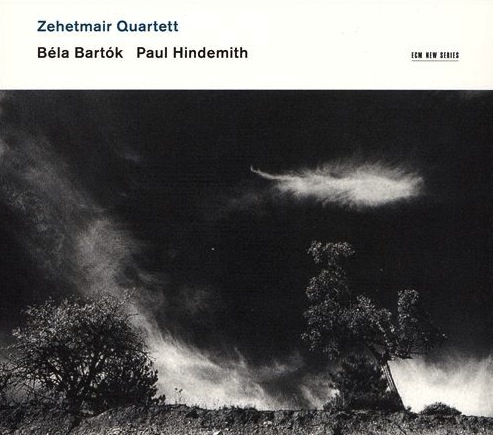
Zehetmair Quartett: Béla Bartók/Paul Hindemith (ECM New Series 1874)


Zehetmair Quartett
Béla Bartók/Paul Hindemith

Thomas Zehetmair violin
Kuba Jakowicz violin
Ruth Killius viola
Ursula Smith violoncello
Recorded June 2006, Kulturbühne AmBach, Götzis
Engineer: Stephan Schellmann
Produced by Manfred Eicher

The sound of the Zehetmair Quartet is hard to miss. Playing from memory, this intensely talented ensemble brings a fiery passion to everything that receives its bows. Following up their groundbreaking recordings of Schumann and Hartmann/Bartók, Zehetmair and company return in the latter vein, pairing the Hungarian’s Fifth (1934) with Paul Hindemith’s Fourth (1921).

Bartók’s writing is as colorful as it is a joy to play, and from the first Allegro even the new listener will note the freshness of the territory. So begins a flowing series of vignettes, of which the slinking Adagio is the most enigmatic departure from the density of its surroundings, as if the ghost of the first were whispering in our ears. The Scherzo proves fertile ground for the composer, a gesture par excellence that stakes a claim in the brain. Promises are fulfilled in chains, as Bartók seems to favor a tight and, in Zehetmair’s words, “functional” approach. The Finale sets us swooning, working in knit clusters made all the more intriguing by the flawless playing.

Hindemith’s quartet, also in five movements, stresses a complimentary ability at the slow and inward looking. The Fugato through which it breathes into life is a perfect example of his ability to do for introspection movements what Bartók does for the extro, forging an idiosyncratic lyricism that constantly reforms itself. The Debussy-like charm of the third movement touches the heart, lulling us via a cello-heavy passage into the fanciful Rondo that leaves us breathless.

Invigorating, committed, superb. No lesser adjectives will suffice.

Hindemith: Viola Sonatas – Kashkashian/Levin (ECM New Series 1330-32)

Paul Hindemith
Sonatas for Viola/Piano and Viola Alone

Kim Kashkashian viola
Robert Levin piano
Solo sonatas recorded 1985-86, Kirche Seon, Switzerland and Karlshöhe, Ludwigsburg, Germany
Engineer: Stephan Schellmann
Sonatas for viola and piano recorded 1986, Feste Burg Kirche, Frankfurt, Germany
Engineer: Peter Laenger
Produced by Manfred Eicher

“The viola is commonly (with rare exceptions indeed) played by infirm violinists, or by decrepit players of wind instruments who happen to have been acquainted with a stringed instrument once upon a time.”
–Richard Wager

If ever a recording could put Wagner’s infamous statement to rest, this would be it. Simply overflowing with musical brilliance, it remains one of the finest examples of what the viola is capable of. Kim Kashkashian’s technique and passion are almost palpable and one can only marvel at the humble respect she brings to both. The viola doesn’t simply exist somewhere between violin and cello, forever doomed to be second rate to both. It is, rather, an utterly dynamic and rich musical object, and the ways in which Hindemith unravels its subtler intonations in these sonatas is nothing short of monumental. Every chapter tells us something new, until the linguistic possibilities of the music represented in this eclectic set are exhausted.

Sonate op. 31,4
The first movement is a virtuosic leap through microtonal harmonies and energetic flights of fancy. Kashkashian negotiates these with such conviction, they sound spontaneously composed. As evocative as the music is, it is difficult to picture anything while listening to it, existing as it does in a sound world fashioned from the innards of its own body. And in this fashion it proceeds, drawing from its ligaments, veins, and arteries a broader musical circulation that extends one’s sense of self beyond the instrumental and into the metaphysical. Kashkashian ends with a dramatic flourish, as if to punctuate the ineffability of belonging. The second movement is a mournful monologue. This, Kashkashian plays with heartfelt sensitivity, much in contrast to the raw strength with which she attacks the opening movement. She extracts from her instrument sounds and emotions that are deeply ingrained in the wood itself, brought forth through the strings just as breath is spun into voice through the throat. She does this not so much with the “effortlessness” often ascribed to virtuosi, but rather makes audible her long hours of dedicated practice, her struggles to wrench from this neglected instrument an entirely orchestral palette of atmospheres. The third movement opens with double stops and a linear introduction of the theme before venturing off into beautiful variations and idiosyncratic counterpoint. Again, Hindemith shows a fondness for tight harmonies, for the spatial potential between adjacent notes. The theme is a fascinating melody, devoid of context and therefore unbounded. As Kashkashian builds her energy, the music regresses into its constituent melodic parts before taking pause. The next section of the third movement is marked “Langsam,” and is an accordingly pliant interlude that hangs in the air like a piece of windblown pollen. Kashkashian plays it as if sharing a new discovery. The final passage springs from the solace of the tangential middle with almost Pan-like exuberance. We see in this music a certain quality of “understanding,” a mischievous surrender to the will of compositional potential.

Sonate op. 25,1
This second sonata erupts with a series of portati, which are dissonant enough to catch our attention with discomfort but which eventually resolve themselves in airy double stops. Here we find beauty not only in those moments that provoke consonance, but perhaps even more so in those moments swirled like knots in a tree. The second movement is another earthy meditation that allows the listener to focus on every sound contained in the lone string. We find in this movement a robust patience. There is no sadness here, only the room in which to deal with our own faults. Through these singular notes we are given a glimpse of what such a process might look like. The third movement is a violent dance that climbs the ladder of its own expression before hurtling itself into a vale of doubt. It is a short foray that dies as quickly as it is born. The final movement begins slowly and with a beauty that is only heightened in the aftermath of the previous display of suicidal vigor. Kashkashian draws out each note into a linear phrase before accentuating it with another. This kind of lilting pattern continues throughout, lending a dirge-like quality to a fitting conclusion.

Sonate 1937
This sonata is like a lesson in biology, highlighting the fluidity between skin and the musical score. The first movement is a convoluted organism indeed. It undulates with its own respiratory rhythm, shaping itself as a voice might in a debate or argument, and in doing so perfectly captures the details of its own fallibility. This is followed by another heartfelt slow movement, as nocturnal as it is bright. The mood changes quickly as the playing erupts into a more frenzied exhibition, plying the listener with forced resolution and the impatience that drives it. The ensuing calm segues into a beautiful pizzicato passage, which exploits all the resonance residing within the viola’s, and the performer’s, body. Soon the bow is returned to the strings, laying out a delicate tessellation of finality. We finish with a somber and somewhat indecisive third movement.

Sonate op. 11,5
This sonata begins with a rather terse opening statement, both in length and in mood. It is as if we have been given a contentious opinion that we can’t quite figure out, but which we know is fraught with danger. The movement has a touch-and-go quality that comes to a head with an obligatory and theatrical exit. The second movement climbs even as it descends, a Jacob’s Ladder toy in sound. As gripping as Hindemith’s faster movements are, it is in these downtempo moments that he displays his greatest deftness, so engaging are they in their fortitude, in their ability to imply the inexpressible, in their wantonness for melody and articulation, and in their remarkable ability to highlight the joys of self-discovery. The Scherzo is a stone changing directions in mid air as it skips across water. It is playful; not in the sense that a child might play, but in the sly intelligence of social agency that is part and parcel of adulthood. A masterful miniature, to be sure. The 11-minute epic that is the last movement also moves very organically. It dances and glides—opening its melodic gills to whatever might pass through them before erupting into gorgeous runs across the fingerboard that simply revel in the melodic possibility they so artfully carry—and moves like a folksong.

After such an exposition of prowess on the viola alone, the gentle introduction of a piano changes things considerably. While a certain level of restraint is to be expected from the accompanist, Robert Levin draws his playing through the viola’s almost vocal cartography, astutely aware of the dialogic nature of their music-making. The recording from hereon out is strikingly different. The viola remains quite present while the piano seems far away, as if playing on the other side of the room, thereby opening the spatial possibilities of the music and further contrasting the intimate pointillism of the solo sonatas with the broader strokes of the accompanied. At times the piano and viola would seem to be talking to themselves, as if after a long argument between a couple that has been together for so long that, no matter what they say, their voices blend with an exacting harmony.

Sonate op. 11,4
The opening Phantasie is stunningly beautiful, lapsing into moments of passive romanticism even as it unravels more overblown threads. The second movement is comprised by a jaunty theme with variations and fleshes out the sonata form in uniquely ecstatic ways. The finale with variations brings itself even closer to the inherency of the first two movements, only to lower into mysterious asides that seem to hover around the edges of its introduction.

Sonate op. 25,4
This sonata brims with a Bartókian jouissance, at once sylvan and nomadic. The viola enters, a dancer waiting for just the right moment to let loose her footwork. The piano responds with a playful challenge, which the viola answers wholeheartedly and with due respect. This rhythmically dynamic and challenging movement ends with a light touch of pizzicato. The second is full of tragedy, proceeding at a crawl through an indefinable wreckage that, while familiar to us, is also something we can never experience because it is not our own. The finale is filled with drama and screeching tremolos, and sings with the conviction of a mountaineer. The third movement is a boisterous exposition that ends with a few lines in unison and a soaring high note to finish.

Sonate 1939
This last sonata begins as if in mid-phrase, jumping right into its melodies with careful abandon. The piano and viola play off each other rather explicitly, holding fast to connection and release. Whereas this movement is filled with playful moments, plucked diversions, and pianistic revelry, the second plants its feet firmly on the path and rushes toward its finale. The third movement, another Phantasie, ruptures the music’s icy surface like the sticks on the album’s cover. As we come to a close, the sound cracks like an egg.

Of the many solo sonatas for various instruments composed since the time of Bach, it is Hindemith’s that most concretely capture a likeminded spirit. While Paganini’s caprices, for example, model Bach on the surface, they are essentially showstoppers meant to test the technical limits of whoever dares perform them. The solo violin works of Ysaÿe are also closely allied with Bach. Ysaÿe draws more specifically and overtly, and in doing so pushes away from Bach in the process. By contrast, Hindemith chose colors from his own palette. In the same way that Bach revitalized the violin and the cello, Hindemith forged a space for the viola. I hear no evidence in these sonatas to suggest that Hindemith was in any way attempting an imitation. He was, rather, exploring his own territory with unbridled honesty. Thankfully, Kashkashian has given us this landmark performance to enjoy to our hearts’ content. Her playing is by turns robust and delicate, her tone impeccable, her technique assured and minimally adorned.

It has been said that, as a performer, one develops a certain appreciation for a given piece of music that the listener can never access, for the performer learns a piece from the inside out. What separates Kashkashian from the rest is her willingness to let the listener in on the performer’s appreciation, and on the different levels of which such an engagement is comprised. We feel every detail as we would feel our own.

<< Gary Burton Quintet: Whiz Kids (ECM 1329)
>> Keith Jarrett: Spirits (ECM 1333/34)