Keith Jarrett: In The Light (ECM 1033/34)

ECM 1033_34

Keith Jarrett
In The Light

Keith Jarrett piano, gong, percussion, conductor
String Section of the Südfunk Symphony Orchestra Stuttgart
Mladen Gutesha conductor
The American Brass Quintet
The Fritz Sonnleitner Quartet
Ralph Towner guitar
Willi Freivogel flute
Recorded 1973
Engineers: K. Rapp, M. Wieland, M. Scheuermann
Produced by Manfred Eicher and Keith Jarrett

One look at my other Keith Jarrett reviews is enough to confirm that I have been guilty of separating his skills as performer and improviser from those of his role as composer. After listening to an album such as In The Light, however, I begin to suspect that for him they are one and the same.

The lush flavors of Metamorphosis for flute and strings are a most substantial appetizer to the many courses that follow in this early foray into larger territories. Soloist Willi Freivogel soars through the orchestra’s empty skies with a free and easy charm, bringing a pastoral sound in which memory is more than recreated; it is relived. Jarrett’s balance of density and linearity speaks with the same sense of total concentration and calculated surrender to the melodic moment as his most admirable improvisations. Moods and techniques take sudden turns, as in a particularly inventive passage during which the members of the orchestra tap their instruments for a pointillist interlude. The album has its fair share of similarly expansive works, including the enchanting Short Piece For Guitar And Strings (with Ralph Towner on nylon), and the anthemic In The Cave, In The Light (pairing Jarrett on piano, gong, and percussion with orchestra). While the latter two never quite scale the heights of Metamorphosis, they are so distinctly realized that one is hard-pressed to make a case for such comparisons. A smattering of chamber works rounds out this ambitious double effort, of which the String Quartet is the most appealing. Its pseudo-neoclassical style is sharp, taut, and uplifting. Unfortunately, Crystal Moment for four celli and two trombones doesn’t work so much for me, and seems to meander from the album’s otherwise steady path. The Brass Quintet, on the other hand, is a wonderful hybrid of timbres and chameleonic styles. Two solo pieces, Fughata for Harpsichord and A Pagan Hymn (both played by Jarrett on piano), provide the sharpest angles in a gospel-Baroque pastiche.

Overall, the idiomatic slipperiness of In The Light keeps us on our toes and ensures that we never outstay our welcome in any given label. Though perhaps a daunting journey to take in one sitting, it is nevertheless a deep insight into one of contemporary music’s most fascinating figures. These orchestral projects are in some ways Jarrett’s most “experimental.” Then again, isn’t experimentation what music is all about?

<< Ralph Towner: Diary (ECM 1032)
>> Keith Jarrett: Solo Concerts Bremen/Lausanne (ECM 1035-37)

Ralph Towner: Solstice (ECM 1060)

ECM 1060

Ralph Towner
Solstice

Ralph Towner 12-string and classical guitars, piano
Jan Garbarek tenor and soprano saxophones, flute
Eberhard Weber bass, cello
Jon Christensen drums, percussion
Recorded December 1974 at Arne Bendiksen Studio, Oslo
Engineer: Jan Erik Kongshaug
Produced by Manfred Eicher

This is arguably the first recording to fully flesh out the aural expanse for which ECM has come to be known. Although I am well aware of the immense groundswell of musical activity that was the 1970s, certainly an album like this was a refreshing and altogether mind-altering experience for those fortunate enough to be young musical explorers at the time. Featuring a lineup of musicians who would go on to weave ECM’s significance into the fabric of time, Solstice is a tour de force of musicianship, writing, arrangement, and recording.

Each track is brimming with life and features the sensitive application of a variety of instrumental combinations and studio savvy. “Oceanus” showcases Garbarek in his prime, soaring with an unbridled emotional register. As always, Towner’s 12-string speaks in 360 degrees. Superb drumming from Christensen complements lush melodic lines from Weber, who stretches a melodic cello into infinity while his bass arises like the conical aftereffect of a water droplet. “Visitation” clouds this ardor in a nocturnal vision filled with laughing spirits. “Drifting Petals” is a slow progression, a timid look out onto a dusty plain where the promise of freedom looms larger than the possibility of danger. But then an elder’s advice rings in our ears and pushes us onward. Feet move of their volition and pull us into the ever-receding horizon as the first drops of a squall streak across our foreheads. Towner proves again that his piano musings are not to be taken lightly, as they make for one of the most evocative tracks on the album. A transcendental 12-string solo (with gentle dimensional support from Weber) opens “Nimbus,” soon blossoming into a flourish of flutes, drums, and a bowed bass that cries with the grating fluidity of a sarangi. Garbarek’s sax joins in the fray and lets loose its harmonious fire. The deftly overdubbed flutes return, spreading their wings for a few moments before fluttering off into the distance. “Winter Solstice,” “Piscean Dance,” and “Red and Black” comprise a triptych of duets: the first for classical guitar and sax, the second a prime jam for 12-string and drums, and the third for 12-string and bass. “Sand” ends our cosmic journey with one of Garbarek’s deepest meditations for sax set to the strangely compelling ululations of Christensen’s flexatone lolling about in the background.

Melodically robust while structurally yielding, this is an album to be treasured and is a must-listen for anyone desiring to know what ECM is all about. An astounding meeting of musical minds if there ever was one.

<< Arild Andersen: Clouds In My Head (ECM 1059)
>> Abercrombie/Holland/DeJohnnette: Gateway (ECM 1061)

Ralph Towner: Diary (ECM 1032)

1032 X

Ralph Towner
Diary

Ralph Towner 12-string and classical guitar, piano, gongs
Recorded April 4 and 5, 1973
Engineers: Kurt Rapp and Martin Wieland
Produced by Manfred Eicher

This is about as intimate as music gets. Diary features Towner on guitars and piano via overdubs, creating a layered sound that is at once dialectical and univocal. The recording gives Towner vast space in which to work, pushing his reach ever skyward. His guitar lines drip like liquid mercury, beading apart and reforming in continually novel ways. As with much of Towner’s work, Diary gives us a series of pictures, or perhaps even an array of lenses through which to view the same scene from different perspectives or times. “Icarus” is a resplendent duo for 12-string guitar and piano that erupts into a stunning passage of plucked harmonics accompanied by bursts of piano improvisation. Though one of Towner’s most beloved compositions, nowhere else does it sparkle with such effervescence. “Mon Enfant,” a traditional tune and the only non-original in this set, is lovingly arranged for the temperate give of nylon. “Ogden Road” is another 12-string/piano number, the scope and feel of which seem to presage the epic tendencies of Steve Tibbetts. “Erg” is an invigorating piece for two guitars, one of which Towner scrapes, jangles, and taps to furnish a uniquely rhythmic backdrop. As coda we have the lovely “The Silence Of A Candle” for piano alone. Overall, Diary stays true to its subtle convictions. And while more abstract tangents like “Images Unseen” may feel somewhat less realized than other pieces, they never fail to welcome the listener into their frustrations and fears. That being said, an intriguing indifference coheres the album, as if born of the thrill of charting new territory: the explorer’s heart is struck with such awe that all people and circumstances leading up to that moment seem to fade into the most unreachable recesses of memory. Yet once the discovery has been made, all of it comes rushing back. This is precisely what a diary does, turning the past into the present through the act of inscription (recording) so that one can uphold that past later as a tangible object of scrutiny or validation, a log of one’s journey to “getting there.”

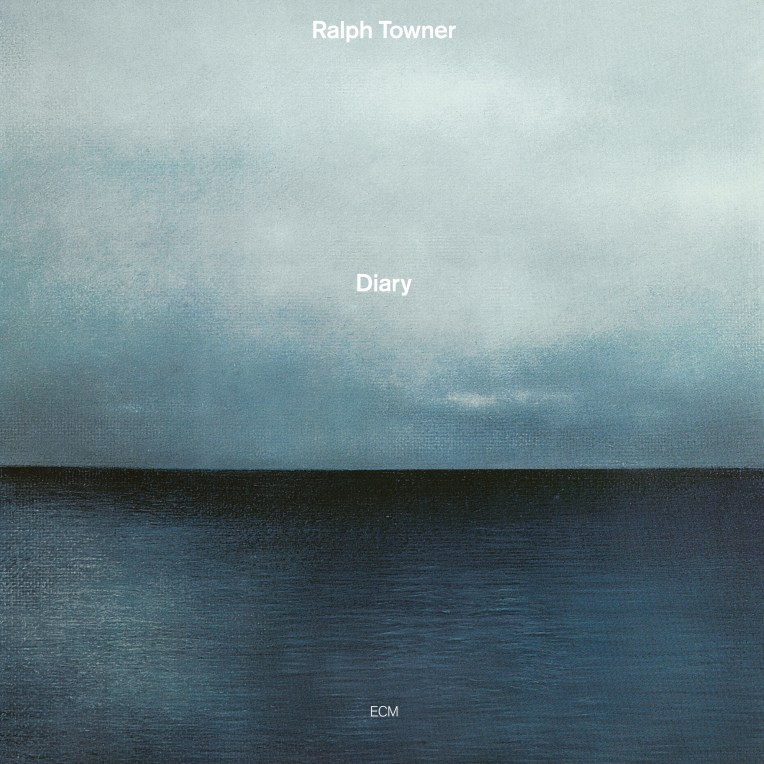
As the cover art would imply, this music is two-thirds stratospheric, one-third oceanic, and accordingly played with grace and undulation. Every instrument and sound is the result of careful thought and choice, and the deeply considered arrangements are delectable. The 12-string is a mainstay of Towner’s repertoire, and what he does with the instrument is nothing short of inspiring. Having first discovered Towner through his solo guitar music, I was pleasantly surprised by how suitably well his duly inspired piano riffs complement this album. Towner has everything he needs at his fingertips: a full-fledged percussion section, lead voice, and accompaniment. The one thing missing in his ensemble is you, the listener.

<< Terje Rypdal: What Comes After (ECM 1031)
>> Keith Jarrett: In The Light (ECM 1033/34)