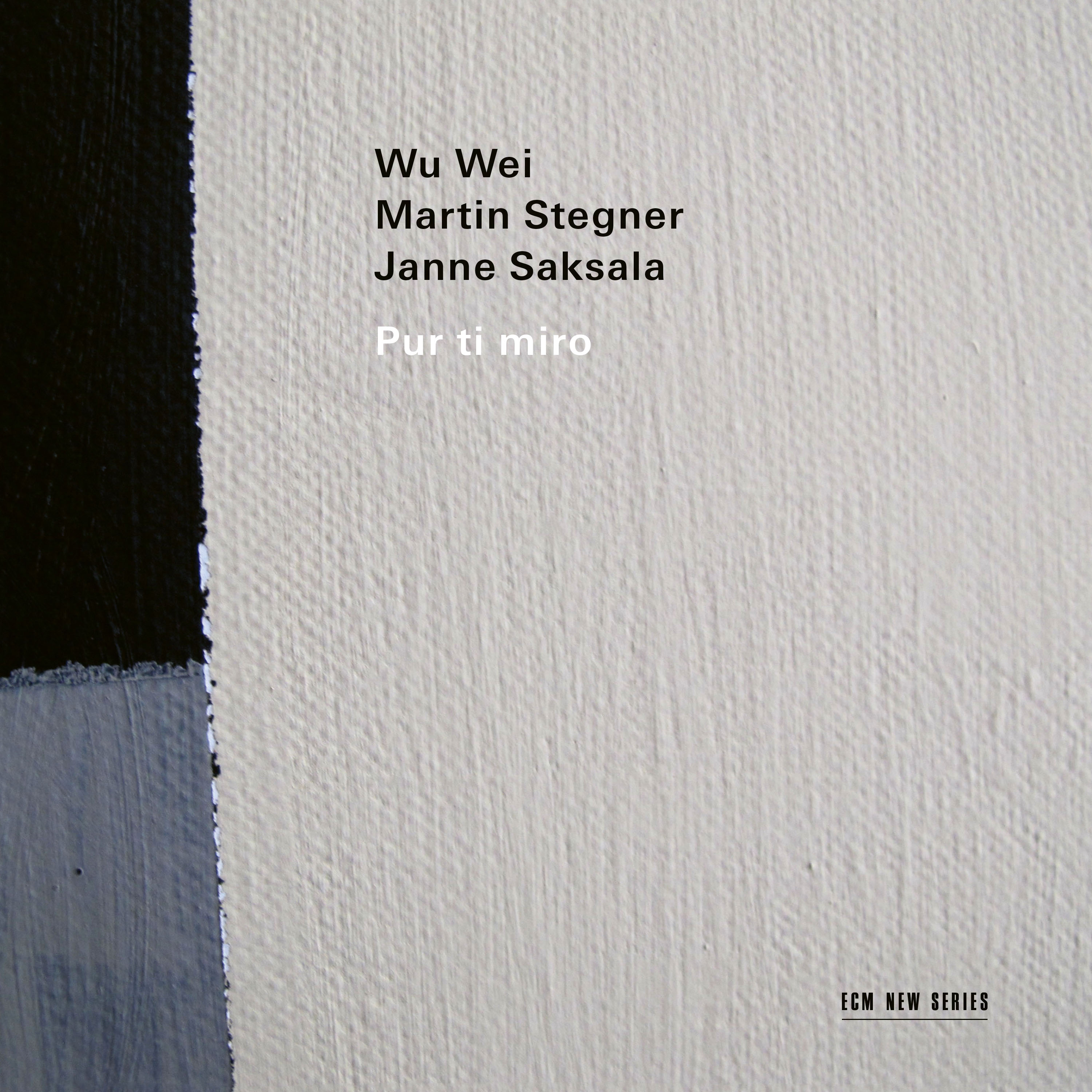
Wu Wei/Martin Stegner/Janne Saksala: Pur ti miro (ECM New Series 2843)

Wu Wei
Martin Stegner
Janne Saksala
Pur ti miro

Wu Wei sheng
Martin Stegner viola
Janne Saksala double bass
Recorded October 2022
Teldex Studio Berlin
Cover: Fidel Sclavo
Executive producer: Manfred Eicher
Release date: November 21, 2025

Pur ti miro represents one of those rare convergences in classical music when disparate lineages find themselves speaking, almost accidentally at first, a common language. It begins with curiosity, as violist Martin Stegner and double bassist Janne Saksala, both members of the Berlin Philharmonic, step beyond their usual orchestral frame to meet Wu Wei, master of the sheng. His instrument—an ancient Chinese mouth organ whose history predates all the works played here—has been modified with keys for the modern ear, capable of whispering like breath against glass or expanding in a cathedral-like radiance. When Stegner encountered Wei in 2009, as he recounts in the album’s liner note, he felt something akin to recognition, as if this millennia-old voice, rendered anew, had been waiting patiently to show him a corner of the musical universe he had not yet visited.

Their collaboration began with long improvisations that felt like conversations between strangers who, little by little, discover that they share the same dreams. But the true spark arrived one day when Wei, without announcement or expectation, introduced Claudio Monteverdi’s Sì dolce è’l tormento to the group. The sheng’s timbre, at once reed-like and celestial, enfolded the melody in a new kind of vulnerability. Early music, that echo of distant rooms and candlelit courts, suddenly breathed with a startling immediacy. Hearing it was nothing short of a revelation for Stegner.

From this moment, a desire for a project to nurture that revelation without taming it grew. The idea of a trio emerged: sheng, viola, and cello. Yet Stegner wondered what might happen if the music’s lower roots reached even farther into the earth. And so, the cello was replaced in the imagination by a double bass, and eventually in reality by Janne Saksala, whose warm resonance, playful experimentation, and architectural sensibility offered the perfect counterweight to the sheng’s shimmering glow. What began as an artistic experiment became a living portrait of three musicians drawn together by curiosity, humility, and a willingness to let go of what they thought they knew.

The recording opens, fittingly, with Sì dolce è’l tormento, and one feels immediately the trust between them. The strings do not accompany the sheng, nor does the sheng simply ornament the strings; instead, they dissolve into one another, forming a single instrument with three voices. The mournfulness of Monteverdi’s melody gains new terrain. It feels less like lament and more like a story we have heard so many times in languages we do not speak, whose meanings we may sense only in the pauses between syllables. Here, at last, someone translates them for us in real time.

Johann Sebastian Bach’s Organ Trio Sonata No. 1 in E-flat major follows, and with it an architectural shift. The lively outer movements float and spin with a measured buoyancy, but it is the Adagio that becomes the trio’s proving ground. In that slow movement, the muted viola curls around the bright woodiness of the sheng, while the double bass expands the room so we may step inside the harmony itself. Bach’s geometries reveal themselves as bodies in motion, human-shaped and breathing. The Andante from the Organ Trio Sonata No. 4 in e minor deepens the sense of natural inevitability, a landscape in sound. The sheng is a waterfall glimpsed from afar, the viola a lone bird carving patterns into a gray sky, and the bass the mist that holds all of it in gentle cohesion. And when the title piece from L’incoronazione di Poppea at last appears, we recognize the sensation it carries: that life is forever repeating its own small operas, and we are simply pilgrims passing through the middle of one that has been running since long before we arrived.

At the center of the album sits Vivaldi’s La Follia, a theme-and-variation playground that allows the musicians to stretch not only their technique but their imaginative reach. Here, Wei’s sheng sounds at times like an accordion leaning into a waltz, at others like a human voice. Meanwhile, Saksala’s bass dances with kinetic clarity. When the trio slips unexpectedly into jazz-tinged territory, we catch a glimpse of what they can do when the score becomes a suggestion rather than a command. Echoes of Gianluigi Trovesi and Gianni Coscia drift through, blooming into a finale that approaches the exuberance of a Romanian folk dance.

Thus, it makes poetic sense to end with a folk song proper: Bruremarsj frå Beiarn, a Norwegian bridal march. The trio plays it with both reverence and wonder. There is a hint of sadness at the beginning, that ache of separation inherent in every union, the leaving of one home to build another. The sheng’s accordion-like hum traces a path between joy and nostalgia. In its gentle call, the future becomes something familiar, while the past turns mysterious and soft-edged, retreating into obscurity.

Throughout the album, even in the most composed selections, a spirit of improvisation remains. The players listen more than they declare. They treat each phrase not as a given but as a question waiting to be answered. And because none of the instruments carries an aggressively sharp tone, the ensemble moves within a spectrum of shadow rather than light. The absence of a violin removes any temptation toward brilliance for its own sake.

It seems no coincidence that Pur ti miro translates to “I gaze upon you.” Listening to this album, one feels watched, not with scrutiny but with tenderness. The music looks at us the way a friend might look across a quiet table, curious about what we will say next. It regards us openly, lovingly, holding its breath just long enough for us to understand that we, too, are part of this conversation.

EUROPE IN FLAMES: ONE

ONE is the debut of EUROPE IN FLAMES, the apocalyptic ambient project of Jason Wach and Hamish Low. In this intentional sonic sanctuary, the duo has crafted a refuge from the din of the current zeitgeist. In this space, the thunder of sociopolitical conflict becomes a distant shudder, melodic signals from afar. This is not an apocalypse of fire and smoke but the quieter aftermath that follows. It is the long exhalation after the collapse, the stillness that asks what it means to create once everything familiar has burned away.

The album opens with “for those who know the dawn,” a piece that serves as an invocation. Piano tones scatter their seeds on barren soil, mingling with the soft hiss of static and what might be the faint hum of machinery left running in an abandoned building. Each note gestures toward rebirth but is shadowed by the awareness that loss is first required. The track inhabits that moment when the first bird calls, not to announce light but to mourn the dark. This forlorn sentiment is only magnified in “forgetting how to breathe.” As low frequencies bloom in bruises, the listener feels themselves dissolving into vapor, suspended between panic and surrender. Dreams twist into strange geometries; trauma scratches the surface of consciousness like windblown branches on a windowpane. This is where the moral infrastructure of the self begins to crumble, leaving behind the rawness of skinned emotions.

The title of “seal the images in an envelope and say nothing” serves as a commandment as repression takes the place of grace. The atmosphere thickens until movement slows to molasses. Within this stagnation, a distant, rasping tone threads through the mix, binding us to our own restraint. The song becomes an act of preservation, suggesting that silence, too, can be a form of resistance. We then find ourselves “stumbling home through the rain.” After so much enclosure, it is a benediction. Its percussion on metal and stone creates a rhythm more human than a heartbeat. Digital glitches flicker through the soundscape, prayers half-remembered. The world, fractured as it is, feels newly sacred. A woman’s distorted voice emerges, a ghost in the circuitry. She becomes our lone witness, her syllables igniting the sky with fluorescent melancholy before “nocturne” lubricates the central axis with its ode to fragmentation. The piano and electronics drift apart, unable to find resolution, yet their disunity feels deliberate and compassionate. The music forgives itself for breaking, inviting us to do the same.

The closing track, “upon waking,” is a new beginning. Dawn finally breaks, revealing not salvation but continuity. The world is still in ruins, yet the rubble hums with faint electrical life. Smoke lingers, dust swirls, and through it all runs a current of hope: the fragile belief that creation can begin again, quietly, invisibly, from within. Every contact of the flesh, every fleeting gesture, sends out an unreturnable signal into the void that says, We are still here.

The album’s surreal brilliance lies in how it blurs the distinction between sound and memory, between the present and its ghosts. When archival voices or cinematic fragments surface, as in a clip from 12 Angry Men, they don’t feel sampled so much as resurrected. They reach us as if from another planet, their gravity warped, their meaning refracted. And yet, because of this distance, they cut deeper. Like nightowls who swear by the strange clarity that arrives when the sun has vanished and the world sleeps, they are most alive in that hour when thought loosens its grip. But ONE is not of the night. It lives in that trembling, liminal moment just before dawn, when the first blue light begins to touch the earth. This is music for that boundary state between remembering and forgetting.

ONE is currently available from bandcamp here.

Mal Waldron: Free At Last (Vinyl Reissue)

“I feel if you look back too much,
you trip when you take a step forward.”
–Mal Waldron

Although Mal Waldron began his career in jazz as an alto saxophonist, playing in the long, tapering shadow of Charlie Parker, fate would soon guide him back to the keyboard. The piano was, for him, not just an instrument but a resonant vessel sailing in the tempests and calms of his cross-hatched personality. His classical training gave him a compass; his improvisational instincts supplied the wind. A prolific writer of tunes—angular yet melodic, pensive yet full of forward motion—he became an indispensable sideman to the luminaries of his era, including John Coltrane, Art Farmer, Jackie McLean, and, above all, Billie Holiday, with whom he shared a natural rapport. Their collaborations seemed to hover between worlds—her voice the smoke, his chords the fire.

But every light casts its own darkness. Waldron’s journey was interrupted by a nervous breakdown that landed him in the hospital. And then, at his seeming lowest point, when he was invited to Paris to score a film. It was more than a job; it was a turning point, a new way of listening. Each city he touched thereafter—from Bologna to Cologne and, ultimately, Munich—became another note in the unfolding score of his reinvention. By 1967, he had settled in Munich. Along the way, he crossed paths with Swiss bassist Isla Eckinger and drummer Clarence Becton, another American expatriate whose trajectory brought him across the pond into a music scene unlike any other.

Free At Last, a title that feels both biographical and prophetic, ended up being one of three studio recordings Waldron made with ECM’s founder, Manfred Eicher, the others being The Call (JAPO) and the elusive Spanish Bitch (Victor Japan). In Waldron’s rhythmic restraint, in his careful placement of silence and tone, surely Eicher glimpsed a growing philosophy of sound, one defined not by density but by depth, not by volume but by presence. Waldron’s subsequent decades would see him traversing genres, yet always with the same chiseling intent: to refine expression until it gleamed with truth.

Now, in this two-LP reissue, gloriously packaged in a gatefold sleeve with all the original artwork, plus new liner notes by Steve Lake (from which I’ve distilled much of the information above), we are granted with both the familiar and the newly unearthed. The 1969 session unfolds again like a memory recalled in sharper resolution, joined by alternate studio takes on sides III and IV. The all-Waldron set list remains startlingly modern. From the very first shimmer of Becton’s cymbals on “Rats Now” to the closing sparkle of “Boo,” Eicher’s curation of space and clarity is already very much alive. Listening to it in 2025 feels less like revisiting an old field and more like standing again in its soil, still fragrant, still fertile, still yielding. To reap this harvest after more than half a century is to marvel at how sound, once released, can resist decay.

As noted in my first-impressions review, the trio’s momentum is undeniable in “1-3-234” and “Rock My Soul.” Both skip across a sunlit surface like stones whipped by practiced hands. Yet it is in the quieter pieces that Waldron reveals his most robust intentions. Whether mixing shadow and sparkle in “Balladina” or masterfully blending poetry and prose in “Willow Weep For Me,” he makes us acutely aware that emotions are points of departure, not destinations. Eckinger’s bass hums with empathy, Becton’s drumming reacts in real time like reflected light, and together they guide the listener on a journey worth savoring.

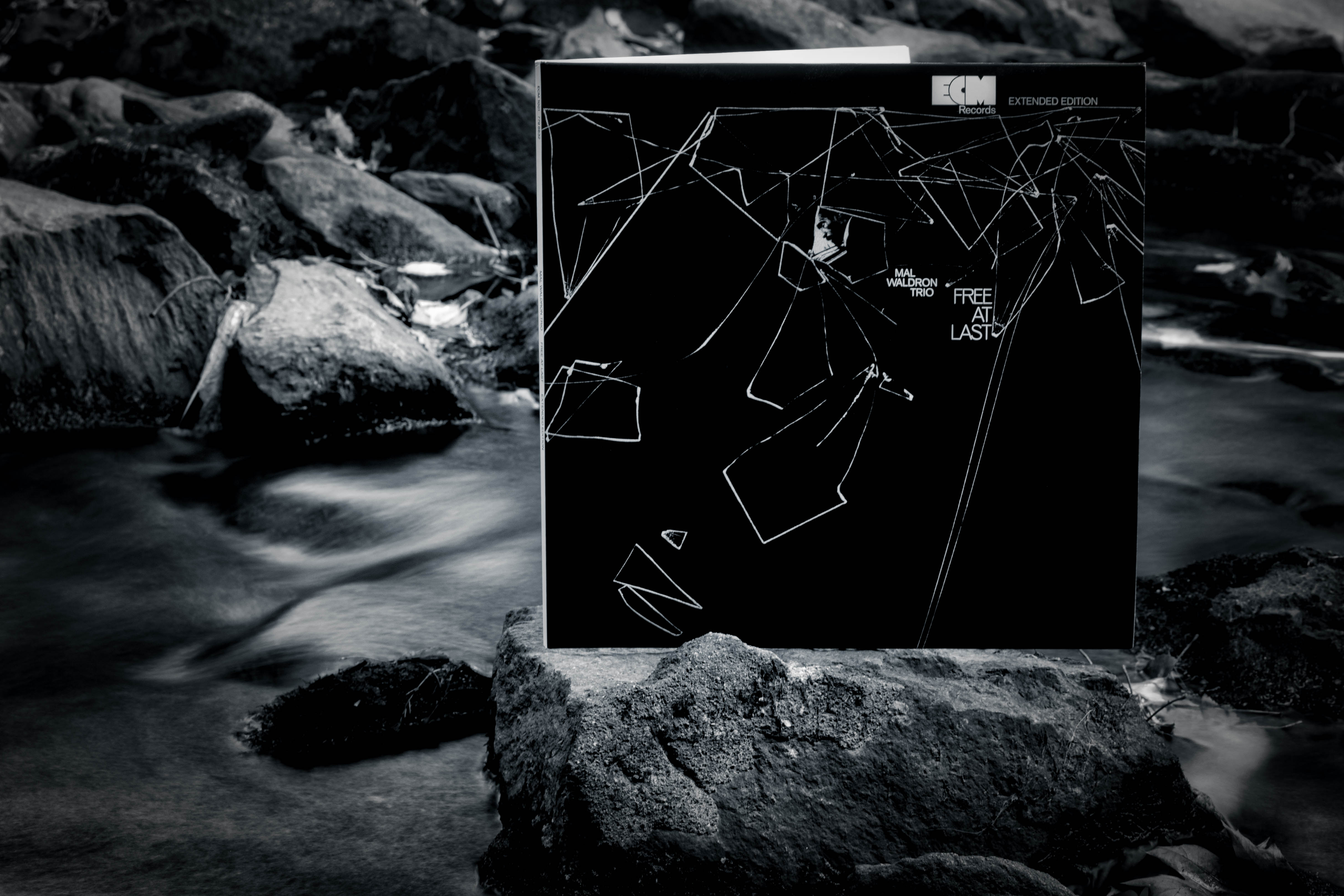
Among the newly released takes, the extended “Willow” is especially revealing. Each gesture seems to weigh more, to linger longer. One senses them circling not around a song but around a feeling, its perimeter undefined, its center perpetually receding. As in the photograph of the LP I took above, their coming together stands as a testament to the power of a vision that, even as the tide of history swirls and churns around it, remains true to itself to this day.

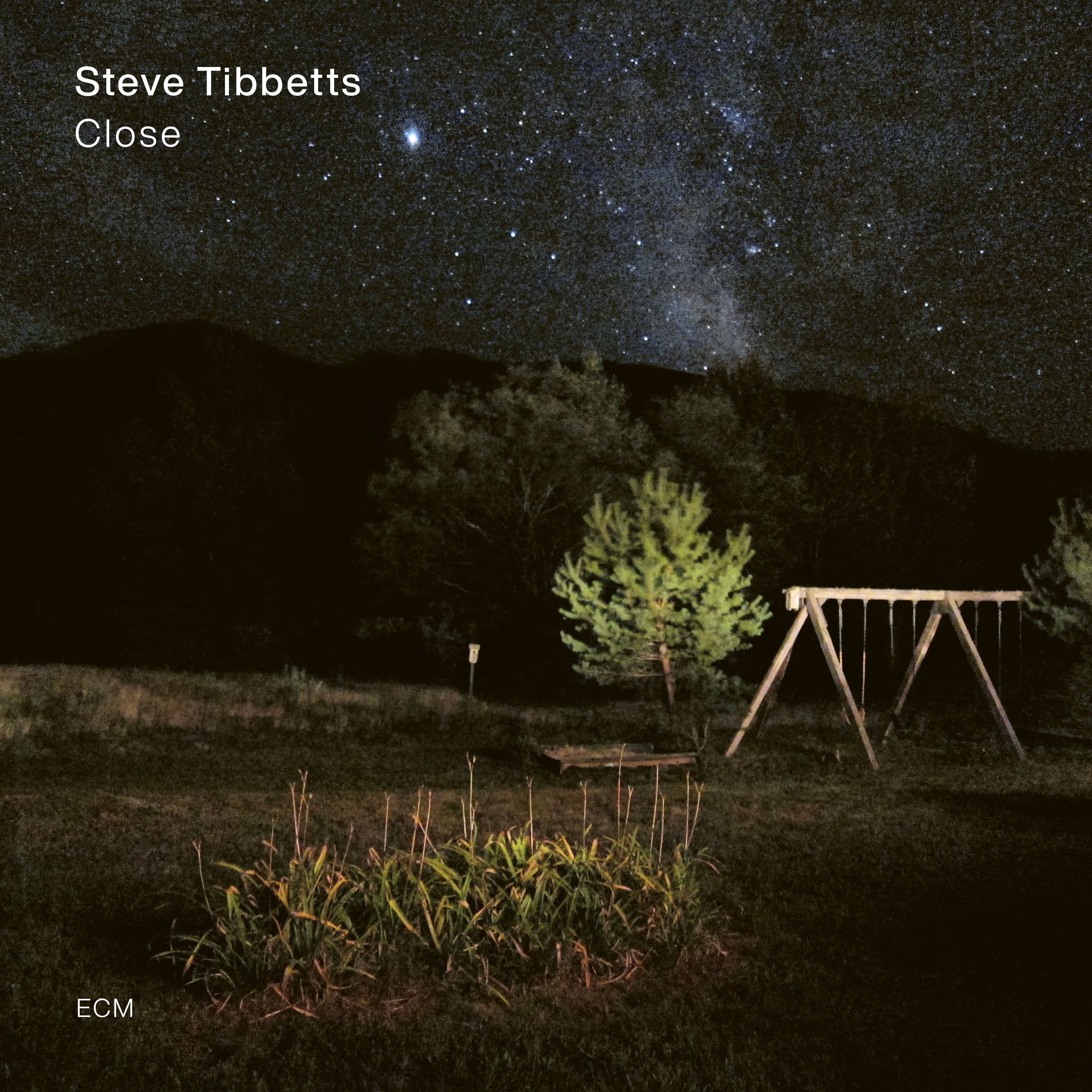
Steve Tibbetts: Close (ECM 2858)

Steve Tibbetts
Close

Steve Tibbetts guitar, percussion, piano
Marc Anderson percussion, gongs, handpan, loops
JT Bates drums
Recorded 2021-2024 in St. Paul by Steve Tibbetts
Drums recorded at 8vb Studio, Minneapolis by JT Bates
Mastered by Greg Reierson at Rare Form Mastering
Cover photo: Joel and Norris Tibbetts
An ECM Production
Release date: October 24, 2025

“Music is a twilight language.
The job is to translate some shadow into sound.”
–Steve Tibbetts

On his 11th album for ECM, guitarist Steve Tibbetts returns with his ever-present ally, percussionist Marc Anderson, joined by drummer JT Bates for a session of immense intimacy. If long-standing classics like Exploded View and Big Map Idea have attuned your ears in a certain direction, you can safely put those expectations aside. This time around, Tibbetts offers us imploded views and small map ideas. And while these are meticulously yet organically crafted as per usual, to appreciate their full potential requires meditation, repeat listenings, and an openness to disconnecting oneself from the FOMO of our digital lives in service of something far more subliminal and enduring.

All the more appropriate, then, that the album should take its first steps with “We Begin,” wherein a deep and sinuous sound stretches from horizon to horizon. Like many of the pieces here, it unfolds in multiple numbered parts, each embodying an interlocking experience that builds on the last. In Part 2, for example, the introduction of hand drumming gives traction and earthiness to the proceedings, even as Tibbetts morphs from one register to the next, swapping terrains with the ease of a fox changing the color of its fur without even thinking. The seasons are his compass, trudging through the underbrush as winter approaches. The delicate patter of canine footsteps is audible now and then, marking the forest floor with rhythms older than all of us put together.

In “Away,” another tripartite wonder, hints of distant thunder begin to encroach on our audible view. Without an umbrella, Tibbetts constructs one out of the materials at hand: his strings provide the metal spines, the percussion the webbing between them, and the melodies themselves the rod and handle where they meet. And even though the rain never comes, that’s okay. The beauty was in the anticipation of the downpour.

Not all is ferns and fronds, as “Remember” offers some grittier textures, recalling the solo work of Andy Hawkins. What’s fascinating here is how the title can be read as a metaphor for listening: both require a certain sensitivity to sounds and movements beyond one’s control. There is a sense of flow that exists just outside of time, especially in the piano Tibbetts adds to Part 2, lending an even more nostalgic tinge to the whole.

“Somewhere,” “Anywhere,” and “Everywhere” are something of a triptych in their own right. Consisting mostly of short intakes of breath, they cradle within them the slowest of burns in Part 3 of “Somewhere.” (It’s also a literal burn, as the tubes in Tibbetts’s amp catch fire at the 4’06” mark—listen for their satisfying decay!) Beyond that, one encounters hints of whale song, death knells, and other dark turns, all finding their final rest in “We End.” It’s a flower without a vase, gifted instead to the water’s surface.

Throughout this mellifluous journey, we are guided by two distinct voices. One is the 12-string, which Tibbetts strings in double courses rather than the standard octaves; the other, his acoustic and electric six-strings, on which he drops the low A and E down to G and C, respectively. “There’s always a bass drone available,” he notes of the effect. “That tends to keep all the tunes in the same key. I’m comfortable with that, having spent some time around gamelan ensembles, Tibetan longhorns, court music from Java, Hardangar fiddle from Norway. Most of the world’s music stays in one key or another.” True, and all the more reason to appreciate the yearning, keening quality of his touch. Like the sitar, so much happens after contact has been made.

This is by far the most delicate of Tibbetts’s albums, but for that reason, it speaks more directly to the heart. There is something uniquely tensile here such as only he can articulate. He is a master of suspensions: even in silence, one feels the slack in his gut. The cumulative effect borders on an autonomous sensory meridian response, where the creaking of strings and frets makes the very spine of the universe tingle. A shooting star in slow motion, it possesses time-lapse qualities. And just when you think Tibbetts will lift off and leave you behind, he touches down back on the soil and ensures your safe travels.

Meredith Monk: Cellular Songs (ECM New Series 2751)

Meredith Monk
Cellular Songs

Meredith Monk & Vocal Ensemble
Ellen Fisher
Katie Geissinger
Joanna Lynn-Jacobs
Meredith Monk
Allison Sniffin
John Hollenbeck
Recorded January-March 2022 / March 2024
Power Station Studios, New York
Engineers: Kevin Killen (2022), Eli Walker (2024)
Assistant: Matthew Soares
Mixing: Eli Walker, Alexann Markus (assistant)
Cover photo: Julieta Cervantes
Recording producers: Meredith Monk and Allison Sniffin with John Hollenbeck
Executive producer: Manfred Eicher
Release date: October 17, 2025

All too often, women have been mythologically depicted as vindictive creatures who exist only to distract and destroy. Whether in the Sirens of the ancient Greeks or Tennyson’s Lady of Shalott, they sing, weave, and create in isolation, forbidden the pleasures of love, peace, and community. And while the work of singer and composer Meredith Monk has always been concerned with questions of agency, it was never made so clear to me as when the boxed set of her collected ECM recordings materialized in 2022. As the first album to appear since that watershed release, Cellular Songs doesn’t so much continue the journey as fold in upon itself, so that by the end, the listener is left with a compact flower of such potent expressivity that it seems capable of leading one’s ears in directions never thought possible yet which sound intimately familiar, as if remembered from a dream that preceded language.

Cellular Songs is the second part of a trilogy that began with On Behalf Of Nature, a work exploring our global ecosystem from a molecular vantage point. For Monk, the title names what is fundamental not only to life but to all of creation. “What is going on in the cell is so complex,” she writes, “and it’s a prototype of the possibility of what a society could be if you take those same principles and expand them.” As Bonnie Marranca suggests in her liner notes, composing and contemplation are synonymous, which makes Monk a meditator of worlds, one who reduces the act of communication to a microcosmic array of consonants, vowels, and blends. In this regard, it is difficult to imagine anything so biologically poetic as the opening “Click Song #3 Prologue,” in which Monk and her vocal ensemble (Ellen Fisher, Katie Geissinger, Joanna Lynn-Jacobs, Allison Sniffin, and Monk herself), with percussionist John Hollenbeck, get to the heart of things. Their tongue clicks are droplets in a distant cave, each carrying minerals and unfelt emotions until, over millennia, stalagmites rise as records of their passage. Like the three “Cell Trios” that follow, they constitute an internal code that locks into place. Flowing harmonies and dissonances encompass the breadth of life itself, a reality in which the voice is central, porous in its itinerant grace. 

Hollenbeck’s vibraphone appears organically in a handful of pieces, a trace element in the soil of this music. Whether documenting a universal grammar in the syllabically potent “Dyads,” playing alongside the piano in “Dive,” or bowing a glassy surface in “Melt,” it allies itself with the building blocks of existence, defying the horrific structures so often fashioned from them. It is the vein in every vocal leaf, seeking photosynthesis without flesh and treating entropy as the dissolution of time. Sniffin’s pianism is equally cathartic in “Lullaby for Lise,” where she joins Geissinger. Rather than leaning on lyricism to seek fantasy, it straddles the threshold between waking and dreaming, recognizing that lived experience is always a blend of both. I hear it as a song to a child not yet born, gestating and growing with all the possibilities of time in her blood and brain, opening her eyes at last in “Generation Dance.” Thus, she comes to know the vision of her mother and her mother’s mother, and as she exhales in “Breathstream,” Monk’s solo voice gives shape to inherited traumas, now able to be wielded in the name of healing.

In the unfolding of “Branching,” each voice becomes the first in an ever-multiplying lineage of wisdom. Speaking of rituals and sacrifices, their repetition serves not as comfort but as a catalyst born of a primeval, generative power. “Passing” finds those same figures trading off vocalizations with a precision that is open to nature’s chaos, while “Nyems” reveals the playfulness of communication for the ephemeral metaphor it truly is.

Given that nearly all of the work presented here is stripped of linguistic meaning, what a radical blessing to encounter the coherence of “Happy Woman.” Here, the feeling is one of transparency, yet also of quiet critique, an awareness of the many roles women inhabit, whether by choice or by force. The opening refrain and its variations (“I’m a happy woman,” “I’m a hungry woman,” “I’m a thinking woman,” etc.) are the stitches of a mother among mothers, quilting herself into the patchwork of history.

By the album’s end, the sacredness of vibration becomes paramount. From these humming atoms emerge animals, rivers, and clouds, leaving us to wonder where the so-called intellect fits into the larger picture. Because if a heartbeat is nothing without silence, then its divisions are where forgiveness begins.

Zehetmair Quartett: Johannes Brahms / op. 51 (ECM New Series 2765)

Zehetmair Quartett
Johannes Brahms / op. 51

Zehetmair Quartett
Thomas Zehetmair
 violin
Jakub Jakowicz violin
Ruth Killius viola
Christian Elliott violoncello
Recorded November 2021
Konzerthaus Blaibach
Engineer: Rainer Maillard
Recording supervision: Guido Gorna
Cover photo: Eberhard Ross
Produced by Manfred Eicher
Release date: October 17, 2025

After much-lauded recordings of works by Hindemith, Bartók, and Schumann, among others, the peerless Zehetmair Quartett returns to ECM to interpret Op. 51 of Johannes Brahms (1833-1897). In his liner notes for the album, Wolfgang Stähr characterizes the German composer as one who “wrote both much and little.” Cases in point are his string quartets, of which he quilled over 20 in his youth but later destroyed, leaving only the two featured on this recording, plus a third. As Brahms once related to his biographer, Max Kalbeck, “The boxes with those old manuscripts stood in Hamburg for ages. When I was there two or three years ago, I sat on the floor—entire walls were beautifully decorated with my scores, even the ceiling. I only had to lie on my back to admire my sonatas and quartets. It looked rather good, actually. But I tore it all down—better I do it than someone else!—and burned the rest along with it.” Work on these survivors began in the mid-1860s, but it was only in 1873 that his perfectionism conceded to the decision to call them complete. And so, we are left with, at best, mere intimations of what came before, shattered and reworked into collages of a mind slightly more in tune with its self-inflicted wounds.

The String Quartet No. 1 in C minor blossoms into exuberant life from the start, its gentle lead-in masking an almost volcanic energy beneath. This declamatory statement is not the setting of a tone but the breaking of it, snapping us out of a painful reverie into something more immediate—a real crisis rather than the arbitrary melancholy with which we tend to surround ourselves. The constant vacillation between urgency and resignation renders these proceedings a masterful exercise in tension and release. The sheer level of rhythmic and melodic invention is dazzling to behold, evolving into something beyond incidental. The Zhehetmair Quartett navigates every twist and turn with the precision of a film director who nevertheless allows his actors to make every scene leap from the screen.

Such heroism, however, is destined to fall, for even the romantic gestures of the second movement are not offered in hopes of fulfillment but rather in expectation of being forgotten. This undermining is what separates Brahms from the gigantry of such predecessors as Beethoven. He is uninterested in staid forms and inherited expectations. He speaks and lets his sentiments carry the day, rather than deferring to baskets with pretty little labels and easily identifiable contents.

In the third movement, a subdued yet altogether lively Allegretto, he unveils another facet of determination, all the more powerful for being caught in a web of its own making. A particularly gorgeous moment occurs when the quartet coalesces into a pizzicato dandelion, then blows its seeds far and wide. But if anything is left to wander offscreen, it is brought right back into focus with the final Allegro. Here, the camera zooms in, revealing every detail. It is a stunning conclusion that declares itself undeclarable.

While these quartets are quite violin-forward, as proven by the leading voices of Thomas Zehetmair and relative newcomer Jakub Jakowicz, violist Ruth Killius deserves admiration for providing the rudder that steers both vessels. Her sinewy strength is astonishingly present in the String Quartet No. 2 in A minor, of which the opening movement lets her sing with unbridled lyricism. The same must be said of cellist Christian Elliott, for whom this would be his last recording with the quartet before his untimely death earlier this year. His depth of color and texture is felt throughout, especially in the two central movements, where the instrument’s endurance is revealed in tonal breadth, muscular leaps of intuition, and smooth layers of binding energy.

In the finale, all signatures come to the fore, each a piece in a larger puzzle upon which light continues to fall. The violins are once again declamatory without feeling desperate, pointing instead to inspirations deeply internal and chaotic, funneled into a sound as interlocking as it is yearning to be free of its own design. Thus, the music leaves us behind, not with a sense of closure but of an ongoing trajectory, an arrow still in light. For in Brahms’s hands, drama has no fixed abode, only the upheavals of time itself, to which we all must ultimately succumb and from which, through performances such as this, we momentarily rise again.

Muthspiel/Colley/Blade: Tokyo (ECM 2857)

Wolfgang Muthspiel
Scott Colley
Brian Blade
Tokyo

Wolfgang Muthspiel guitars
Scott Colley double bass
Brian Blade drums
Recorded October 2024 at Studio Dede, Tokyo
Engineer: Akihito Yoshikawa
Assistant engineers: Ryuto Suzuki and Yo Inoue
Mixing: Michael Hinreiner (engineer), Manfred Eicher, and Wolfgang Muthspiel
Bavaria Musikstudios, Munich
Cover photo: Juan Hitters
Album produced by Manfred Eicher
Release date: September 26, 2025

For its third studio outing, the trio of guitarist Wolfgang Muthspiel, bassist Scott Colley, and drummer Brian Blade lays down its most complex and adventurous session yet, fittingly recorded amid the electric calm of its titular city. The band achieves simpatico liftoff from the start in its swinging take on Keith Jarrett’s “Lisbon Stomp.” With a forthright delicacy that is hard to come by these days, they make the music come alive with fluid precision, every note free yet placed right where it needs to be. The plane lands on a more unsettled note with Paul Motian’s “Abacus,” for which Muthspiel slips into echoing distortions for a crunchier sound. Blade taps directly into Motian’s painterly attention to detail, his wider palette eliciting a tactile commentary, while Colley’s solo unpacks every shadow he casts.

Between these two telephone poles, the filaments of Muthspiel’s originals stretch, each charged with varying intensities of voltage. The moods are as distinct as the writing is strong. From the lyrical balladry of “Pradela” to the tongue-in-cheek angularity of “Weill You Wait,” he evokes a spectrum’s worth of times, places, and moods. The latter piece, with its oddly captivating contours, shows just how deeply the guitarist is willing to dive to find his voice.

His wingspan feels broadest when the melody becomes a form of searching, reaching toward something far beyond what the eye can see. This is most evident in “Flight,” which turns the proverbial landscape below into a resonating instrument. Its aerodynamic theme rides one thermal to the next without so much as a wing flap. The blend of acoustic and electric signatures gives the track a rare three-dimensionality.

At just two and a half minutes, “Roll” is the album’s briefest cut but also among its liveliest. With a nod to Weather Report, it radiates that same exuberant sense of living in (and for) the moment. Like the album as a whole, it foregrounds Muthspiel’s talents without stepping on the toes of his bandmates. Colley and Blade are not accompanists but equal protagonists in a story that emerges chapter by chapter into a shared narrative.

“Christa’s Dream” lingers as the most haunting turn, full of transcendence and half-existence, visible yet intangible, like a ghost in the light of day. It gives way to “Diminished and Augmented,” wherein oblique acoustic stylings blossom with playful grace. There’s a hint of Ralph Towner in its balance of leaping precision and sliding ease.

“Traversia” ventures farthest into unconventional harmonies, taking cues from Messiaen’s bold colors while achieving near-Renaissance purity of tone through the use of a capo. Originally written on a children’s guitar, it retains an innocence even as it matures in real time, the arco bass weaving a thread of quiet majesty through it all.

The folk-inspired “Strumming” pays deference to Bob Dylan and Leonard Cohen, refracted through a seamless idiom. Muthspiel’s ember-infused guitar rides atop Blade’s locomotive brushes, creating a boundless sense of space where synthetic and human energies meet. It’s a song of rudimentary joy and quiet surrender, a reminder that sometimes the simplest gestures have the deepest resonance.

In the end, Tokyo feels less like a document and more like a meditation in motion of three travelers translating memories into sound. What Muthspiel, Colley, and Blade achieve here is an equilibrium between structure and spirit. It is jazz as weather: unpredictable, fleeting yet timeless.

John Taylor: Tramonto (ECM 2544)

John Taylor
Tramonto

John Taylor piano
Marc Johnson double bass
Joey Baron drums
Concert recording, January 2002
CBSO Centre, Birmingham
Engineer: Curtis Schwartz
Cover photo: Jean-Guy Lathuilière
An ECM Production
Release date: September 19, 2025

As a dedicated ECM listener, few things excite me as deeply as seeing a neglected catalog number filled (in this case, 2544) and the unvaulting of an archival recording from a musician no longer with us. To have both in one release is a cause for rejoicing. 

Pianist John Taylor (1942-2015) has a storied history on ECM, having made his label debut on 1977’s Azimuth with Norma Winstone and Kenny Wheeler, and since appearing on projects with John Surman, Peter Erskine, and Jan Garbarek, among others. The present recording, captured live in January of 2002 at the CBSO Centre in Birmingham during a Contemporary Music Network Tour, predates the classic Rosslyn with the same trio by only a few months. In fact, “Between Moons” is shared between the two. The bandleader’s ballad walks amiably from shadow to streetlight, letting its thoughts wander as they will to places and people yearned for. With a tenderness only visible behind closed eyes, it slides into delicate propulsions without a hint of force.

Yet it’s in “Pure and Simple,” another Taylor original, where the concert begins by throwing us into the deep end. The title is an ironic one, as there’s nothing pure and simple about it. This chameleonic tune changes colors and faces at the drop of a hat, dancing its way through a gallery of scenes, influences, and moods. The interplay is cosmically telepathic, treating every shift as a stage of development in an organism that still feels like it’s growing all these years later. Johnson manages to both stay within the lines and leap beyond them with great joy, while Baron anticipates every move with fluid precision.

Steve Swallow’s “Up Too Late” is the set’s juicy center. An epic romp through boppish territory, it finds Taylor exuberantly balancing play and rigor. Despite the robustness of its dramaturgy, there’s a masterful restraint that holds its own in the first act before the keyboard unleashes a deluge of liberation. This inspires Baron to unpack his snare like a bag of rattlesnake eggs as Taylor defenestrates his allegiance to form and Johnson sings through his arco vibrato.

The title track by Ralph Towner, first heard with its composer and Gary Peacock on 1994’s Oracle, brings us back to center with Johnson plucking by his lonesome before Taylor emotes his way into frame. The resulting carpet is unfurled one careful turn at a time, a plush and forgiving surface on which to travel toward the 15-minute juggernaut that is Taylor’s “Ambleside.” Opening with finger-dampened strings and percussive tapping, it courts us with understated allure before the theme introduces itself forthrightly. The resulting groove inspires playful turns from all concerned. Baron is on point with his hand drumming, leading the trio into a most delicate and ethereal finish.

Fans of Taylor shouldn’t even hesitate to make this album a part of their collection.

Arvo Pärt: And I heard a voice (ECM New Series 2780)

Arvo Pärt
And I heard a voice

Vox Clamantis
Jaan-Eik Tulve
 conductor
Recorded 2021/22
at Haapsalu Cathedral, Estonia
Engineer: Margo Kõlar
Cover: Fidel Sclavo
Produced by Manfred Eicher
Release date: September 5, 2025

For we [are] strangers before thee, and sojourners, as [were] all our fathers: our days on the earth [are] as a shadow, and [there is] none abiding.
–1 Chronicles 29:15

Building on more than 25 years of working alongside Arvo Pärt (whose relationship with producer Manfred Eicher spans nearly twice that length), Vox Clamantis and conductor Jaan-Eik Tulve present a new recording of choral works drawn from sacred texts. Their last recording, The Deer’s Cry, was a watershed moment in the Estonian composer’s discography, as it simultaneously narrowed the frame and opened up wider possibilities of interpretation.

Although the program is varied in direction, it is wholly centered around a theme of humility, and nowhere more so than in the opening Nunc dimittis (2001). Its setting of Luke 2:29-32 tells the story of Simeon, who holds the baby Jesus in his arms, knowing that God’s promise to see Christ revealed before his death has been fulfilled. What begins as an intimate supplication, however, turns into a vast theological chordscape of meditations on the openness of God’s grace freely given to all. What is so striking about the voices is not only the shapes through which Pärt guides them in the score but also the depth of power in their fragility. When alone, they waver ever so slightly; when aligned with others, they fix their gazes heavenward. 

O Holy Father Nicholas (2021), taken from the Orthodox Prayer Book, was written for the opening of St. Nicholas Greek Orthodox Church and National Shrine at Ground Zero in New York City. Like the Bible itself, its covers grow worn with time; words wear off from handling yet remain unchanged, living and without contradiction. In seeking intercession, the choir allows the light of forgiveness to shine upon human depravity. The singing walks two distinct paths, each passing through like a pilgrim to destinations promised yet unseen. Such tensions reveal the shape of our sin, beautiful from a distance but gnarled and festering at close inspection. This contrast is a sobering one that places life at the center of an infinitely complex structure, of which belief lays the cornerstones.

Each of the Sieben Magnificat-Antiphonen (1988), recently heard arranged for strings on Tractus, speaks to a different manifestation of Christ. From the tender “O Weisheit” (O Wisdom) to the highs of “O Schlüssel Davids” (O Key of David), a full range of vocal and incarnational possibilities is examined through the lens of sound. Buried among them is “O König aller Volker” (O King of All the People), in which rhythmic circles reveal caesurae for glory to slip through like a quiet legion of angels. The stepwise movements that characterized the Nunc dimittis are to be found here in denser but no less translucent configurations.

Für Jan van Eyck (2019) is a rendering of the liturgical Agnus Dei (Lamb of God) based on the same section of the Berliner Messe and written for the restoration of the altarpiece of the van Eyck brothers’ Adoration of the Mystic Lamb, which was reopened in the Ghent Cathedral. Accompanied by Ene Salumäe on organ, it allows us a spell of awe before the magnitude of Christ’s sacrifice. So begins a sequence of shorter yet no less rich works that continues with Kleine Litanei (2015), which pays respect to Irish Benedictine monk, theologian, and philosopher St. Virgil (c. 700-784). Its fragments of traditional prayers shift between harmony and dissonance, evoking the tension of seeking spiritual comfort in a secular world. Last is the album’s title composition, And I heard a voice… (2017). It is, so far, the only Scripture that Pärt has set in his mother tongue. Based on Revelation 14:13, it concludes appropriately on an eschatological note, where the promise of eternal rest—a life without pain and suffering—is offered amid the wrath of the end times, leaving us with a most undefiled sense of hope.

Faith is not determined by the strength of one’s convictions but rather by the truth and integrity of what it worships. We can assert all the faith in the world in thin ice, but it will inevitably crumble beneath our feet. By the same token, we can have little faith in thick ice, and it will hold as we make our way safely across. Much of that truth comes alive in this music. As Christ says in Luke 17:6, “If ye had faith as a grain of mustard seed, ye might say unto this sycamine tree, Be thou plucked up by the root, and be thou planted in the sea; and it should obey you.” Let these choral works each be a mustard seed waiting to be watered by the listener’s tender regard.