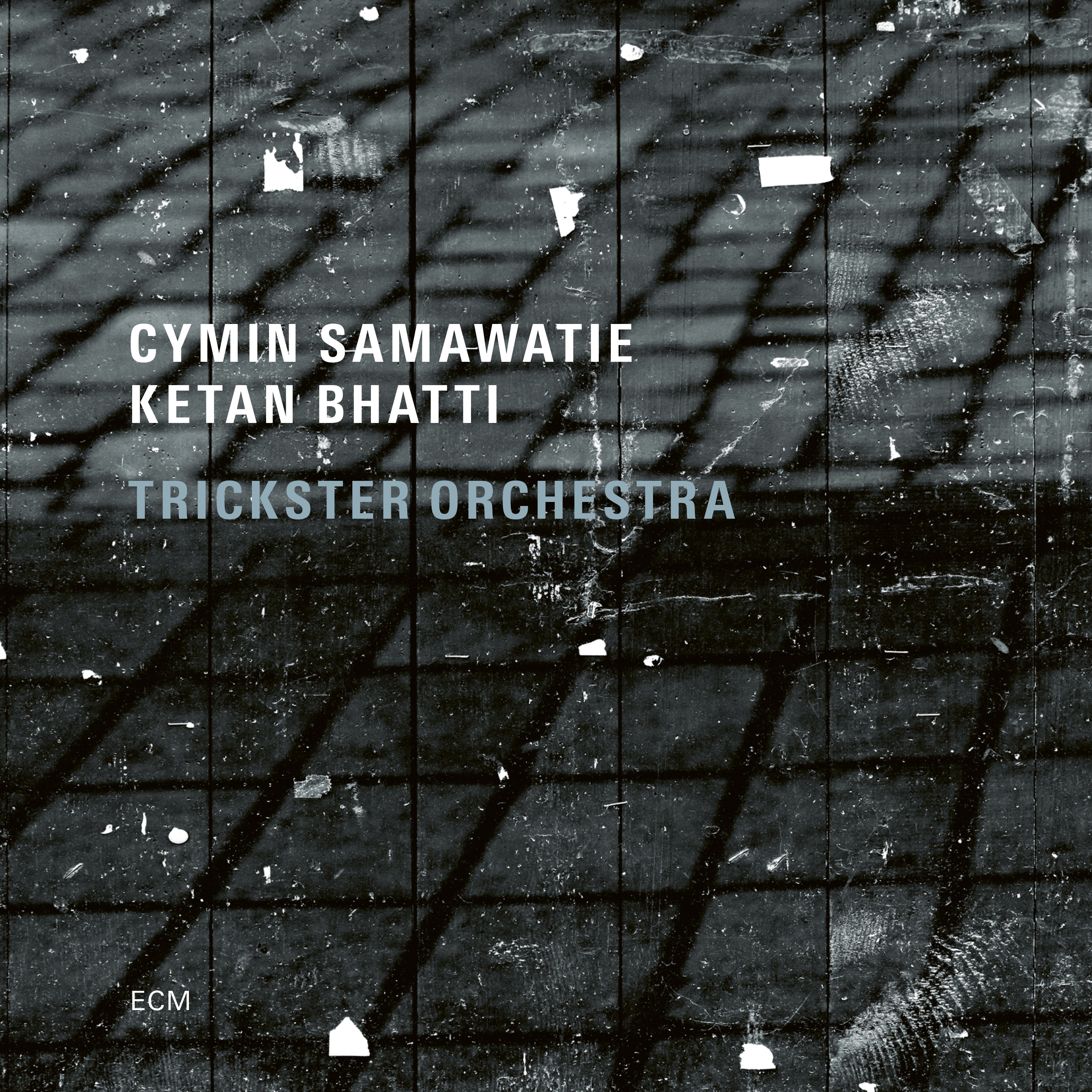
Cymin Samawatie/Ketan Bhatti: Trickster Orchestra (ECM 2696)

Cymin Samawatie
Ketan Bhatti
Trickster Orchestra

Cymin Samawatie vocals
Ketan Bhatti drums
Trickster Orchestra
Recorded January 2019, Meistersaal, Berlin
Engineer: Martin Ruch
Assistant engineer: Philip Krause
Mastering: Christoph Stickel
Cover photo: Fotini Potamia
An ECM Production
Release date: April 23, 2021

I wait for the LORD, my soul doth wait, and in his word do I hope. My soul waiteth for the Lord more than they that watch for the morning: I say, more than they that watch for the morning.
–Psalm 130:5-6

Since gracing ECM’s catalog with three facets of its musical wisdom, Cyminology reconfigures itself on a larger scale. This time, the group’s leader, singer Cymin Samawatie, and mainstay percussionist Ketan Bhatti drop their stones into the pond of the Trickster Orchestra, forming a 23-piece supergroup poised to interpret a wide repertoire that includes Old Testament scripture and Sufi poetry, connected by linguistic threads spun in Hebrew, Arabic, Turkish, and Farsi. Instruments span an even wider gamut, from the koto of Naoko Kikuchi, the kanun of Bassem Alkhouri, and the sheng of Wu Wei to the clarinet of Mona Matbou Riahi, the recorders of Susanne Fröhlich, and the viola of Martin Stegner. Among the resulting music’s many excitements is the feeling that, despite finding themselves in unfamiliar territory, the musicians paint with an exploratory quality that makes every blade of grass their own.

“Shir hamaalot” is one of two songs cowritten by Samawatie and Bhatti. This stark setting of Psalm 130 evokes the inner turmoil born of self-awareness that prompted David to praise God with such fervency, while “Keşke” (“If Only”) melodizes a poem by Efe Duyan. This playful exploration of morbid topics, from trauma and self-harm to disaster and desire of the flesh, presents the human voice as a fluid presence given afterlife through electronic manipulations in what is arguably the album’s expressive apex.

On their own, each composer emotes with a genuinely distinctive quality. Samawatie’s sound-world is designated by its careful attention to syntax, its validation of textual histories, and its uplifting of the human experience. In “Gebete,” the tangible words of Rumi blend into Psalm 23, the former’s resignations easing into the latter’s divine comforts through tribulation before the sun’s radiance shines crosswise through the mesh of Sura 91. Like the verses themselves, the music blurs the line between inner and outer. Samawatie’s voice is joined by those of Rabih Lahoud and Sveta Kundish, who string their incredible harmonies from far and wide. In “Modara” and “Por se ssedaa,” we encounter freer singing and groovy undercurrents, respectively. Both look beyond the veil of religion to a place where reverence can flourish without constriction.

Bhatti’s atmospheres are more overtly about contrast. From the whispered imaginings of “Tounsibuurg,” which constitutes the album’s solar plexus, to the urgency of “Hast Hussle II,” he examines a mélange of influences, cultural touchpoints, and philosophical inquiries. Even the emerging chaos of “Kords Kontinuum” feels narratively structured, especially when the bass clarinet of Milian Vogel peeks above a rim of cloud while the viola works clockwise through its string games.

These songs are sirens of tomorrow gracing the here and now, each strand of their hair fanning out to reveal a possible trajectory across arid land, through murky waters, and over snow-dusted mountains. Still images are so frequent and congruent that, before long, they begin to take on the illusion of movement one would expect to find in the flipbooks of childhood.

This unusually thorough (and thoroughly unusual) experience is an ode to those who feel most at home in liminal spaces.

Vijay Iyer: Uneasy (ECM 2692)

Vijay Iyer
Uneasy

Vijay Iyer piano
Linda May Han Oh double bass
Tyshawn Sorey drums
Recorded December 2019 at Oktaven Audio Studio, Mount Vernon, NY
Engineer: Ryan Streber
Mastering: Christoph Stickel
Cover photo: Woong Chul An
Produced by Vijay Iyer and Manfred Eicher
Release date: April 9, 2021

while in the midst of horror
we fed on beauty – and that,
my love, is what sustained us.

–Rita Dove

The term “microaggression,” often thrown around in today’s politically wounded climate, is a misnomer. There’s nothing “micro” about the injustice that a (seemingly) offhanded remark can inflict. Such impacts are felt at the macro level, returning to the systemic ashes from which they spring like so many phoenixes of abuse. These feelings and more circulate throughout my blood vessels as I listen to Uneasy, Vijay Iyer’s seventh leader date for ECM. Says the pianist of his chosen title, “Maybe, since the word contains its own opposite, it reminds us that the most soothing, healing music is often born of and situated within profound unrest; and conversely, the most turbulent music may contain stillness, coolness, even wisdom.” To unpack this semantic time capsule, he welcomes bassist Linda May Han Oh and drummer Tyshawn Sorey into a studio workout of spectral proportions.

The opening “Children Of Flint,” like much of what follows, bears the scars of recent social history. Dedicated to the residents of its titular Michigan town, where families were tragically deprived of safe drinking water from 2014 to 2019, it blends its first blush into a firmament of bass and piano before cymbals greet a new day. Already, we know that we are in for distinctly animate(d) music that moves like the wind: swift, powerful, and able to adapt to any structure that would threaten to impede its passage. “Combat Breathing” (the latter word, of course, completing a larger-than-ever circuit of tragedy) handles its subjects with equal care. Oh and Sorey till a powerful soil into which Iyer throws handful after handful of melodic seeds. Oh waters them with her solo, keeping one set of fingers on the strings and the other curled around Sorey’s hand as they navigate the rays of a setting sun.

This diurnal cycle of life requires stasis to explode and vice versa. Hence, the melodic forest that is Cole Porter’s “Night And Day,” which in this iteration inhales more than it exhales, as if to protect itself from the political oxygen deprivation of which it was an unwitting(?) reflection. The bassing is so exquisite in its regard for textural detail, a signal of agency and purpose. Drawing on McToy Tyner’s cartographic precedent, it is the very embodiment of exposition as practice. The polyrhythmic “Drummer’s Song” is a nod to another master composer, Geri Allen, whose spirit blossoms in this rendition, born of an obvious amount of consideration. Each movement connects to the next, ball to socket, until the choreography lays itself on an altar of forgiveness.

“Touba” (cowritten with Mike Ladd) has a more insistent quality, which by its understatement pulls a thread of unwavering allyship through varicolored beads. Iyer’s unbound spirit here is glorious, singing of freedom without forgetting the sacrifices suffered to flex it like the historical muscle it has become, while the groove-oriented “Configurations” reveals a sonic Rubik’s cube that trio coaxes it into a solved state by breath alone. In this instance, virtuosity is a necessary means of engagement. Sorey’s drumming glistens with the persuasiveness of an ice cream cone in July.

The title track is the album’s solemn soul. Fueled by self-awareness and grit, it sheds its aquatic nature to run on land. A phenomenal yet brief image takes shape when Iyer plays single high notes, as if suspending the action before diving into the fray. If this one looks inward, then “Retrofit” looks forward, holding on to that which is good instead of merely abandoning it for the sake of the new. This is the trio’s M.O.

“Entrustment” imbues the proceedings with subtle finality. It treads carefully so as not to hurt those it wishes to protect. This primes a canvas for brushstrokes of every imaginable thickness, each a window into a life that matters. Like the solo piano improvisation, “Augury,” that bathes us along the way, it manifests an internal spirit using external vocabularies, weaving a tapestry of foresight into the pandemic that loomed just beyond the horizon of its recording. Its poignancy finds solidarity throughout Uneasy, which affords a bird’s-eye view of our violent world, a place where even unrest must succumb to slumber. Knowing we cannot stop it alone, prayers like this are a necessity because they remind us that, even as we chant the memories of a select view, 99% of those who met the same fate are names we will never know, swept by the largest of brooms under the asphalt carpet. Let us take the five seconds with which this album starts, then, as an opportunity to reflect on what this music touches: the fragility of identity.

Nik Bärtsch: Entendre (ECM 2703)

Nik Bärtsch
Entendre

Nik Bärtsch piano
Recorded September 2020, Auditorio Stelio Molo RSI, Lugano
Engineer: Stefano Amerio
Cover: Fidel Sclavo
Produced by Manfred Eicher
Release date: March 19, 2021

The word entendre means “to direct one’s attention.” It’s root, entente, is the Old French from which we get the English “intent.” It’s akin to the modular concept that links the interpretive experiences of composer and pianist Nik Bärtsch—as indeed, each piece is a frame without a window. The nature of any light shining through that window is at the behest of the given moment, which arranges its particles simultaneously through passive and agentic being. Bärtsch serves the music rather than forcing it to bow at his feet. Its ritualistic qualities, therefore, have nothing to do with conjuring energies out of nowhere and everything to do with illuminating energies already around and within us so that we might begin to understand the generative qualities of the body’s interactions with the physical world.

While some of these modules will be known to longtime listeners, one will surely hear them anew when stripped of their brethren, flowing from ocean into river rather than the other way around. It would be challenging, however, to separate these self-directed readings from the bleed-through of their collective predecessors. One will hear the influences of not only his own projects, especially the well-documented Ronin, but also his relationships with producer Manfred Eicher and engineer Stefano Amerio, whose fingers leave their prints in the very air like Bärtsch’s on the keys.

“Modul 58” is a bird in our aural binoculars. It flits from one branch to another to engage the muscular scores with which it has been encoded, bone by bone and feather by feather. Passages of wonder give rise to fallen dances, a clan of hunters stripped of everything they own as a test of their inward focus. In place of swords, they wield a self-awareness that only the martial body can attain: efficient, visceral, and clean. As all of this blends into Modul 12 (an organic transition suggested by nothing more than the Lugano studio in which it was recorded), the touch of flesh, string, felt, and wood coheres into an ideographic language all its own.

The more forthright attack of “Modul 55,” as subtle as it is direct, eschews the violation of injury. Bärtsch shunts his bodily organs onto tracks of far less absorbent purpose so that flesh does not risk the temptation of polishing itself as a one-way mirror. Every time he strums the piano’s strings, the instrument’s very heart shimmers with a delight that can only be described as celestial. Thus, the moods and textures of Entendre are never stable. Realizing this is key to aligning oneself with the granular synthesis that abounds in this sequence. In “Modul 26,” an open sustain leads us into the temptation of a reverie, only to quickly fold itself in sentient origami. Each crease is so slight that the illusion of roundness reveals itself until the minimal becomes maximal. This highlight of the Bärtsch catalog shines with all the power of a supermoon, minus the fanfare. Cut off from all possibility of exaggeration, we stand before it in silent regard. This is enough.

“Modul 13” reveals only slivers of its various profiles, each more beguiling than the last but always within the reach of memory. Perhaps, this where all of this music is meant to live—that is, in a realm content with the idea of space but not its full realization. The seeking of harmonics on the dampened string of “Modul 5” unravels the biography of a half-tone. Loosely guided by variations on a heartfelt theme, it blurs its own skin until it is indistinguishable from the wind that caresses its follicles. Higher note clusters give way to moonlit floors across which only empty armor stands cast their shadows.

In the absence of geographical names, “Déjà-vu, Vienna” brings about the deepest blush of familiarity. Gone as quickly as it arrives, turning as a fallen leaf in search of its resting place, its veins flash a map for future travelers to follow when all is lost and prophecies fall dead, unfulfilled except as fertilizer for that one tree upon which the following verse will be carved:

to those who walk with eyes open
be not afraid to see with your ears
to those who walk with eyes closed
be not afraid to listen with your heart

Konstantia Gourzi: Anájikon (ECM New Series 2545)

Konstantia Gourzi
Anájikon

Nils Mönkemeyer viola
William Youn piano
Lucerne Academy Orchestra
Konstantia Gourzi conductor
Minguet Quartett
Ulrich Isfort violin
Annette Reisinger violin
Aroa Sorin viola
Matthias Diener violoncello
Ny-él
Concert recording, August 21, 2016, KKL Lucerne,
by SRF Schweizer Radio und Fernsehen,
in collaboration with Lucerne Festival
Engineer: Moritz Wetter
Hommage à Mozart and Anájikon
Recorded March 2018, University of Performing Arts Munich
Engineer: Peter Laenger
Cover photo: Thomas Philios
Produced by Manfred Eicher
Release date: April 30, 2021

These all died in faith, not having received the promises, but having seen them afar off, and were persuaded of them, and embraced them, and confessed that they were strangers and pilgrims on the earth.
–Hebrews 11:13

When searching the scriptures for truth, one is said to be guided by the Holy Spirit. Similarly, when listening to the music of Greek composer Konstantia Gourzi, one is shepherded by the vibrations it produces. Like the Israelites wandering in the desert for 40 years, we who receive these melodies remember the taste of manna but, with enough faith, look past the murmuring toward not only the promised land but also the assurance of someday coming face to face with the one who blessed it. In light of faith, “the substance of things hoped for, the evidence of things not seen” (Hebrews 11:1), we know that recognizing the value of audible art requires giving up the colonial notion of tangibility in favor of metaphysical awareness. Hence, the theme of angels in Gourzi’s work, here and elsewhere, which, as Paul Griffiths writes in his liner notes, “seems appropriate for a composer whose work is frequently interrogative.” In a world where answers are longed for as rain among draught-stricken farmers, questions might seem like the last thing anyone wants, but without them we would simply recycle the same tired doctrine. In musical terms, there would be no rests to allow the performers room to breathe.

Gourzi, however, deeply appreciates that every piece of music she composes is a landscape with its own topography, inhabitants, and history. And so, regarding the title of her opus 56, Hommage à Mozart (2014), one could be forgiven for expecting a piece filled with (or at least built around) quotations and recognizable motifs. For as many reasons as there are movements, it unravels two knots for each that it ties, by the end loosing myriad possibilities of flight. First, the viola sings as if for no other reason than to hear itself beyond the reach of a towering monolith so distant that even the tip of its shadow is no longer visible. The piano is the parchment to its ink, which renders a flowering garden in shades of gray. Second, its forest of trees provides ample hiding space for children who don’t wish to be found, reminding us of what it felt like to want to disappear before we knew in whose image we were created. Third, in the wake of a storm, damp foliage offers a scene of organic intimacy. A flutter of the bow indicates an animal shaking off the dew and jumping into the river for a nocturnal swim. So begins a snaking trajectory in which the wonders of slumber tremble in anticipation of waking.

Waking is precisely what we encounter in Ny-él, Two Angels in the White Garden for orchestra, op. 65 (2015/16). What begins with Biblical themes—its first three movements bearing the titles “Eviction,” “Exodus,” and “Longing”—ends in the mystical encounter of “The White Garden.” Thus removed from bondage, hearts and minds wander into speculation even as a chosen generation finds its home. Along the way, the aforementioned lead-ins explore percussion-heavy bursts of clarity, the piano dimpling the sands with its passage in a distinctly cinematic atmosphere that turns orientalism on its head and spins it like a top until its colors blend into one. There are still mysteries to be found here, lingering in the air, in the trees, and among the bushes. Shades of Bedřich Smetana invite fractal conversations. Block chords rise with insistence, silhouetted against a cloud-streaked sky as they march toward us without ever reaching out for contact.

The program ends with Gourzi’s String Quartet No. 3, op. 61 (2015). Under the title Anájikon, The Angel in the Blue Garden, it culminates in a triptych within a triptych. Where the first two parts, “The Blue Rose” and “The Blue Bird,” skim away layer beneath layer of watery surface, showing that the air inhaled through every f-hole is transformed upon exhalation, “The Blue Moon” implies a story in every crater and meteoric scar. Throughout, gestures in the violins give way to a flowing undercurrent in the viola and cello without ever feeling the need to divide them. They are at once parallel and intertwined. (Occasionally, the viola pokes its eyes above water, if only for a brief survey of the quartet’s travels.) Like a huntress in the night, pizzicato footsteps speak of careful survival. Dreams are kept at bay but close at hand, as yet invisible. The eyes continue to hold their awareness through the cages of their lashes. They hope to spot a candle in a window, but no such respite is forthcoming. Instead, they hang their lids from the stars, knowing they will no longer be needed in the life to come.

Stephan Micus: Winter’s End (ECM 2698)

Stephan Micus
Winter’s End

Stephan Micus chikulo, nohkan, 12-string guitar, tongue drums, voice, kalimba, sinding, charango, nay, sattar, Tibetan cymbals, suling
Recorded 2018-2020 at MCM Studios
Cover art: Eduard Micus (1925-2000)
An ECM Production
Release date: June 11, 2021

although there is the road
the child walks
in the snow

–Murakami Kijo (1865-1938)

Tempting as it is to characterize the music of Stephan Micus as the soundtrack of a solitary traveler, given the staggering amount of instruments he uses to articulate those songs, one can hardly say he is alone. With so much companionship through his interaction with, study of, and reactions to humanity’s need for music, his albums are consistently open-ended, each inhaling in anticipation of the next’s exhalation. Every project, too, has its focal instrument, and in this case, it is the chikulo, a bass xylophone from Mozambique with a distinct buzzing quality (though for many tracks, Micus removes the plastic membrane responsible for that quality). It is heard most distinctly in the “Autumn Hymn,” which convenes three of those instruments with the nohkan, a Japanese bamboo flute used in Noh theatre. Though often used for its dissonant effects (which add to the drama of Noh’s out-of-time sensibilities), here it is as clear as a mountain stream, quietly wandering its way through barren trees in search of nothing but its fulfillment of a natural order. In “The Longing Of The Migrant Birds” (3 tongue drums, 2 chikulo, 14 voices), the buzzing is left aside for percussive melodies to clear a path for tongue drums (wooden boxes with “tongues” of various sizes cut into the top surface) and a chorus of magnified voices, cradling sacred things to leave a profane world behind. This same combination is called upon in the less nomadic “Sun Dance.” In “Baobab Dance,” a single chikulo holds counsel with 4 kalimba and one sinding, a West African harp fitted with five cotton strings. In the absence of fleshly voices, fashioned ones are bid to share their narratives of experience. “Black Mother” also uses one chikulo as its anchor, while sinding arpeggios and 11 voices carve their glyphs into the tablet of their becoming. The ultimate dive into this instrument’s heart, however, is “Oh Chikulo,” in which a quartet of these wooden wonders opens a drum-like heart.

Sprinkled throughout these scenes are interludes that bend the light more intimately. The harmonics of “Walking In Snow” (12-string guitar solo) dance off Micus’s fingertips like clumps of snow shaken from heavy boughs. Micus detunes and alters his instrument so that it jangles with glorious details, turning what might normally be seen as a travelogue into something far more profound: an elegy. Paying homage not to lives that have come and gone but to those who never get the chance to materialize, it offers those unrequited journeys a place for souls to converse, play, and love. Its companion piece, “Walking In Sand,” is the hymnal counterpart.

In “Southern Stars,” four charangos (small guitars of the Andes) convene with five suling (recorder-like flutes associated with Balinese gamelan orchestras), one sinding, and two nay (Egyptian hollow reed flutes). Shades of these cultures mingle without conflict, birthing new associations of light to dispel the dark arts of reductionism. This is where the most light can be found—not in terms of brightness but of distance and symbolic charge. Here are the album’s most ancient sounds brought forth as if they never died.

“A New Light” is a standout in the sequence, not only for its instrumentation (using three sattar, long-necked bowed instrument played by the Uighurs of Western China) but also for its subliminal potency. Another is “Companions” for two charangos, whose resonant strings indeed feel like hands joined in friendship to weather the implications of faraway storms. “Winter Hymn” adds to the opening combination, the nohkan and buzzing chikulo now tempered by Tibetan cymbals, whose voices articulate what we, perhaps, have all been feeling this past year: fatigued and in need of a loving embrace.

Migration is the language of life, but all too often borders get in the way of our understanding of it. Here we can rest in the full knowledge that beauty is not a choice but a given.

Terje Rypdal: Conspiracy (ECM 2658)

Terje Rypdal
Conspiracy

Terje Rypdal electric guitar
Ståle Storløkken keyboards
Endre Hareide Hallre fretless bass, Fender Precision
Pål Thowsen drums, percussion
Recorded February 2019 at Rainbow Studio, Oslo
Engineer: Martin Abrahamsen
Mixing: January 2020 by Manfred Eicher, Terje Rypdal, and Martin Abrahamsen (engineer)
Cover photo: Woong Chul An
Produced by Manfred Eicher
Release date: September 11, 2020

For his first studio album in twenty years, Norwegian guitarist and composer Terje Rypdal convenes the talents of Ståle Storløkken (made familiar to Rypdal fans by his contributions to Vossabrygg and Crime Scene) on keyboards, Pål Thowsen (whose association with ECM dates back to Arild Andersen’s projects during the label’s first decade) on drums and percussion, and the youngest recruit, Endre Hareid Hallre, on fretless and Fender Precision basses. Known collectively as Conspiracy, they map territories that are at once well-trodden and uninhabited.

While Rypdal intended to use the group as a platform for reexamining old tunes, it became entity unto itself, yielding the six new cuts (many first performed for the first time here) included on the present disc. Foremost among them is “As If The Ghost… Was Me!?” As enigmatic as its title suggests, it opens with crisp cymbals before Rypdal’s unmistakable crooning snakes into frame. This clarion call to (and of) the creative spirit recalls the fishing lines cast into the waters of If Mountains Could Sing. Storløkken’s washes bring temperance to Rypdal’s fire, while Hallre’s bass dances without ever severing its roots.

The production yields organic details throughout. The buzz of Rypdal’s amp in “What Was I Thinking,” for example, is a bright comfort in an otherwise nocturnal hymn. In the face of such introspection turned into song, there’s hardly a lyric that would fit it. The keyboard swells are like breathing—so natural and automatic that we barely think of it. Not all is mist and gloom, however, as the rock-leaning title track attests. Even so, Rypdal’s painterly sensibilities are no less impeded by the harder canvas. 

Hallre absorbs the spotlight of “By His Lonesome,” wherein his flexible tones take low flight, surveying the landscape set before him with careful regard. Although such rounded topographies might be impossible in reality, save for the windswept dunes of faraway deserts, they sculpt a mountain with its own songs to sing. “Baby Beautiful” submerges its heart in a pool of liquid mercury. Cohering groovily halfway through, riding the tails of brushed drums and Hammond organ, it suggests rather than declares. The waves are dynamic but short-lived, content with never knowing another shore. And as “Dawn” crests with bowed tones and gongs, it signals the transformation of immobility into nomadism.

Conspiracy offers much to celebrate and admire for the longtime listener. Licks and atmospheres will go down as easily as favorite comfort foods. What shakes the boughs of expectation a bit, however, is the music’s clarity of purpose, which can only be born of experience. Gone are the 20-minute jams of his Odyssey days. In their place are concise yet dense short stories that parse nothing to convey their characters’ inner worlds, each a wayward blush with which we are privileged to share this leg of the journey.

Two New Releases from Marilyn Crispell

To say that pianist Marilyn Crispell, who turns 74 this month, has charted new territory would be an understatement. It would be just as accurate to say she has redrawn maps of old territory. At her hands, the keyboard leaps like a compass gleeful over its sentience, directing notes with the same force of intention that a seafarer would a ship carrying precious cargo. Whether solo or, as in the two discs presented here, in combination with others, she brings a reverent sense of space honed over decades. 

For ConcertOTO, she planetarily aligns with Eddie Prévost (drums) and Harrison Smith (bass clarinet, saxophones) for a traversal of freely rendered terrain. Recorded live in November of 2012 at London’s Café OTO, the album documents most of what went down on that stage. On the one hand, it’s a study in contrasts. “An Exploratory Introduction” opens with just that, reacting to space as much as defining it. The “Finale” balances it with forthright exposition. At many points between them, however, something powerful happens—a magical kind of coalescence that only musicians who truly listen to one another can achieve. And so, whereas “A Meditative Interlude” is a dreamy combination of pianistic icicles, moonlit bass clarinet and hand-swept drums, its quiet moments are no match for the main concert portions flanking it. In those, one will find a veritable catalog of touchpoints linking chains around the ears. In this respect, Crispell is a master collage artist. Because nothing is planned, passages of exhale make the inhalations that much tenser and wilder with possibility. Prévost is a fabulous player, never losing track of the inner thread even when he severs it while Smith treats time as a physical dimension. Their occasional exchanges in absence of piano are just as visceral. An interesting coincidence that the club’s name is homophonous with the Japanese word for “sound,” as this is a gift articulated in that very medium.

Streams pairs Crispell with Yuma Uesaka (saxophones, clarinets), whose compositions constitute the set in its entirety. If ConcertOTO was about being in the moment, then this meeting of minds is about connecting moments as one would a constellation: each piece is minimally indicative of its title and, over time, seems to take on those characteristics as if by default. If anything connects the two projects, it’s a willingness to move wherever the winds of inspiration blow—this, despite the through-written nature of every melody Uesaka offers on the altar of improvisation. Hence the beautifully contradictory atmosphere at play. The title track and “Torrent” are exactly as they should be. The former feels like water that pools and eddies when blocked by fallen branches; the latter like a cannonball dive. Further dichotomies of description abound in the prophetic tinge of “Meditation,” in which a bass clarinet courts the piano’s deepest growls. Elsewhere, dialogues are pushed to extremes, each infused with equal parts catch and release, before funneling into “Ma / Space,” for which the duo welcomes Chatori Shimizu on the shō (Japanese mouth organ) for an added touch of sunlight through branches.

(This article originally appeared in the March 2021 issue of The New York City Jazz Record, a full PDF of which is available here.)

Nock/Stuart/Wilson/Zwartz: This World

This World brings together a new quartet of seasoned players. Recorded after a string of shows given in 2019 by Mike Nock (New Zealand, piano, who turns 80 this month), Hamish Stuart (Scotland, drums), Julien Wilson (Australia, tenor saxophone and effects) and Jonathan Zwartz (New Zealand, double bass)—all four of whom are based in Australia—the album glistens with music written especially for this studio session around a core of unmistakable experience. Said experience translates not into mountaintop pontificating for the fortunate few but rather into a grounded message that all can understand. The album’s title, like the Zwartz tune after which it is named, is therefore more than an anthem; it’s a mission statement from a group of musicians content in forgoing the flaunt in favor of the flavor.

Other examples of the bassist’s writing are “And in the Night Comes Rain” and “Home.” Where the latter comes across as being less about being home than about returning to it after a long time away, the former is a highlight of the set for its collective pause in anticipation of a storm. Instead of thunder, we get the gentle kiss of autumn as prelude to a soulful dance that goes from solid to liquid and back again.

These scenes highlight the evocative abilities of Wilson, who adds two parts blues (“Riverside”) and one part groove (“We Shall Rise Again”) to the compositional brew. As performer, the saxophonist renders a painterly wisdom that is fully integrated into its surroundings and is enhanced ever so subtly by an application of electronic effects. Whether lending sparkle and shine to “Any Heart” (a cinematic montage by Stuart in which the drummer’s vacillation between skating and dancing is equally wonderful to behold) or tempering the edges of Nock’s swinging “Old’s Cool,” he excels at unpacking vivid dreams beneath the surface of things.

The pianist, for his part, wields the most multicolored pen of them all, delivering the persistence of “The Dirge” with just as much conviction as he does the blush of “Aftermath” with gentle persuasion. Regardless of mode, he and his cohorts prove that at a time in history when division is the order of the day, four souls crafting melody together can abide by a deeper principle of love and listening.

(This article originally appeared in the September 2020 issue of The New York City Jazz Record, a full PDF of which is available here.)

Sun of Goldfinger: Congratulations to You

Most of the material on this record was captured at the first performance in 2010 by David Torn (guitars and electronics), Tim Berne (alto and baritone saxophones) and Ches Smith (drums and electronics). Known since then as Sun of Goldfinger, this power trio opened a sonic can of worms to be reckoned with that’s only now seeing the light of aural day.

Featuring three tracks of hefty proportion, the album opens with “Bat Tears,” in which alto, sampled in real time and cast into the active volcano that is Torn’s looping guitar, gives way to a skronky baritone, ending in a mix of drone and catharsis. Following this, “Coco Tangle” dances as if its pants were on fire (though, to be sure, this is honest music rendered in tough love). Sampling does the trick again this time around while arpeggiators and percussive accents from Smith fill in every pothole. That said, no roads herein stay smooth for too long and even the thickest tires of expectation will find themselves beautifully compromised by the terrain ahead.

Despite the fact that Sun of Goldfinger can break out the big guns when it feels so inclined, there’s a distinctly meditative heart beating at the center of it all. One hears this especially in the final and title track, where a train crossing signal-like guitar stretches over head-nodding drums before alto kicks in the door bearing gifts of awakening. The sheer depth of coherence that ensues is a balm to behold in these wounded times.

(This article, in its original form, appeared in the September 2020 issue of The New York City Jazz Record, a full PDF of which is available here.)