Search Ensembles: Prescient/Legend

Prescient:Legend

With Prescient/Legend, producer and sound artist Dale Lloyd deepens his Search Ensembles project excavation after breaking ground with its 2015 self-titled debut on Lloyd’s and/OAR label. Although released 2019 on the either/OAR sibling imprint, this follow-up was culled from recordings made between 1986 and 2018 by a range of field recordists and instrumental artists, including Alan Courtis, Cedric Peyronnet, Cyril Herry, Eric Lanzillotta, Jani Hirvonen, Jon Tulchin, Mark Reynolds, Michael Northam, Mike Hallenbeck, Phil Legard, and Slavek Kwi. Lloyd sifted through their previously unreleased archives, forging timeless relationships in reassembly, while also inviting new material to be added through a variety of instruments.

“Search Ensembles started as an archaeological dig in the audio sense,” says Lloyd of the project. “I’d always wanted to do a project that revisited this planet’s history, but in a sense beyond anything we’ve learned in our school textbooks. It’s similar to something I started in early 90s called Lucid, for which we intentionally ‘weathered’ or ‘aged’ the recordings to give them an older aesthetic. That’s one of the motivating factors for digging into past recordings with so-called less-than-perfect sound quality. It felt compatible at all levels.”

Search Ensembles renders each of its sources, both organic and manufactured, as instruments in a compositional array. The result is a catalyst for elemental reactions. As far as choosing material that felt appropriate, Lloyd notes that coincidences of opportunity played an important role in shaping what emerged. “It was partially a happenstance thing. Some of the material, for instance, was gradual—things I had heard over time and which felt both appropriate and available.” Beyond that, he points to a relatively new interest in library production music as a tangible influence. Such recordings are forgotten time capsules, and hold in their nostrils the fragrances of ancient civilizations. In that sense, what we have here is nothing short of a patient awakening of buried melodies and textures after millennial slumber. In keeping with the metaphor—indeed, treating it as more than such—the album lays out artifacts still clinging to dust. Each is a village unto itself, spoken in the language of a place that no longer exists.

What follows is this listener’s own field notes, taken while surveying the album’s discoveries and calibrated by ears undeterred by temptation of silence…

1
As natural causes bubble to surface of perception, each works symbiotically with the other in a conversation so internal that it slips through the other side into an external manifesto. Tones at once distant yet so ingrained in the skin that you cannot help but be wounded by them coil around one another, searching for ideas as if they were physical traces left by immaterial souls.

2
Heartbeats and hints of thunder are kindred spirits. Their children are our ancestors, whose messages make paper of our brain tissue when we dream. Worthy only of being imbibed like plants crushed in stone and brewed into a tea of knowledge, they grow for the purpose of being snipped at the source. The crickets nestling around them are not messengers of the night, but remnants of the day speaking in tongues of sunrise.

3
Birds flock behind closed eyes, touching the liminal covering of reality with their wingtips but always returning to the percussion of flesh, metal, and bone.

4
A perpetual shushing of impulses by mothers whose evening chorus filters out the purest components of twilight. Voices are implied by the horizon’s arching back, flush with starlight as a lotus to pond’s surface. What was once implied becomes doctrinal, yearning to bring distances together: a Big Bang in reverse to the first pinprick of creation.

5
That same calling echoes here as dotted lines surround areas of conquering. Like frightened children wielding chalk on a blacktop, they reveal themselves in a tentative cartography, as predictive as it is unknowable.

6
The insects arrive with songs in their thoraxes, hidden until the final sting ejects their souls into death. They wander as if to wonder, hoping for the sky to fill in their broken choices with the possibility of a new hive, only to watch it die with roll of a farm machine intent only on destruction.

7
Splashes of water eject molecules of death, giving way to imaginary towers whose resonant chambers are the beginnings of life.

8
The printing press of the night leaves its mantras visible in the sky above, while the ground below thrives with pre-cultivation memories. A synthesizer is aurora to the flute’s borealis, reaching in for warmth and finding a talisman that is cool to the touch.

9
Static made biological: a song of conception, fertile in its detail. In the background: the cry of a mother yet to be born.

10
Overtones are undercurrents of faith, each dripping with reason until only truth is left in its evaporated wake.

Throughout this album, things hidden in the recesses of our collective past are being reckoned with sonically. More than that, they are turned in the hands until their sharpest points become rounded. A roof over solace, a library of parthenogenetic design whose shelves are as layered as the rock from which they were unearthed. “We’re documenting cultural activity,” Lloyd observes, “something that hasn’t been documented in any other way or is far less known to us.” More than unknown, I would venture to say that what we stumble upon here is a culture that does not exist except by the grace of those fortunate enough to give it three dimensions in the listening.

(For ordering information and to hear a sample, click here.)

Mieczysław Weinberg: Chamber Symphonies / Piano Quintet (ECM New Series 2538/39)


Weinberg Chamber Symphonies

Mieczysław Weinberg
Chamber Symphonies / Piano Quintet

Kremerata Baltica
Gidon Kremer principal violin
Andrei Pushkarev timpani, triangle, percussion
Yulianna Avdeeva piano
Džeraldas Bidva violin
Dainius Puodžiukas violin
Santa Vižine viola
Giedrė Dirvanauskaitė violoncello
Mate Bekavac clarinet
Mirga Gražinytė-Tyla conductor (Chamber Symphony No. 4)
Chamber Symphonies Nos. 1-3
Recorded live June 13, 2015 at Musikverein Wien
Piano Quintet, Chamber Symphony No. 4
Recorded June 9/10, 2015 at Latvian Radio Studio, Riga
Tonmeister: Vilius Keras, Aleksandra Kerienė
Engineer: Varis Kurmins (Riga)
Mastering by Christoph Stickel, Manfred Eicher at MSM Studio, München
Album produced by Manfred Eicher
Release date: January 13, 2017

Following his first examination of Mieczysław Weinberg (1919-1996), violinist Gidon Kremer returns with his eponymous ensemble for another album devoted to the Polish-born Soviet composer. “No other composer has entered my own and Kremerata Baltica’s repertoire with such intensity,” writes Kremer in a liner note for the album, citing the four chamber symphonies recorded here as his finest examples. Despite Weinberg’s penchant for chamber music, if not also because of it, in these pieces one finds heartbreaking intimacy.

The Chamber Symphony No. 3, op. 151 (1990), loosely transcribed from his String Quartet No. 5, opens the program’s descending first half. The string orchestra for which it is scored opens in the mode of Lento with such clarity that it feels like a mirror in which every listener is reflected in high definition. Its tactility of history finds purchase wherever it can, clawing its way slowly into the inner ear, where it nests like a dying bird. Its afterlife is marked Allegro molto, lively yet underlined by melancholy, shifting into a tutti passage of chords that teeters on the brink of decay. The Adagio that follows is Weinberg’s default state of mind, giving itself over to thoughts of fog and shadows. The cello arising from shimmering violins gifts us one of the great solos of modern music. Lastly, the Andantino, a macabre dance interspersed with surprising Baroque textures utters a transfixing farewell.

This piece and its predecessor come from a time when Weinberg was fading into obscurity. Sick and isolated, he could only watch as his friends died or emigrated beyond his reach. Still, works like these continued to be premiered and touch the lives of those fortunate as we to hear them.

Chamber Symphonies Nos. 2 and 1 are further reworkings of string quartets and both supplement new movements in their reiterated forms. The Chamber Symphony No. 2, op. 147 (1987) adds to the orchestral milieu a pounding timpani, and with it a layer of storm. It circles, dances, and flirts with romanticism even as it transcends boundaries with the ease of breathing. The second movement shifts from lacey dance to exuberant outpouring, capped by a solo violin that also figures centrally in the final Andante. The strings are gnarled like tree roots, only some of which are visible aboveground. The Chamber Symphony No. 1, op. 145 (1986) closes out the first disc, balancing the Tchaikovsky-esque textures of its first movement with the final Presto’s full-on desperation, treading the edges of collapse between them with a strange mixture of glee and fear. Although no timpani is to be heard, it may just be the most percussive of the symphonies.

The Piano Quintet, op. 18 was composed in 1944, a year into Weinberg’s settlement in Moscow, where he would spend the remainder of his life, following a harrowing escape from the Nazis in 1941. By influence of Shostakovich, it takes a five-movement structure, and is presently arranged for piano, string orchestra and percussion by Andrei Pushkarev and Gidon Kremer. The gentlest of persuasions eases us into its sound-world, brittle enough to snap at the merest hint of impropriety. In the interest of its protection, Kremer and company lend it an evenness that never ruptures, except at choice moments of catharsis. That said, there’s very little in the way of redemption. In its place are the anxieties of its faster movements, which in their headlong rushes of detail reveal many possible outs, none of which are taken until the mighty Largo that follows. Over its 14-minute duration, as much urgency as recall feeds into the final movement. Appropriately designated Allegro agitato, the latter mocks the army of time.

Last is the Chamber Symphony No. 4, op. 153 (1992). Scored for clarinet, triangle and string orchestra, and bearing dedication to composer Boris Chaykovsky as a gesture of reconciliation to their waning friendship, it was to be Weinberg’s final completed work. Its opening Lento is his crowning achievement. Here, as in all subsequent movements, the clarinet flows as if through the prism of a traumatized yet resolute soul. The second movement, a fierce Allegro molto, treats the clarinet as a voice among voices, a representative of its community, vying for attention in the push and shove of a politically overwhelmed life. Again, a cello figures sagaciously at the end, tracing wisdom born of conflict. The Adagio is another patient stroke of genius, drawn like an ink-laden brush until every last drop is elicited. The final Andantino is a ballet without dancers in which microtonal plies are front and center before collapsing into a funereal drone.

If Shostakovich, with whom he was a close friend, can be said to be pathos, then Weinberg is the pathos of that pathos. Kremer’s focus on this music is therefore more than a recovery effort, but a philosophical resurrection. Under his direction, the music leads itself, and in that spirit walks crosswise with regard to every expectation, head bowed and hand dashing across the page before the flesh expires.

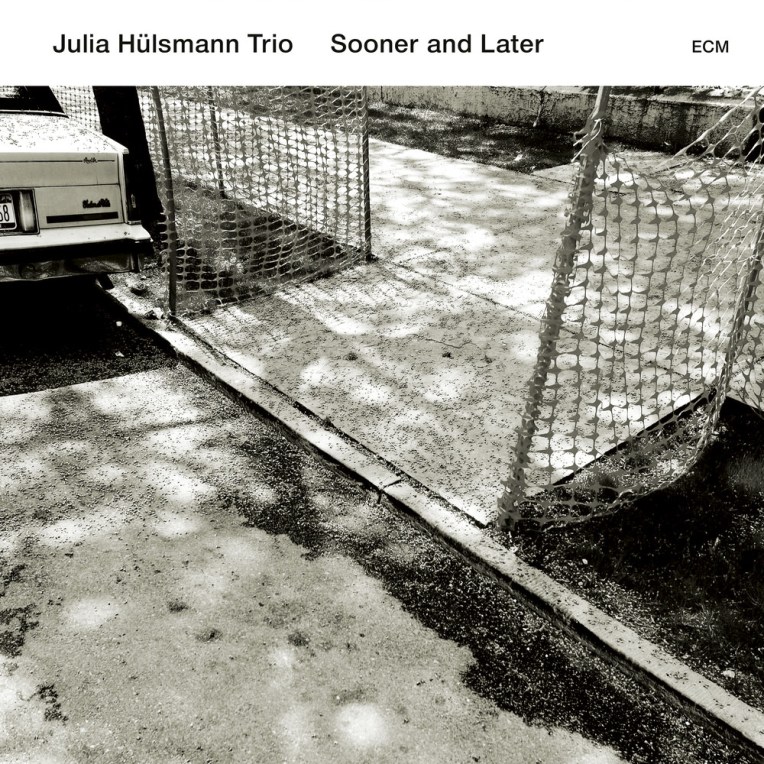
Julia Hülsmann Trio: Sooner and Later (ECM 2547)

Sooner and Later

Julia Hülsmann Trio
Sooner and Later

Julia Hülsmann piano
Marc Muellbauer double bass
Heinrich Köbberling drums
Recorded September 2016 at Rainbow Studio, Oslo
Engineer: Jan Erik Kongshaug
Produced by Manfred Eicher
Release date: February 24, 2017

Julia Hülsmann returns to ECM bearing the flag of the phenomenal trio that marked her label debut as leader. Rejoined by bassist Marc Muellbauer and drummer Heinrich Köbberling, she paints one fully fleshed image after another, leaving not a single brushstroke unnoticed. Such artistry abounds in the album’s opener, “From Afar.” One of four originals by Hülsmann, it signals a theme of itineracy, inspired in no small part by her travels with the band in North and South America, China, and Central Asia. The latter geography reveals deepest influence in “Biz Joluktuk,” a melody by a 12-year-old violinist from Kyrgyzstan named Rysbay Abdykadyrow. In addition to its melodic beauties, it’s also a quintessential example of how movement connects humanity in the spirit of allusion. Hülsmann’s “J. J.” and “Soon” are especially head-nodding tracks, sparkling like a disco balls in some cerebral night club. “Der Mond” ties a beautiful ribbon around it all for a final swing of the compass. “Thatpujai” is a standout track. This introverted homage to German jazz pianist Jutta Hipp (1925-2003), whose name was anagrammed into the present title, is built around transcriptions of Hipp’s solos and goes straight to the heart.

Köbberling and Muellbauer contribute two tunes apiece. Where the drummer’s “You & You” is a rhythmically savvy and sunlit tune brimming with welcome, “Later” is a groovier affair, replete with complex changes, superb bassing, and sumptuous piano voicings. The bassist walks an enchanting path in his “The Poet (for Ali),” as if turning the desert into a giant piece of sheet music in wait of each step to notate it. “Offen,” by contrast, flips the scales into a tropical climate and finds Hülsmann weaving her mantras one pregnant word at a time.

Rounding out the set is an arrangement of Radiohead’s “All I Need,” which by its gentle suggestions rewrites the parameters of the trio’s boundaries while also deepening them in their place.

Gary Peacock Trio: Tangents (ECM 2533)

Tangents

Gary Peacock Trio
Tangents

Marc Copland piano
Gary Peacock bass
Joey Baron drums
Recorded May 2016, Auditorio Stelio Molo RSI, Lugano
Engineer: Stefano Amerio
Produced by Manfred Eicher
Release date: August 25, 2017

Following the 2015 debut, Now This, Gary Peacock helms his trio with pianist Marc Copland and drummer Joey Baron once again into pristine waters. As if by force of metaphor, the trio indeed coheres like a finely made vessel in the set’s opener, “Contact.” The first of five Peacock originals, it opens with the bassist by his not-soon-to-be-lonesome, a voice with something to say. As Copland’s postmodern lyricism and Baron’s scintillating cymbals step into frame, we find ourselves moving from doorway to outside world. Throughout Peacock’s other compositions, whether in the evocative “December Greenwings” or the narrative title track, his bassing rises and falls as a city breeze while Copland fills in the footsteps of every pedestrian footprint below. And in the enthrallments of “Tempei Tempo” and “Rumblin’” he blossoms into jagged grooves that only reinforce their adhesive qualities with every rhythmic turn.

For this session, Baron pens the rightfully bubbling “Cauldron,” a sonic stew that goes down one hearty morsel at a time. His detail-rich drumming proves to be an intuitive foil for Copland’s chord voicings, as well as for Peacock’s ebullience. “In And Out” is another Baron creation that finds the drummer in lithe duet with Peacock. Copland contributes his own “Talkin’ Blues,” which by its sharp turns and fancy footwork glides over a uniquely joyous terrain.

The trio’s resplendent takes on nocturnal standards like Alex North’s “Spartacus” and Miles Davis’s “Blue In Green” show us only what masters can do with the masters when recorded by the masters, while between them breathes the freely improvised “Empty Forest.” This gentle yet no-less-formidable beast of a tune hangs its stars from every tree to replenish a foliage withered by time.

Remarkable about Tangentsis how equally each player contributes to the overall sound. One could write its roster on a wheel, spin it at any moment, and find enjoyment by focusing on whatever name it lands on. Everyone is as much a listener as a crafter of that which is heard, a chaser of the same muse whose love of communication is as indelible as the sentiments conveyed here.

Tomasz Stanko New York Quartet: December Avenue (ECM 2532)

December Avenue

Tomasz Stanko New York Quartet
December Avenue

Tomasz Stanko trumpet
David Virelles piano
Reuben Rogers double bass
Gerald Cleaver drums
Recorded June 2016, Studios La Buissonne, Pernes-les-Fontaines
Engineer: Gérard de Haro
Mastering: Nicolas Baillard
Produced by Manfred Eicher
Release date: March 31, 2017

Now the windows, blinded by the glare of the empty square, had fallen asleep. The balconies declared their emptiness to heaven; the open doorways smelt of coolness and wine.
–Bruno Schulz, The Street of Crocodiles

Tomasz Stanko’s twelfth album for ECM as leader, released just shy of sixteen months before his death in 2018, is both a lean into the future and a languid dip in the past. In the former regard, one can expect a darker side of jazz to reveal its face at many turns herein. From the opening “Cloud” to the closing “Young Girl in Flower,” the Polish trumpeter and his New York Quartet don’t so much render a single circle as an ever-growing coil of them, each transitioning through iridescent colors of retrospection. In pianist David Virelles, bassist, Reuben Rogers, and drummer Gerald Cleaver he finds climatic support that opens the firmament to let in vaporous songs of resuscitation. Each is strangely thrilling, despite Stanko’s overcast writing.

Virelles keeps the barometric pressure balanced, setting the tone of “Blue Cloud” and “Bright Moon” with patience before an overflow of emotion takes place. Rogers and Cleaver add masterful waves of recall beneath Stanko’s storytelling vibe, in which the bandleader uses gestures and feelings to convey his characters’ deepest moral decisions. Like “Ballad for Bruno Schulz” and its distant cousin, “The Street of Crocodiles,” each breathes us mid-sentence into a literary world. The latter tune’s cinematic cool, in combination with Rogers’s arco drunkenness and Stanko’s back-alley flutters, is a pinnacle.

Not all is doom and gloom, however, as we’re treated to some scattered uprisings of emotion. Although still drawn from the shadows, “Burning Hot” and “Yankiels Lid” excavate the night with tools of fire, while the groovier title track feels like a lost take from Stanko’s previous effort, Wisława.

Three free improvisations fill in the gaps, each with Rogers as its fulcrum in largely duo settings. Sharing the air with Stanko in “Conclusion” and with Virelles in “Sound Space,” the bassist understands that any dream can be turned real by the flick of destiny’s wrist. Thankfully, one of those flicks loosed this album through the ether and into our receiving ears.

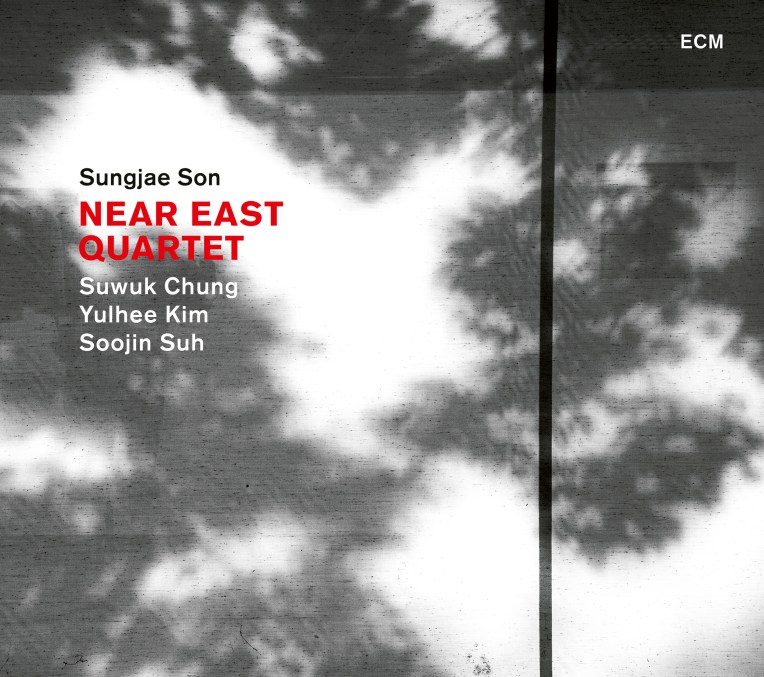
Sungjae Son: Near East Quartet (ECM 2568)

2568 X

Sungjae Son
Near East Quartet

Sungjae Son tenor saxophone, bass clarinet
Suwuk Chung guitar
Yulhee Kim vocal, percussion
Soojin Suh drums
Sori Choi traditional Korean percussion on “Baram”
Recorded December 2016, Stradeum Studio, Seoul
Engineer: Rick Kwan
Mixed by Nicolas Baillard, Manfred Eicher, and Sun Chung at Studios La Buissonne, Pernes-les-Fontaines
Produced by Sun Chung
Release date: August 31, 2018

Saxophonist/composer/bandleader Sungjae Son and his Near East Quartet splash into ECM territory with this phenomenal debut. Joined by guitarist Suwuk Chung, singer-percussionist Yulhee Kim, and drummer Soojin Suh, he charts new paths along old maps, bringing traditional Korean music, or gugak, into the stratosphere of improvisation. It’s a unique concept not explored on the label since Then Comes the White Tiger, but with a freshness all its own. The concept is in the name, which came at the suggestion of Chung. In the guitarist’s words: “We’re all born and raised in an Eastern country, but our identity is very much Westernized. Not by choice of our own, but of the world that made us. So we can’t really say our music is from the ‘East.’ Rather, it feels like we’re standing somewhere near it.” This push and pull of identity politics is expressly felt in the set’s two Korean folk songs. Where “Mot” zooms in like a cinematic close-up on a young woman picking lotus seeds, the seafaring “Pa:do” evokes the undulation of waves, both literal and figurative. Son’s bass clarinet in the former moves full dark over desolate landscape while Suh’s drums in the latter illuminate details where few others would find purchase. The ability of both to embody what they articulate is marvellous.

In response to the question of combining traditional Korean music and jazz, Son tells me by email that for him jazz “is all about different cultures meeting together from the start. It’s only natural for me to bring something from my own cultural background into jazz that I love. East and West share the beauty of sound and the beauty of silence. As for what makes Korean traditional music distinct, I can only say that it embraces empty space instead of filling it in.” And embrace it they certainly do in “Ewha.” This opening track is a portal of welcome into a sound-world that’s equally physical and immaterial. Its mood is so initiatory that it’s all one can do to close one’s eyes against the glare of its forthrightness. It shares body heat as a way of shedding the skin of expectation for something uniquely honest.

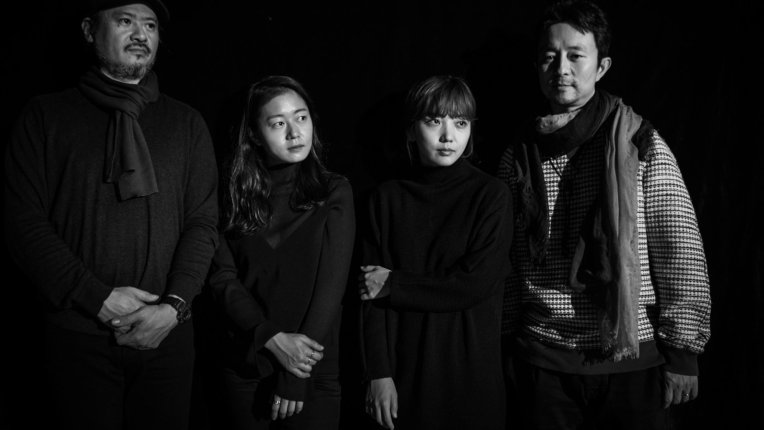
NEQ
(Photo credit: An Woong Chul)

Just as the modern elements emphasize their ancient counterparts, so do the ancient shed light on the modern. In that respect, however, Son has little to say with regard to the Korean jazz scene: “My quartet doesn’t sit squarely in the Korean jazz scene, which is small enough as it is and has no place for outsiders like us. It hasn’t been easy, but we’ve made due by creating our own scene.” Listening to tracks like “Baram,” for which Sori Choi joins on traditional percussion, it’s impossible to disagree. The first in a handful drawn from the orally transmitted Pansori epics, it’s told from the viewpoint of a lover wishing for word from the one who has left her behind, yet whose dedication results in a fatal beating when she refuses a local magistrate. Her only hope is to reunite with her true love in another life. Kim sings with audacity and emotional integrity, embraced by a cosmic pond of guitar and lured by the percussion’s death knells. As also with the urgency of “Galggabuda” and patient intensity of “Jinyang,” each word feels like a sonorous wound. That said, Son attributes no special thematic significance to the chosen texts. “The language itself,” he says, “has its own color and rhythm that brings a different atmosphere to the music. There’s no point in understanding the meaning of the lyrics in my music.” To be sure, we can just as easily feel its pulse as if it were our own without translation.

This feeling of human connection is only enhanced by producer Sun Chung, whose gentle hand is felt by its very absence. “He never tried to guide us or anything,” recalls Son. “He just believed in our music. We recorded new songs that no one has heard before. Even we didn’t know what was going to happen. But during the recording, I felt like he already knew exactly what needed to happen. At one point I asked him, ‘Sun, why don’t you say something?’ To which he responded, ‘I’m not here to speak. I’m here to support whatever it is you want to do.” Although such freedom of expression is palpable throughout, it’s especially evident in “Garam” and “Ebyul.” Like currents flowing between islands, they make long distances seem surmountable by mere strum of guitar, brush of drum, or whisper of reed. Each is a dream turned inside out until we can step through it in reality, breathing in words as sacrifice and exhaling melody as reward.

When I ask Son what he hopes listeners will experience in this album, his answer is as straightforward as the music it describes: “Somethin’ else.”

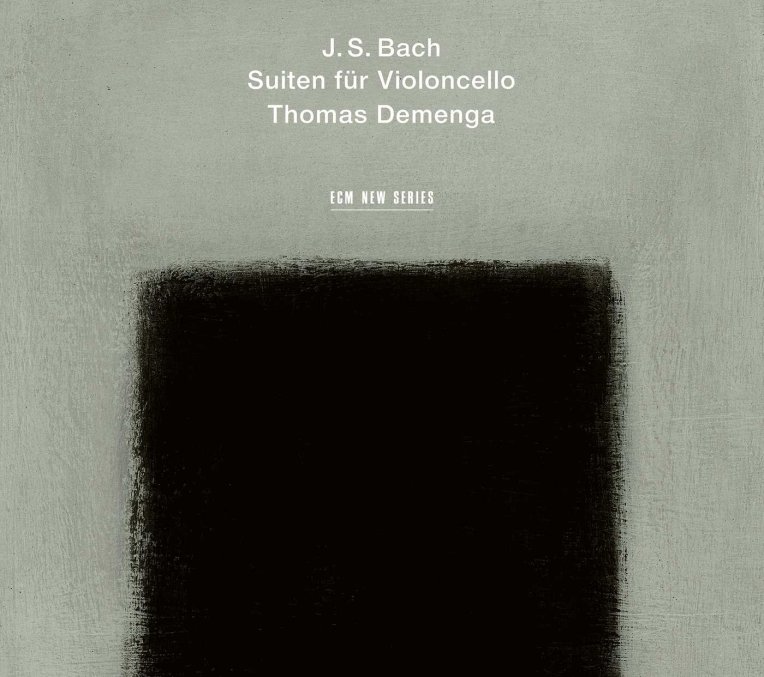
Thomas Demenga: J. S. Bach – Suiten für Violoncello (ECM New Series 2530/31)

Demenga Bach

Thomas Demenga
J. S. Bach: Suiten für Violoncello

Thomas Demenga violoncello
Recorded February 2014, Hans Huber-Saal, Basel
Engineer: Laurentius Bonitz
Executive producer: Manfred Eicher
Release date: October 27, 2017

The Cello Suites of Johann Sebastian Bach, like his Sonatas and Partitas for solo violin, are touchstones for listeners and performers alike. In the latter sense, Thomas Demenga approaches them through an ECM lens for the second time here. Having first fragmented his traversal between 1986 and 2002 through a series of pairings with contemporary works, thereby suggesting exciting new relationships, here he uncovers intra- rather than interrelationships, moving from fundament to firmament and back again with mind and hands sculpted by experience into something unmissable.

Where some interpretations might seek to add something new, Demenga’s embrace something old, always there but too often crucified on the scoreboard of modernism. Here we encounter a return to form, if not also a form of return, in the deepest interest of music that springs eternal from Creator to creator. Referred to in Thomas Meyer’s liner essay as “every cellist’s gospel,” the Cello Suites do more than encourage rereading; they demand it. Having played these masterpieces for more than 50 years, Demenga understands that no one is ever “done” with them and that we’re all born and expire in its swaddling echoes.

In the First Suite, he carries an antique sensibility from first inhale of Prélude to last exhale of Gigue, working shadows into familiar nooks and crannies as if they constituted a physical substance. That same feeling of breath, more than metaphorical, whispers, rasps, and soliloquizes through the Second Suite’s philosophical journey. Its Prélude liquifies the heart and feeds it to another in a cycle of life that cannot be qualified by any other means than the gut strings and baroque bow with which Demenga has chosen to articulate every stroke. The Courante is strangely beautiful in its jagged denouement, while the Sarabande that follows it speaks with haunting urgency and the concluding Gigue with three-dimensional tactility.

The lithe stirrings of the Third Suite’s Prélude and Allemande form a dyad of such emotional integrity as to occupy a realm all their own. As in the famous Bourrée I & II, he dives inward for pearls of wisdom, unpolished and offered in their own shells, glorious specimens of nature whose perfection communicates in the language of imperfection. Demenga’s trills and glissandi are as surprising as they are organic, and flow of their own volition.

Says Demenga of Bach, “His music is detached from personal feelings and dramas or other events to which many composers give expression in their music. That is why his music is so pure and why it possesses, we might say, something divine.” In interest of that expression, this performance is made all the more solitary for its attention to dance-informed structures. This is especially evident in the program’s second half, which through the prism of the Fourth Suite shines a light striated with as much solemnity as exuberance. From the throaty Prélude unspools a narrative of timeless impulses. In the Allemande and Courante that follow, one can feel the soul of a viola da gamba squeezing through the strings, as if the latter were portals of mastery to which our ears must seem as eyes hungry for vistas beyond the known. And in the footwork of the final Gigue, the press of flesh into soil is vivid and alive.

From that sunlit scene Bach pivots into the twilight of the Fifth Suite. Here the modesty of its inception tangles in moral debate with its fleshly Courante—made all the more carnal for Demenga’s intuitive bowing—before finding solace in the blushing Gigue.

This leaves the Sixth Suite to stand as its own Book of Revelation, a scriptural culmination of all that came before it, a fulfillment of prophesies as old as they are indisputable, and which spread the good news of salvation not through words but actions.

As the opening movements—not least of all in the dizzying Prélude—suggest, we must find our own way into this music not by way of deciphering but in the knowledge of receiving a gift in and of faith. And if the finality of its Gigue is any indication, we must treat farewell as the opening of a deeper relationship with life itself, personified in every tremble of the waiting ear and reciprocated whenever we need to be reminded of purpose.

John Abercrombie Quartet: Up and Coming (ECM 2528)

Up and Coming

John Abercrombie Quartet
Up and Coming

John Abercrombie guitar
Marc Copland piano
Drew Gress double bass
Joey Baron drums
Recorded April/May 2016 at Avatar Studios, New York
Engineer: James A. Farber
Assistants: Thom Beemer and Nate Odden
Produced by Manfred Eicher
Release date: January 13, 2017

The quartet of guitarist John Abercrombie, pianist Marc Copland, bassist Drew Gress, and drummer Joey Baron, last featured on 2013’s 39 Steps, returns for the final ECM album to be released before the bandleader’s death. As if we ever needed a reminder of why his art was more than its own musical country but a continent unto itself, this gorgeous swan song fulfills that duty and then some.

Each facet of Up and Coming pays tribute to Abercrombie’s meteoric development as a musician, and by the brushwork of his bandmates renders a group portrait quite unlike any other in the business. On “Joy,” we’re introduced to their symbiosis in spades. As wind currents of guitar and piano flow over each another, they trace a cymbal-kissed shore and its trail of bass footprints. If joy abounds here in name, so does it also in spirit on “Flipside,” of which an understated brilliance showcases the quartet at its straightforward best.

If “Sunday School” is a lesson in grace and doctrinal congruity, wherein Abercrombie shines with a quiet light and sparks a particularly introspective solo from Gress, the title track is a more secular campaign led by the guitarist’s liquid-mercury call to arms. In likeminded spirit, Copland contributes two tunes written for this session. Where “Tears” rows a classically inflected river that finds Abercrombie and Gress wielding the most delicate of improvisational oars, “Silver Circle” elicits a funk-infused passion.

Channeling Bill Evans in their rendition of the Miles Davis standard “Nardis,” the band begins without rhythm, floating in reverie before landing into sunlit fields. And there we find Abercrombie cartwheeling away in “Jumbles.” Here, as until now, Baron’s splashing cymbals are the leitmotif of a palpable scene.

It goes without saying that this album’s title is most ironic, given that such playing can only be forged by those who’ve been around the block more than a few times. From beat one to none, Up and Coming is a fitting end to an unparalleled legacy—one, I sincerely hope, of more in the wings of ECM’s archives.

JAQ
(Photo credit: Bart Babinski)

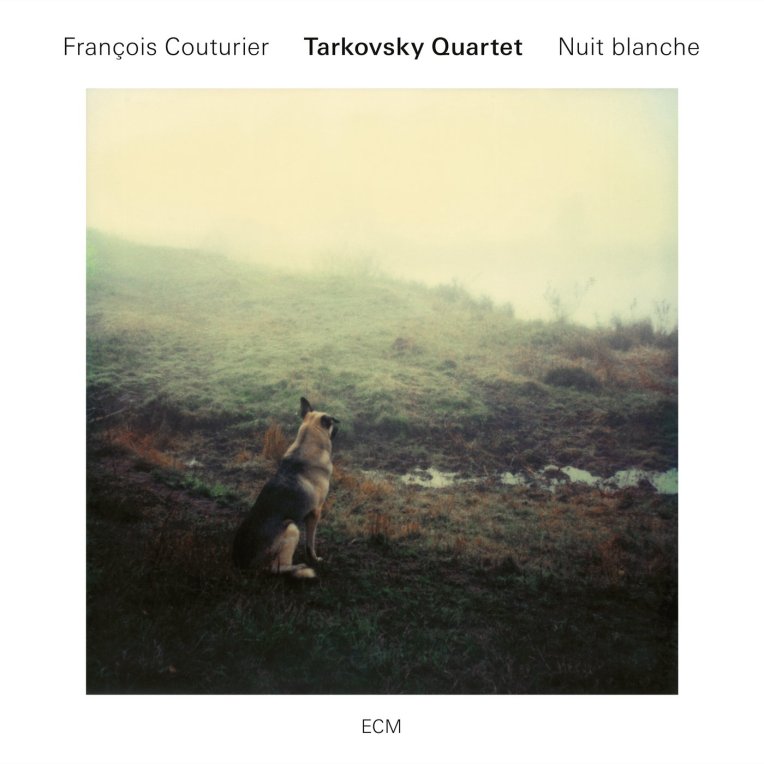
Tarkovsky Quartet: Nuit blanche (ECM 2524)

Nuit blanche

Tarkovsky Quartet
Nuit blanche

François Couturier piano
Anja Lechner violoncello
Jean-Marc Larché soprano saxophone
Jean-Louis Matinier accordion
Recorded April 2016, Auditorio Stelio Molo RSI, Lugano
Engineer: Stefano Amerio
Produced by Manfred Eicher
Release date: April 7, 2017

When opening our eyes, do our minds turn to thoughts of waking? Nuit blanche, the latest from pianist François Couturier’s ever-deepening Tarkovsky Quartet, answers this question with a possibility of dreams. It’s clear not only in the tracks variously titled “Rêve,” “Dream,” and “Traum,” but also in the blurring of corporeal borders such linguistic costume changes imply. In those pieces, each fitting into a larger improvisational puzzle, we get lost just to be found.

In so much of the connective tissue that holds together these vital organs, this quartet’s ethos blossoms vividly. A gentle urgency in the title track’s cello, singing at merest touch of Anja Lechner’s bow and tempered by the cross-hatching of Jean-Louis Matinier’s accordion, provides ample preparation for the soprano saxophone of Jean-Marc Larché to unfold its wings one feather at a time. As if to drain that metaphor of its itineracy, tracks like “Soleil sous la pluie” and “Fantasia” evoke a feeling of suspension. Taps of bow on strings and of knuckles on hollow body play out a dialogue of mechanical sins and immaterial salvations, each detail a poem without words. The latter piece’s transcendence recalls the levitation scene in The Sacrifice, and by that association adds a touch of spirit to vessels of the flesh, turning in on itself until the two are indistinguishable in glory.

Whether in more direct references such as “Dakus,” inspired by Tōru Takemitsu’s Nostalghia (itself written in memory of the director), or the distinct nostalgias of “Urga,” every ruined landscape we encounter here is, as in the wasted Zone of Stalker, a blanket of broken futures over a memory too joyous to contain. Couturier’s unaccompanied “Daydream” and “Nightdream” are likewise liminal, at once floating and sinking in a stream of imagined silence. Between them is “Cum dederit delectis suis somnum,” plucked from Antonio Vivaldi’s Nisi Dominus and passed like a torch from bow to reed with all the sanctity it demands.

If, as Andrei Tarkovsky himself once said, “the sounds of this world are so beautiful in themselves that if only we could listen to them properly, cinema would have no need for music at all,” we might also say that the music of this quartet named for the Russian auteur, if watched properly, would have no need for imagery at all. Then again, one can’t help but treat it as a projection screen for internal scenes, each more personal than the last. And so, ending as we began, with the eyes as fulcrums between dreaming and waking, never knowing where to draw a line between the two yet confident that no level of imagination can do justice to what they see, we walk into sunset, knowing that all we need to make it a sunrise is stand on our heads.