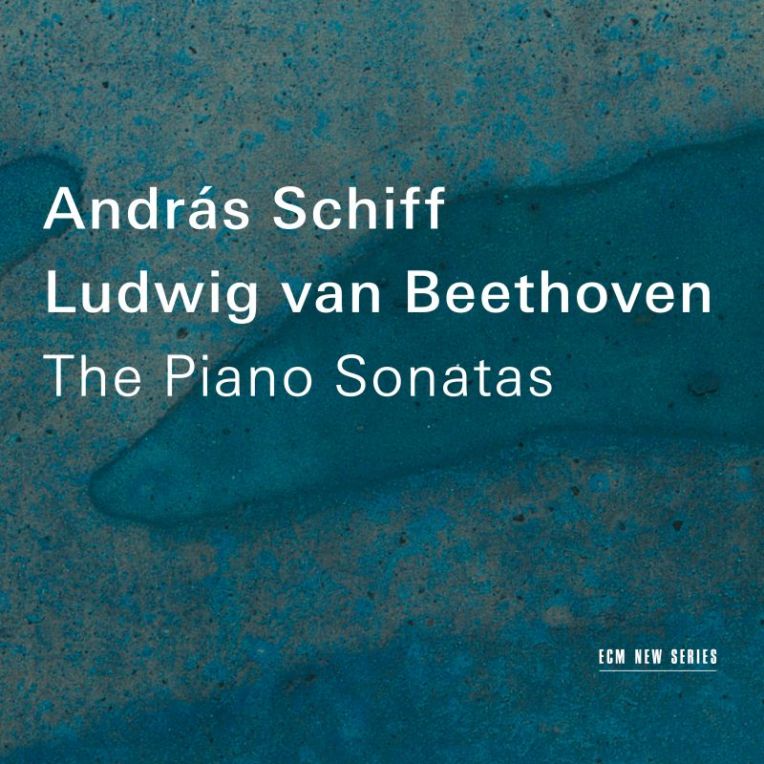
András Schiff
Beethoven: The Piano Sonatas
András Schiff piano
Concert recordings at Tonhalle Zürich, March 2004-May 2006
Engineer: Stephan Schellmann
Produced by Manfred Eicher
Release date: November 25, 2016
Renowned conductor and pianist Hans von Bülow (1830-1894) famously said: “Bach is the Old Testament and Beethoven the New Testament of music.” But this analogy only feels true in chronological terms. In any other aspect, the reverse would be more accurate, for while in Beethoven we encounter the judgments of a vengeful God, in Bach we feel the salvation of grace. Indeed, ECM’s New Series had been enamored with Bach for years before dipping into the canon of Beethoven, and Hungarian pianist András Schiff (previously known for his spirited renderings of Schubert, Mozart, and Bach himself) did that and more, gifting us with revelatory performances of the entire Beethoven piano sonata cycle. Totaling 32 in number, these sonatas remain the heart of the iconic composer’s oeuvre, each its own ecosystem of influence.
“Unlike with Mozart and Schubert, there are no repeated gestures in Beethoven: everything unfolds and is developed in a new aspect.” So says András Schiff of the difficulties of approaching this cycle as a whole. Of course, such progressive demands present formidable challenges to the Beethoven interpreter, who must play as if caught in the immediacy of every musical gesture. “Like picture restorers,” he goes on, “we performers have to scrape off the layers of convention, have to remove the dust and dirt, in order to reproduce the work in all its original freshness.”
To that end, Schiff boldly decided to perform each sonata in at least 15 cities before sitting down for these live recordings at Zürich’s Tonhalle, the acoustics of which seem spun directly from the piano itself. Schiff believed the immediacy of live performance was vital in bringing Beethoven to life on CD. The only exception is the final disc, recorded in the empty hall of the Reitstadel in Neumarkt, Germany. Schiff also used three pianos: a Steinway for the more dynamic pieces and two different Bösendorfers for the lyrical. In terms of sound mixing, the left hand dominates the left channel and vice versa, thereby creating a virtual piano in the ears.
Volume I: Sonatas opp. 2 and 7 (originally ECM New Series 1940/41)
Recorded March 2004, Zürich Tonhalle
Kernels of what would later be construed as Beethoven’s genius are easily gleaned from these groundbreaking first offerings. Consequently, Schiff waited for decades to ease into this material, a decision that rewards our listening most profitably. Schiff is adamant about following the interpretive clues Beethoven has left behind in his scores, taking to heart—even as he sets aside—the elisions and additions of his predecessors. He greets each sonata as a new friend, idiosyncrasies and all. Although these sonatas are hot on the heels of Mozart, in Schiff’s estimation Beethoven is prose to Mozart’s poetry. If Beethoven is synonymous with drama, then let this be the curtain-raiser to Schiff’s epic endeavor.
Sonata No. 1 f minor op. 2/1 (1793-5)
Shades of Haydn (to whom all of op. 2 is dedicated) abound, but arrive at a series of distinct solutions, both open-ended and alternatively solved. Schiff manages to draw out a dramatic exploration of themes with limited means. Dynamic control in the Menuetto is strikingly effective here, while the Prestissimo is a thrilling conclusion to this earliest sonata and already speaks of a turgid energy dying for a way out. The final bars are filled with a lush restraint that erupts into the ultimate downward trill.
Sonata No. 2 A major op. 2/2 (1794-5)
A more playful, even humorous mood dominates the op. 2/2. A sense of freedom within bounds, like a child who is limited only by imagination in terms of what can be seen and experienced under constant supervision. This sonata is a grand experiment in movement. It runs, trips, falls, and picks itself up again in its repeated attempts to regain locomotive control. This seems to be one of the most difficult of the 32 sonatas to play, if only because of the demand for sustained focus and emotive energy that plows its whimsical soil. The Allegro is a grandiose series of textures all describing the same playroom and recasts us as parents watching over the children we once were. On the one hand we are joyful toward the innocent display; on the other we mourn the loss of our interest in trivial things. This isn’t the philosophical Beethoven, but no less a contemplative one unafraid to work through his own indecision in the open forum of our scrutiny. The Scherzo sparkles here with jewel-like brilliance before tossing us like a discarded doll into a satisfying conclusion.
Sonata No. 3 C major op. 2/3 (1794-5)
A verdant and dramatic Allegro starts things off with the slightest hint of Händel to keep our ears in check. Superbly controlled runs and arpeggios make this a joyful listening experience overall. The musical equivalent of a period of rest that precedes the return leg of a long journey: we relive the joys of our destination while yearning for those of home.
Sonata No.4 E-flat major op. 7 (1796-7)
This sonata offers such a wide variety of colors that one wonders where the young Beethoven found the time to pluck them from the proverbial tree. Of the early works, this more than any other showcases Beethoven’s unique “posturing” as one looking back over a much longer life. Already he displays a grand affinity for, and subtle reinvention of, the sonata form. We end on a curiously somber note, collapsing to the ground after a futile attempt at escape.
Volume II: Sonatas opp. 10 and 13 (originally ECM New Series 1942)
Recorded November 2004, Zürich Tonhalle
Schiff’s second installment is full of surprises and reflects the superior dedication of its execution.
Sonata No. 5 c minor op. 10/1 (?1795-7)
The op. 10/1 sonata feels like running. Like all of the early sonatas, it’s always moving. Whether slowly, briskly, or at a horse’s gallop, one feels it going somewhere, even if the destination isn’t always clear (not least of all to Beethoven himself). This leaves the performer to determine said destination and to commit to a path leading there. The op. 10/1 further reveals formative intimations of Beethoven’s “concertistic” leanings. Rather than exhibiting the embryonic characteristics of a composer in his mid-twenties, the forms herein act like fully realized beings who think deeply before speaking.
Sonata No. 6 F major op. 10/2 (1796-7)
The opening Allegro establishes a one-to-one correlation between form and melodic drive. Schiff’s playing veritably jumps off the page like a script dying to be orated before an enraptured audience. Arpeggios sing with grace and dutiful restraint as the right hand dominates with subtler pleasures. A contemplative Allegretto leads into a swinging Presto with all the verve of one who believes passionately in the value of darkness. Not that this is a morbid piece; only that its nooks and crannies are deep enough to inscribe loaded variations into an otherwise dainty surface. A standout in the entire cycle. What Schiff does with it is miraculous.
Sonata No. 7 D major op. 10/3 (1797-8)
A bit statelier in feel, this sonata nevertheless rushes forth with its own power. Among the quieter sonatas, it embodies a chamber-like sensibility. And even though it may not hit you over the head with its style, it packs a delayed punch, seeping undetected under the skin, lacing our systems with subdued petulance.
Sonata No. 8 c minor op. 13 “Pathétique”
Though often seen as one of Beethoven’s more “symphonic” sonatas, here the op. 13 if anything feels “sympathetic.” The opening movement fights its way to a centered mode of understanding in its attempts to overshadow internal pain. It is consolatory, patient, even kind. Its many spontaneous shifts are never instigated without careful reassessment of their own devices. The recapitulating motif is comforting, mellifluous in its persistence. The Adagio binds us. In doing so, it avoids falling into a trap of oversentimentality, unfolding instead with the uneasy grace of human (read: mediated) emotion. The concluding Rondo and Allegro twirl with the measured rhythm of a dancer who must leave her shoes in a dusty, shadowed corner at the end of the day, but who refuses to leave the studio without first giving her all in defiance of the wall-length mirror that stands before her.
Volume III: Sonatas opp. 13, 22 and 49 (originally ECM New Series 1943)
Recorded February 2005, Zürich Tonhalle
“Already in his early sonatas,” Schiff tells us, “Beethoven is a psychologist, not only as regards the organization of the movements according to their inner logic, but also in the unity between the various movements.” Thus does the trenchant pianist bring an analytical edge to his third installment in the Beethoven cycle. Its offerings are rougher around the edges, even as they continue to be microscopic in precision.
Sonata No. 19 g minor op. 49/1 (1797?)
This sonata sets the tone for a disc that is markedly miniaturistic. The gestures are quick and painless, never lingering too long on the tongue before subsequent flavors take over.
Sonata No. 20 G major op. 49/2 (1795-6)
There’s an overt delicacy to this sonata that is strangely invirogating in light of the last volume’s “Pathétique.” In contrast to the energetic infusions required on Schiff’s part to bring it to life, the Op. 49 presents a more relaxed Beethoven, rocking us gently through the final menuetto into the op. 14/1.
Sonata No. 9 E major op. 14/1 (1798)
While this sonata and its present company are relatively easy to play, they’re not without their difficulties (though one would be hard pressed to distinguish them from the melismatic uniformity of Schiff’s effortless stylings). While this might not be one of the most memorable of sonatas overall, its lively Rondo is a highlight among them.
Sonata No. 10 G major op. 14/2 (?1799)
For all its brevity, this one is charmingly captivating. The opening Allegro ripples like a fluid stream caressing rocks rounded by centuries of erosion. The Andante plods along with an almost pompous assuredness, swaying its head from side to side as it prowls the streets for attention. The closing Scherzo is deceptively constructed, cloaking itself in the mood of a sporadic chase, a cat in search of the elusive thematic mouse until…not a pounce but a strange remorse over the killing of one’s object of entertainment.
Sonata No. 11 B flat major op. 22 (1800)
This might very well be Beethoven’s “breakout” sonata, as it marks his return to the four-movement structure he made his own. With a sort of fractured bravado, it circles an axis of motifs like a bird whose confidence gives its victims that much more false security before diving in for a meal. The Adagio practically floats on its own ineffable air, wafted ever higher with each beautifully articulated trill. A compellingly woven Minuetto prepares us for a masterful Rondo as bidirectional runs travel into two succinct and conclusive chords.
Volume IV: Sonatas opp. 26, 27 and 28 (originally ECM New Series 1944)
Recorded April 2005, Zürich Tonhalle
This disc marks the end of Beethoven’s “early” period (though Schiff is quick to point out the arbitariness of such categorical distinctions). Here we see Beethoven the character actor, the pantomime and experimenter, donning a new mask with each successive gesture.
Sonata No. 12 A-flat major op. 26
As with every sonata on this standout disc, Schiff displays the utmost patience with the material. The gentle opening is an early morning brightening into daylight: brief snatches of dreams flit across the mind, only to be lost again as we try to grasp them. The Allegro bustles with the liveliness of daily chores, while a funeral march adds a new element into the mix.
Sonata No. 13 E-flat major op. 27/1 “Quasi una fantasia”
The second movement pulses with the precise syncopation of Bach’s Well-Tempered Clavier, and is a key moment of transcendence in the collection. As affecting as it is brief, it is suitably balanced in its weight and distribution. This is followed by a plaintive Adagio and the crowning Allegro, between which Schiff exhibits the diversity of his approach as he winds up for a rousing finale.
Sonata No. 14 c-sharp minor op. 27/2 “Moonlight”
Perhaps nowhere is Beethoven’s posthumously acquired pomposity more sensitively challenged than in this, the ubiquitous “Moonlight”-Sonata (the name is not Beethoven’s, given instead by nineteenth-century German poet and music critic Ludwig Rellstab, who likened the piece to an evening view of Lake Lucerne). There are, perhaps, justifiable reasons why its opening movement has been so widely interpreted, excised from its connective tissue and upheld as a prototypical organ of its kind. Yet none of that seems to matter the moment it falls within Schiff’s purview. The rhythm is duly appropriate, never lagging while allowing for every note to speak its piece. Schiff makes a seemingly bold yet ultimately sensible move in following Beethoven’s controversial cue to depress the sustain pedal for the Adagio’s entire duration. This prescription has more often been overridden because of the modern piano’s longer sustain. Schiff’s magically realized solution seems as much a matter of his choice of instrument as of his technique. The central Allegretto is a vital hinge—“a flower between two chasms” in the words of Franz Liszt—to another recognizable burst of melodic intensity in the Presto, in which the sonata form is resurrected with ferocious efficacy.
Sonata No. 15 D major op. 28 “Pastorale”
The “Pastorale”-Sonata, with its instantly recognizable grandeur and intervallic range, marks a period in which Beethoven’s deafness was growing markedly worse. The subtitle was appended by publisher A. Cranz and should be taken with a grain of salt, lest one miss out on the contrasting dynamics of the two central movements. The Scherzo is one of Beethoven’s more charming creations and spices the mix like laughter before hurtling into a kinetic gigue and virtuosic finale.
Volume V: Sonatas opp. 31 and 53 (originally ECM New Series 1945/46)
Recorded December 2005, Zürich Tonhalle
Culled from Beethoven’s so-called “Middle Period,” challenge the heroism so often ascribed to his concurrent works (e.g., the “Eroica” Symphony). Rather, this is an introverted heroism honed in the artifice of its own self-conscious desire. Violence is shown to be futile, as bendable as the will of its practitioners.
Sonata No. 16 G major op. 31/1
Schiff characterizes this as Beethoven’s “wittiest” sonata. It also marks a shift from the classical style and indicates a composer desperate to forge his own path. At times parodic, this sonata leaves the listener with a sense of renewed vibrancy and proves that we need not always take ourselves so seriously to create animated art.
Sonata No. 17 d minor op. 31/2 “The Tempest”
Despite the dramatic implications of its subtitle (again, not the composer’s own), it is this sonata’s gorgeous Adagio that stands out and partners well with the closing Allegretto’s full sense of development and reprise. The “Tempest”-Sonata is, then, more than just turmoil. It is the sum of its parts, from the subtle and unseen to the antagonistic.
Sonata No. 18 E-flat major op. 31/3 “The Hunt”
This sonata is often noted for its jocularity, but Schiff manages peel back its veneer to expose a deeper psychology at work. Beethoven forgoes the usual ternary form in the Scherzo, thereby shading its sprightly mood with a hint of fortitude. A graver Menuetto and determined Presto bring necessary closure to its titular pastime.
Sonata No. 21 C major op. 53 (1803/4) “Waldstein”
The notorious “Waldstein”-Sonata is as economical at its center as it is expansive and epic at its edges. It is beyond programmatic, second in scope perhaps only to the “Hammerklavier.” This is a rollicking and sensory ride through pastures and mountains, rivers and snowdrifts, and all with the concentrated clarity of a composer hermetically devoted to his niche. The central Adagio is an exercise in mounting tension, whereas the final Allegretto sparkles with the effervescence of a natural spring. A particularly formidable section features a floating trill with the right hand as the left jumps quickly through its own set of hoops, all the while sandwiching a series of punctuating notes in the middle register. This precedes a long series of hills and valleys that boils into a bittersweet triumph, undercut as it is by the prospect of separation. The “Waldstein”-Sonata is kaleidoscopic, revealing new perspectives with every turn. The virtuosity here is a wonder, all the more so for Schiff’s ability to shake off romanticism and play with unwavering consistency. In doing so, he allows the variety of the piece to come through with surprising transparency.
Andante favori F major WoO 57 (1803)
This was the original second movement of the “Waldstein”-Sonata. After being criticized for its excessive length, it was (after much reflection on Beethoven’s part) switched out for the more succinct movement we have today. This little orphan survived well enough to earn the title of “Favored Andante.” It is almost a sonata in its own right, inverted and miniaturized as if for a shelf of curios.
Volume VI: Sonatas opp. 54, 57, 78, 79 and 81a (originally ECM New Series 1947)
Recorded April 2006, Zürich Tonhalle
In this sixth installment, continuing with the “middle” sonatas of Beethoven, emotions span the gamut from exuberance to anxiety. Schiff consciously places the formidable “Appassionata” second in this program, bowing to chronology over any a posteriori prestige collected along the way like so much canonic dust.
Sonata No. 22 F major op. 54 (1804)
This sonata, which Beethoven placed far higher than his ever popular “Moonlight,” ebbs and flows with a series of thoughtful ruminations and graceful attacks. The result is an accommodating piece, as brilliantly bipolar as it is unassuming—an enjoyable experiment in pastiche that seems to spit out its final thoughts like a conference presenter rushing to stay within time.
Sonata No. 23 f minor op. 57 (1804-06) “Appassionata”
A clear winner. Schiff’s playing courses like blood and with as much feel for change as one could ask for in a work for solo piano. That being said, one should not mistake Beethoven’s antics for showy musicianship. Accordingly, Schiff loosens the seams only so far before allowing the piece to dictate its own narrative trajectory. Just prior to composing this sonata, Beethoven was confronted with the irreversibility of his hearing loss, and so one might wish to see the “Appassionata” as a cry to hear rather than to be heard. Schiff finds in the octaval opening “an atmosphere of absolute danger.” Beethoven switches moods with the deftness of a seasoned quick-change artist, infused as the Allegro is with dark undertones and rhythms drawn from Scottish folk songs. The middle movement takes a very rudimentary theme and unpacks it for all it is worth. The finale is like a dirge in fast-forward, a tragic life condensed into nine minutes of fleeting youth and unrequited aspiration, and ends with a crunchy spate of frightening detonations.
Sonata No. 24 F-sharp major op. 78 (1809) “à Thérèse”
Beethoven was apparently partial to this sonata above all others. Either way, it stands as a vibrant testament to his dedicatory streak. Throughout its two-movement structure, the composer (and Schiff by extension) weaves a picturesque tapestry with essentially limited materials. The opening is filled with plenty of titillating flourishes to satisfy any type of listening while second movement nearly buckles under the weight of its profusion of ornaments, letting up just enough to maintain its integrity.
Sonata No. 25 G major op. 79 (1809)
Short and sweet is the op. 79. Its condensations, along with an undying sense of melody interspersed with unsettling mortality, make for (if you will excuse the alliteration) a pointillist portrait of playful proportions.
Sonata No. 26 E-flat major op. 81a (1809-10) “Les Adieux”
Regardless of what one wishes to make of the exact inspirations behind the programmatic titles of each movement (“The Farewell,” “The Absence,” and “The Return”), this sonata surely tells a story, albeit an elliptical one. The beauty of “Les Adieux” is its openness to interpretation: neither Beethoven nor Schiff want to impose an overarching theory onto the listener. It is a delectable and varied journey throughout which we encounter a variety of characters. In this sense, the sonata “speaks” in both whispers and shouts, relating a tale that never ceases to enthrall.
Volume VII: Sonatas opp. 90, 101 and 106 (originally ECM New Series 1948)
Recorded May 2006, Zürich Tonhalle
Continuing with its strict chronological adherence, Schiff’s seventh installment of the Beethoven cycle brings us squarely into the composer’s “Late Period.” The Sonatas opp. 90, 101, and 106 represent a turning point in Beethoven’s piano literature, blossoming with a more radical unfolding of internal conflict.
Sonata No. 27 e minor op. 90 (1814)
Characterized by Beethoven as “a contest between the head and the heart,” the op. 90 is a solitary endeavor into the hinterlands of introspection. Pastoral moments bleed into fleeting lapses of determination that quickly devolve into old habits.
Sonata No. 28 A major op. 101 (1815-17)
Where op. 90 is brooding, op. 101 is nostalgic. This sonata is one of the more romantic in the Beethoven catalog, and opens with assurance in spite of his near-total deafness (descriptive cues, such as “Somewhat lively, and with innermost sensitivity” for the selfsame movement, supersede the standard markings in order to better convey to performers how he imagined the music in his head). The sonata continues with its elegiac exploration of the past and its bearing on the present, culminating in an agitated finale.
Sonata No. 29 B-flat major op. 106 (1817-18) “Hammerklavier”
Considered by many to be the most daunting work of all piano literature, the nearly 45-minute “Hammerklavier” heaves like a gentle beast. Yet the seemingly insurmountable sonata is pulled off here with literary panache. The first movement delights with its palpability and energetic drive. The brusque Scherzo feels all the more so in the company of such towering neighbors, managing to hold its own while injecting much-needed whimsy. Next is the monumental Adagio, in which Schiff gives all the breathing room one could need in order to devour the final movement, building from a tentative Largo to an astounding fugue and coda in which each and every note gallops with equine agility.
Volume VIII: Sonatas opp. 109, 100 and 111 (originally ECM New Series 1949)
Recorded September 2007 at the Reitstadel in Neumarkt, Germany
Schiff is utterly committed to the urtext: he observes every prescription laid out before him. His approach is as constellatory as the music itself, carrying on with or without us. It is not so much timeless as it is timely and deserves at least one undivided listen in sequence, if only to absorb its messages in all their developmental glory.
In the Sonata No. 30 E major op. 109 (1820), two compact introductory statements pave the way for an intimate third movement. The music is tear-stricken and brimming with quiet resolution. The somber mood continues with the first movement of the Sonata No. 31 A-flat major op. 110 (1821) before giving way to some merciful humor in the second. The third movement is, for all its sparse distribution, a heavy lament. Though we do get some closure at the end, one senses that recovery is as ephemeral as the notes we have just heard. This sudden spurt of confidence seems a desperate slap in the face of mortality. The Sonata No. 32 c minor op. 111 (1821-22) provides a prismatic conclusion to an already multifaceted collection. In two movements, Beethoven expresses a lifetime’s worth of turbulence while managing to leave with the final proud nod of one who has won a long and fruitful argument.
Clearly, the demands presented to Beethoven interpreters are great. Not only must they play under the looming shadow of an enigma, but must also machete their way through centuries of scholarship, public dissemination, and imperialistic reputation. Schiff seems unable to escape the context of each sonata as he approaches it, even as he owns up to his modernity. His renderings have left an indelible mark on the Beethovenian pantheon. He plays as if every finger were its own pianist, offering music that demands attention not because it is Beethoven’s, but because it is ours.
(This seminal boxed ends with a disc of encores gathered from these concerts. Released also as their own album, they are reviewed separately here.)




 Between Sound and Space: ECM Records and Beyond