

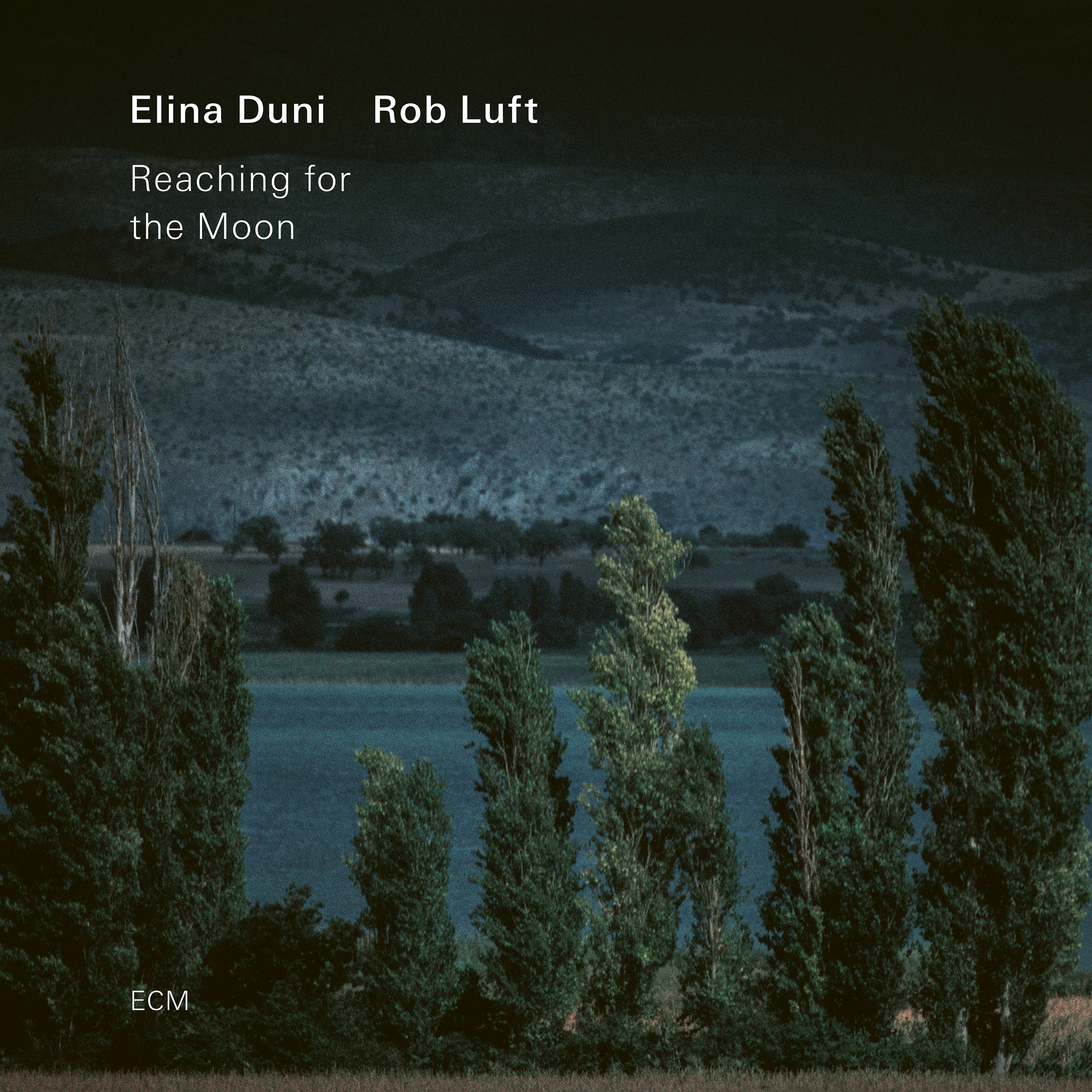
Elina Duni
Rob Luft
Reaching for the Moon
Elina Duni voice, percussion
Rob Luft guitars, electronics
Recorded June 2025 at Studios La Buissonne
Engineer: Gérard de Haro
Cover photo: Jean-Guy Lathuilière
Mastering: Christoph Stickel
Album produced by Manfred Eicher
Release date: April 24, 2026
Stranger is the heart
In the shadows it has grown apart
Lonely dancer, lonely lark
Your song is lost, adrift from the start
For her sixth foray into the ever-expanding territory of ECM records, singer Elina Duni returns alongside her most intuitive counterpart, guitarist Rob Luft, shaping a shared breath sustained across time. This meeting dispenses with the quartet format of their previous studio collaborations and settles into a two-person orbit, where every gesture carries even greater weight of intention. The result is a listening experience in which language itself becomes a constellation, each tongue a different shade of twilight, flickering against the dark. Italian, French, English, Albanian, and Arabic drift as migrating birds, presence the invisible translator between them.
The title track by Irving Berlin already bears the fingerprints of history, yet here it sheds its familiarity. Luft lays down chords that feel weathered by recall, soft as footsteps on a path that no longer exists, while Duni’s voice rises in quiet illumination. There is a sensation of recognition without name, of sketching a horizon that recedes as one approaches, inviting pursuit rather than arrival.
From this invocation, “Cammina Cammina,” by Italian singer-songwriter Pino Daniele, deepens the album’s nocturnal terrain. The old man it pictures wandering through the past becomes less a character than a mirror held up to the listener’s own sediment of experience. Duni traces his solitude with exquisite restraint, allowing each syllable to carry the weight of absence. The moonlight here feels tangible, something one might gather in the hands only to watch it dissolve. Luft bends toward fragility, his phrases hovering at the edge of dissolution.
The duo’s thematic commitment is further unraveled in “Les Berceaux.” This setting of René-François Sully-Prudhomme to the music of Gabriel Fauré embodies the rocking motion of its title (French for “The Cradles”), allowing us respite in the warmth of a lullaby. Speaking of lullabies, we are treated to two further examples of this ancient art. First is “Leili Lullaby” by Mahsa Vahdat, the astronomically talented Persian singer in whose lineage I might easily place Duni in terms of psychological acuity and somatic transferrence, breathes with a rhythm all its own. Second is “Sleep Safe and Warm” by Krzysztof Komeda, a haunting piece of art from Roman Polanski’s Rosemary’s Baby that, despite being relieved of its cinematic veneer, reminds us that a mother’s song is sung only to become a memory in her eventual absence. The latter is paired with “Yumeji’s Theme” by Shigeru Umebayashi, which references the 1991 Seijun Suzuki film, Yumeji. Both are offered with Duni’s voice as pure instrument.
Two Kosovar songs introduce the pulse of the earth. “Ani More Nuse” conveys vitality, its rhythmic foundation grounding the album’s more ethereal tendencies. Duni’s percussion adds a tactile dimension, a reminder of the body’s presence within this otherwise weightless landscape. “Zambaku I Prizrenit” by composer Akil Koci blooms with a different energy, its melodic contours unfolding under an unseen sun. Luft navigates its modal terrain with a sense of curiosity.
Three originals serve as emotional waypoints within this journey. “Foolish Flame” flickers with restless energy, its chromatic lines tracing the unpredictable path of desire. There is vulnerability here, though it is not offered as confession but as an open question. “Magnolia” answers with certainty, a rootedness that feels earned rather than assumed. The voice carries a newfound steadiness, an acceptance of the self’s shifting contours. “Your Arms” extends this feeling outward, exploring the architecture of intimacy. Luft’s solo glows with the warmth of a fire one might sit beside in the depths of winter.
The inevitable farewell comes in the form of “Lonely Woman.” The Ornette Coleman standard, paired with lyrics by Margo Guryan, brings us back into the fold of night, allowing the hesitations of life to wander free from the trappings of the flesh, so that they might achieve the spiritual journeying that human ways so often tarnish.
Throughout, there are moments when Duni abandons words altogether, allowing vocalese to emerge as a self-sustaining channel of communication. These passages offer glimpses into fragments of thought and feeling that resist translation. Luft’s subtly altered arpeggios lay down tectonic plates beneath them, creating a sense of movement even in stillness. It is here that the album reveals its deepest truth, not as a statement but as an experience.
Ultimately, we are left with a sensation akin to standing beneath a sky so vast it erases the boundaries of the self. Indeed, music invites a willingness to dissolve into something larger, where the distinction between listener and sound becomes irrelevant. What remains is the fragile yet enduring glow of a star whose light continues long after its source has vanished.

