

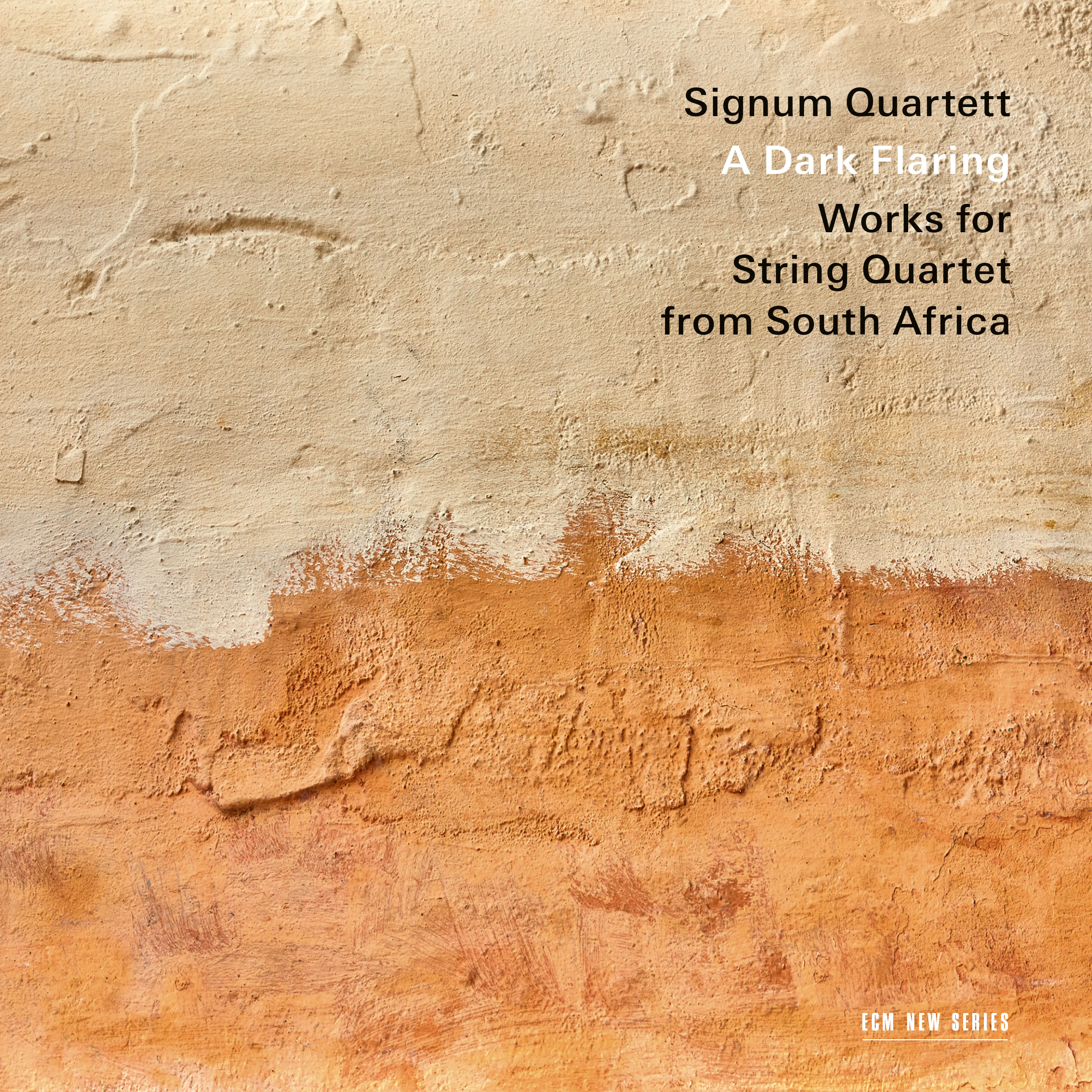
Signum Quartett
A Dark Flaring
Signum Quartett
Florian Donderer violin
Annette Walther violin
Xandi van Dijk viola
Thomas Schmitz violoncello
Recorded March 2022, Sendesaal Bremen
Engineer: Christoph Franke
Design: Sascha Kleis
An ECM Production
Release date: July 18, 2025
A Dark Flaring marks the second ECM New Series appearance of the Signum Quartett, following their renditions of Erkki-Sven Tüür’s chamber music on 2020’s Lost Prayers. With an even more evocative title through which to guide our listening, they present a singular program of selections from South Africa. In her liner notes, journalist and music critic Shirley Apthorp sets the stage for us most vividly:
“In both Xhosa and Zulu tradition, a healthy relationship with your ancestors is a prerequisite for wellbeing in the present; modern psychology is still catching up with much of what older cultures have known for centuries. While it remains a challenge to find a common thread between South Africa’s many and diverse cultures, this awareness could be said to knit together both the rainbow nation’s populace and the works on this recording.”
And in Komeng (2002), by Mokale Koapeng (b. 1963), we begin to understand just how wide the gap between mind and body can be. The piece takes its inspiration from “Umyeyezelo,” a celebratory song by Thembu musician Nofinishi Dywili (1928-2002). Dywili was a master of the uhadi, a single-stringed bow played with a stick akin to the Brazilian berimbau (an effect replicated here con legno). The song’s title means “ululation” and refers to a Xhosa coming-of-age ritual, the circular nature of which is organically expressed in the music’s structure. A play of sunlight on a child’s face, a swaying reed, a tree standing tall on the horizon: images of past and future comingle in the present, rendering such divisions of time meaningful beyond measure (to say they do away with them would be to undermine the music’s committed sense of time). A rocking motion in the cello, fragile pizzicato, and other liminal gestures from the higher strings add vital details.
Next is (rage) rage against the (2018) by Matthijs van Dijk (b. 1983), which begins innocently enough before imploding. It is directly connected to loss (the composer having lost his mother when he was 18) and personal trauma, paying homage to both the Dylan Thomas poem “Do Not Go Gentle Into That Good Night” and the band Rage Against the Machine. Toeing the line between fury and dark resignation, it exploits the limits of the string quartet’s capacity for depth and breadth. Stomping feet add necessary punctuation. The piercing sirens of its final act are thrilling, like a rock song being fed through the meat grinder of Penderecki’s Threnody for the Victims of Hiroshima until the bleeding slows to a trickle. A subliminal drone woven into the ending gives hope of a life beyond the chaos.
From the newest to one of the oldest of the program, we switch to the Five Elegies for String Quartet (1940-41) of Arnold van Wyk (1916-1983), who, in the late 1930s, became the first South African composer to study at the Royal Academy of Music in London. He also knew loss, having suffered the death of his mother and oldest sister by age 17. Despite being his first compositions for string quartet, these elegies immediately evoke Shostakovich in their fiercely shaded lyricism and were among a handful of early works that earned him great renown in his day. The balance of fluidity and razor-sharp insight is immediately apparent in his examination of war. The lively second movement, marked Allegro feroce, grabs the hem of joy but never manages to defrock the dark zeitgeist that flaunts it. The central Adagio is the mournful heart of it all, a forlorn viola solo against a backdrop of aftereffect: bomb smoke, fire ash, and tear stains. Only toward the end does the cello answer the call as if from the grave. And in the final movement, we encounter the most lyrical motifs, which build into a Beethovenian drama before ending in a near whisper.
Péter Louis van Dijk (b. 1953) is the father of Xandi van Dijk, violist of the Signum Quartett. His iinyembezi (2000) draws from John Dowland’s “Flow My Tears” (1596), as indicated by the Xhosa title (meaning “tears”), refracting the theme until it becomes a chain of half-starts and unrequited remorse. At one point, pizzicato playing evokes the mbira (African thumb piano), and the musicians even tap their instruments in kind. Over the course of 16 and a half minutes, it traverses continents’ worth of terrain, giving itself over to jubilation but always falling back into a bed of tentative truth claims. Despite the expressive depth at hand, it draws an ever-tighter circle of influence around itself until, like an ouroboros, it must stop just shy of self-extinction.
Robert Fokkens (b. 1975), who also studied at the Royal Academy of Music and has lived in the UK ever since, gives us Glimpses of a half-forgotten future (2012). An elegy to deaths in his own life, it too evokes the uhadi but bears further imprints of Cage, Feldman, Bach, and the French spectralists. Spaced out in three movements, the second of which leaps as if in an attempt to escape the clutches of grief, it finishes with microtonal contemplation, seemingly at odds with its surroundings.
The finale is an astonishing discovery in the form of the Quartet for Strings (1939) by Priaulx Rainier (1903-1986), another Royal Academy of Music graduate who studied with Nadia Boulanger, among others. Inspired by the music she grew up with in Zululand, she stayed on at the Academy as a professor of composition. Being a relatively early work, the Quartet for Strings eschews some of the technical challenges that would beset much of her later pieces, but it’s no less challenging for its emotional demands. Its opening movement, for one, teeters between lyricism and skepticism—or, if you will, between looking us straight in the eye and askance—while the trembling second movement dances at the edges of a fading memory. The third movement, marked Andante tranquillo, makes artful use of pizzicato cello and moves in flowing chords attached at the hip. Finally, a spirited Presto chews hard until it reaches bone in the viola. Sliding strings share the air with muted harmonics, a textural quality that makes me wonder whether she didn’t make an impression on composers like Boucourechliev later on.
If A Dark Flaring has a soul partner there in the universe, it is the Kronos Quartet’s seminal Pieces of Africa from 1992. If you admire that album as much as I do, then you’ll find plenty to savor in this one as well. Although born of a different stripe and spirit, it holds equally deep roots in its hands and refuses to let go of them from start to finish.
 Between Sound and Space: ECM Records and Beyond