

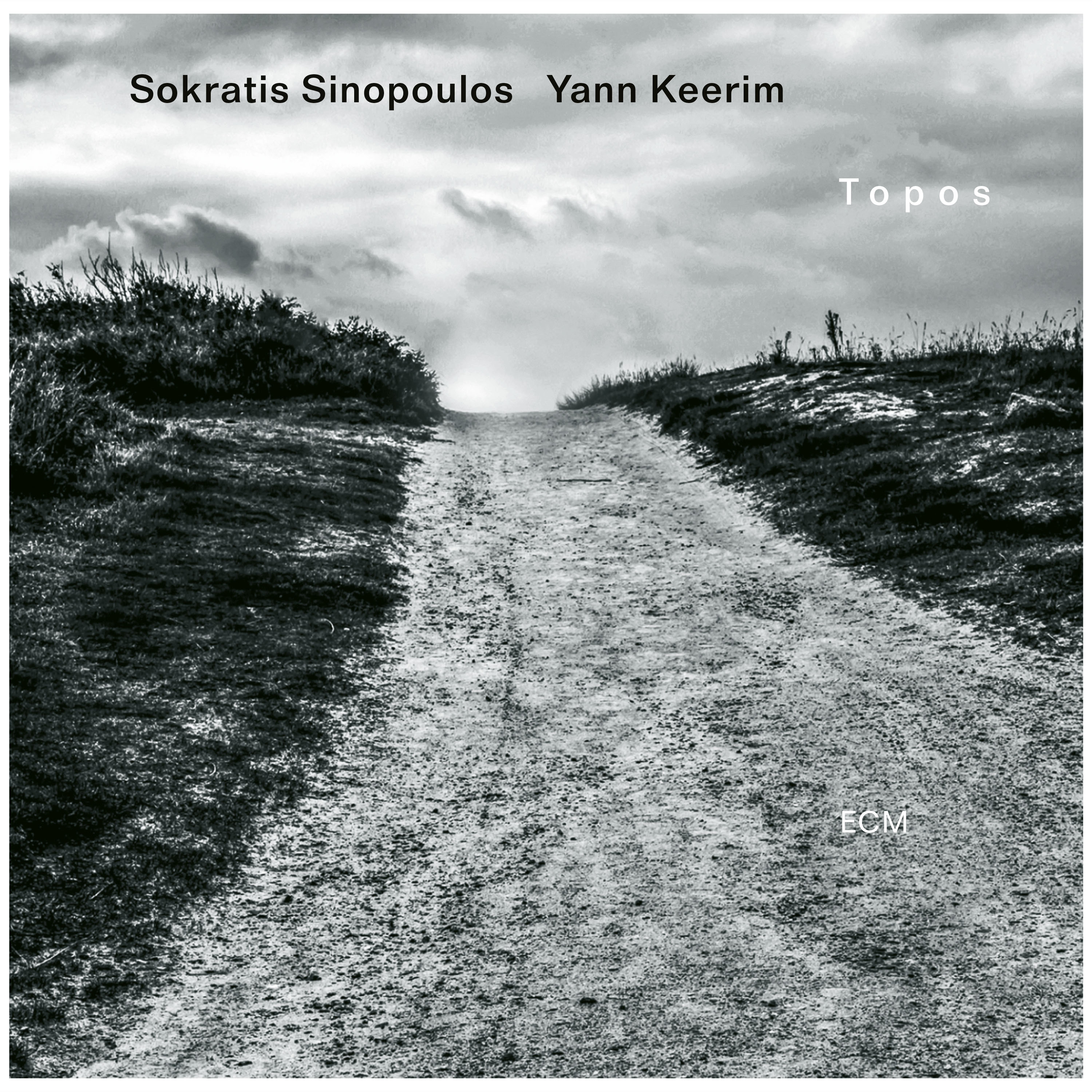
Sokratis Sinopoulos
Yann Keerim
Topos
Sokratis Sinopoulos lyra
Yann Keerim piano
Recorded February 2024
Sierra Studios, Athens
Engineer: Giorgos Kariotis
Cover photo: Jean-Marc Dellac
Produced by Manfred Eicher
Release date: October 17, 2025
There is nothing quite like the sound of the lyra when Sokratis Sinopoulos takes it in hand. The instrument exhales an ancient soul into the modern air, and few musicians draw from its strings such a fusion of myth and immediacy. From his quartet recordings, Eight Winds and Metamodal, this more intimate duo with pianist Yann Keerim distills their chemistry into an even deeper alchemy of tone and silence. Their collaboration of nearly twenty years has ripened into an art of pure intuition, where melody and freedom speak the same language.
At the album’s heart lies Béla Bartók, whose Romanian Folk Dances serve as both axis and atmosphere. Yet it is in “Vlachia,” one of four original pieces inspired by the Hungarian composer, where their vision truly unfolds, as melancholy and art relate like light through water. The piano’s chords rock gently, a cradle of memory, while the lyra hovers between waking and dreaming, resisting the lull of its own tenderness. “Valley,” by contrast, opens like a watercolor, the soul of the landscape awakening at dawn, when even the smallest stones remember their own luminosity. Between the modally inflected interlude “Mountain Path,” with its blues-tinted horizons, and the quietly breathing “Forest Glade,” the musicians walk among elderly oak, beech, and elm, each exhaling the voices of forgotten peoples, their songs hanging in the air.
The Romanian Folk Dances themselves are reimagined here as meditations on time’s elasticity. “In One Spot,” normally brief and fleeting, becomes a slow unfurling, each phrase examined as though through a magnifying glass instead of a telescope. What was once a dance is now an act of remembrance, a transmission through hands, hearts, and breath. Keerim’s improvisations shimmer with restraint, unveiling the dance as a living organism rather than a set of steps. “Sash Dance” begins like a gift being unwrapped, its introduction a flowering reverie, before the familiar theme emerges, tender as an heirloom passed from parent to child. Sinopoulos’s harmonic touch is radiant, his bow tracing lines that dissolve as soon as they are drawn, while Keerim decorates with the grace of rain gathering on the edge of a leaf.
A solo lyra ushers us into “Dance from Bucsum,” its lament carrying the weight of centuries. Gradually, it finds vitality again, as if memory itself were relearning its steps. The piano’s entrance is light breaking through foliage. “Romanian Polka” delights in this interplay, its bowings and pluckings coaxing the piano into a rhythmic embrace. The music feels rooted in the soil, yet perpetually on the verge of flight. “Fast Dance” is not so much quickened as transfigured. What was once earthy now becomes spectral, its pulse sifted through the mesh between moments.
“Stick Dance” closes the circle, beginning in abstraction before broadening into a spacious terrain of inspiration. There is such reverence here that one hesitates to call it an ending at all. In returning to the first of Bartók’s dances, the album folds time in upon itself, reviving what it has just allowed to rest. It becomes not a conclusion, but a threshold, suggesting that each listening might return us to the beginning with altered ears.
As Sinopoulos and Keerim write in the album’s booklet:
“Our Topos is where tradition meets the present, the Balkan Mountains meet urban space, the music of the countryside meets contemporary creation. Our Topos is where we meet and interact, shaping our individual and common identities.”
Indeed, Topos is less a location than a living field, a place where listening itself becomes part of the composition. Between the lines of melody and silence, we, too, are invited to breathe, to dwell, to remember. And as the final tone recedes, one wonders whether the music has ended at all or merely crossed into another realm, where echoes continue to shape the clouds, unseen but never lost.

 Between Sound and Space: ECM Records and Beyond