Caminante, no hay puentes, se hace puentes al andar.
–Gloria Anzaldúa
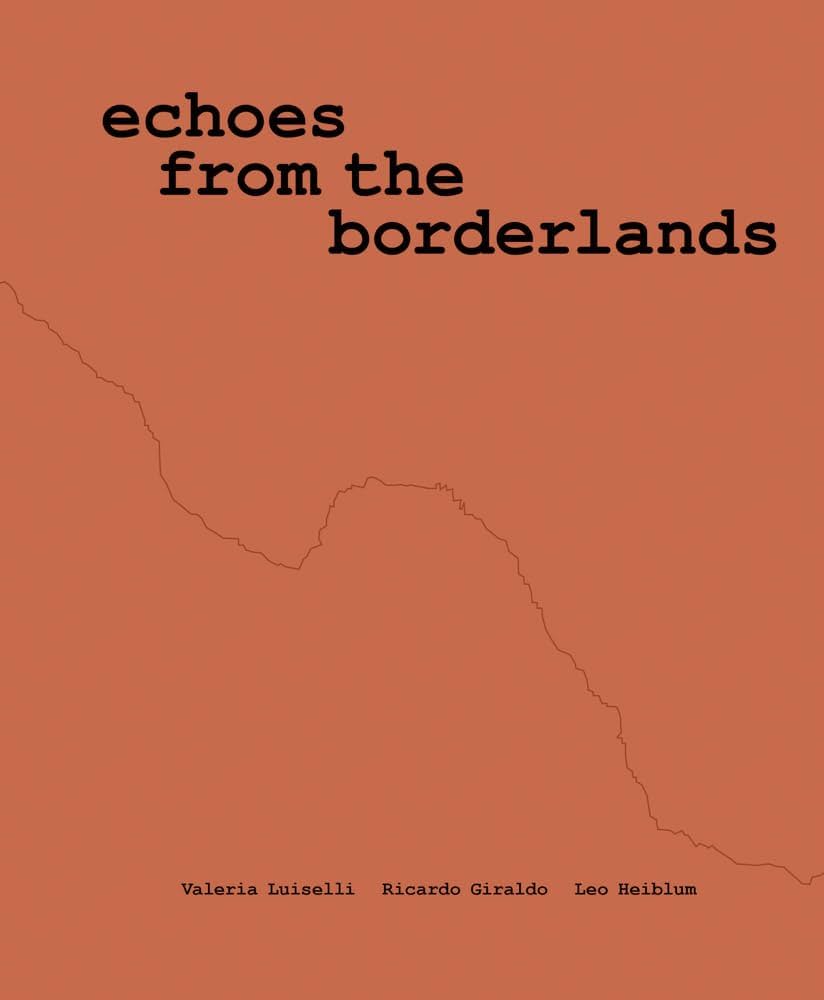
Echoes from the Borderlands is a collective comprised of Valeria Luiselli, Ricardo Giraldo, and Leo Heiblum. It also names the 24-hour sound piece that explores and gives voice to areas of interstate violence along the U.S.-Mexico border. At the core of this sonic experience is a living canvas of sorts, a vibrational palimpsest built from binaural and quadraphonic recordings. Into this are woven archival recordings and other voices, authored by Luiselli, which move through the piece as necessary witness and disturbance. The result is a constellation of counternarratives to the official stories that pervade our newscycle, allowing Indigenous, brown, and black perspectives to keep pace with the conventional histories that ignore or kill them. The land itself serves neither as an abstraction nor as a mere foil for sociopolitical musings. It is a witness whose testimony has been buried under weary curricula and the administrative trance of empire. In this way, the project upsets the schema that dominates our lives in standard parochial models, not by refuting them point by point, but by placing beside them a deeper grammar of residue and return.
The present chapbook is the first study in this hallway, a narrow, illuminated passage that provides insight into the project’s core values and perspectives. Subtitled “Call You When I Get Home,” it exceeds the categories of reading and auditory experience, even as readers can scan a QR code to access its accompanying audio file. It is interactive in the most imperative sense. The pages are divided into three columns of text: the left representing the voices of imagined personas, which the reader is encouraged to read aloud during the allotted timestamps; the right containing interviews and archival materials; the middle holding field recordings taken during the authors’ travels across California, Arizona, New Mexico, and Texas. Over the course of 71 minutes, the reader becomes an implicative subject who must regard their own life experiences and histories as braided into those of maiming and erasure. To listen is to enter a chamber in which history does not sit behind glass but presses its mouth to the present tense.
The sounds open with a clear recording of humpback whales off the Pacific Coast, bringing us into dialogue with nature, a realm in which the cares of human self-interest have no throne. Yet this solace is short-lived because the first voice we hear questions why, in creation myths, the earth and sky are always “cloven asunder.” Must everything be broken to be told? Then again, such is the nature of trauma: we must be fragmented before we can be made whole. And our tormenters know and exploit this intimately. Stories get stolen, butchered, and consumed until they turn into the feces of time, buried along with the rest of our detritus in the middens of the forgotten. In this opening movement, the piece establishes one of its fiercest claims: that creation and destruction have too often been forced into the same orality, and that origin stories carry their own hidden instruments of cutting. Every atom is narrated by those who learn to split it.
The border, then, is the “margin of a page,” a place where the real commentary begins and where the thoughts we hold dear can manifest beyond what is published, printed, and codified. One voice, for example, tells us about the many iterations of the border wall since President Truman erected the first in 1945, just after World War II. Not coincidentally, those initial chain-link fences were dug from the very desert where Japanese Americans were interned before being trucked to the border. “Each president,” we are reminded, “has since potlucked his bit of iron, steel, cement, mesh, and wire.” Despite what legacy media would have us believe, no one in recent history is guiltless of this charge. Everyone has that dust and ballast on their hands. In light of this, the border does not emerge here as a fixed line but as an accumulating technology of dread, a ceremonial scar renewed by the ritual polishing of fear on a national level. Its materials migrate across history with obscene efficiency. What once enclosed the demonized now repels the displaced. The same metal keeps changing uniforms.
Many of the archival voices concern how true love gets trampled by systemic pressures of citizenship, feeling lost and found by the enemy. We hear the sounds of people crossing the border, their bodies reduced to mechanical baggage that reflects time in constant reversal. Desire itself is subject to inspection, while kinship must answer to paperwork. The body, in transit, is converted into a problem of storage, the metaphysical insult of being processed by a system that cannot recognize the sacred velocity of arrival.
An unheard story then emerges: voices of detention center inhabitants whose lives have been confined to shells of their former selves. Children are taken from their parents and kept “in their place.” Woven into their testimony are histories of early-20th-century racial eugenics in the U.S., which, let it not be forgotten, would become the model for Nazi Germany. The haunting audio of a promo film about the lushness of revitalized land, using water to bring newness to the desert, arrives at the expense of forced sterilization. Both involve the severing of channels. The parallel is vastly intentional, the female reproductive cycle and anatomy mapped not over but under the land, out of sight and out of mind, so that the infrastructural powers that be need not acknowledge the effects of their own actions. The fantasy of improvement conceals a theater of extraction. The project asks us to hear irrigation as incision, settlement as anesthesia, and fertility as a field administered by those who confuse conquest with care. But the land cannot be settled, for it is constantly in motion. Those who kill try to force the illusion of its stillness, yet entropy always wins. The only certainty is possibility.
“And which story do you believe in?” we are asked. Only then do we realize the luxury of not answering, of turning both the physical and metaphorical page, tuning the radar dishes of our ears to off-planet signals while terrestrial cries go unheard. Speech acts are life acts, birthing newness and assertion that someone was here. They are the vibrational footprints most easily ignored. Yet they can also be recovered and repurposed. What is the point of fear when it is manufactured as a drug to be taken by mouth? The question hangs in the auditory field with almost pharmacological force. Fear circulates through public life as the prescription of a patriotic supplement, whereupon it is metabolized and mistaken for instinct. Against this, Echoes from the Borderlands offers listening as detoxification, not in the shallow language of purity, but as an intellectual and bodily refusal to let terror do all the thinking.
Still, all of this casts doubt on our ability to know what has been shielded from us, for how can we begin to document what is no longer there? And yet, perhaps there is no need to document in the ordinary sense but rather to make space for the old and forgotten paths. Just because one gentrifies the land does not mean the veins running beneath it are bloodless. The heart of the earth is still beating. Knowledge does not exist to be extracted but to be lived and passed on to those with private power, those who inherit not domination but obligation. Therefore, the proverbial question is not whether a tree that falls alone in a forest makes a sound, but whether the death cry of the one falling at the hands of its destroyer is ever acknowledged. We are returned to this ethical threshold time and again, reminded that sound is never merely sound. It is a demand placed upon the living by that which has been made absent, if only by being declared administratively unreal.
And the more we learn of the history of pleasure, and how women’s access to it continues to be medically inhibited, the less room remains for any excuse. The ores of the world are the building blocks of their oppression; that is what we so often forget. Without the materiality of that harm, there might not be so much destruction. From the copper mines that find their way into IUDs to the sand and rock that hide the bodies of victims, they are the disease and the artificial cure, the problem, reaction, and solution, all rolled into one. Because the more you dig into the earth, the more of an excuse you have to kill for what you find. Extraction becomes a philosophy before it becomes an industry. It trains the eye to regard depth as inventory. In the chapbook’s most unsettling passages, body and sediment are coextensive archives of intrusion. What is done to one is rehearsed upon the other, and the wound learns to speak in minerality.
By the time we encounter the long, wordless passage of a Union Pacific train at the 49’40” mark, we must face our own complicities in the contents of its cargo. Where are all of those materials going? Whose financial and political interests will they serve? By the time we wonder, it is already too late, for the objects of our scrutiny are already on their way to destinations we can only imagine. Not the trainyards and depots written on delivery logs, but the bodies in which they will eventually find a host to parasitically take over slowly, year after year, until their role in the deaths of the Other is obscured beyond recognition. The sound of a military plane flying overhead, too, reminds us that the long arm of surveillance reaches into homes and orifices while we sleep. Because no one can hear you from that high up. Aerial power converts people into smudges of movement beneath an indifferent machine sky. It is the same script of altitude as moral evasion.
One might feel inclined to pore through these recollections in search of secrets that may enlighten us about their hidden meanings, but such an approach amounts to an uncut key at best. In this case, we do better to see the act of recording as a living practice, a ritual of attendance in which capture does not mean possession. And while it is tempting to read Echoes from the Borderlands as an index of disorientation or a manual for wandering through the ruins of state-sponsored sense, we must see in its rhythms and framings an affirmative orientation, not so much an act of alienation as an alienation of action. The project estranges the habits that render violence ordinary. It asks the listener to inhabit the interval before conclusion, the charged hollow between hearing and response, where responsibility first begins to condense.
“The ear,” wrote Pauline Oliveros, “is a faithful collector of all sounds that can be gathered within its limits of frequency and amplitude. Sounds beyond the limits of the ear may be gathered by other sensory systems of the body.” Might we, then, read the microphone as an ear of expanded intimacy or even radical hospitality that gathers what the sanctioned ear has been trained to discard in anticipation of the real? Then again, the English word anticipate has its roots in the Latin ante and capere, giving us a portmanteau that means “before taking.” A painful reminder that we arrive after the seizure and before the reckoning, in that spectral jurisdiction where every footstep is both evidence and plea.
The timely charge of Echoes from the Borderlands lies in its refusal to convert suffering into a discernible shape. It does not “cleanse” the archive or turn the border into a metaphor tidy enough to be carried away unharmed. Instead, it leaves us with the difficult splendor of relation: the knowledge that every silence contains a confiscated name. To listen here is to accept that the connection from soul to soul is not waiting somewhere ahead, already engineered by grace, but must be made through the unbearable patience of continuing.
Voyager, there are no bridges, one builds them as one walks.