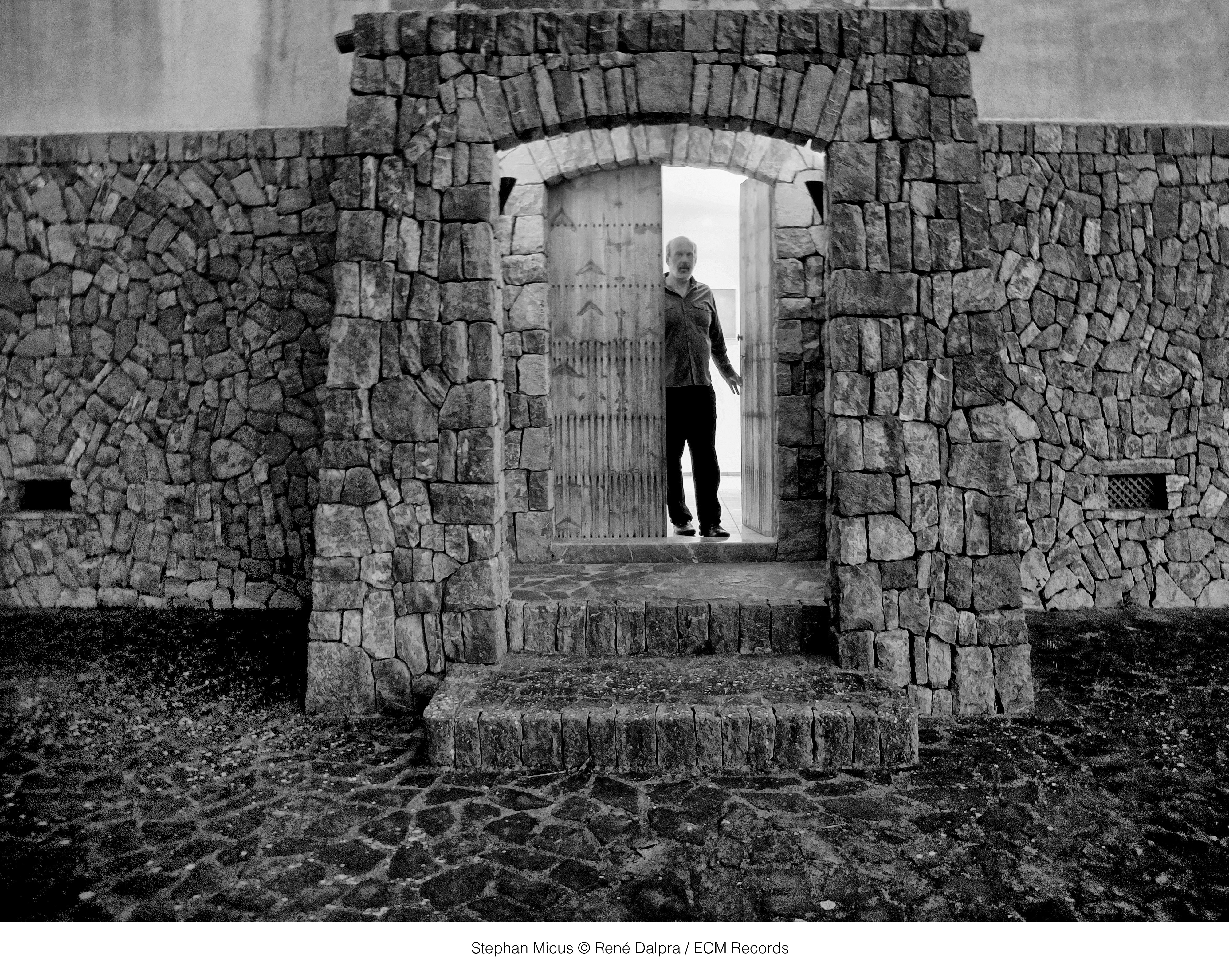
Stephan Micus: To The Rising Moon (ECM 2834)

Stephan Micus
To The Rising Moon

Stephan Micus tiple, dilruba, sattar, chord zither, tableharp, nay, sapeh
All music and voices composed and performed by Stephan Micus
Recorded 2021-2023 at MCM Studios
Cover art: Eduard Micus (1925-2000)
An ECM Production
Release date: November 15, 2024

my house burned down
now I have a better view
of the rising moon
–Masahide Mizuta (1657-1723)

To step into a new Stephan Micus recording is to approach a koan from the inside out. For while every world he creates feels immediately familiar, there’s also something about it that distances us from ourselves. In To The Rising Moon, his 26th solo album for ECM, he unravels an out-of-body experience through characteristically novel combinations, transcending cultural and historical borders in search of a collective humanity.

His narratives always seem to have a central protagonist; this time, it is the tiple. Sounding like a charango but with a looser feel, it is the national instrument of Colombia, but in the present context, it steps out of space and time into its own. “To The Rising Sun” features two of them: one to establish a percussive jangle, the other to sing through its contours. Building a monument one stone at a time, even as Micus scales it, he comes prepared with the finishing capstone, so that we can fully admire the valley of which it affords a sacred view. This format is later replicated in “Unexpected Joy,” which has all the internal tension of a young warrior walking through the forest on his first solo hunt, and in “To The Lilies In The Fields,” where gemstones rounded by the river’s current are ignored in favor of the greater value of leaving them as they are. “In Your Eyes” increases the count to three and adds a lone voice. Its juxtaposition of steel strings and Micus’s rounded singing gives us room to explore. At the heart of all this is “The Silver Fan,” a tiple solo through which light and shadow merge with a kiss.

On the topic of voices, another prominent one is the dilruba, an Indian bowed instrument with sympathetic strings. Six of these band together for “Dream Within Dream,” painting a realm where the physical world recedes into the farthest corners of consciousness. The sound is thin and incisive. Like wisdom offered by a sage on his deathbed, its truth can never be forgotten. The dilruba finds a long-lost brother in “Embracing Mysteries,” where the sapeh, a four-stringed lute from Borneo (normally plucked but modified to be played with a bow), evokes nature and nurture in equal measure. Meanwhile, Micus’s voice cuts the figure of a traveler with a rucksack filled with hymns, which he drops in place of crumbs.

Yet another member of this ad hoc family is the sattar, a long-necked bowed instrument of the Uigur people. In triplicate, it elicits one of Micus’s most spiritual creations: “The Veil.” He runs his hands gently across, feeling every pleat and fold as if it were an era of history to be navigated. In that sense, there is also mourning for the past and a hope that all the destruction we’ve brought has not ultimately been in vain. Despite taking part in the album’s largest ensemble in “Waiting For The Nightingale” (which brings together two dilruba with five sattar, five voices, three Cambodian flutes, and two chord zithers), the result feels open, a spider’s web touched with dew that has withstood an entire day’s worth of climatic change. Micus’s chorusing is a call to the wilderness within. The sattar also binds three tableharps (which combine elements of bowed psaltery, zither, and harp) in “The Flame,” leaving blurred traces of its past like paintings on stone. Finally, in the title track (alongside two tiples and two nay), it is a birthing ground of fluidity and purpose. Having nowhere else to go but inward, it bows its head in offering to silence, a prayer without words to get in the way of meaning.
Stephan Micus: Thunder (ECM 2757)

Stephan Micus
Thunder

Stephan Micus frame drum, storm drum, dung chen, Burmese temple bells, Himalayan horse bells, ki un ki, bass zither, bowed dinding, kyeezee, shakuhachi, sarangi, nyckelharpa, kaukas, sapeh, voice, nohkan
Recorded 2020-2022 at MCM Studios
Cover art: Eduard Micus (1925-2000)
An ECM Production
Release date: January 20, 2023

Multi-instrumentalist Stephan Micus goes bigger than he ever has before on Thunder, his 25th solo album for ECM. Inspired by the dung chen, a four-meter-long trumpet heard booming from monasteries during his travels to Tibet, he long dreamed of incorporating it into a series of compositions. After immersing himself in its depths (only in Kathmandu did he find someone willing to teach him how to play this instrument normally reserved for monks), he settled on the ki un ki (a cane stalk common among the Udegey people of Siberia played by inhaling) and the nohkan (a transverse bamboo flute from the Japanese Noh theatre). From this trinity arose a series of nine compositions, each dedicated to a different god of thunder from different world traditions.

Despite the album’s concept, however, and the decidedly spiritual overtones, there is something undeniably elemental about the music itself. For while there are certainly far-reaching moments of great drama and development, others are intimate spirals of reflection that are just as content in staying where they are. Of the former persuasion are pieces like “A Song For Thor,” “A Song For Vajrapani,” and “A Song For Perun.” All three make use of dung chen, frame drums, Burmese temple bells, Himalayan horse bells, bass zither, and either the ki un ki or nohkan. The drums are the heartfelt griots of this primal tale, evoking the sound of footsteps on dirt and stone. The ki un ki moves with an eagle’s precision, so determined that every clod seems to get out of its way as it barrels through with a human soul firmly in its sights. As it traverses the landscape, passing through every dead object as if it were made of air, it finds its way to life itself. Through this transformation, it lingers on the edge of speech. Meanwhile, the dung chen move like elephants across the plains, each carrying a virtue known only by its ancestors.

So much of what we encounter here, however, is as reflective as a pond in moonlight. For example, “A Song For Raijin” and “A Song For Leigong” feature the storm drum, which, despite its name, betrays only the slightest hint of a climatic disturbance on the horizon. Both tracks also feature bowed sinding (a West African harp), kyeezee (bronze chimes from the Buddhist temples of Burma), and shakuhachi. With so much tenderness between them, each wrapped in the arms of a subcutaneous drone, the Japanese bamboo flute can only plant its prayers in whispers. It is a frail warrior that would be torn in the next violent rainfall, the possibility of which haunts every dream.

Of those dreams, we get two glimpses through the lenses of “A Song For Armazi” and “A Song For Zeus.” These share the same scoring (3 sarangi, 2 bass zithers, and nyckelharpa), opening spaces of translucent incantation. Speaking of which, Micus’s voice enters magnified in “A Song For Shango” and “A Song For Ishkur.” Accompanied by the sapeh (a lute from Borneo) and kaukas (a five-string lyre of the San people in Southern Africa), he traces the aftermath of nature’s fury. We can feel the humidity in the air, the sweet musk of precipitation in the nostrils, and the tang of love on the tongue. The sapeh shimmers, while the singing rolls across the mountains, flattening everything it touches with quiet power—not a ritual but a revelation that manifests itself as a footnote on the page of time.

Stephan Micus: Winter’s End (ECM 2698)

Stephan Micus
Winter’s End

Stephan Micus chikulo, nohkan, 12-string guitar, tongue drums, voice, kalimba, sinding, charango, nay, sattar, Tibetan cymbals, suling
Recorded 2018-2020 at MCM Studios
Cover art: Eduard Micus (1925-2000)
An ECM Production
Release date: June 11, 2021

although there is the road
the child walks
in the snow

–Murakami Kijo (1865-1938)

Tempting as it is to characterize the music of Stephan Micus as the soundtrack of a solitary traveler, given the staggering amount of instruments he uses to articulate those songs, one can hardly say he is alone. With so much companionship through his interaction with, study of, and reactions to humanity’s need for music, his albums are consistently open-ended, each inhaling in anticipation of the next’s exhalation. Every project, too, has its focal instrument, and in this case, it is the chikulo, a bass xylophone from Mozambique with a distinct buzzing quality (though for many tracks, Micus removes the plastic membrane responsible for that quality). It is heard most distinctly in the “Autumn Hymn,” which convenes three of those instruments with the nohkan, a Japanese bamboo flute used in Noh theatre. Though often used for its dissonant effects (which add to the drama of Noh’s out-of-time sensibilities), here it is as clear as a mountain stream, quietly wandering its way through barren trees in search of nothing but its fulfillment of a natural order. In “The Longing Of The Migrant Birds” (3 tongue drums, 2 chikulo, 14 voices), the buzzing is left aside for percussive melodies to clear a path for tongue drums (wooden boxes with “tongues” of various sizes cut into the top surface) and a chorus of magnified voices, cradling sacred things to leave a profane world behind. This same combination is called upon in the less nomadic “Sun Dance.” In “Baobab Dance,” a single chikulo holds counsel with 4 kalimba and one sinding, a West African harp fitted with five cotton strings. In the absence of fleshly voices, fashioned ones are bid to share their narratives of experience. “Black Mother” also uses one chikulo as its anchor, while sinding arpeggios and 11 voices carve their glyphs into the tablet of their becoming. The ultimate dive into this instrument’s heart, however, is “Oh Chikulo,” in which a quartet of these wooden wonders opens a drum-like heart.

Sprinkled throughout these scenes are interludes that bend the light more intimately. The harmonics of “Walking In Snow” (12-string guitar solo) dance off Micus’s fingertips like clumps of snow shaken from heavy boughs. Micus detunes and alters his instrument so that it jangles with glorious details, turning what might normally be seen as a travelogue into something far more profound: an elegy. Paying homage not to lives that have come and gone but to those who never get the chance to materialize, it offers those unrequited journeys a place for souls to converse, play, and love. Its companion piece, “Walking In Sand,” is the hymnal counterpart.

In “Southern Stars,” four charangos (small guitars of the Andes) convene with five suling (recorder-like flutes associated with Balinese gamelan orchestras), one sinding, and two nay (Egyptian hollow reed flutes). Shades of these cultures mingle without conflict, birthing new associations of light to dispel the dark arts of reductionism. This is where the most light can be found—not in terms of brightness but of distance and symbolic charge. Here are the album’s most ancient sounds brought forth as if they never died.

“A New Light” is a standout in the sequence, not only for its instrumentation (using three sattar, long-necked bowed instrument played by the Uighurs of Western China) but also for its subliminal potency. Another is “Companions” for two charangos, whose resonant strings indeed feel like hands joined in friendship to weather the implications of faraway storms. “Winter Hymn” adds to the opening combination, the nohkan and buzzing chikulo now tempered by Tibetan cymbals, whose voices articulate what we, perhaps, have all been feeling this past year: fatigued and in need of a loving embrace.

Migration is the language of life, but all too often borders get in the way of our understanding of it. Here we can rest in the full knowledge that beauty is not a choice but a given.

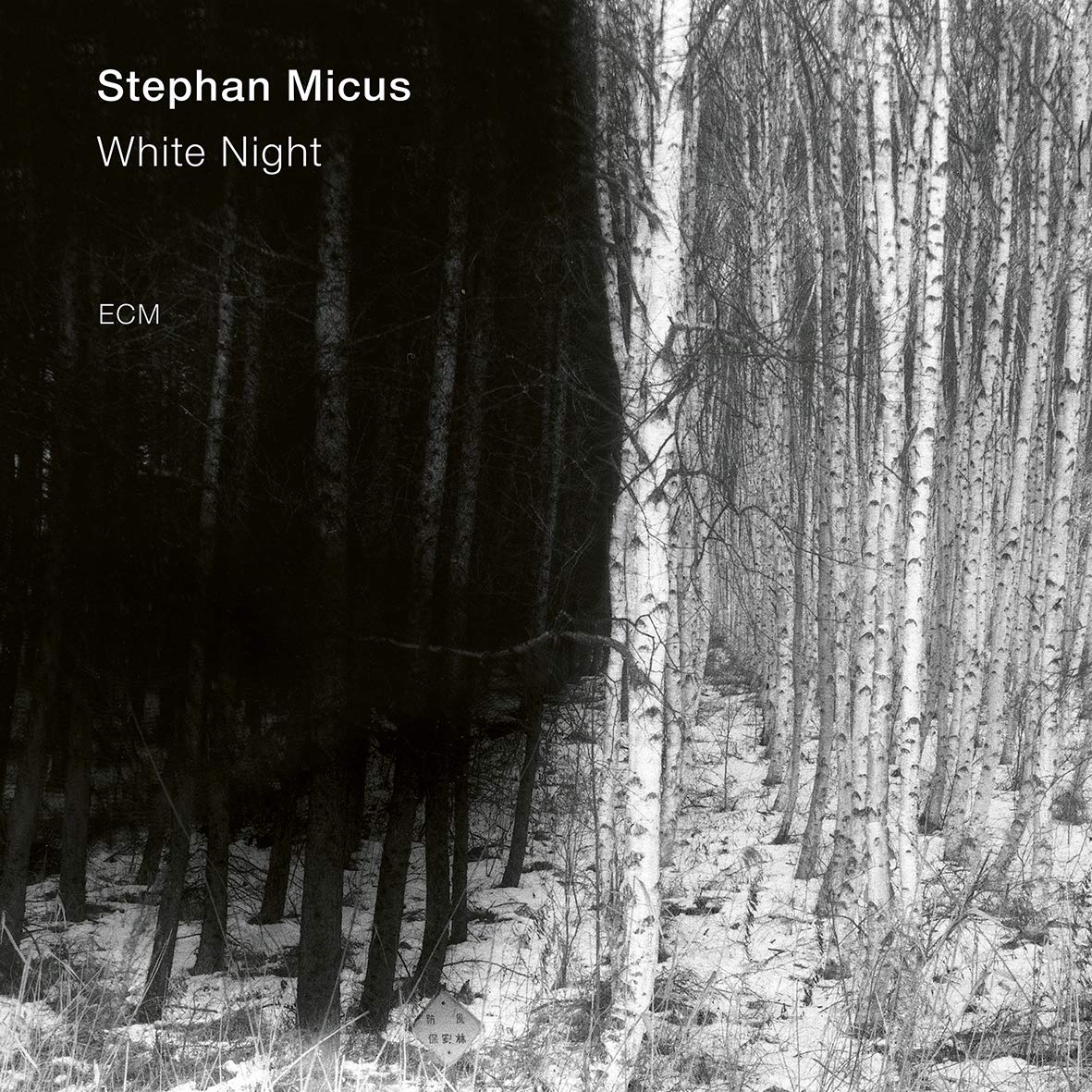
Stephan Micus: White Night (ECM 2639)

White Night

Stephan Micus
White Night

Stephan Micus guitars, duduk and bass duduk, cymbals, kalimba, sinding, dondon, voice, cane whistles, nay
Recorded 2016-2018 at MCM Studios
An ECM Production
Release date: April 26, 2019

Though the purity of the moonlight has silenced both nightingale and cricket,
the cuckoo alone sings all the white night.
–Anonymous, Japanese

White Night is Stephan Micus’s 23rd solo album for ECM and might just be his most inwardly focused. Figuring centrally in this sojourn is the kalimba, which through various incarnations hosts us at six of the ten waystations marking our path.

The bronze kalimba—a modern version of this ancient instrument—makes magical appearances in “The Forest” and “The Bridge.” Both tracks feature purely phonic vocalizations. The latter song multiplies the kalimba by four and adds the sinding, a West African harp with cotton strings that resonate through a gourd. As one of his most evocative pieces to date, it seeks meaning in selfless regard. Other vital stars in this constellation include “The Poet” (kalimba, sinding, voice), in which the voice primes soil for harvest; “The River” (2 kalimba, duduk), which elicits gamelan-like textures and suspends the duduk in gentle persuasions of moonlight; and “Fireflies” (kalimba, sinding, 13 Indian cane whistles, 7 voices), which renders the earth an altar for vocal offerings. And then there is the kalimba solo “All The Way,” touched by the souls of a faraway people. Each is a journey within a journey, a story within a story, a prayer within a prayer.

Framing the album are “The Eastern Gate” (5 fourteen-string guitars, bass duduk, Tibetan cymbals, steel-string guitar) and “The Western Gate” (5 fourteen-string guitars, bass duduk, sinding, Tibetan cymbals). Their fourteen-string guitars have a slack, liquid quality, which by virtue of their human construction (they are designed by Micus) reveal more-than-human energies. Harmonics speak of realms beyond the senses, while the bass duduk tenders its grace. From one gate to the other, we embrace the world in the span of 50 minutes, starting the cycle anew. Along the way, we stop to view “The Moon,” wherein a role that might normally have been filled by lone shakuhachi finds a multivalent replacement in the double-reed duduk. Like the nay that appears alongside the Ghanaian dondon (or talking drum) in “Black Hill,” it is a thought made incarnate by contact of skin and breath.

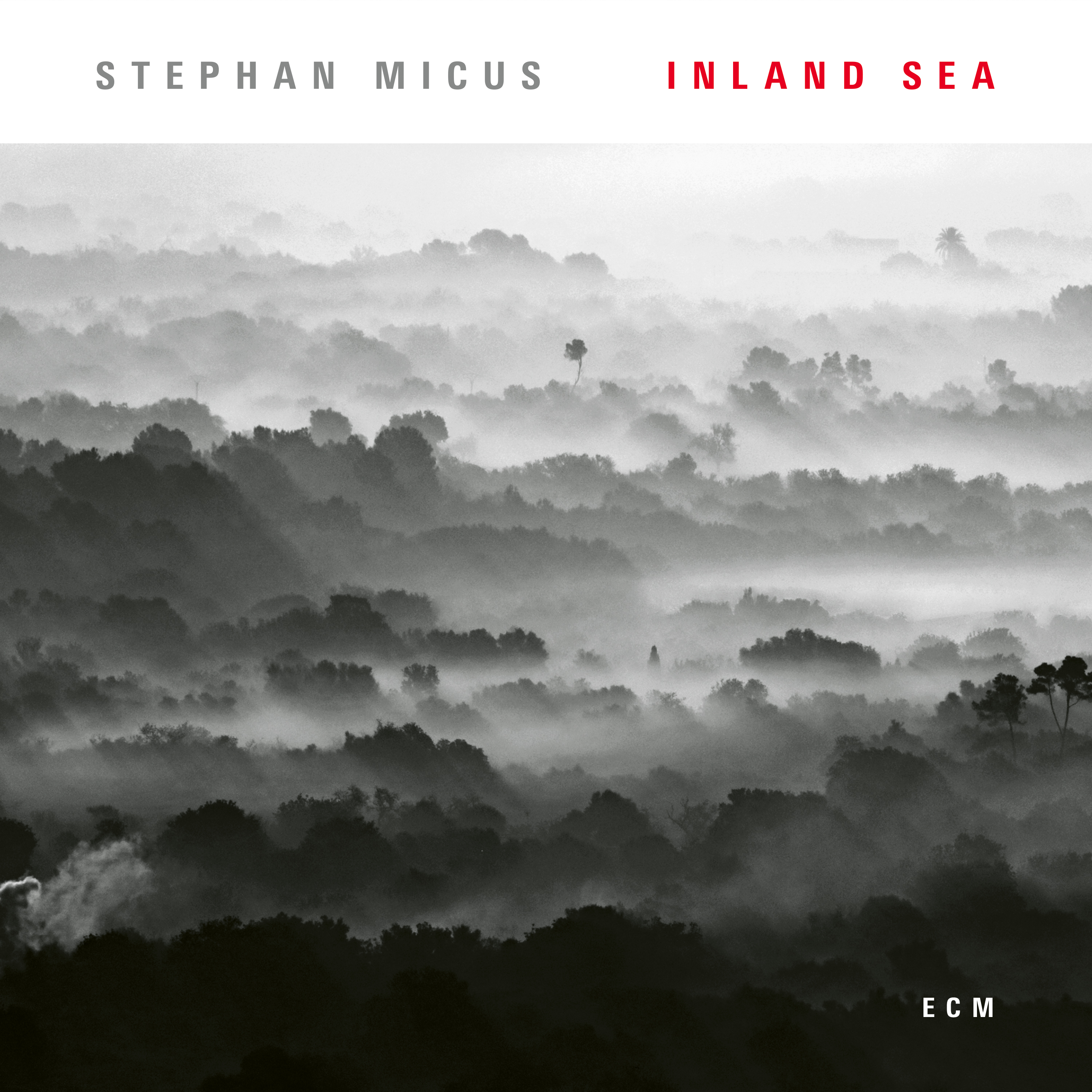
Stephan Micus: Inland Sea (ECM 2569)

2569 X

Stephan Micus
Inland Sea

Stephan Micus balanzikom, nyckelharpa, chord and bass zithers, shakuhachi, voice, steel-string guitar, genbri
Recorded 2014-16 at MCM Studios
An ECM Production
Release date: June 16, 2017

When talking about differences between cultures, it’s tempting to uphold products such as food, art, and music as foci of distinction. On the latter point, Stephan Micus has dedicated his life to that without which music would not exist: the instruments themselves. From the staggering amount in his repertoire, he draws stories that could never have been written by any other means. Take the duo, for example, which makes its first appearance in his milieu via the opening “Haze.” The balanzikom, an obscure seven-stringed lute from Tajikstan, feels so much like the mountains and open plains of its origins that it could never have come from anywhere else. The very land is its womb, as also of the wordless gestures projecting life into being. The nyckelharpa, a Swedish bowed instrument keyed like a hurdy gurdy, is as crisp as the climate of which it was born, accordingly grounded. Micus listens to these instruments much more than he plays them, and through his performances allows them to learn new languages by the same tongue and teeth. As the only one-on-one conversation between them, “Haze” sets a precedent of civil and spiritual exchange for all to follow. The nyckelharpa, for its part, glows in triplicate in “Dawn” and “Dusk.” Their combined song is more than diurnal; it’s life and death.

Likewise, the shakuhachi is more than a conduit for breath. For while Micus has rewritten its futures many times over, its ancestral home is unalterable. In “Sowing Wind,” he matches this Japanese bamboo flute with the chord zither, a 68-string instrument of his own design. The arc thereof is a primordial one, along which feelings of mutual regard flow as if they were a mythology to which we’ve blinded ourselves. This relationship deepens in “Reaping Storm,” switching chord zither for its bass counterpart. Now the mood is fragile and of a different season, fragrant of a world humbled by nature.

The balanzikom delineates further circles for Micus’s singing in “Flor del Sur.” Radiating along cardinal axes as if to hold continents in its embrace, the solo voice welcomes five percussive nyckelharpa, chord zither, and shakuhachi in “Nuria,” and among that assembly enacts a tale of disparate peoples brought together by tragedy. For “Virgen de la Mar,” Micus choruses his voice fifteen times over, and to it adds three genbri, a three-stringed bass instrument from Morocco. Treading the same soil packed by the feet of “Dancing Clouds” (plucked nyckelharpa, 6 percussive nyckelharpa, 3 bowed nyckelharpa, steel string guitar, genbri, bass zither) and laid to rest by “For Shirin and Khosru” (2 bass zithers, 2 nyckelharpa, 3 steel string guitars, genbri), it treats melodic resolution as the caress of a loving parent who dispels fears of darkness. Thus we are protected, hoped for, and fortified to face new days, bringing our own children to the well of mortality, that they might also see the reflections of all who came before them.

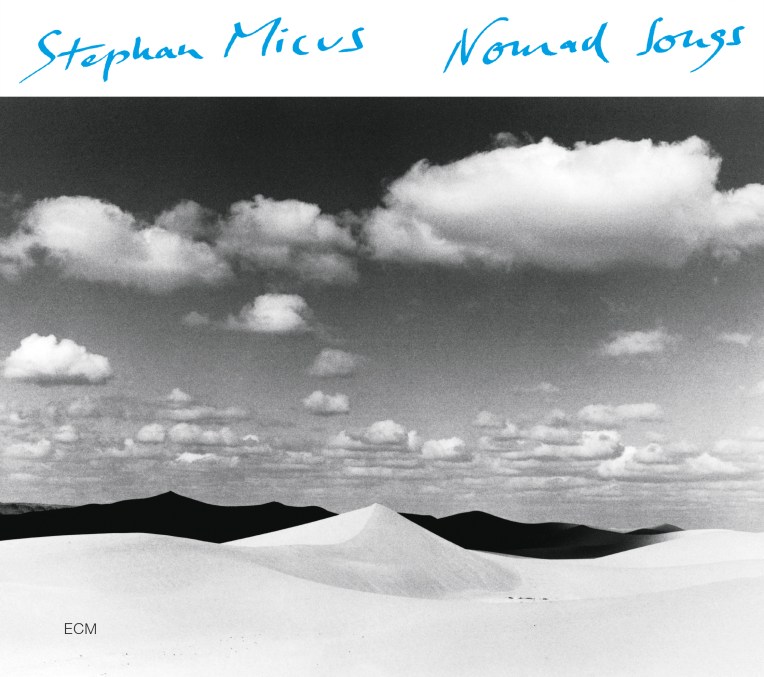
Stephan Micus: Nomad Songs (ECM 2409)

2409 X

Stephan Micus
Nomad Songs

Stephan Micus ndingo, genbri, steel-string guitar, suling, voice, nay, rewab, rabab, twelve-string guitar, fourteen-string guitar, tin whistle, shakuhachi
Recorded 2012-2014 at MCM Studios
An ECM Production
U.S. release date: August 7, 2015

Pundits often speak of “going green” as if all it involved were more considerate allocation of resources and regulation of harmful industry. Yet with this comes the responsibility of creating more resources in turn and balancing injury with abundance. Greenness entails awareness of Earth in all its forms, physical and metaphysical alike. The music of Stephan Micus engages both persuasions, enriching the inner lives of those fortunate enough to hear it while encouraging a harmonious and, above all, creative relationship with the environment. A consummate traveler and student of traditional instruments from nearly every continent, Micus has drawn inspiration from a staggering variety of locations, but that makes him no mere collector checking off items on some cultural itinerary. Instead, he modifies these instruments to suit his needs and manifests his connections to them through truly original compositions, all while replenishing what the world has gifted him, and then some.

Micus has had a long association with ECM Records, known for its rigorous production standards (typically recording, mixing, and finalizing an album in three days) but which has come to give the German multi-instrumentalist free reign to record in his home studio and send in the master(ful) tapes for postproduction. Despite being his 21st album for the label, Nomad Songs is no less thoughtful than the 20 previous. If anything, it’s a return to the most essential forces of his physics: push and pull. This is not to imply conflict but balance in the music, whereby seemingly contradictory actions flow into one another in the manner of the tide, expanding and recessing to the beat of an invisible drum. Which is perhaps why Micus plays, for the first time on record, the genbri, a bass lute used by Gnawa of Morocco as an instrument of healing and, in his hands, a percussive force throughout these sequences. Also new is the ndingo, a kalimba-like instrument favored by the San, an indigenous people of Botswana stripped of their nomadism by African nation states. The album’s title thus has dual meaning, tracing Micus’s own itineracy and honoring those deprived of it.

“Everywhere, Nowhere” opens the 11-part odyssey with a duet between the two newcomers. The resonant buzz of the ndingo, enhanced by means of a wooden sounding box, is as organic as a human-made instrument can be. Like the throat of one who has sung for eons, it reveals lifetimes of knowledge with every utterance. The genbri, in the enlarged form heard here, could almost be mistaken for an upright bass and as such takes Micus in lucid directions, unveiling a little of the mystery of his expressions. Only one other piece, “The Spring,” features this same combination of roots and leaves. Like a row of people walking hand in hand through the night, it sneaks away into the hope of a future without hierarchy.

Such respect has always been at the core of the Micus soundscape: his music may be openly visual but is temporal at heart, compressing and decompressing long stretches of time as if they were matter to be molded. A kindred message prevails in the album’s two solitary pieces. “The Blessing” is a vocal solo that meshes Micus’s spontaneous language with wayfaring melody, yet it is the 12-string guitar of “The Stars” that acts the part of storyteller. Brief, delicate, and ending in sparkling harmonics, it is a meteor shower reduced, as the sky would have it, to a play of light against the yawn of night.

Whether pairing steel-string guitar and the Balinese recorder known as a suling (“Leila”), or two Irish tin whistles, played simultaneously (“Sea Of Grass”), the duo pieces are less conversational than they are integrational. These, too, glance back to Micus’s earliest work. In characteristic fashion, the more instruments he adds, the more uniform his sound becomes. The gamelan qualities of the three ndingo in “Under The Chinar Trees” mesh exceptionally well with shakuhachi and voice, making for one of the most beautiful experiences he has ever committed to record, while appearances by the Egyptian nay (“The Feast” and “The Promise”) and a 14-string guitar of Micus’s own design add fire and water in equal measure. The rewab (long-necked lute of the Uyghur people of Western China) and rabab (Afghan lute) expand the plectrum-heavy palette, culminating with guitars in “The Dance,” in which the rabab’s shamisen qualities pave an alluring detour.

Not only is this some of Micus’s finest work; it is also the most enchantingly recorded and mastered. Listening to it, one can hardly be surprised that his last name is an anagram of “music,” because everything he touches turns into nothing less. His gestures open arteries by linking them to a universal blood flow, in which the aneurisms of supernovas and the embryos of planets weave a path that he treads, for all a sage, crushing nothing beneath his feet except denial of eternity.

(See this article as it originally appeared in RootsWorld online magazine, from which you may also link to a sample track.)

Stephan Micus: Implosions (JAPO 60017)

Implosions

Stephan Micus
Implosions

Stephan Micus sitar, acoustic guitar, vocal, Bavarian zither, shakuhachi, shō, Thai flute, rabab
Recorded March 1977 at Tonstudio Bauer, Ludwigsburg
Engineer: Martin Wieland
Produced by Manfred Eicher

As of this month (August of 2015), ECM’s intrepid Stephan Micus has released his 21st album for the label, Nomad Songs. In recognition of this achievement, and of the prescience of that title, I thought it only appropriate to acknowledge Implosions, his first album for producer Manfred Eicher, released on the JAPO sub-label in 1977. What might the first-time listener have imagined when spreading roots into its soil? What fantasies or lamentations? What creeds or philosophies? Micus’s sound art, assembled as it is from a uniquely global perspective, is one in which such questions, but never their answers, reign supreme. Like the sitar solo which opens “As I Crossed A Bridge Of Dreams,” it contains many possible universes but yields only one. One sitar becomes three, and one instrument two as Micus adds an acoustic guitar, all the while spirographing this inner sanctum with the curvature of his singing. The two lap instruments reveal themselves to be indeed rooted in seated chakras, while the voice treads with more luminescent footprints to show for its passage. Crossing threshold after threshold, it shakes the sky out as if it were a laundered sheet, until the stars release their hands from prayer.

Although Micus has most often crafted albums at his home studio and sent them to Eicher for mixing and mastering, earlier ones such as this were recorded at Tonstudio Bauer in Ludwigsburg, Germany, where many of ECM’s formative releases were also realized. The studio dynamics imbue these travels with a rather different intimacy, one which brings its own climate and bounces back sunlight like the moon. Three Bavarian zithers, each with its own signature, form a dense and percussive bed for Micus’s singing in “Borkenkind.” His floating transpositions trail sutras of memory, spinning from them a yarn of forgetting. This becomes the sole purpose of the music: to detach oneself from the snares of fame and recognition until only the sound and the ear are left to dance unhindered. And indeed, when Micus sings again in “For M’schr And Djingis Khan,” accompanied by the uncut diamond of the rabab (Afghani lute), he balances on a tipping point into infinity, his mouth filled with empty pages.

Even when he doesn’t sing, his heart resounds through the four shakuhachi of “Amarchaj,” each chamber a bird with its own ritual warble, threading clouds to their shadows on earth below. This leaves only the Thai flute of “For The ‘Beautiful Changing Child’” to cast itself into an ocean without language. Lifted by three shō (Japanese mouth organs), it resists even these words struggling to catch it, riding the waves from one dawn to the next, waiting for my well to run dry.

Stephan Micus: Till The End Of Time (JAPO 60026)

Till The End Of Time

Stephan Micus
Till The End Of Time

Stephan Micus table harp, kortholt, zither, guitar, vocal
Recorded June 1978 at Tonstudio Bauer, Ludwigsburg
Engineer: Martin Wieland
Produced by Manfred Eicher

Before migrating across the ECM continent, Stephan Micus outfitted some of his most formative expeditions in the territories of the JAPO sub-label. On these albums one hears Micus at his most elemental, turning every gesture into inter-spatial awareness. The album’s duration of 36 minutes only serves to deepen its intimacy as a space in which the listener might catch a cushion of meditation in a world of splinters.

Micus’s practice has always been to render the stem before the flower, and in the album’s title track a table harp provides that very illustrative function. Its dulcimer-like heart beats a rhythm at once ancient and fresh, curling as the scriptural page, its edges darkened from constant contact with the hands. Those same hands cradle a method of speech so musical that its melody is discernible only in the freedom of solitude. This is perhaps why Micus tends to work alone: so that he might open every angle honestly and uniquely, until the geometry of his life grows big enough to Venn-diagram into the listener’s own. Bowed zither expands the roots and gives way to a kortholt, a crumhorn-like reed from the Renaissance that pulls hidden colors from the sunlight. A classical guitar, which all but disappears from Micus’s later work, defines ethereal flesh through a worldly skeleton. Like the music itself, it is gut and wood and movement, drawing a string through immediate intellect to that of another time.

“For Wis And Ramin” is even more direct in its expressiveness, triangulating guitar and zither with Micus’s imagined singing. Imagined, because no words would do justice to the palette from which he draws, one that harbors not the barest pigment of politics. After the opening classical guitar solo connects its geometric touch-points, only a throated language can bring to the light that which is born in the dark. Micus is thus a troubadour who seeks love not only on earth but also from heaven, so that when the zither walks in the voice’s path, we must also feel the soles of our feet pressing their outlines into planes of stardust, refuges of forgotten pollen.