

It’s all our music.
–Robert Frost, “The Self-Seeker”
I. A Living Archive
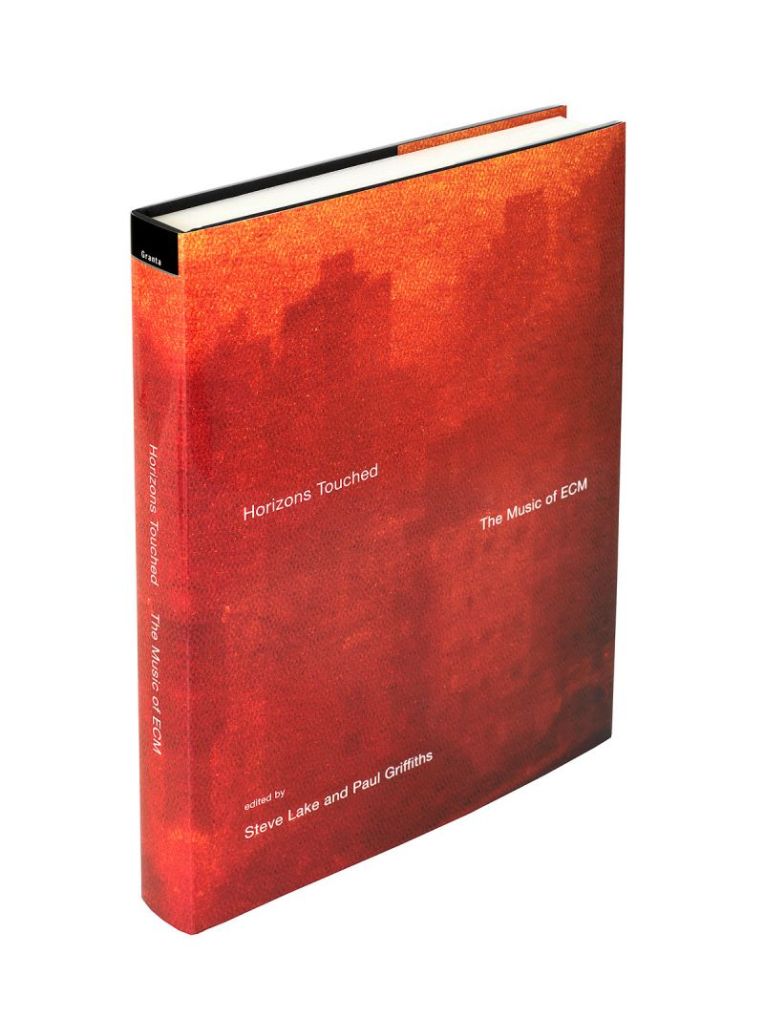
Few record labels compel us to approach them in any way other than chronologically. ECM is one of them. Its catalogue does not merely document music made; it charts ways of listening learned, unlearned, and learned again. Horizons Touched: The Music of ECM arrives, then, not as a monument erected after the fact but as an attempt to take measure of a phenomenon still in motion, to listen back without closing the ear to what has yet to sound.
The importance of this book, devotedly published by Granta Books in 2007, lies precisely here. Rather than offering a definitive account of ECM, it gathers voices, memories, and reflections in a way that mirrors the label’s own refusal of finality. It does not summarize so much as resonate. In doing so, it becomes something rarer than an institutional history: a field of attentiveness, an act of collective listening directed both backward and forward. What is preserved is sensibility over consensus.
In his introduction, Steve Lake rightly calls ECM a “work-in-progress.” Indeed, ECM is not a repository of completed statements but a living archive in which the contributions of everyone who makes it a reality function as vital organs within a larger, thriving body. The questions posed throughout the book are as follows: How does one listen to a past that refuses to settle into style, school, or doctrine? How does one write about music that has always positioned itself slightly ahead of its own reception?
Before ECM and its leadership under bassist-turned-producer Manfred Eicher, no one had thought of space in jazz in quite the same way. Through Eicher’s early work with engineers Martin Wieland and Jan Erik Kongshaug, the recording studio itself emerged as an unspoken player, an active participant rather than a neutral container. Light entered sound. Atmosphere became structural. Silence was no longer an absence but a condition. Yet even this often-cited “ECM sound” resists fixation, not because it lacks identity but because it repels reduction.
Given that so many locations, musicians, and traditions have passed through the label, to distill its ethos into a single style would be to flatten precisely what has given it life. As Eicher admitted in a 1999 interview, “All that can be really said about the ‘ECM sound’ at this point is that the sound that you hear is the sound that we like.” From this deceptively modest admission unfolds an expansive reality. What began as a jazz imprint grew far beyond the conventions of genre, making room for folk music, film soundtracks, electro-acoustic alchemy, and, with ECM New Series, classical streams grafted into the same current. Even there, the borders remain porous: Jan Garbarek improvising alongside the Hilliard Ensemble; curated excerpts from a Heiner Goebbels sound installation; Keith Jarrett playing Bach’s French Suites on harpsichord.
Horizons Touched matters because it understands this permeability not as a problem to be solved but as a condition to be honored. Enabled by over 100 contributors, the book presents itself as an “oral history,” though the term hardly captures its scope. What emerges instead is a polyphonic portrait of a label that has always worked obliquely through implication, atmosphere, and trust. Like the music it documents, the book does not insist. It invites. And in doing so, it affirms ECM as a listening practice still unfolding.
II. Seeing as Listening
It is telling that, following Lake’s opening statement, the essays do not begin with Eicher but with “Our Music: Synopsis for a Film” by Jean-Luc Godard and Anne-Marie Miéville. The filmmakers speak of seeing as listening, and few in their art would know better. This inversion of sensory hierarchy sets the tone for what follows.
Eicher’s essay, “The Periphery and the Centre,” originally delivered as a speech upon receiving the Kultureller Ehrenpreis of the City of Munich in 2005, continues this meditation on margins and essence. He speaks of the ECM office in Munich, located in what he calls “a no man’s land of industrial culture” at the periphery of things. Having been there myself, I can attest to its uncanny contradiction of placelessness and situatedness. Yet Eicher cautions against romanticizing such things: “We must never settle too comfortably at the periphery—the margin should only be a source, a spot from which to grasp the essence of the centre.”
His reflections braid together formative years in music school and the cinema, early encounters with Godard and others yielding a profound understanding of the overlaps between ears and eyes. For Eicher, atmosphere is not decorative but catalytic. “The atmosphere produced at a recording session,” he writes, “should be inimitable and awaken the desire to make changes or, where necessary, to improve and perfect.”
III. Redefining Tradition: European and Northern Voices
John Fordham’s “ECM and European Jazz” traces how figures like Jan Garbarek and Eberhard Weber became pioneers not by breaking with tradition but by redefining it as personally as possible. Weber’s admonition to his band—“you can play anything, as long as it doesn’t sound like jazz”—was a refusal of complacency. As Americans like Keith Jarrett, Bill Frisell, and Pat Metheny entered the fold and collaborated with European musicians, the sound expanded further. British artists such as Norma Winstone and John Taylor, alongside Kenny Wheeler in the influential Azimuth trio (with Ralph Towner welcomed into the circle), contributed to this widening field. Saxophonists John Surman—particularly in his solo recordings—and Evan Parker, with his Electro-Acoustic Ensemble, ensured that the threat of typecasting never fully took hold.
On the mainland, artists like Louis Sclavis, Enrico Rava, Tomasz Stańko, and Miroslav Vitouš laid the groundwork for a new canon. And then there are the Scandinavians, whose presence Michael Tucker explores in “Northbound: ECM and ‘The Idea of North.’” What Tucker calls “a multi-hued Northern aura” begins with Afric Pepperbird, Garbarek’s historic recording with Terje Rypdal, Arild Andersen, and Jon Christensen. Yet this “North” is less a geographic persuasion than an idea taking shape in those who inhabit it or yearn toward it.
To my ears, few albums embody this sensibility more adroitly than Rypdal’s If Mountains Could Sing. But the Northern idea is not all cool washes and snowbound stillness. There is also unrest and existential fervor, as in the shamanic charge of Garbarek’s Visible World, which, despite its cool sheen, is rich with colorful flame. Even in the gentler worlds of Tord Gustavsen and Mathias Eick, there is a nomadism that never feels quite settled in its skin.
IV. Liminal Spaces and Less is More
This sense of in-betweenness finds articulate expression in Ivan Moody’s 2004 conversation with Jan Garbarek, “On Parallel Lines.” Garbarek speaks candidly about the difficulty critics have in placing his music. Jazz and classical camps alike often seem unsure how to approach it, leaving it to resound in a liminal space. “I consider myself extremely lucky,” Garbarek says, “because ECM already has a given audience, and they don’t really think of it as jazz or classical: it’s just a certain approach.”
Their dialogue ranges across questions of collaboration with musicians from other traditions, converging on a shared belief that constraints can be the most liberating conditions for creation. “I only seem to have dreams when I’m awake,” Garbarek remarks, a line that feels like an unofficial ECM motto.
V. New Series: Shadows, Voices, and Reinvention
The ECM New Series emerges throughout the book not as an offshoot but as an intensification of the label’s core ethos. John Potter’s “Early Music Discoveries and Experiments” marvels at Eicher’s uncanny ability to bring together musicians, ideas, and inspirations no one else would think to combine—most famously in Officium, but also in the Dowland Project.
Helen Wallace’s “Musicians of the New Series” observes that “the musicians who make ECM recordings are shadowy presences.” (My own early encounters with the New Series included Paul Giger’s Chartres. I remember trying to imagine what he looked like, how he moved while playing. When a clearer photograph finally appeared on Schattenwelt, it felt like seeing, through time, a mythical figure brought briefly into focus.) Wallace also notes the lack of musician biographies in the CD booklets, emphasizing that these recordings arise not from contracts but from shared visions and relationships with living composers illuminated by deeply human interpretations, resting in a nest of empathy.
Peter Rüedi’s “Continuity in Change: The Metamorphoses of Keith Jarrett” goes on to frame genius as a state of constant reformation rather than a sustained pinnacle. Jarrett’s “many-sidedness,” of “supernatural proportions,” exemplifies this restlessness. Rüedi speaks of the hymnic quality shared by Jarrett’s music and ECM: an ember that glows with varying degrees of warmth, sometimes sparking fires that take on lives of their own beyond the hearth.
VI. Free Playing, American Roots, and the Canvas Without an Edge
Josef Woodard’s “ECM and US Jazz” reminds us that the label has always been “a source of cohesion” for American artists and a further corrective to simplistic notions of the “ECM sound.” The label’s genesis lay with Mal Waldron, and figures like the Art Ensemble of Chicago brought incendiary free-jazz energy into its orbit. Jack DeJohnette, Pat Metheny, John Abercrombie, Ralph Towner, Bill Frisell, Joe Lovano, Peter Erskine, Paul Bley, Paul Motian, Steve Swallow, Gary Burton, Chick Corea, and Charles Lloyd all testify to a lineage of hard-edged expressivity as much as lyric spaciousness.
In “The Free Matrix,” Steve Lake’s interview with Eicher, free playing again emerges as a foundational principle. Eicher recalls early encounters with Paul Bley and identifies a “special electricity” shared by artists as varied as Glenn Gould, Chick Corea, and Keith Jarrett—an ability to act as “an inspired catalyst whatever the context.” Music, Eicher says, is “a canvas without an edge.” He recounts the genesis of the label’s name, inspired by Werner Goldschmidt’s Wergo series and Stockhausen’s From the Seven Days, leading him to imagine loosening borders through the idea of an “edition” (borrowed from the world of visual art) of contemporality. Thus, Edition of Contemporary Music was born. He likens the label to a sea: “A continuous movement of undercurrents and unexpected drifts… But sometimes the sea is tranquil, and stays tranquil.”
Keith Jarrett’s essay, “Inside Out: Thoughts on Free Playing,” deepens this philosophy. He distinguishes between artists who treat nothingness as lack and those who understand it as a state “pregnant with everything.” His notion of having “accidents on purpose” feels like a quiet manifesto for improvisation.
VII. Forms, Covers, Folkways, and Modernist Echoes
ECM’s visual identity receives eloquent treatment in Lars Müller’s “The ECM Cover.” Müller sees the label as transforming its musical philosophy into the realm of vision. The covers rarely illustrate the music directly, yet they exist in harmony with it—two verses from the same poem, not mirror images.
Karl Lippegaus, in “Colours, Densities, Forms,” traces how ECM reshaped folk music through artists such as Egberto Gismonti, Anouar Brahem, Lena Willemark, Savina Yannatou, Eleni Karaindrou, Gianluigi Trovesi, Shankar, and Dino Saluzzi. He also recounts asking Eicher why ECM albums open with five seconds of silence. Eicher laughed: “People need time to sit down, don’t they?”
Paul Griffiths’s “Against the Grain: Modernist Voices” reframes modernism not as rupture but as continuity. For example, in Thomas Demenga’s fifteen-year traversal of the Bach cello suites—paired with works by Holliger, Veress, and Isang Yun—Bach emerges as modern for his time, just as modern works echo the past. Griffiths writes lovingly of Holliger and Kurtág as poets, a lineage that includes the spoken-word forays of Bruno Ganz (to say nothing of Griffiths’s own).
Hans-Klaus Jungheinrich’s “All Roads Lead to Bach” both confirms and dismantles Bach’s mythic status. Bach was no passive vessel of divine inspiration but a laborious musical scientist whose work fell out of favor for decades. Returning to Bach, Jungheinrich argues, is an anti-Romantic gesture, one that resonates deeply with jazz musicians like Jarrett. Yet ultimately, the metaphor inverts itself: not all roads lead back to Bach; they stem from him outward into space and time.
VIII. Instruments, Futures, and the Listener’s Life
John Cratchley’s “ECM and the Guitar” charts the instrument’s breadth across the label—from Abercrombie, Towner, Connors, Frisell, Tibbetts, Rypdal, and Metheny to figures like Keith Rowe, Mick Goodrick, Derek Bailey, and Christy Doran—extending into the next generation with Jacob Young.
John Kelman’s “Present and Future Songs” characterizes ECM as a place of discovery. Alongside its mainstays, it has consistently welcomed new voices: Trygve Seim, Christian Wallumrød, Tord Gustavsen, Savina Yannatou. What unites them, Kelman writes, is not style but vision: “All hold humanity as paramount; all ask that music be accepted as a contradiction, engaging perfectionist ideal and practical imperfection.”
Geoff Dyer’s “Editions of Contemporary Me” offers a listener’s diary, his discovery of ECM entwined with the formation of his inner life. It makes me nostalgic for my own early listening sessions with friends, before digital fragmentation fractured albums into isolated tracks.
Further interviews, such as Griffiths and Lake’s with Eicher, reaffirm that the New Series was never a departure, only a continuation of ECM’s inner spirit. Thomas Steinfeld’s “Words and Music” explores the “aesthetical alliances” listeners inevitably draw across the label’s vast terrain.
IX. Voices, Engineers, and the Hand Holding the Key
Interleaved among the essays, Horizons Touched offers biographical sketches and first-person statements from ECM’s musicians, each a small window that opens onto a whole climate. These fragments do not merely annotate the label’s history; they humanize its method. They remind us that ECM’s continuity is not a doctrine but a chain of encounters: one musician hearing another across a room, across a record, across years, then walking away altered.
Jan Garbarek’s recollections of meeting Don Cherry glow with this catalytic force. Cherry’s folk sensibilities did not function as ornament or exotic garnish; they sank into Garbarek’s musical bloodstream, shaping how the saxophonist would understand melody as something older than genre, something carried like a story rather than “played” like a role. John Surman, too, appears not as a solitary figure descending fully formed but as someone who fell in with the Norwegian jazz scene by way of circumstance and gravity via Karin Krog’s quintet with Arild Andersen, Jon Christensen, Garbarek, and Terje Bjørklund—a scene, then, as a confluence of players finding shared weather.
The book is equally attentive to the invisible labor that turns vision into sound. Iro Haarla’s memories of bringing her partner Edward Vesala’s musical worlds to life are among the most moving examples. Vesala would sing ideas into a tape recorder—raw transmissions, half-formed, urgent—and Haarla would transcribe them, arrange them, translate the unrepeatable into something held and shared, using those recordings and other means of transmission. Here, creativity is shown not as solitary lightning but as an act of listening so deep it becomes architecture.
Generational echoes reverberate as well. Trygve Seim recalls his first encounter with Jan Garbarek—not in person, but through the spell of Eventyr, which set him on the path toward the saxophone at a time in his life when he was more interested in sports. That detail matters: it gives us the unmistakable sense of a life diverted by sound, a horizon touched early enough to become destiny.
From the New Series world, Kim Kashkashian offers a statement that feels like reassurance and challenge: the intense preparation of a recording is precisely when “preconceived notions are abandoned and the music is created anew.” ECM’s paradox—rigor as the gateway to freedom—finds proof in her fearless championing of Kurtág, Mansurian, Kancheli, and so many others, repertoire approached not as museum artifact but as living material, remade in the present tense. András Schiff appears, too, animated by a seeking spirit that never settles for attainment, spurring him toward greater interpretative levels, as if interpretation were not a finishing touch but an ethical pursuit, a way of staying in motion.
Anouar Brahem’s reflections widen the field again, returning us to that Godardian hinge where sight and sound exchange roles. He speaks of the silence that precedes image and the music that follows it, a dynamic mirrored in many bands along the ECM spectrum, where what is withheld becomes part of what is said, and where the breath before the phrase is meaning. Annette Peacock, in turn, expresses gratitude for Manfred Eicher, whose prophetic understanding of her essence became a leitmotif at ECM, less the discovery of a new artist than the recognition of someone already speaking in her own dialect, waiting for ears fluent enough to listen.
Several statements arrive like aphorisms—compact, paradoxical, strangely complete. Christian Wallumrød’s reflections on harmony and freedom turn composition and improvisation into mirror arts: “You write something because you couldn’t improvise it, and you improve something because it couldn’t be written.” Carla Bley’s slow, forward-thinking approach to making music is distilled into another truth earned over decades: “My solos usually end because I’ve had to abandon them.” Such statements suggest minds always moving ahead of what the hands can say.
Folk tradition is not treated as a quaint inheritance but as a living accumulation. Ale Möller speaks from deep knowledge, describing folk music as cumulative and locating ECM’s contribution in inward intensification, “increasing the inner density in music by reducing the external.” Dino Saluzzi sharpens this imperative by insisting on emotional sensitivity as the bridge to freedom: “Art doesn’t need muscles.” Robert Wilson’s poetic hymn to ECM (stylized as “Every Color Maginable”) extends the label into chromatic metaphysics. And Gidon Kremer, attentive to the bond between composer, performer, listener, articulates his love for Eicher’s vision of bringing them lucidly to us: “ECM stands for music intent on communicating something to us.”
Taken together, these voices form their own ensemble, less a supplement to the book than its beating heart. They do what ECM has always done at its best: place the “work” back into the work, the human back into myth, reminding us that the key is never merely the catalogue, the studio, the aesthetic.
The book closes not with an argument but with a gesture. Paul Griffiths raises a glass in the form of a prose poem written in Ophelian, in which meaning and music collapse into one another: “The key is in his hand. The key is his hand. There’s music in that hand.” The image lingers, unfinished, as if the act of letting go is where melody begins.
Leading up to this closing utterance is a dotted path of voices whose work has shaped ECM as surely as any score or improvisation. Reflections from photographers and visual artists—Roberto Masotti, Jan Jedlička, Jim Bengston, Mayo Bucher, Thomas Wunsch, Dieter Rehm—remind us that ECM’s sound has always traveled with an image, even when that image defies the conventions of illustration. Their contributions affirm the label’s belief that vision and music are parallel arts, each extending the other’s reach without collapsing into it.
Equally essential are the engineers, those who inhabit the threshold where intention becomes vibration. Peter Laenger, Jan Erik Kongshaug, James Farber, Stefano Amerio, and Gérard de Haro speak from within the studio’s invisible architecture, where listening is technical and moral. Amerio’s remark—“Recording for ECM means opening your mind to 360 degrees”—could stand as an epigraph for the enterprise. It names a practice of attention that is spherical rather than linear, attuned not only to what is played but to what surrounds it, precedes it, remains after it fades.
In ending this way, Horizons Touched refuses closure in the conventional sense. Instead, it disperses authorship, returning the music to the many hands that have shaped it, hands that frame images, tune microphones, adjust distances, wait for silence to speak. The key does not lock the door behind us. It stays in the hand, warm, provisional, ready to be passed on.
X. The Horizon Remains Open
Horizons Touched does not seek to close a circle. It leaves it slightly ajar, breathing. ECM has always seemed less concerned with preservation than with readiness for the next silence, the next alignment of breath and intention, the next sound that arrives without asking permission. To listen in this way is to relinquish certainty. It means accepting that meaning does not always announce itself, that music may resist immediate comprehension, that its most lasting truths often surface obliquely, long after the final note has faded. ECM’s legacy, if it can be called that, is not a fixed aesthetic but a discipline of sustained attention.
In this sense, the future of listening suggested here is neither utopian nor nostalgic. It is quieter, more demanding. It asks for patience in a culture of acceleration, for depth in a time of surfaces. It asks us to sit with ambiguity, to trust that what has not yet resolved may still be working on us, shaping us from within. The music does not rush to meet the listener; it waits. And in that waiting, something essential is restored.
Perhaps this is the true horizon being touched. Not a distant line toward which we move but a threshold we learn to inhabit. A space where sound and silence exchange roles, where intention loosens its grip, where listening becomes less about capture than encounter. The future implied by Horizons Touched is one in which music continues to arrive from unexpected directions, carrying with it traces of many worlds, yet asking only one thing in return: that we be present enough to hear it.
The horizon remains open because it must. To close it would be to mistake listening for possession. And ECM, at its heart, has never been about owning sound—only about making room for it, and trusting that what enters will know what to do next.
 Between Sound and Space: ECM Records and Beyond