

The Hilliard Ensemble: Perotin (ECM New Series 1385)

Perotin

David James countertenor
John Potter tenor
Rogers Covey-Crump tenor
Mark Padmore tenor
Charles Daniels tenor
Gordon Jones baritone
Paul Hillier baritone, director
Recorded September 1988, Boxgrove Priory, Sussex, England
Engineer: Peter Laenger
Produced by Manfred Eicher

There is a moment in the opening Viderunt omnes when, to signal the final section, its voices modulate to a higher space. This shift from gravid baritone- to tenor-driven majesty is for me one of the most sublime moments in all of music. Such transformative moments are what make many of the Hilliard Ensemble’s endeavors so enduring. In medieval music in particular, the enigmatic Hilliards have found a groove of sorts from which they seem reluctant to part. As Paul Hillier notes, these sounds represent a major development in the polyphonous “organum” typical of the ars antiqua style, breaking from the staid (though certainly no less “organic”) Gregorian mode. This fine disc metes out a hefty dose of the works of Magister Perotinus (fl. c. 1200), along with some worthy anonymous pieces to thicken the brew. Listening to this music, I cannot help but try to imagine the time and place of its conception. I can almost taste the air, feel the cold stone of gothic architecture on my fingertips and the swept floor beneath my sandaled feet. The voices glitter like facets of the same dusty light that once pierced arched windows and landed softly on solid pews.

This is music we approach impressionistically, seeing it first as a worldly sound before distinguishing local colors. The interpretations are restrained yet full of overwhelming power. The Alleluia posui adiutorium is a stunning example of Perotin’s craft. On the surface transcendent, the piece is also laden with paratextual significance. The pedal tones here are airy yet substantial and the brief lapses into chant are like translucent beads on a deftly interwoven chain. Dum sigillum, sung here by tenors John Potter and Rogers Covey-Crump, sounds like four voices compressed into two. They flit and fall, taking one step back for every two taken forward. The Alleluia nativitas is, like its companion piece, a finely wrought macramé. David James’s glorious voice has its day in Beata viscera, a Communion prayer (and Perotin’s only extant monophonic work) rising like censer smoke in a solitary alcove. Sederunt principes closes the disc on a fittingly supplicatory note.

On April 23, 2004 I had the fortunate experience of seeing the Hilliard Ensemble live at Wesleyan University, where they opened with the Viderunt in an otherwise eclectic program. The experience was very much like putting on this disc: the audience had almost no time to prepare for the sudden immersion that ensued the moment they took the stage. This is precisely what the home listener can expect. As always the Hilliards offer an impeccable performance that speaks of a deep and heartfelt commitment to every project they undertake, and it is this same commitment that I feel obligated to bring to the table every time I sit down to partake of this finest of recordings.

<< Stephan Micus: The Music Of Stones (ECM 1384)
>> Paul Giger: Chartres (ECM 1386 NS)
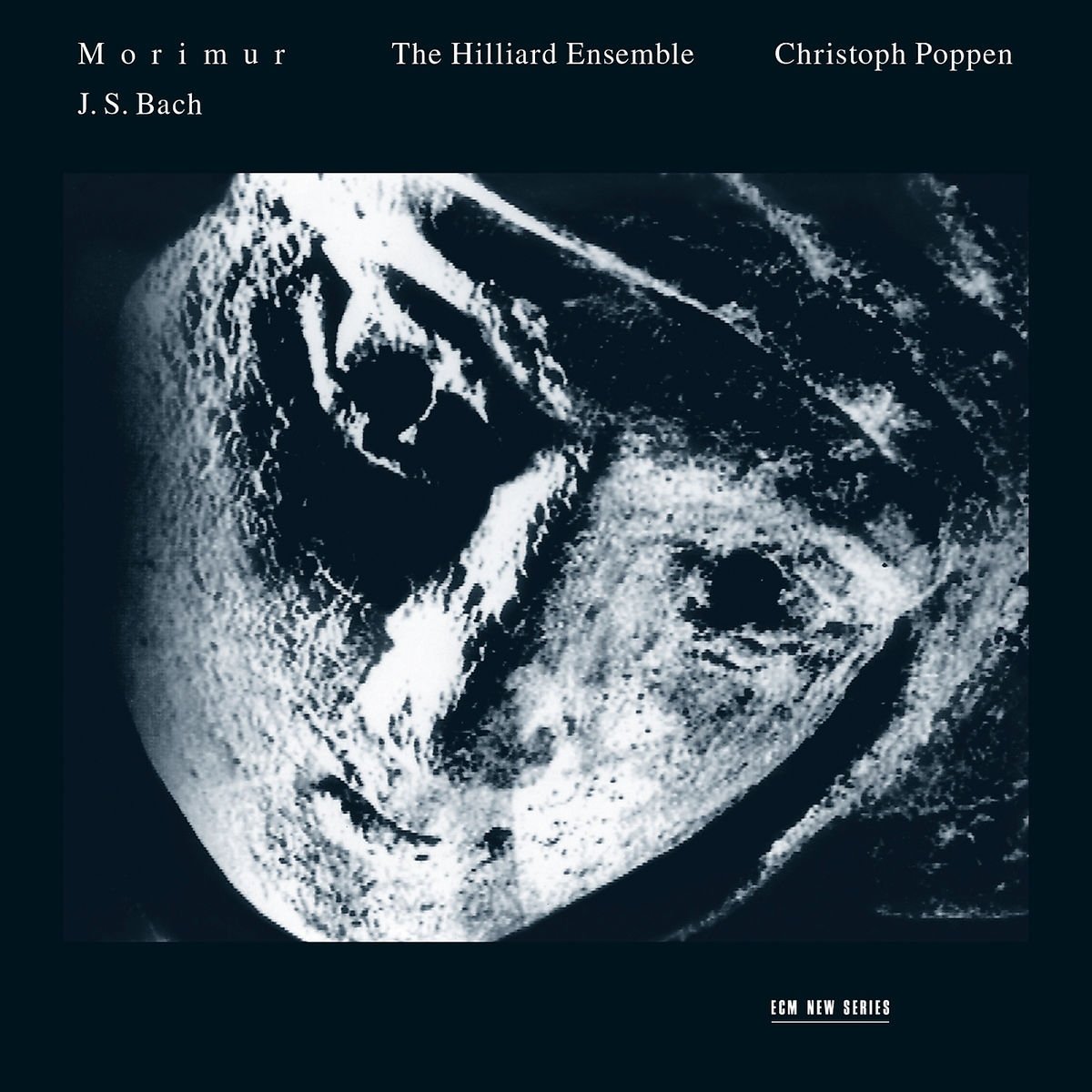
Christoph Poppen: Morimur (ECM New Series 1765)

Version 1.0.0

Morimur

Christoph Poppen baroque violin
The Hilliard Ensemble
Monika Mauch soprano
David James countertenor
John Potter tenor
Gordon Jones baritone
Recorded September 2000, Monastery of St. Gerold, Austria
Engineer: Peter Laenger
Produced by Manfred Eicher

Drawing on the research of musicologist Helga Thoene of the University of Düsseldorf, Christoph Poppen and the Hilliard Ensemble take great care in juxtaposing the monumental “Ciaccona” from J. S. Bach’s Partita in D Minor BMV 1004 alongside (and against) various Bach chorales, through which cryptic synchronicities are brought audibly to light. These “chorale quotations”—believed by Thoene to comprise a “tombeau” (i.e., epitaph) for Bach’s deceased wife Maria Barbara in the larger context of Christ’s death and resurrection—are transformed here into an entirely new experience that traces the intangible borders between life and death. And indeed, the title of the album, Morimur, connotes “death as a passage to life” and reflects the numerology therein as an equation for transubstantiation. Chorale passages are interspersed between movements of the refracted Partita, thus allowing us insight not only into the hidden connections of violin and voice (insofar as the Ciaccona is concerned), but also into the nearly tangible sinews that hold together the Partita as a whole. Poppen’s violining digs ever deeper into its source, as if overwriting the original manuscript with heavier ink.

This is a very challenging album to encapsulate in one review, for it is a listening experience like no other. With each new turn it offers hitherto unexplored avenues of creation. As a mere listener, it may be easy for me to dismiss the intense scholarship that has gone into this recording and simply enjoy it for the contemplative music it contains. After all, much of what lies hidden between the Ciaccona and its companion chorales is perhaps more obvious to the trained eye on paper than it is to the casual, if not enraptured, ear on disc. At the same time, I cannot help but think that the connections drawn out through its attendant scholarship are vastly important for the sole reason that this program would not exist in its present form without them. That being said, I feel that Bach’s ciphers stimulate the heart without the need for a direct correlation in numbers. In other words, we don’t necessarily require those connections to be spelled out for us as a guidebook to what remains fundamentally communicative.

Music never ceases to amaze and entice with its potential for infinite variation. The intersections drawn in Morimur are omnipresent and need not always be so contrived. Bach’s music, especially as it is rendered here, reminds us that sometimes those transparent bridges between our intellect and the environments around us are also the most fleeting and unexpected. Contrary to what we might expect from a project so described, this is not about solving some age-old code left for only the most astute of posterities. It is, rather, about uncovering those mysteries that never go away and make us who we are: mysteries of faith, of love and absolution, of desire, and of death. Therefore, I see this album not so much as a reflection of Bach’s often-touted genius, but of his humility.