
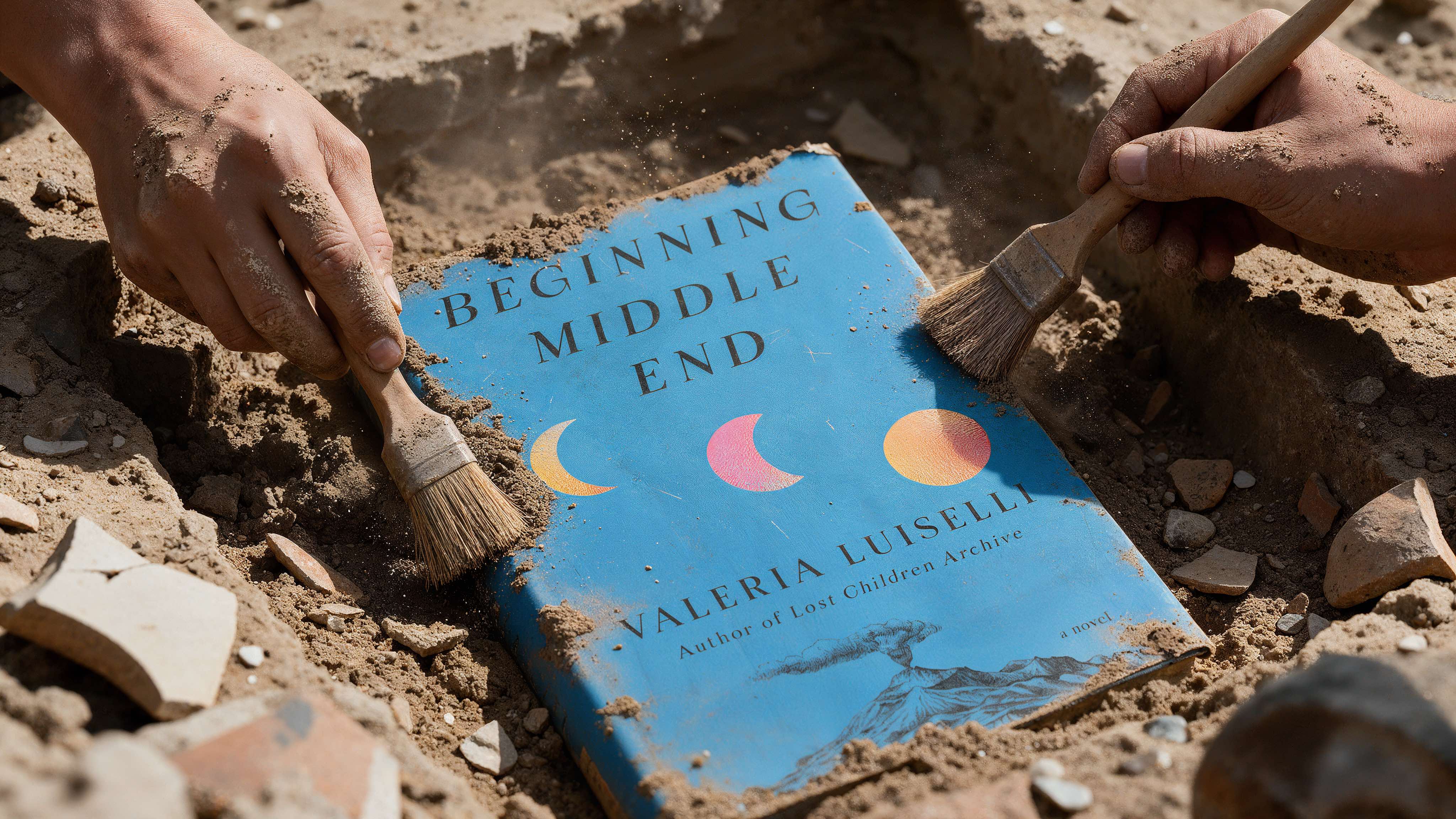
Valeria Luiselli: Beginning Middle End (Book Review)

Memory has its own methods of excavation. What one generation buries, another may uncover without knowing what it has found. In Beginning Middle End, the soil of Sicily holds a family history whose meanings are still being negotiated: the narrator’s grandmother once worked here on an archaeological dig, and now the narrator arrives with her daughter, carrying the aftermath of a failed marriage. Elsewhere, her mother’s memories are slipping away. Between that loss and the accumulating impressions of a child approaching adolescence, she must reckon with how much of their shared past she can claim to understand. Across four generations of women, recollection moves unevenly, gathering in one life as it recedes from another. The search for origins becomes an inquiry into the stories we entrust to our children, and what happens when they begin to tell them back.

The island brings a different scale to this uncertainty. Its ruins and volcanic disturbances place the women’s lives alongside histories that exceed any family’s capacity to remember, while encounters with migrants and shopkeepers keep those histories tethered to the present. Yet the novel’s intimacy rests in smaller exchanges: a meal prepared together or the shifting allegiances of a chess game. Through these daily negotiations, the daughter begins to exert her own narrative authority. Her questions alter the direction of their travels and unsettle the mother’s account of how they came to be here. The narrator is struck by the permeability of beginnings and endings, and the inarticulability of what comes between. Belonging reaches her as “an echo of someone else’s belonging.” Later, she muses that perhaps the middle is all there is. Her answers remain as fragmentary as her current sense of self, drawing from their new yet ancient surroundings as if strands of memory could still be woven into tapestries for their becoming. As Mount Etna erupts in the backdrop, a looming threat and a point of fascination, the mood proceeds in curls and thermals.

In many ways, the novel is as much about the machinations behind its own creation as the story it seeks to create. “Why is the language of fiction writing so full of real estate?” the narrator asks early on, bringing a valid concern to our penchant for thick description. The question also exposes the possessive grammar of storytelling: to establish a setting can become a way of claiming it; to explain a daughter can become a way of occupying her future. Her resistance to journalists and critics who draw a straight, unbreakable line between her life and her words belongs to this same inquiry. “I have, of course, used slivers of my own life,” she admits, because “I wouldn’t know what else to write with.” Lived experience becomes the building material of fiction, retaining edges that can cut the hand arranging it. As she contemplates how her daughter, now ripped from the master narrative of family life, must learn to navigate the world anew, her own position as a daughter passes beneath the distorted magnifying glass of retrospection.

The novel, accordingly, unfolds in a strangely beautiful vignette style, each passage carrying its own title while flowing into the larger story taking shape in real time. Their separateness gives uncertainty room to breathe. An image can arrive before its significance becomes apparent; a thought may find its consequence several pages later. Many of these images suggest the universe and its natural phenomena, sometimes surreal and distant, because a solar system in need of a new name is forming between mother and daughter. They are trying to reinvent their lives in a home away from home, learning the pull of a changed relation without knowing where its orbit will lead. The daughter’s questions exert a force the mother can neither calculate nor keep outside the story. What appears to be fragmentation gradually reveals the gravitational field of another consciousness entering the composition.

The narrator quickly realizes that there are things she would rather withhold from her daughter, or reveal only through the lens of obfuscation, where the author’s art takes over in service of life. Invoking Greek theater, she observes that “the violence happens backstage.” Concealment becomes a problem of form, asking us to consider what an omission protects and what it allows to continue unchallenged. The daughter’s desire for a Polaroid camera, whose images eventually make themselves metaphysically known at the back of the book, establishes a nuanced reciprocity between what one observes and what one makes of the observation. Her photographs give another gaze a place within the broader account, preserving evidence she cannot entirely explain. All the while, they are caught up in moments of inconspicuous portent: a mosquito crushed on a pillow; a ladybug occupying a wall. A plume hangs in the sky in the wake of Etna’s wrath, the residue of a thought too large for the earth to contain.

Staying in the apartment of the mother’s lover, a pianist and collector of Greek and Roman classics, they begin reading through the works from which the novel’s section titles are taken. The warrior mythos of the Odyssey brings its troubled promise of return, while the destruction of the Aeneid presses loss into the service of a future homeland. Between these monumental arrangements, the unrest of Trojan Women exposes the lives left beneath heroic accomplishment. The myths hover as a constant pool beneath the action, into which the characters may dip a hand or a foot and emerge with something substantial to hold in the present moment. Reading becomes one of their daily negotiations, with the daughter’s presence changing what can be asked of an ancient text. An epic opens differently when a child is there to question the account it gives of survival.

One day, mother and daughter attend a performance of Trojan Women, with incidental music by Greek composer Eleni Karaindrou. Brief as it is, the sequence feels strangely intimate and private, reducing the novel to a single kernel of curiosity from which it seems to sprout all over again. Euripides’ tragedy, first performed in 415 BCE, attends to the captive women after Troy’s destruction, granting the aftermath of conquest its devastating duration. The scene in Luiselli’s novel is also the scene of an earthquake, shaking experience to its foundations and drawing the act of witnessing into the instability of the ground beneath it. What the spectators encounter onstage passes into their bodies.

In my earlier review of Karaindrou’s Trojan Women, I heard its choral odes as vertebrae of story and music and traced the way its related themes changed their instrumental clothing from one visage to another. Returning to those impressions through Luiselli, I find a new resonance in that fluidity. The family’s stories also acquire different bodies as they pass between women, each voice altering the weight of what it carries. Karaindrou’s chorus gathers suffering into a shared utterance, opening a space beyond the solitary narrator’s reach. Within the novel, that possibility matters acutely: the mother must find a form that can hold her anguish without requiring her daughter to become its instrument. Music lends this difficulty a tangible melodic beauty, allowing what cannot yet be articulated to enter the room.

When the pianist returns to his apartment and works his way into their lives, he creates another ripple in that water. His words also cut theirs short, however, introducing a disruption that cannot hold its own in their orbit. The room’s borrowed hospitality begins to reveal its conditions. Read alongside the narrator’s question about fiction and real estate, this disturbance makes possession painfully immediate, entangling the right to speak with the right to inhabit. As mother and daughter plan their escape, things turn inward and outward simultaneously. Their departure gives their relation room to continue, even as it requires them to leave the shelter where it has been taking shape. The road carries them toward family history while allowing the daughter’s questions to travel beyond the acoustics of someone else’s home.

The narrator wants to “write a reverse catastrophe: from the end of the world to the beginning of it; from the loss of memory to the first image of the world imprinted on a big brown eye.” As details of her lineage emerge, whether through an archaeological discovery or a shipwreck, we find places in which to fit our own. Their road trip begins returning a piece of genetic history to its origins, and the geography without becomes less important than the border crossings within. Yet the first image belongs to an eye the mother cannot see through. When the daughter picks up the proverbial pen and finishes the story, the direction of inheritance changes. Beginnings and endings take another shape through the people to whom we pass slivers of ourselves, our identities blurring in the watering eyes of humanity writ large. The mother’s longing for an origin must make room for someone else’s beginning.

The book ends with postcards and photographs, its archival images standing beside the daughter’s Polaroids. These materials extend the transfer of narrative authority into physical margins. The older photograph carries the burden of having outlived its occasion; the instant image is already separating from the moment that produced it. Neither supplies the whole life we might ask it to recover. Their incompleteness asks us to attend to the distance between evidence and invention, looking closely without converting every surface into an explanation. The daughter’s images preserve the freedom of an attention that has wandered beyond the mother’s prose. At the edge of the frame, something remains in motion, declining the stillness we have mistaken for understanding.

There is also a sonic parallel to the novel in the form of recordings made on site in Sicily and the Aeolian Islands by Charles de Montebello and Ricardo Giraldo. Alongside raw field recordings, 12 sound mixes form “constellations” between locations. A timeline follows the novel’s structure, while a separate soundscape offers its sonic environment without narration. The daughter’s postcards can be read and heard; photographs accompany videos. Whether immersing oneself underwater at Basiluzzo or in the evening ambience of Caltagirone, there is much to be felt and heard. The more one explores these places, the more they reveal the people who live and work there, whose lives intersect ephemerally to become part of the landscapes they inhabit. This is palpable in Catania’s fish market, but even in the absence of flesh, humanity can be felt in the winds of Scopello and the eruptions of Mount Etna. The assembled portrait lets the setting exceed its description, occupying the ear with pressures that have no obligation to become a plot.

That possibility returns us to the narrator’s reverse catastrophe, now turned toward a future she cannot arrange. Perhaps the daughter will one day listen to these waters and think of no one in her family. A sound her mother associated with loss may enter her life under an entirely different sign. The thought hurts precisely where love has mistaken remembrance for its only means of moving on. Beneath the sea, an unheard movement passes through stone; above it, a child is growing into the right to forget. The strands woven into the tapestry of her becoming may loosen without destroying it. An inheritance might endure most fully at the moment it ceases to point toward the person who gave it. The hand opens, allowing something loved to escape the duty of returning.
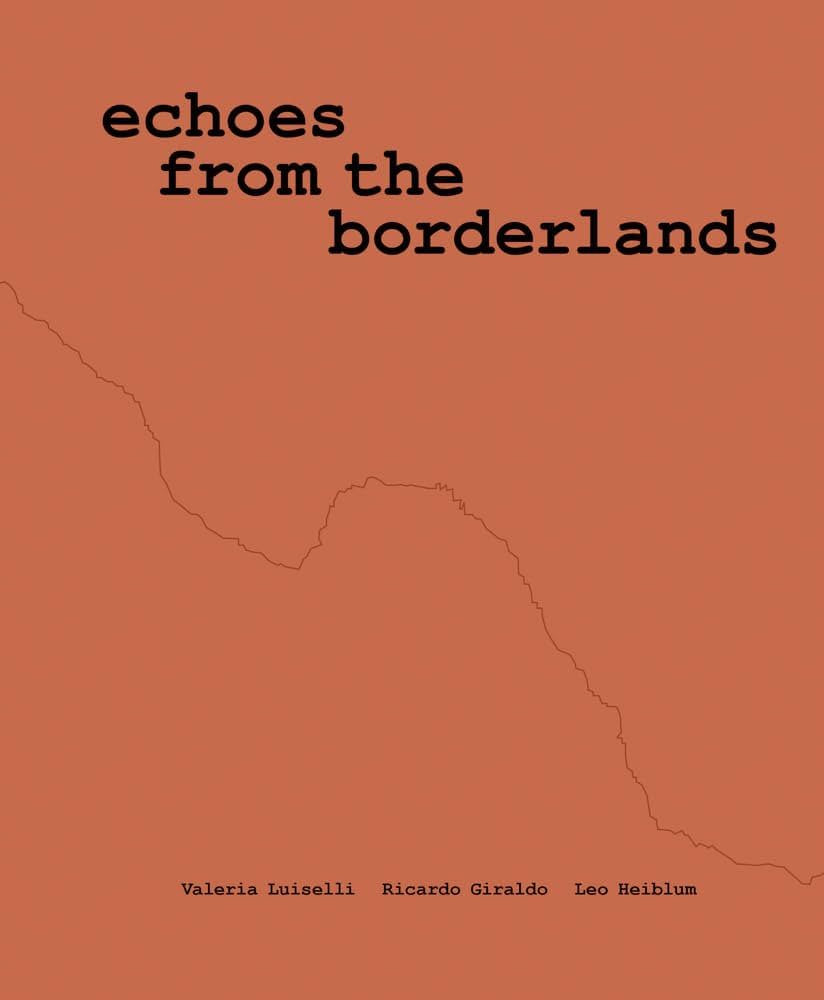
Valeria Luiselli/Ricardo Giraldo/Leo Heiblum: Echoes from the Borderlands

Caminante, no hay puentes, se hace puentes al andar.
–Gloria Anzaldúa

Echoes from the Borderlands is a collective comprised of Valeria Luiselli, Ricardo Giraldo, and Leo Heiblum. It also names the 24-hour sound piece that explores and gives voice to areas of interstate violence along the U.S.-Mexico border. At the core of this sonic experience is a living canvas of sorts, a vibrational palimpsest built from binaural and quadraphonic recordings. Into this are woven archival recordings and other voices, authored by Luiselli, which move through the piece as necessary witness and disturbance. The result is a constellation of counternarratives to the official stories that pervade our newscycle, allowing Indigenous, brown, and black perspectives to keep pace with the conventional histories that ignore or kill them. The land itself serves neither as an abstraction nor as a mere foil for sociopolitical musings. It is a witness whose testimony has been buried under weary curricula and the administrative trance of empire. In this way, the project upsets the schema that dominates our lives in standard parochial models, not by refuting them point by point, but by placing beside them a deeper grammar of residue and return.

The present chapbook is the first study in this hallway, a narrow, illuminated passage that provides insight into the project’s core values and perspectives. Subtitled “Call You When I Get Home,” it exceeds the categories of reading and auditory experience, even as readers can scan a QR code to access its accompanying audio file. It is interactive in the most imperative sense. The pages are divided into three columns of text: the left representing the voices of imagined personas, which the reader is encouraged to read aloud during the allotted timestamps; the right containing interviews and archival materials; the middle holding field recordings taken during the authors’ travels across California, Arizona, New Mexico, and Texas. Over the course of 71 minutes, the reader becomes an implicative subject who must regard their own life experiences and histories as braided into those of maiming and erasure. To listen is to enter a chamber in which history does not sit behind glass but presses its mouth to the present tense.

The sounds open with a clear recording of humpback whales off the Pacific Coast, bringing us into dialogue with nature, a realm in which the cares of human self-interest have no throne. Yet this solace is short-lived because the first voice we hear questions why, in creation myths, the earth and sky are always “cloven asunder.” Must everything be broken to be told? Then again, such is the nature of trauma: we must be fragmented before we can be made whole. And our tormenters know and exploit this intimately. Stories get stolen, butchered, and consumed until they turn into the feces of time, buried along with the rest of our detritus in the middens of the forgotten. In this opening movement, the piece establishes one of its fiercest claims: that creation and destruction have too often been forced into the same orality, and that origin stories carry their own hidden instruments of cutting. Every atom is narrated by those who learn to split it.

The border, then, is the “margin of a page,” a place where the real commentary begins and where the thoughts we hold dear can manifest beyond what is published, printed, and codified. One voice, for example, tells us about the many iterations of the border wall since President Truman erected the first in 1945, just after World War II. Not coincidentally, those initial chain-link fences were dug from the very desert where Japanese Americans were interned before being trucked to the border. “Each president,” we are reminded, “has since potlucked his bit of iron, steel, cement, mesh, and wire.” Despite what legacy media would have us believe, no one in recent history is guiltless of this charge. Everyone has that dust and ballast on their hands. In light of this, the border does not emerge here as a fixed line but as an accumulating technology of dread, a ceremonial scar renewed by the ritual polishing of fear on a national level. Its materials migrate across history with obscene efficiency. What once enclosed the demonized now repels the displaced. The same metal keeps changing uniforms.

Many of the archival voices concern how true love gets trampled by systemic pressures of citizenship, feeling lost and found by the enemy. We hear the sounds of people crossing the border, their bodies reduced to mechanical baggage that reflects time in constant reversal. Desire itself is subject to inspection, while kinship must answer to paperwork. The body, in transit, is converted into a problem of storage, the metaphysical insult of being processed by a system that cannot recognize the sacred velocity of arrival.

An unheard story then emerges: voices of detention center inhabitants whose lives have been confined to shells of their former selves. Children are taken from their parents and kept “in their place.” Woven into their testimony are histories of early-20th-century racial eugenics in the U.S., which, let it not be forgotten, would become the model for Nazi Germany. The haunting audio of a promo film about the lushness of revitalized land, using water to bring newness to the desert, arrives at the expense of forced sterilization. Both involve the severing of channels. The parallel is vastly intentional, the female reproductive cycle and anatomy mapped not over but under the land, out of sight and out of mind, so that the infrastructural powers that be need not acknowledge the effects of their own actions. The fantasy of improvement conceals a theater of extraction. The project asks us to hear irrigation as incision, settlement as anesthesia, and fertility as a field administered by those who confuse conquest with care. But the land cannot be settled, for it is constantly in motion. Those who kill try to force the illusion of its stillness, yet entropy always wins. The only certainty is possibility.

“And which story do you believe in?” we are asked. Only then do we realize the luxury of not answering, of turning both the physical and metaphorical page, tuning the radar dishes of our ears to off-planet signals while terrestrial cries go unheard. Speech acts are life acts, birthing newness and assertion that someone was here. They are the vibrational footprints most easily ignored. Yet they can also be recovered and repurposed. What is the point of fear when it is manufactured as a drug to be taken by mouth? The question hangs in the auditory field with almost pharmacological force. Fear circulates through public life as the prescription of a patriotic supplement, whereupon it is metabolized and mistaken for instinct. Against this, Echoes from the Borderlands offers listening as detoxification, not in the shallow language of purity, but as an intellectual and bodily refusal to let terror do all the thinking.

Still, all of this casts doubt on our ability to know what has been shielded from us, for how can we begin to document what is no longer there? And yet, perhaps there is no need to document in the ordinary sense but rather to make space for the old and forgotten paths. Just because one gentrifies the land does not mean the veins running beneath it are bloodless. The heart of the earth is still beating. Knowledge does not exist to be extracted but to be lived and passed on to those with private power, those who inherit not domination but obligation. Therefore, the proverbial question is not whether a tree that falls alone in a forest makes a sound, but whether the death cry of the one falling at the hands of its destroyer is ever acknowledged. We are returned to this ethical threshold time and again, reminded that sound is never merely sound. It is a demand placed upon the living by that which has been made absent, if only by being declared administratively unreal.

And the more we learn of the history of pleasure, and how women’s access to it continues to be medically inhibited, the less room remains for any excuse. The ores of the world are the building blocks of their oppression; that is what we so often forget. Without the materiality of that harm, there might not be so much destruction. From the copper mines that find their way into IUDs to the sand and rock that hide the bodies of victims, they are the disease and the artificial cure, the problem, reaction, and solution, all rolled into one. Because the more you dig into the earth, the more of an excuse you have to kill for what you find. Extraction becomes a philosophy before it becomes an industry. It trains the eye to regard depth as inventory. In the chapbook’s most unsettling passages, body and sediment are coextensive archives of intrusion. What is done to one is rehearsed upon the other, and the wound learns to speak in minerality.

By the time we encounter the long, wordless passage of a Union Pacific train at the 49’40” mark, we must face our own complicities in the contents of its cargo. Where are all of those materials going? Whose financial and political interests will they serve? By the time we wonder, it is already too late, for the objects of our scrutiny are already on their way to destinations we can only imagine. Not the trainyards and depots written on delivery logs, but the bodies in which they will eventually find a host to parasitically take over slowly, year after year, until their role in the deaths of the Other is obscured beyond recognition. The sound of a military plane flying overhead, too, reminds us that the long arm of surveillance reaches into homes and orifices while we sleep. Because no one can hear you from that high up. Aerial power converts people into smudges of movement beneath an indifferent machine sky. It is the same script of altitude as moral evasion.

One might feel inclined to pore through these recollections in search of secrets that may enlighten us about their hidden meanings, but such an approach amounts to an uncut key at best. In this case, we do better to see the act of recording as a living practice, a ritual of attendance in which capture does not mean possession. And while it is tempting to read Echoes from the Borderlands as an index of disorientation or a manual for wandering through the ruins of state-sponsored sense, we must see in its rhythms and framings an affirmative orientation, not so much an act of alienation as an alienation of action. The project estranges the habits that render violence ordinary. It asks the listener to inhabit the interval before conclusion, the charged hollow between hearing and response, where responsibility first begins to condense.

“The ear,” wrote Pauline Oliveros, “is a faithful collector of all sounds that can be gathered within its limits of frequency and amplitude. Sounds beyond the limits of the ear may be gathered by other sensory systems of the body.” Might we, then, read the microphone as an ear of expanded intimacy or even radical hospitality that gathers what the sanctioned ear has been trained to discard in anticipation of the real? Then again, the English word anticipate has its roots in the Latin ante and capere, giving us a portmanteau that means “before taking.” A painful reminder that we arrive after the seizure and before the reckoning, in that spectral jurisdiction where every footstep is both evidence and plea.

The timely charge of Echoes from the Borderlands lies in its refusal to convert suffering into a discernible shape. It does not “cleanse” the archive or turn the border into a metaphor tidy enough to be carried away unharmed. Instead, it leaves us with the difficult splendor of relation: the knowledge that every silence contains a confiscated name. To listen here is to accept that the connection from soul to soul is not waiting somewhere ahead, already engineered by grace, but must be made through the unbearable patience of continuing.

Voyager, there are no bridges, one builds them as one walks.