

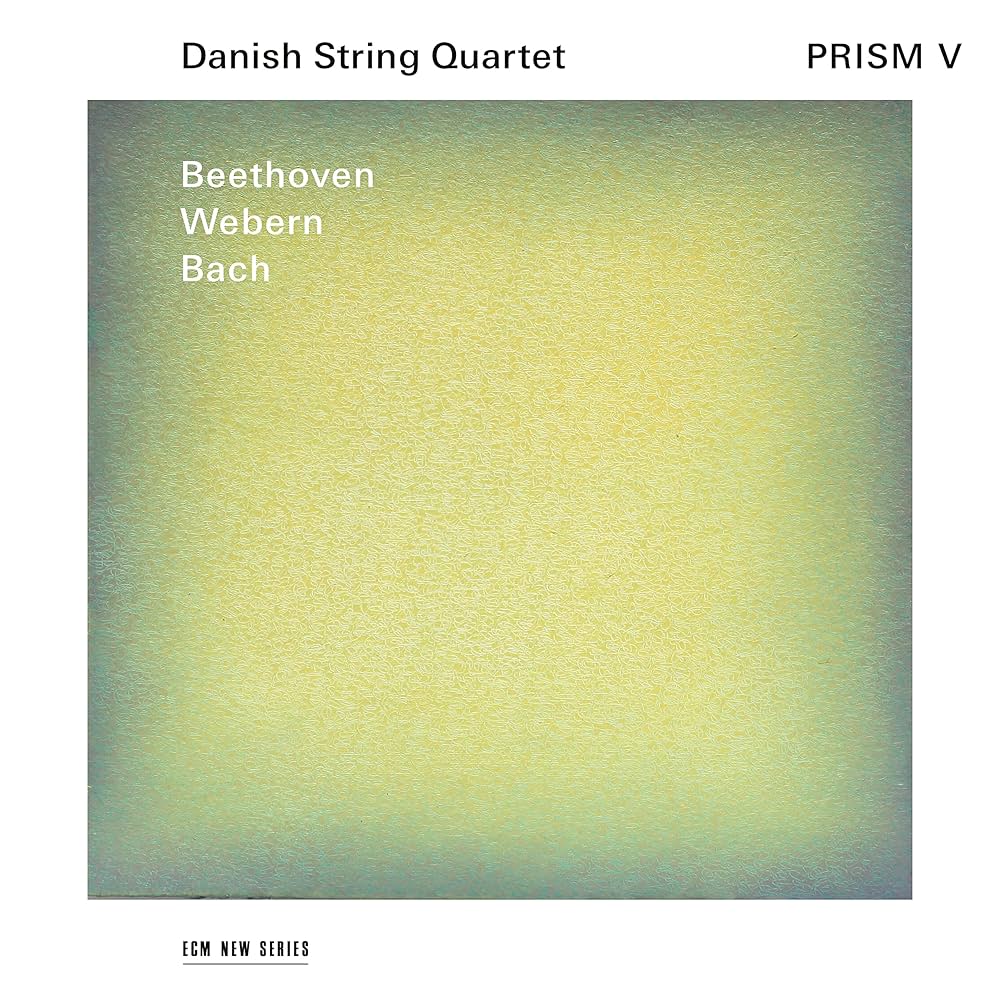
Danish String Quartet
PRISM V
Rune Tonsgaard Sørensen violin
Frederik Øland violin
Asbjørn Nørgaard viola
Fredrik Schøyen Sjölin violoncello
Recorded June 2021
Festsal, KFUM/KFUK, Copenhagen
Engineer: Markus Heiland
Cover: Eberhard Ross
Produced by Manfred Eicher
Release date: April 14, 2023
The Danish String Quartet concludes its nearly eight-year journey pairing Ludwig van Beethoven’s five late string quartets with works by Johann Sebastian Bach and later composers. Looking back, I can’t help but smile at how deeply and patiently the DSQ has fertilized the soil of this project to yield the richness of spring harvest.
As the musicians humbly observe, “Micromanagement is rarely a successful strategy when it comes to late Beethoven.” Therefore, if the music feels almost fiercely detailed, it’s because the relationships between the notes speak up for themselves at every turn. Indeed, it’s impossible to encounter the initial stirrings of the String Quartet No. 16 in F major, op. 135, wherein the composer returns not only to the quadripartite form but also to his astonishment of the past, without blushing. And what, you might wonder, is immediately apparent this time around? Nothing less than the undeniable realization that the late Beethoven deviates from other “standard” quartets of the repertoire (including his earlier own) in how inevitable it feels. Whether in the lucidity of the second movement or the dark pastoralism of the third, every sound takes on a physical appearance. The sheer grit the Danes bring to these contrasts is wonderous. Whereas the faster rites of passage would give little room for personal interpretation in less capable hands, in the present context, they are vessels in which the pudding of proof is artfully mixed. In the final stretch, which begins in gentler territory while also expressing great urgency, the call and response between cello and violins opens the door into a run across an open field where life itself becomes the map leading the way to the other side.
Anton Webern’s String Quartet of 1905 (the second of two he wrote that year) brought about a sea change in the genre. Although played in one continuous 18-minute stretch, it takes on a nominal structure in three sections (“Becoming,” “Being,” “Passing Away”) based on the work of painter Giovanni Segantini. Its shifts between darker and lighter keys, between exhalations and holdings of breath, would seem to mirror Beethoven, while its central fugue casts a shadow further back to Bach. The more one immerses oneself in it, the more fragmentary it becomes. As with the canvases that inspired it, one is tempted to isolate a mountain from land and sky, all the while missing out on the benefit of zooming in further on individual plants, puffs of cloud, and rocky imperfections that can only be described as “hymnal” in shape.
The setting for these diamonds consists of Baroque prongs. Whereas Bach’s chorale prelude, Vor deinen Thron tret ich hiermit, opens the program as one would wake up from a coma only to realize how much the world has not changed, the Contrapunctus XIV from The Art of Fuguereleases its pollen by the light of the moon, windswept in evening breezes to places we cannot touch until our bodies wither. Being unfinished, it ends mid-statement, leaving the remainder to toss about in the waves of our unworthy fancy. Sometimes, the best way to answer a question is by posing another.

 Between Sound and Space: ECM Records and Beyond