

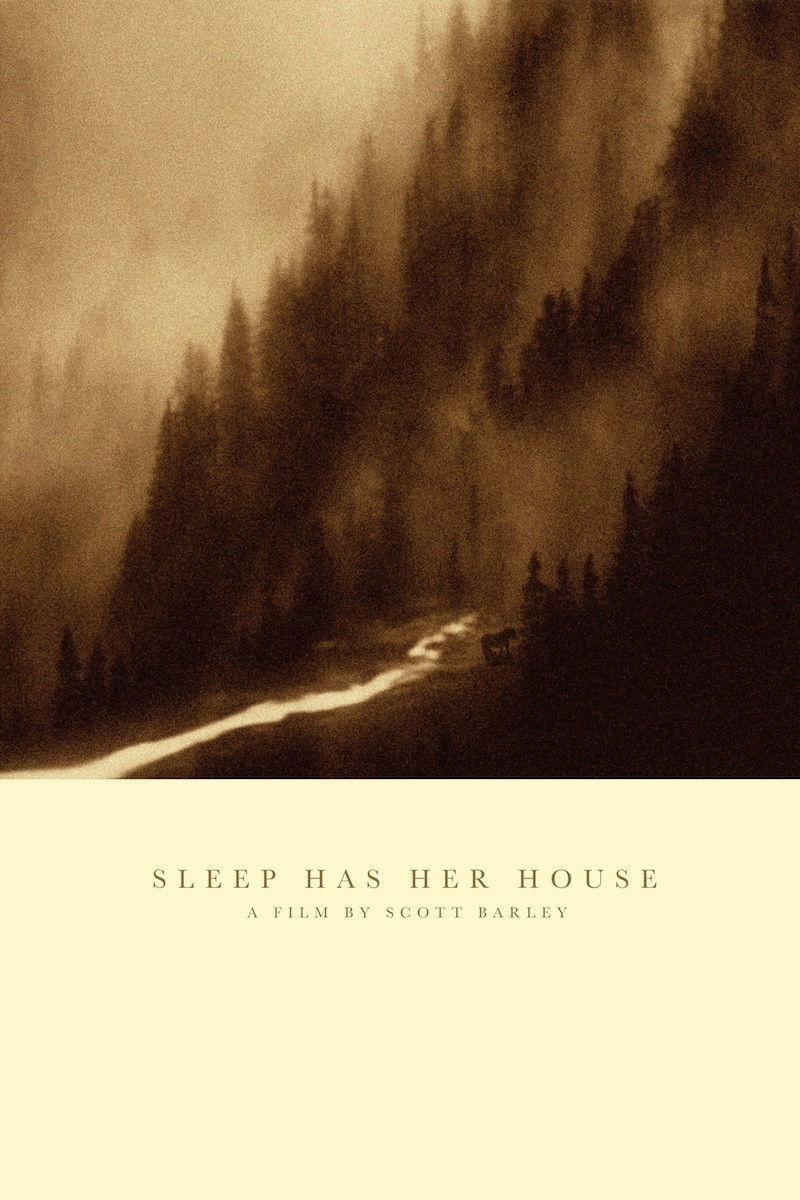
Before anything gathers into form, there is a trembling that does not yet belong to sight, a faint stirring within shadow, as though feeling out the air. What emerges is neither absence nor void, but a density without edges, a field in which something waits without voicing itself. Out of this condition, images condense, hesitate, and drift, carrying with them the sense that they could just as easily recede.
Sleep Has Her House unfolds within this threshold. Rather than presenting a world, it allows one to waver into partial visibility, as though seeing were a fragile event, never fully secured. Movement breathes in long, patient intervals. Light gathers slowly, then loosens, while darkness continues as part of a rhythm with no discernible beginning, only a quiet persistence.
To think of images as things that simply show is to miss the instability at their core. They gather surfaces where perception bends, folds, and slips into itself. What appears carries no fixed boundary. Forms arrive as tremors rather than certainties, flickering into provisional being through an uneasy negotiation between light, duration, and attention.
Filmmaker Scott Barley’s practice is one of attunement, dispersing attention across a field where nothing claims priority. No figure guides the gaze, no arc gathers momentum. Encounters drift into one another with an intimacy that remains strangely indifferent, as though what unfolds were aware of our presence yet entirely unconcerned with it. Nature and cosmology linger less as themes than as atmospheres, conditions in which images gather and dissolve.
The camera ceases to function as an instrument directed outward and instead becomes embedded within what it perceives, a reflexive organ sensing its own act of sensing. Vision loses its hierarchy. Every element hovers on the same trembling plane, significance and insignificance phasing without resistance.
Disorientation never quite arrives. Instead, what fades is the assumption that orientation was ever stable to begin with. In astronomy, averted vision allows faint stars to appear by shifting the gaze slightly aside. Direct sight proves too blunt, too saturated with expectation. The peripheral regions of the eye receive what the center cannot hold.
These images ask for that oblique attention. Meaning glimmers at the margins, appearing only to recede. Darkness becomes both method and substance, a space to inhabit rather than penetrate. Within it, forms hesitate into being: a valley pulses with a faint, unstable strobe as the sensor strains against its limits; mist thickens into a surface that reflects without resolving; an owl lingers in a silence that stretches until it hums.
Jakob von Uexküll’s notion of Umwelt finds an unexpected echo here. Each organism inhabits a world shaped by its relations, a world lived rather than possessed. The apparatus begins to suggest such a realm of its own, raising the question of what it perceives when left alone, and what relations form between grain and the slow erosion of light.
Shot over four days on an iPhone 6, then extended across 16 months through post-production processes that blur the line between motion, stillness, and drawn intervention, the film becomes a layered field. Each image carries the residue of multiple gestures. These layers unfold from within, as though the image were recalling itself into being.
Time resists compression. Events do not assert themselves; instead, conditions gather and disperse. Thus, the viewer is drawn into a circuit where perception gives rise to the image, and the image, in turn, alters perception, an exchange without clear origin or conclusion.
A sense of haunting settles as atmosphere. Light withdraws, leaving behind zones usually passed over behind closed eyes: afterimages that flicker at the threshold of rest, a faint luminescence that persists even when illumination seems absent. These phenomena have always been present, quietly registered and quickly dismissed. Here, dismissal becomes impossible.
The familiar begins to shift under the pressure of sustained attention. A waterfall emerges first as a distant murmur, then as a slow insistence that feels remembered rather than heard. Rock opens its wound, receiving and releasing in the same movement. Water, shadow, and something that cannot be named blend in fragile equilibrium.
Two animals gaze into the dark. Their presence offers no explanation. Their calls dissolve into wind, into distance, into a trace that lingers without resolution. A horse’s eye fills the frame, rain sliding across its surface in delicate, transient paths. The gaze passes through or beyond, as though we occupy a position that cannot be fully perceived.
Trees rise and fall in respiration, each trunk a vertical inhalation, each branch an exhaled uncertainty tracing the air. A lifeless deer rests with a stillness that refuses transformation, its form functioning as a density of matter returning to quiet dispersion. The forest offers no acknowledgment. It neither absorbs nor rejects; it simply continues, carrying within it the slow work of decay and renewal, processes so gradual they dissolve into a single continuous gesture.
Above, stars fracture the sky into granular tremblings. Clouds drift with a weight that feels almost intentional, as though bearing something that cannot arrive, their movement both aimless and exact. Then the sun breaks through with pressure, an overwhelming saturation that presses against the limits of form.
Night returns in long, measured intervals, gathering thought the way night gathers moisture, condensing it into something fragile and momentary. Each withdrawal of light folds back into its own interior. What follows is a thickening.
Sound moves through these images as a quiet force of disturbance. Wind unsettles the trees, bending them into slow, reluctant gestures. Water expands beyond the limits of any attempts to contain it. The camera listens. Light becomes something that resonates rather than reveals. Seeing drifts toward a tactile sensing in which vision no longer dominates but pulses and recedes without hierarchy.
Nothing resolves into memory as something fixed or retrievable. What remains is a condition. The world now feels less certain, as though chemically softened, forms loosening their agreement to remain what they are.
Somewhere just beyond attention, something persists. It does not gather into shape or ask to be known. It lingers as a force without location, a presence that surrounds the space where we might be. It watches without eyes, listens without ears, as if perception itself had slipped free of its objects and continued, alone, in the dark.
 Between Sound and Space: ECM Records and Beyond