Gesualdo: Tenebrae (ECM New Series 1422/23)

Carlo Gesualdo
Tenebrae

The Hilliard Ensemble
David James countertenor
Ashley Stafford countertenor
John Potter tenor
Rogers Covey-Crump tenor
Mark Padmore tenor
Paul Hillier baritone
David Beavan bass
Recorded March 1990, Douai Abbey, England
Engineer: Peter Laenger
Produced by Manfred Eicher

Those who have read my first post on this site will know that my teens marked an important transition in my listening life through the discovery of classical music, in particular by way of ECM’s New Series. At the same time, I found my mind and ears opening to more esoteric forms of musical expression. This, coupled with my growing interest in Japan, led me to discover Haino Keiji, who after decades is still the reigning troubadour of the Japanese underground and whose discography numbers well over 100 albums. During my first trip to Japan in the summer of 1998, I had the honor of attending two of his performances in Tokyo. Haino often likes to spin a CD before he takes the stage, coaxing his audience into a certain mood that prepares them for what they are about to experience. And sure enough, before one of these shows, he was playing a recording of choral music by Carlo Gesualdo (ca. 1561-1613). I had one of the greatest meetings of my life when a contact arranged an informal interview with Haino after the second show. During that conversation, Haino professed his adoration for Gesualdo, which, if you’ve ever heard Haino’s music, may come as something of a surprise. He went on to tell me that, in his estimation, Gesualdo had explored almost every harmonic possibility available to him, and that in so doing had left behind a musical corpus that was in its own way “complete.” I was already quite familiar with the Hilliard Ensemble’s standard-setting ECM recording of the Tenebrae Responsoria and, upon my return from Japan, I went back to this recording with renewed interest, and discovered in it far more than I had ever dreamed. Years later, I find that its mysteries still evade me. By “mysteries” I do not mean to mythologize an already indisputably gorgeous exposition of polyphony, but to uphold it as a singular testament of a troubled soul.

The details of Gesualdo’s life are likely familiar to anyone who has delved even briefly into the biographies of the Renaissance’s most revered composers, for in 1590, the Neapolitan-born nobleman would stain his reputation with the blood of his first wife, who he had murdered along with her not-so-secret lover in the throes of what they believed to be a clandestine passion. According to some researchers, his second infant son—whose paternity Gesualdo may have doubted—also fell victim to his indignation. In spite of his heinous crime(s), Don Carlo’s noble rank as Prince of Venosa absolved him of any and all legal repercussions, though as a precaution he relocated from Naples to a private residence in Fererra, where he would meet and marry his second wife before returning to his castle. Their marriage was not a happy one, and Gesualdo was plagued by depression after the death of their son in 1600. Speculations abound as to the nature of this depression, though the evidence suggests he’d been confronting the specter of his past deeds. These responsories for Holy Week were to be his final compositions, and their Passion texts deal appropriately with crucifixion and betrayal, reflecting the inner turmoil of a mind in decline.

I somehow feel it would be a disservice to Gesualdo to single out any particular responsory over the rest, just as it would be impossible to single out any of the tears I imagine were shed in his lifetime. Every piece blossoms with the unstoppable force of nature, even as it questions that very nature for having driven a man to such extremes. The music is knotted with gut-wrenching and unbridled honesty. It is a wellspring of supplication into which one never dives and from which one never emerges, filling one nostril with the stench of death and the other with the perfume of remorse. It seems to puncture holes in the sky and thread through them a most painful confession that supersedes our peripheral constellations. The music also has a peculiar quality that I can only describe as an “ascendant descension,” as it always seems to reaching toward some semblance of God, even as it feels itself being pulled underground, so that by the end its identity has been torn and exists in neither place. This would seem to be the nature of Gesualdo’s repentance: one that dissolves rather than resolves. The tectonic plates of his chosen texts shift beneath their execution. Even in the greatest moments of upheaval they retain earthly shape. The final Miserere alternates between recitative polyphony and monophonic chant, animating the formless into the material. This pattern continues until the final chant disappears into the darkness: a star that burned out millennia ago, but which only now blinks from the sky unnoticed.

It’s difficult to imagine the Hilliard Ensemble sounding better than they do here in their duly magnified incarnation. The addition of Ashley Stafford broadens the already heavenly palette of David James, and both of them form the shining sun in the center of this choral zodiac. The performances are replete with unpredictable key changes, rhythmic anomalies, and luscious morphological details, so that every word seems its own composition, bound to its neighbors by a narrative that may only be divinely understood.

Just last night I was present at a live performance by Pomerium in the beautiful acoustics of St. Patrick – St. Anthony Church in Hartford, Connecticut, where they sang two of the Gesualdo responsories in a program of carefully chosen mannerist music. Finally hearing Gesualdo live brought a whole new understanding of the tortured drama that binds them. Like the Hilliards, Pomerium’s conductor Alexander Blachly has been a tireless champion of music that is both well established in the repertoire and that which begs exposure. If anything, his fantastic ensemble taught me one thing: music from even the most despicable circumstances can indeed transcend those circumstances through each new listener. The power of collective musical ablution may have no equivalent, but in this recording we get to experience just that in solitude.

<< Keith Jarrett Trio: Tribute (ECM 1420/21)
>> Gavin Bryars: After the Requiem (ECM 1424 NS)

Veljo Tormis: Forgotten Peoples (ECM New Series 1459/60)

Veljo Tormis
Forgotten Peoples

Estonian Philharmonic Chamber Choir
Tõnu Kaljuste conductor
Recorded February 1990, Tapiola Church, Finland
Engineer: Peter Laenger
Produced by Paul Hillier

“I do not use folk song, it is folk song that uses me.”
–Veljo Tormis

During the final years of the Soviet occupation in the Baltic states, Estonia took charge in a characteristic way by staging a series of peaceful demonstrations in demand of sovereignty. These came to be known as the Singing Revolution. Two high points of this resistance revolved around the annual Song of Estonia festival, held in the capital city of Tallinn. On 11 September 1988, 300,000 citizens gathered in solidarity and sang old songs until sunrise, uncaring of the reproach such a blazon act might incur. During the same festival the following year, and with a similarly sized crowd surrounded by armed Soviet troops, voices broke out into the Estonian national anthem, still forbidden under the current communist regime. Throughout this censorious period, composer Veljo Tormis found his politics nourished by song, as evidenced in the ban of his more passivist compositions. Yet despite this censure, if not because of it, Tormis’s music only gained popularity. At the heart of his compositional output, containing some 500 choral works, is the regilaul, a song form stemming from the oral traditions of the Balto-Finnic peoples. Regilaulud are distinguished by their call-and-response structure, but add a unique twist: a soloist’s line is taken up at the last word by the chorus, while the chorus’ last line is subsequently taken up by the soloist, thus creating a musical “chain” to which any number of dynamic elements may be linked.

The music of Tormis, who retired from composing in 2000, nevertheless continues to thrive in worldwide performances and recordings such as the one under review here. One unfortunate side effect of this increasing popularity is the way in which the Estonian composer has become romanticized. Many reviewers—which, to be fair, often have only scant liner notes to work from—paint a rather Bartókian image of Tormis: the heroic anthropologist trekking through outlying villages in order to rescue the final vestiges of their oral culture by preserving them in a more widely accessible form. Although Tormis did some minimal fieldwork, and even then only as compiler, he relied heavily on the extensive and no less significant collections of Finnish and Estonian language institutes and university archives. Nevertheless, Tormis holds to his source material as something to be nurtured. As the famous quote above implies, he sees himself as a mediator and advocates a syncretic approach, which takes into account not only the song’s “original” function, but also its new setting and (re)presentation.

Unustatud rahvad (Forgotten Peoples), written between 1970-89, is Tormis’s magnum opus: a collection of 51 songs, each one more immersive than the last, divided into six cycles representing the Livonians, Votians, Izhorians, Ingrian Finns, Vepsians, and Karelians. The first of these, Liivlaste pärandus (Livonian Heritage) is also the earliest, and shows a composer searching for his own voice in the voices of others. Its melodic structures comprise a deft blend of chromatism, orthodox chant, and sustained drones, across which monophonic lines are drawn with careful textual attention. Herding calls, an amusing satire of patrilineal inheritence, and one content little mouse all play equal roles in this colorful set. The seven pieces that make up the Vadja pulmalaulud (Votic Wedding Songs) bristle with more overt regilaul qualities. Their cyclical structure seems to underscore the matrimony at their center. Every aspect of the celebration falls under the music’s watchful eye: from the “Arrival of the Wedding Guests,” through the obligatory “Mockery Singing” and dowry distribution, to the charming “Praising the Cook,” which reminds us even in the most heightened moments of frivolity to acknowledge those whose hard work have made that frivolity possible. In these songs, one can almost smell the provisions, feel the textures of the fibers being worn, feast upon the gentle lay of the landscape and the solid colors of the architecture, which linger in the senses long after the final decrescendo. What follows is the longest and most dramatic cycle. Isuri eepos (Izhorian Epic) begins with a creation myth and launches into a retrospective of Izhorian principles, divine musings, and customs. Women’s voices dominate here, both in the singing and in the narration, adding an emphatic power matched nowhere else in the entire collection. Ingerimaa õhtud (Ingrian Evenings) is more domestic in both feeling and content, focusing as it does on the mundane pleasures of village life. A bare sense of rhythm and unwavering inner energy lend these songs a rustic flavor that speaks directly to the heart. Vepsa rajad (Vepsian Paths) consists of fifteen children’s miniatures. The songs exist only in fragments, but their brevity only underscores their joyful evocativeness. Highlights include the delightful “Pussy-cat,” which purrs and meows just as one might hope, and the melodic but bittersweet “Forced to Get Married,” with its gorgeous glissandi from the sopranos and motherly alto responses. Finally, Karjala saatus (Karelian Destiny) presents us with five examples of Tormis’s most profoundly developed choral sensibilities, culminating in the masterful “Lullaby,” with its promises of comfort and salvation.

This is a culturally and musically important collection sung by one of the world’s finest vocal collectives. The Estonian Philharmonic Chamber Choir seems to have a limitless supply of breath. Yet while this music certainly does draw in faraway listeners, it also casts a powerful cultural message into a world that had shunned it for so long. This is part of what makes Forgotten Peoples so potent. By the same token, Tormis himself has said that his “promotional” approach to folksong is just as instructive to his own people as it is to the global market, which may or may not see his music as little more than a niche to be filled. He is not advocating a revival, nor is he looking to return to way of life forever lost. Rather, he is using his music as a way of claiming these songs for his own, in the hopes that others will feel them as theirs. Either way, the astoundingly committed performances and ECM’s well-balanced recording—itself significant for having been produced before Estonia regained its independence—ensure these peoples will be anything but forgotten.

For the most balanced perspective on Tormis available in English, I cannot recommend highly enough Mimi S. Daitz’s insightful book Ancient Song Recovered: The Life and Music of Veljo Tormis, from which some of the information for this review was gathered.

<< Louis Sclavis Quintet: Rouge (ECM 1458)
>> Edward Vesala/Sound & Fury: Invisible Storm (ECM 1461)

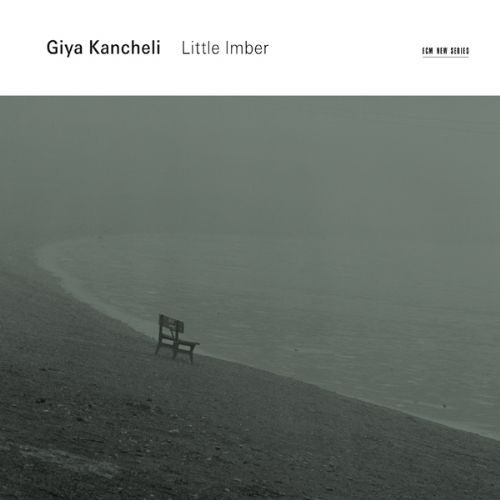
Giya Kancheli: Little Imber (ECM New Series 1812)


Giya Kancheli
Little Imber

Nederlands Kamerkoor
Raschèr Saxophone Quartet
Klaas Stok conductor
Mamuka Gaganidze voice
Zaza Miminoshvili guitar
Matrix Ensemble
Rustavi Choir
Children`s Choir
Recorded May 2006 at Waalse Kerk, Amsterdam (Amao Omi)
Recorded August 2003 at Imber Village, Salisbury Plain, Wiltshire (Little Imber)
Children’s Choir recorded October 2003 at Georgian Records, Tbilisi
Recording supervisor: Giya Kancheli
Produced by Manfred Eicher

“There is this saying that beauty will save the world. But who will save beauty? I think when you sit down at the piano and write music you are trying to do just that.”
–Giya Kancheli

During a total eclipse, there is only a small window of opportunity to watch the event with the naked eye when the moon has completely covered the sun, leaving a corona visible in near darkness. After totality is achieved, the first bead of sunlight peaks beyond the shaded moon in a phenomenon known as the Diamond Ring. This is the moment when viewers must either look away or otherwise protect their eyes. The two pieces on this album are very much like an eclipse, except that they are filled with Diamond Rings, moments of sheer musical intensity that blind the mind’s eye with their urgent desire to be heard.

Amao Omi (2005), the title of which translates to “Senseless War,” is uniquely scored for mixed choir and saxophone quartet. Through an exceptionally unified palette, quartet and choir echo one another in a microtonal journey of ascents and descents. The reeds are played by the phenomenal Raschèr Saxophone Quartet and recorded so as to become an extension of the voices, and vice versa. Like much of Kancheli’s music, Amao Omi swells to moments of dynamic rapture before quickly retreating into quiet solace. Often the choir and the quartet exchange roles: one passage finds the choir bolstering a series of saxophonic solos, while the next finds the latter in a more supportive role as the choir hangs its linear melodies in the airspace above. In those brief moments when the voices do shine their light, the effervescent nebula of the piece bursts into solar flares. Yet rather that shield ourselves from the glare, we willingly open ourselves to it.

Once in a great while, there is an inexplicably effective merging of sound, place, and intent that turns one’s heartstrings into music. Little Imber (2003) is one such composition. In June of 1944, the village of Imber, in Wiltshire’s Salisbury Plain, was evacuated as a strategic training ground for German-bound US troops. Its residents were never able to return, despite repeated protests before and after the war. To this day the village remains in the hands of the Ministry of Defence, which opens Imber’s St. Giles church once a year on the Saturday closest to the feast day (September 1) of its patron saint. Because the performance here was captured in that very church, this isn’t simply a landmark recording, but more importantly the recording of a landmark. The piece is scored more expansively than Amao Omi, though by no loss of intimacy, for small ensemble, voice, children’s and men’s choirs, and uses as its core text an anonymous poem about Imber:

Little Imber on the Downe,
Seven miles from any Towne,
Sheep bleats the unly sound,
Life twer sweet with ne’er a vrown,
Oh let us bide on Imber Downe.

The verse ends the piece on a bittersweet note, resounding with playful verve in the children’s voices before being taken up more somberly by the adults. Captivating solos from Georgian singer Mamuka Gaganidze take Little Imber to even greater heights and clearly manifest the music’s global reach.

When traversing the Kancheli landscape, one can always expect to come across something familiar. He makes use of weighty pauses to ensure that moments of resplendence never develop too far, lest we lose sight of the central path from which they deviate. Staying to true to that path is a spiritual task, and it is only to our benefit to keep our feet moving forward.

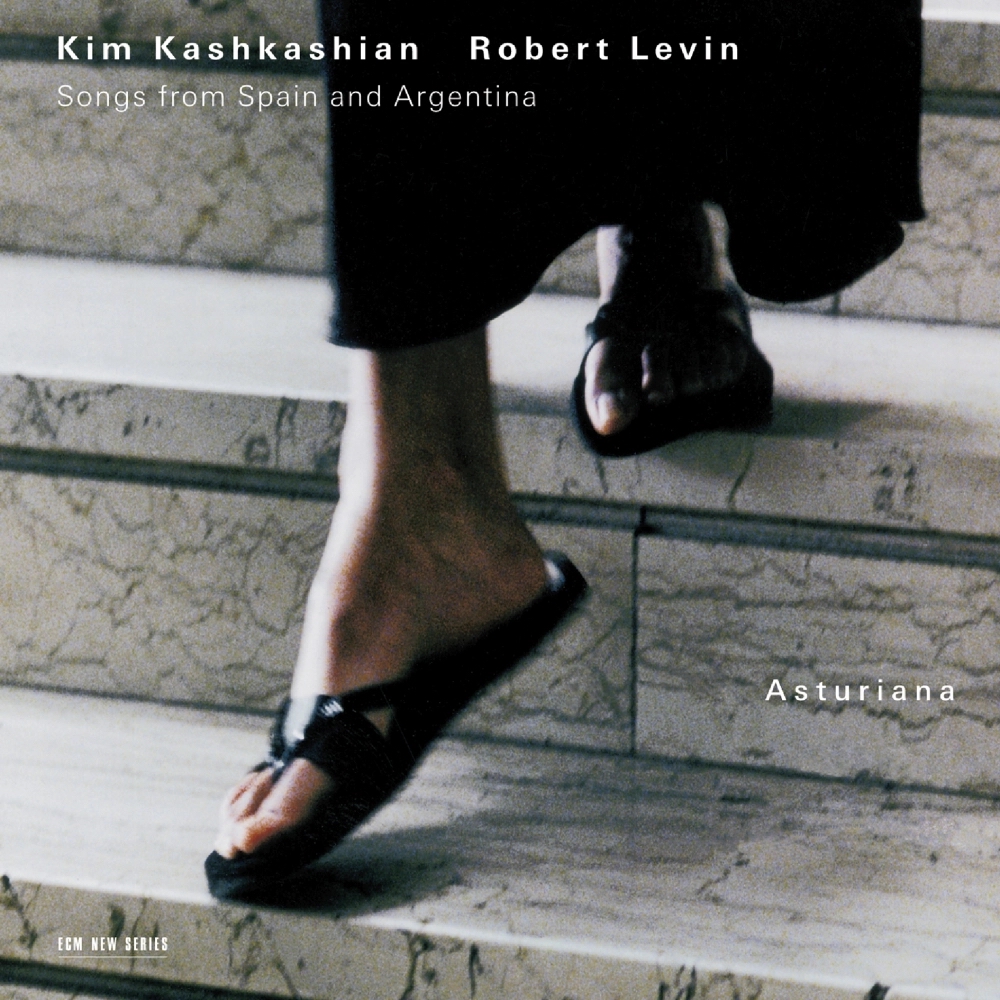
Kim Kashkashian/Robert Levin: Asturiana (ECM New Series 1975)

Asturiana: Songs from Spain and Argentina

Kim Kashkashian viola
Robert Levin piano
Recorded August 2006, Radio Studio DRS, Zürich
Engineer: Stephan Schellmann
Produced by Manfred Eicher

As it opened, the rose embraced the willow.
The tree loved the rose so passionately!
But a coquettish youth has stolen the rose.
And the disconsolate willow weeps for it. Ah!

What can we know of a text when its words are taken away from us? Is it forever lost, or does its ghost still linger? Do we simply replace it with another, or do we revive it in another form? In an expansive and carefully thought out program of Spanish and Argentinean folk songs adapted by a handful of famous and not-so-famous composers and arranged here for viola and piano, the subject of this review provides a simple answer to these questions: all of the above and more. The songs on Asturiana may be without words, but they want for nothing in communicative power. The booklet contains English translations of every song being rendered, if not sung, through Kim Kashkashian’s flawless touch and Robert Levin’s colorful accompaniment, thereby allowing us direct access to each melody’s interior life.

The title of Asturiana comes from its opening song, set by Manuel de Falla (1876-1946) as part of his Siete canciones populares españolas, and is probably the most well-known melody among the album’s twenty-three. This is also the first of three songs that appear twice, each time in a differently nuanced performance—the others being the whimsical “La rosa y el sauce” by Carlos Guastavino (1912-2000) epigraphed above, and heartbreaking “Triste” by Alberto Ginastera (1916-1983) from the fellow Argentinean composer’s Cinco canciones populares argentinas. The latter tells of a shunted lover who has only the shaded pool where he once gave his heart, and which now only reflects the face of a dejected man. Four songs by Enrique Granados (1867-1916) dramatize the loves of majos and majas, denizens of Spain’s lower class. From Xavier Montsalvatge (1912-2002) we get four of the Cinco canciones negras, which look beyond the composer’s Catalonian roots to the West Indies for their inspiration. Avid Mompou listeners will find much to admire in Montsalvatge’s melodic density and personal flair. Then comes the full cycle of de Falla’s Siete canciones, where the title track makes its cameo. Of these, “Jota” is the most exuberant and brims with the blissful naivety of young love, while Kashkashian’s rendition of “Nana” touches the heart as tenderly as any singer ever could (having sung some of these pieces in concert with classical guitarist Joseph Ricker, I can personally attest to this statement). After de Falla’s masterful arrangements, Ginastera’s “Triste” is reprised, followed by a selection of songs by Guastavino. These are the most poetic of the verses represented here, carried along by an almost mystical interest in naturalism and magic. The two final songs by Carlos López Buchardo (1981-1948) speak of deep communication and love’s self-destruction in the same breath.

These timeless, and timely, melodies come to life in Kashkashian’s utterly capable hands. As such, they become more than adaptations, but journeys into the heart of song. Kashkashian’s viola resonates like a deeply exhaling lung, and leaves us just as breathless. If the shortest distance between two points is a straight line, then her musicianship is the straightest line one could possibly drawn between the listener and the music contained on this superlative CD. May she never stop singing.

Heinz Holliger/Clara Schumann: Romancendres (ECM New Series 2055)


Heinz Holliger
Clara Schumann
Romancendres

Christoph Richter violoncello
Dénes Várjon piano
SWR Vokalensemble Stuttgart
SWR Stuttgart Radio Symphony Orchestra
Heinz Holliger conductor
Recorded February 2008, Auditorio Radio Svizzera, Lugano (Romanzen, Romancendres), and July 2007, Stadhalle Sindelfingen (Gesänge der Frühe)

Romance and ashes: not only do these two words comprise the portmanteau that is this album’s title, but they also describe the makeup of the music therein. We may easily praise Romancendres for the ingenious and fascinating concept that lies behind it, and would certainly be far from wrong in doing so. Yet we do well to recognize the passivity of its subjects who, having themselves returned to ashes, continue to inspire “romance” in countless listeners as the unwitting inspiration for new explorations in sound. Much of the album’s genesis stems from a fortuitous confluence of personages and events surrounding the year 1853, when a young Johannes Brahms first visited the Schumanns in Düsseldorf and the symptoms of Robert’s mental breakdown would soon become too obvious to ignore. The latter was, of course, the source of much dismay for his wife Clara, who even took to burning some of his final compositions for fear of tainting his legacy. From these biographical anecdotes Heinz Holliger has pieced together an audio scrapbook of cold facts and suppositions, culminating in a sort of verbal and instrumental detection that defies category.

Clara Schumann was perhaps the most underrated composer of the nineteenth century, albeit one of its most hailed performers. Her 1853 Drei Romanzen—originally for violin (swapped here for cello) and piano—are as enchanting as can be. Richter and Varjón achieve a remarkable separation between their instruments, coming together and separating with the practiced skill of longtime dance partners. The music flows in turns like a bubbling stream or a strong river current, never losing its pastoral edge in the face of more urbane resolutions.

Heinz Holliger’s identically scored Romancendres (2003) gives us a more cryptic, though no less emotive, look back in time. This work seeks to do more than recreate Robert Schumann’s Five Romances, among the handful of pieces silenced by his wife’s hands, and which exist only as they are described in a letter from violinist Joseph Joachim. Rather, they become a meticulous and bipartisan slog through the pathologies of both spouses. As if to make this duality clearer, the piano is played as much on its inner strings as it is topically, making for a subtle effect that is soon vanquished when the music snaps and looses its hidden energies. The playing, like the music, harbors a finely nuanced amalgam of sanity and infirmity. Having listened to this album numerous times, I’ve come to notice that the transition from Schumann and Holliger is hardly apparent anymore. In spite of the surface-level differences between the two, a like-minded connectivity remains evident throughout, at some moments interlocking while at others hanging only by a tendon.

In 1853, Robert Schumann composed five piano miniatures under the title Gesänge der Frühe (Songs of Dawn). Though written just weeks before the Romances, thankfully they survived. The original title for Schumann’s pieces was Diotima, the name given to Susette Gontard, with whom the poet Friedrich Hölderlin was in love and who inspired his magnum opus Hyperion. Incidentally, Schumann would write just one more work for piano: the Theme with Variations in E-flat, the central motif of which Schumann believed to have been dictated to him by a ghost, but which was actually one of his own, having made its most recent appearance in the slow movement of his Violin Concerto not one year earlier. A specter would also seem to haunt Holliger’s monumental piece for choir, orchestra, and tape, which takes more than its title from Schumann’s penultimate pieces. A consonant, almost parochial choral riff sits uneasily on a tenebrous drone before bleeding into a veritable gallery of echoes, voluminous peaks, whispered asides, distorted instruments, and percussive threads, making for a Scardanelli-Zyklus in miniature (in fact, this piece dates from 1987, placing it in the latter half of the cycle’s fruition). The orchestra functions as a repository of emotion, releasing its torrential conclusions in the final two movements.

The lack of English translations in the liner notes is somewhat frustrating—as when, for example, voices read off autopsy reports of Schumann and Hölderlin—even if the intent comes through all the same. Either way, this is no mere concept album but an album about concept, one concerned with the vestiges of insanity, destruction, and of the boundless creativity to be found in both.

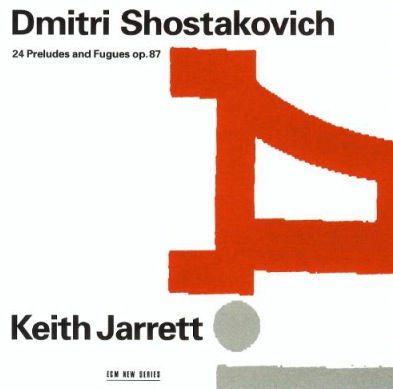
Shostakovich: 24 Preludes and Fugues – Jarrett (ECM New Series 1469/70)

Dmitri Shostakovich
24 Preludes and Fugues

Keith Jarrett piano
Recorded July 1991, Salle de Musique, La Chaux de Fonds
Engineer: Peter Laenger
Produced by Manfred Eicher

“When I first saw these pieces in a music shop, I knew I wanted to play them. I recognized the language. But when I started playing them, they were so close to me that I knew I had to record them.”
–Keith Jarrett

In 1950, during a trip abroad as a cultural ambassador, Shostakovich was treated to a performance of selections from Bach’s The Well-Tempered Clavier by pianist Tatiana Nikolayeva in Leipzig, where the composer had been asked to serve as a judge for the first International Johann Sebastian Bach Competition. Just two years later, Nikolayeva would have Shostakovich’s 24 Preludes and Fugues in hand as their dedicatee for the first public performance in Leningrad. Although one can hardly talk about these pieces without being aware of Bach’s shadow, I think it is precisely Bach’s shadow that Shostakovich is interested in here. In modern parlance one might say these are the “b-sides” of The Well-Tempered Clavier, a record of previously unreleased demos that refused to be lost to time. Like Bach, Shostakovich rallies through a lifetime of moods: from naivety (D major Fugue) to gentility (D major, B major, and F-sharp major Preludes); dawn (E minor Prelude) to destruction (B minor and G-sharp minor Preludes); death (F-sharp minor Fugue) to joy (E major and B major Fugues), resplendence (the standout A major Fugue), and playfulness (A-flat major Prelude and Fugue, B-flat major Prelude). The overall tone, however, is one of exuberance. Whenever this music isn’t dancing, it’s waiting to pick up its feet and resume. The carefully laid out balance of the entire work is clear not only in the distribution of slow and fast movements, but also in Jarrett’s dynamic pianism. He excavates the keyboard like an adult unearthing a time capsule buried as a child—such is the nostalgia folded into every note. From the punctuational bass notes of the E-flat minor Prelude to the poignancy of the F major Prelude and the smooth legato phrasing of the Beethovenian G minor Prelude, Jarrett negotiates a wealth of obstacles with the kind of fluidity that can only exist behind closed eyes. Moments of dissonance creep in only briefly, as if to remind us of perfection in that which is imperfect.

This is incredibly insightful music played by a musician who seems to see more in it than Shostakovich himself. In bearing his heart to us, Jarrett also bears the composer’s. Not only do Shostakovich’s 24 Preludes and Fugues make up one of the most important works of the twentieth century, but Jarrett’s performance and ECM’s flawless production also turn them into one of its most important recordings. Need I say more?

<< Keith Jarrett Trio: Bye Bye Blackbird (ECM 1467)
>> Kancheli/Schnittke: Vom Winde beweint (ECM 1471 NS)

Ambrose Field/John Potter: Being Dufay (ECM New Series 2071)

Being Dufay

Ambrose Field composer, live and studio electronics
John Potter tenor
Recorded 2007, Bishopthorpe, North Yorkshire, UK
Mixed 2008 at Rainbow Studio, Oslo by Manfred Eicher, Ambrose Field, and Jan Erik Kongshaug
Produced by Manfred Eicher

As one of Renaissance music’s most beloved figures, Flemish composer Guillaume Dufay (1397-1474) has been represented through a slew of fine recordings from such groups as the Hilliard Ensemble, the Medieval Ensemble of London, and Pomerium. Though known more for his sacred works, Dufay’s secular chansons find new life here in English electronic composer and performer Ambrose Field’s awe-inspiring soundscapes, with the Hilliard Ensemble’s John Potter at their center. Potter recorded a mere eight minutes of actual singing for an album just shy of fifty, and from this throated nucleus Ambrose Field has cultivated a lush molecular accompaniment.

Potter sings an alluring chanson, bathed in a tender drone, in the introductory Ma belle dame souveraine. Both the melody and its nebulous aura seem to come from a distance. This is one of the more minimal arrangements on the album and as such carries us gently into its unique sound. Je me complains boasts a more pronounced electronic presence with its flanged vocal samples and extended metallic fades. It feels very digital, ending in a viscerally epic swell of synthesized chords amid a fine weave of heavily processed voices. Being Dufay begins with a highly processed and extended vowel, and from this Potter emerges with a more clearly articulated “live” form of the same, spinning from this massive jumble of threads a clearly discernible path for us to follow. Certain phrases become looped before being swept away in a tide of reverb. This density soon relaxes into an even deeper stretch of sound as Potter’s samples flit in and out of view until he reemerges from the cosmic static to gently hang his melody from the clouds. Je vous pri comes into being like a resuscitated lighthouse, not so much piercing as caressing the darkness with its fortuitous light. Along with Je me complains, this track is most effective at shifting between Potter’s solo passages and their ghostly afterlife. It’s also teeming with distinctly organic sounds, as hints of percussion, water, and wind are carefully placed throughout. This ends in a swirl of repeated motif, caught like a song fragment in the net of time before being hoisted out of earshot. Presque quelque chose is an electronic interlude, hovering just beyond the threshold of life and bringing with it the promise of a singer’s dream. Sanctus is built around a sacred chant, undergirded by a bass note that cuts out like a broken radio. Potter’s voice morphs into that of a woman (an effect achieved through Ambrose Field’s painstaking digital modeling), filling the space with a virtual choir. La dolce vista is very much like the first track, giving Potter’s voice full reign of its territory as it glides into finality.

In these settings, one can really appreciate the well-roundedness of the chosen melodies. This isn’t Dufay in outer space, for there is still something undoubtedly earthly about all of this. Even so, the album may not be for everyone. Avid listeners of electronic music may feel more at home, while Renaissance purists may find the electronics outrageously intrusive and might prefer an ensemble of carefully chosen instruments. Yet I believe this album strikes a happy medium between two forms of musical expression that are not so entirely different from one another, and I would encourage even the most reluctant to immerse themselves in its wonders.

This is a conceptually stunning project, one founded on the melodic strength of its source material. In a day and age filled with debates over authenticity and scholarship, and in which so much of the music we have from the early Renaissance survives only in fragments or without clear indication of tempo or arrangement, how refreshing it is to see two musicians taking a strikingly different approach that is no less attuned to the spirit of the music, allowing it to freely wander its own contours without having to fit into those of another. Ambrose Field’s electronics are not “supportive.” Rather, they are an audible extension of something in the music itself and in Potter’s exquisite voice. Regarding his compositional process, Ambrose Field says:

“Whilst being important for my work, I have a general dislike of computers, preferring to find the right sounds first instead of undertaking extensive processing later. This can be a lengthy activity, but has the result that the electronics here highlight the contributions of humans, rather than machines.”

This isn’t just humility, for his statements are clearly evident in his respect for the tactile feel of analog equipment. The combination of digital and analog sounds strikes a fine balance between the former’s “cooler” tendencies and the latter’s heavy warmth, making for an overall effect that is, well, ambrosial.

These pieces are the exact opposite of timeless, beautifully enmeshed in their contemporary technology, be it a band of minstrels, a church choir, or, in this case, an ocean of electronic information. In Dufay’s time, these songs were the supreme form of sound manipulation. They worked in real time, pulsed with an immediacy that required only a willing ear. And in today’s audio landscape, electronics have become equally ubiquitous. We are therefore privileged to hear Potter’s voice unmasked in such unobtrusive company. Even in the longest stretches of synthesized sound, Potter’s presence haunts and provides the foundation for much of the synthetic drive, so that we are never too far from the vulnerable pulchritude of the human voice.

For the sake of live performance, filmmaker Michael Lynch created seven short subjects, one for each of these pieces, from which we are given only a few screen shots on the official site, and which one can sample below. Perhaps a DVD is in order?

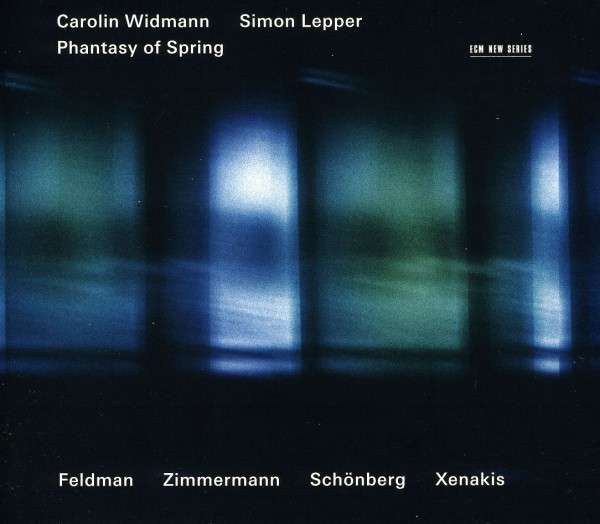
Carolin Widmann/Simon Lepper: Phantasy of Spring (ECM New Series 2113)


Phantasy of Spring

Carolin Widmann violin
Simon Lepper piano
Recorded October and December 2006 at Kölner Funkhaus
Engineer: Stefan Hahn
Executive Producer: Harry Vogt
Co-production ECM/WDR

In order to approach this album, we might ask ourselves: What is spring? While it is popularly associated with rebirth, if not a certain rise in sexual energy and interest, spring is also a prime season of mischief, one in which creatures great and small awaken from their slumber and do their best to placate their raging hunger. And just what does this have to do with this album’s diverse program? Precisely this: the above interpretations are the result of socially bound, and therefore limited, understandings of nature. The four composers represented in this program, I think, understood this in each his own way. And so, while these pieces may seem on the surface to be at most tangentially connected, they are in fact bound by a fearless approach to fallacy.

Morton Feldman’s Spring of Chosroes (1977) is an ideal opener in this regard. While it is the sparest, it suffers no lack of density. The aired spaces are gravid, deeply informed by Feldman’s idiosyncratic sense of time and the performances of our two musicians. Composer Bunita Marcus offers the following insight into the title of Feldman’s enigmatic piece:

The Spring of Chosroes was a sumptuous carpet reputed to have been made for the Sassanian King Chosroes I (sixth-century A.D.). Woven with silk, gold, silver and rare stones, the carpet depicted a garden akin to Paradise. The image of this legendary rug remained with Feldman throughout the composition, inspiring the isolated “gems” of sound, the translucent, interwoven harmonic timbres, and suggesting the form of the work.

This knowledge provides us with a fertile avenue through which to approach its sounds. While Feldman’s chamber pieces have often been laced with a charming sort of regularity, in Spring we find this regularity thwarted in favor of a highly stylized form of variation. By “variation” I mean not to imply the presence of any central theme, but use it in the sense of a degree of change: we are simply pointing our microphones to the winds and capturing the first fourteen minutes of melody that come along. Recording engineer Stefan Hahn is delicately attuned to the instruments in his first ECM endeavor. He gives Carolin Widmann a wide spread, placing her pizzicatos into markedly different spaces than their surrounding notes, thereby leaving a trail of musical breadcrumbs for the patient listener to follow. Widmann herself draws out some of the purest high notes I have ever heard from the instrument as she navigates Feldman’s vast array of meter changes (270 in a score of 388 bars) with apparent ease. At certain points Simon Lepper hits the uppermost keys to produce a hollow percussive sound, as if in foil to the violin’s subtle clarity. Clearly, however, this is no conversation in the way that most violin sonatas are. Marcus again:

Even when one instrument plays alone, we do not get the customary impression that the other is waiting to reply. Rather, Feldman is choosing to turn an ear to one instrument, then to the other; and at times we hear both together. It is through this selective listening that Feldman paces the unfolding dialogue.

Thus, what appears dialogic is really just a trick of shifting perspectives. Feldman’s music, while always provocative in its subtle ways, feels more tongue-in-cheek and blatantly contradictory here. Feldman was always adept at peeling away the skin of “academic” music and trying to see what may be lurking behind it, cowering in a corner of its own making. The music puts me in mind of a large, gangly, and awkward creature that has forgotten its way home, but which at the same time possesses such intoxicating beauty as to befuddle anyone it asks for directions.

The opening bars of the 1950 Sonate für Violine und Klavier by Bernd Alois Zimmermann act as a launching pad for an invigorating first movement of Bartókian dimensions. The second movement, though filled with fluttering high notes, is a rather brooding affair and lays its patchwork carefully. The final movement is an exercise in urgent virtuosity, ending with a most unforgettable trill and flourish, as if signing an enormous document with a quill of sound. Lepper works the piano through considerable changes, each of which is traceable back to its originary big bang, while Widmann breathes life into every dance of this spectacular sonata.

Even more erratic, and seemingly uninterested in resolution, is Arnold Schönberg’s opus 47, the Phantasy for violin with piano accompaniment of 1949, which began as a piece for solo violin to which he later added piano accompaniment. As one of his last compositions, the narrative trajectory of Phantasy veers into as many turns as the violin can allow. Tones seem to pull at one another, wrenching a tortured sort of melody from the realm of possibility. The piece works in clusters, an amalgam of “micro-compositions” that achieve unity only by virtue of existing on a printed score, of having a beginning and an end.

With Iannis Xenakis’s Dikhthas (1979), we immediately know we are in uncomfortable territory. The violin dances in circles, skirting the piano’s turgid interior like a mad prisoner. Moments of agreement are few and far between; moments of disagreement do no justice to the darkness; and separations are a given. Yet the piece isn’t as fatalistic as one would think. Like an overt camera zoom in a melodramatic film, the overuse of glissandi demonstrates the instability of note values and draws a jagged line under the piece’s contrived dual identity. Xenakis was one of the twentieth century music’s greatest game theorists. This impassioned performance allows us to experience one of his most intimate strategies as if for the first time.

Even if you have heard any or all of these pieces before, I guarantee these interpretations will give you much food for thought. Widmann’s incredibly fluid approach partners well with Lepper’s more pointillist one, and together they forge as vast a sound palette as one could imagine from a duo. By turns opaque and resplendent, this is a demanding album that should reap great benefits for the repeat listener.

Rolf Lislevand: Diminuito (ECM New Series 2088)


Rolf Lislevand
Diminuito

Rolf Lislevand lutes, vihuela de mano
Linn Andrea Fuglseth voice
Anna Maria Friman voice
Giovanna Pessi triple harp
Marco Ambrosini nyckelharpa
Thor-Harald Johnsen chitarra battente, vihuela de mano, lutes
Michael Behringer clavichord, organ
Bjørn Kjellemyr colascione
David Mayoral percussion
Recorded October 2007 and May 2008 at Propstei St. Gerold

“To my way of thinking, reconstructions are fairly boring. Do we really want to pretend that nothing happened in music between 1550 and today? I think that would be intellectually dishonest. And the notion that people did not deal freely with their feelings until today is not only naive but arrogant.”
–Rolf Lislevand

For their second ECM album, following in the enormous footsteps of the fabulously received Nuovo Musiche, Norweigan lutenist Rolf Lislevand and his ensemble have pulled out all the stops. In polishing these tenacious gems of the Italian Renaissance to a fine sheen for a 21st-century audience, Lislevand has achieved a delicate balance between an illusory authenticity and the finely wrought mesh of his near-obsessive renewal process. The album’s title refers to a practice, common among the composers represented here, of adding ornaments to intabulations of popular madrigals and chansons. Because the melodies being altered would have been familiar to a 16th-century audience but not to a contemporary one, Lislevand has essentially mapped the source melodies onto their flashier counterparts, so that in the end we get a sort of conversation between source and adaptation made manifest in sound and performance.

The Ricercata prima of Vincenzo Capirola (1474 – after 1578) is an enchanting commencement, rendered all the more so for its wordless vocals and emphatic little chime. It is taken from the Capirola Lutebook, a vastly important document in the literature for its technical acuity and didactic pleasures. The works of Joan Ambrosio Dalza (fl. 1508) also survive as a testament to the early development of Renaissance luteny. His Saltarello and Piva make for two of the strongest showings on this altogether fine disc. The saltarello is a lively dance form dating back to the thirteenth century, while the piva was a popular basse (or “low”) dance at court in Dalza’s time. One could hardly ask for finer examples of either, and both scintillate in Lislevand’s invigorating arrangements. Giovanni Antonio Terzi (1560 – 1620) was more vocally inclined, as evidenced by the playful Petit Jacquet, a setting of the chanson by Jean Courtois. Although the words were not so fortunate as to survive, Lislevand simply wrote up his own: Little Jacquet is lost. Little Jacquet is out of sight, they have searched for him all over the place. He drives us crazy. The accompanying rhythmic twists seem to mimic Jacquet’s pitiful state, as well as the confusion his disappearance has caused. Susanne un jour is Terzi’s lute rendition of the chanson by Orlande de Lassus, telling the almost tragic tale of a Jewish woman falsely accused of adultery by two lecherous Babylonian elders when their advances toward are met with her vehement refusal. The last of the Terzi selections is a series of diminutions on Palestrina’s angelic Vestiva i colli and is easily the most beautiful piece on the album. Another standout moment in this eclectic program can be found in the form of La perra mora. Boisterous and joyful, this anonymous piece comes alive with the passionate exposition of its players.

Francesco Canova da Milano (1497 – 1543) was perhaps the most highly regarded lutenist of the sixteenth century. La Spagna, a popular dance tune of the day, saw its title headed by many composers, but of these da Milano’s version in canon was the most enduring, as one can clearly hear. The Recercada settima of Diego Ortiz (c. 1510 – c. 1570) is a sprightly romanesca and comes from a composer whose extant works consist mainly of music for viola da gamba and a large collection of sacred polyphony. His Recercada segunda is a carnivalesque romp through a crowded piazza and the Recercada quinta is a tour de force of virtuosic runs and varied articulation. Thomas Robinson (fl. 1600) is the only English composer represented here, and his Passamezzo Galliard is a stately air that is far from out of place among its present company. Alondo Mudarra (1510-1580), being a Spanish composer, was a proponent of the vihuela, and as such brings an attractive flavor to an otherwise lute-dominated course. His Fantasía que contrahaze la harpa en la manera de Ludovico sets a piece for harp by the enigmatic “Ludovico el del arpa,” minstrel to Ferrando III of Aragón. The anonymous Tourdion, with its echoes of bagpipes and jigs of the northern isles, brings the album to an exhilarating climax.

Diminuito is bathed in the lush acoustics of St. Gerold and sounds absolutely spectacular. The vocal presence of Trio Mediaeval’s Linn Andrea Fuglseth and Anna Maria Friman is to the album’s overwhelming credit, helping to recapture a bygone spirit in territories that instruments alone can only dream of traversing. The accompaniment as a whole is spot-on (the percussionists’ negotiation of inherent hemiolas adds an especially dramatic punch) and one could never praise Lislevand enough for his dynamic sensitivity. This is an album that opens itself further with every listen and one to be cherished for a lifetime.