Herbert Henck: Alexandr Mosolov (ECM New Series 1569)

Alexandr Mosolov

Herbert Henck piano
Recorded March 1995, Festburgkirche, Frankfurt
Engineer: Andreas Neubronner

“I must compose, and my works must be performed! I must test my works against the masses; if I come to grief, I’ll know where I must go.”

These words, written by Alexandr Mosolov (1900-1973) in a 1932 letter to Joseph Stalin, reveal a composer of fierce disposition and ardent dedication to his craft. The young Mosolov, who had already fought for the Red Army but was discharged for PTSD, continued to see himself as an arm of the Revolution. After earning a living as a silent film pianist, during which time he studied music with Reinhold Glière and Nikolai Myaskovsky, Mosolov had made of himself a pastiche of trenchant modernism and preservationist grace. Of equal dedication is pianist Herbert Henck, who places Mosolov’s work squarely at the crossroads of late Scriabin and early Prokofiev, yet imbues this neglected contemporary with a shadow all his own. Despite being a staunch proletariat, Mosolov was met with resistance from the very faction in whose honor he composed. Enemies in the Soviet Composers’ Union even had him expelled for public disorder and sentenced to eight years in the Gulag. Fortunately, he was released after just as many months when his mentors vouched for his character in a bid for his freedom. During his recuperation, Mosolov extended his interest in the music of Central Asia, particularly in the folk songs in Turkmenistan and Kyrgyzstan, where he traveled to enrich his archive.

The 1920s were Mosolov’s most productive period, well represented by the selections offered here. The Sonata for piano No. 2 in B Minor op. 4 (1923-1924) gives us hints of the “futurism” for which he was most known in such orchestral works as Iron Foundry. Where Foundry is thrumming with productivity, the sonata’s contrast of high clusters and low chords reenact a failing industrial landscape. More confrontational than progressive, it treads with ever-heavier footsteps toward a goal it knows it cannot reach. A morose Adagio applies desperation as a cosmetic and admires itself in a mirror of repetition. Resolve is found only in the culmination of silence, from which the finale is reaped like a crop at the height of ripeness. The Two Nocturnes op. 15 (1925/26) constitute a ponderous, if dynamically diverse, pair, seemingly predicated on a traumatic inward glance and sketchable only in tragedy. After the heartrending opening movement of the Sonata for piano No. 5 in D Minor op. 12 (1925), we come to a whimsical aside, which dances like a childhood dream of Shostakovich before twisting ever so incrementally into a cloudy nightmare. The following Scherzo becomes a violent attempt to awaken oneself in a flurry of futile pinches, all tumbling inward into the physiological certainty that reality is so close and all the more unendurable for its lack of self-awareness. A gorgeous final movement coalesces in dense punctuations in the right hand before plunging into a pool of chords with only potential as life preserver.

Performances of Mosolov’s music were restricted until as late as 1985, since which time it has slowly crept into revival. Leading this quiet march was Detlef Gojowy (1934-2008), musicologist and tireless champion of modern Russian music, whose 1979 “Encounter with the Soviet Union” festival first exposed Henck to the previously obscured composer. Once again, Henck has turned his discovery into ours. He nourishes our ears with palpable meticulousness, playing these pieces as if for the first time, which in some ways he is, liberated as they have been from the annals of unwarranted censorship. These modest offerings are continually fascinating, for they always seem bound to a discernible core surrounded by storms of activity. The entire album is an effigy in sound, every musical gesture describing, however much in artifice, the contours, the ligamenture, the structural integrity of a human body whose only purpose is to burn in remembrance of those who once moved of their own accord. This album is truly a most splendid feather in Henck’s multifaceted cap, and a prime example of ECM’s tireless mission to give forgotten music our undivided attention.

<< Giya Kancheli: Caris Mere (ECM 1568 NS)
>> Eleni Karaindrou: Ulysses’ Gaze (ECM 1570 NS)
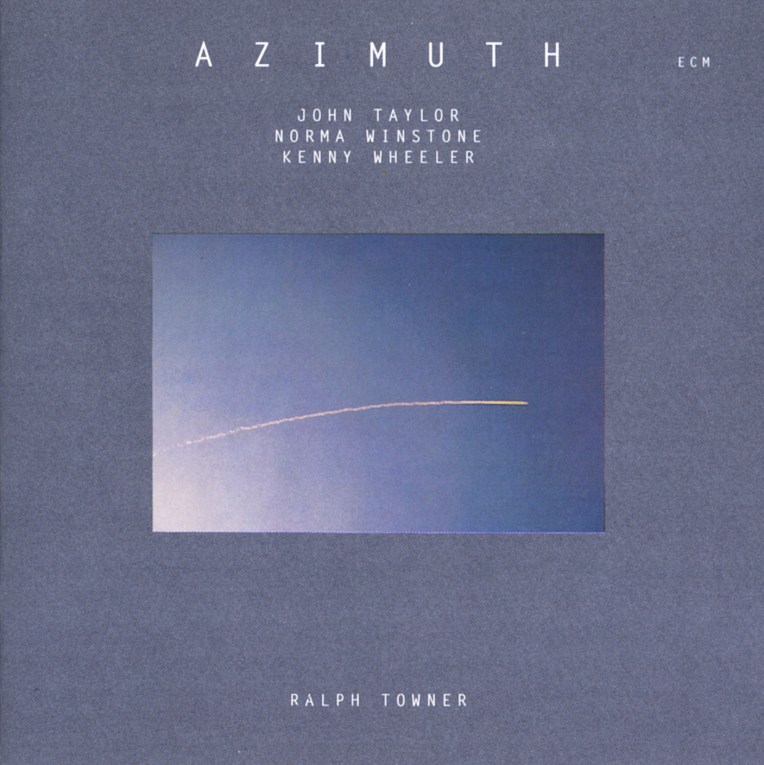
Azimuth (ECM 1546-48)

ECM 1546_48

Azimuth

John Taylor piano, organ, synthesizer
Norma Winstone voice
Kenny Wheeler trumpet, fluegelhorn
Ralph Towner 12-string and classical guitars

Azimuth:
1. The arc of the horizon measured clockwise from the south point, in astronomy, or from the north point, in navigation, to the point where a vertical circle through a given heavenly body intersects the horizon.
2. A group made up of vocalist Norma Winstone, husband John Taylor on keyboards, and trumpeter/fluegelhornist Kenny Wheeler whose music, measured from any point, draws an arc through countless heavenly bodies before intersecting with the enchanted listener.

Azimuth was (and remains) emblematic of the ECM label, marking its timelines from 1977 to 2000 with a handful of indelible punctuations. The group’s characteristically expansive sound was overshadowed only by its utter commitment to the melodic line and the trustworthiness of its expression. In the three albums collected for this timely rerelease, the journeys upon which we are taken are the same as those taken by the musicians themselves. Such immediate correspondence is a rare achievement in any vertical circle, and is to be cherished for its productive honesty.

ECM 1099

Azimuth (ECM 1099)

Recorded March 1977 at Talent Studio, Oslo
Engineer: Jan Erik Kongshaug
Produced by Manfred Eicher

The group that would become Azimuth began its journey on this self-titled album. “Siren’s Song” rests on the forgiving laurels of a repeated motif, gilded by a horn-flanked voice amid pianistic accents. Like a Steve Reich riff dropped in a pool of jazz, it treats the pulse as the animating force of its creation. Wheeler broadens Winstone’s palette in the melodic relays of “O.” The title track is buoyed by a stunningly gorgeous arpeggiator, over which Winstone sets to flight a pair of overdubbed birds. Once they have flown away, Wheeler draws between their pinpointed forms a sinuous trajectory, along which one is able to chart the album’s path with even more fluid precision. The synthetic backdrop builds in scope, turning what might otherwise be a repetitive New Age loop into an elegiac improvisational exercise. The plaintive piano introduction of “The Tunnel” extends this supportive electricity, into which Winstone begins to sow her potent words. Semantics trail off into further meanderings, reminiscent of the previous track, before the backdrop morphs into a stunning change of key. This makes “Greek Triangle,” a curious piece for brass, all the more whimsical for its appearance. Though outwardly incongruous, it breathes with the same focused spirit that animates the whole, thereby elevating it beyond the status of fanciful diversion. It also serves to refresh our palette for the lyricism of “Jacob,” in which Winstone’s braids and Wheeler’s fluid accents close an altogether fascinating mosaic of atmospheres.

<< Julian Priester and Marine Intrusion: Polarization (ECM 1098)
>> Keith Jarrett: Sun Bear Concerts (ECM 1100)

… . …

ECM 1130

The Touchstone (ECM 1130)

Recorded June, 1978 at Talent Studio
Engineer: Jan Erik Kongshaug
Produced by Manfred Eicher

Azimuth’s second ECM effort is also the group’s most enigmatic. The organ that underlies “Eulogy” gives just enough air for Wheeler to glide, and injects all that follows with deep, warm breath. The trio writes a more intimate letter in “Silver,” answered in the unsteady penmanship of “Mayday,” over which our soloists take great care to dot every i and cross every t. The distant muted trumpets of “Jero” mesh with Winstone’s ambulatory menageries. Taylor draws a fluid line through their incantations, ignoring the periphery all the way to the end of “Prelude,” a track so lovely that it makes one want to listen to the album backwards. This is an elusive set, to be sure, filled with quiet, seething power, but also one that builds its nests comfortably over our heads. It can only fly, because it knows no other way to travel.

<< Steve Reich: Music for 18 Musicians (ECM 1129 NS)
>> Pat Metheny: New Chautauqua (ECM 1131)

… . …

ECM 1163

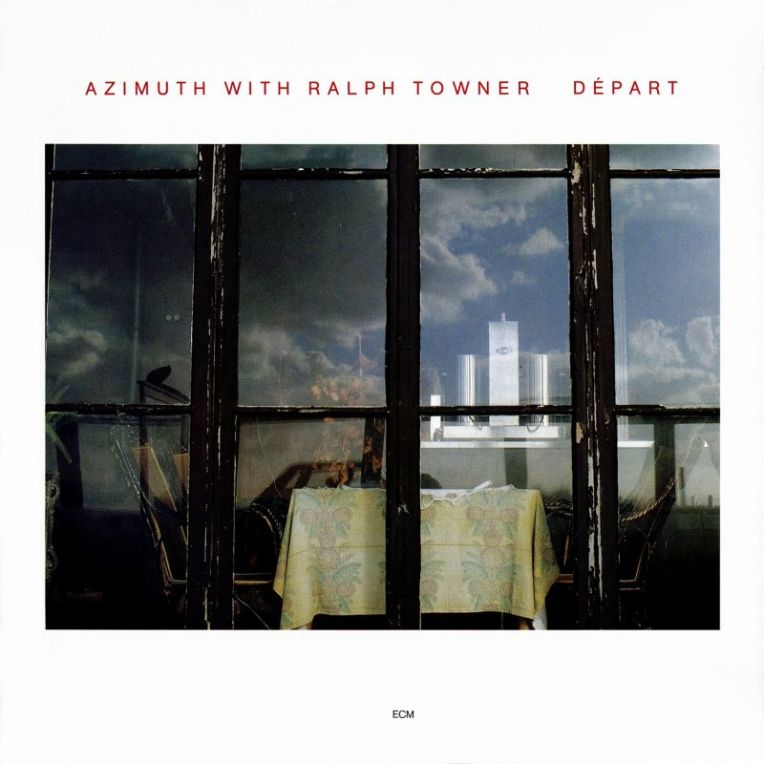
Départ (ECM 1163)

Recorded December 1979 at Talent Studios, Oslo
Engineer: Jan Erik Kongshaug
Produced by Manfred Eicher

For its third outing, Azimuth welcomed the strings of guitarist Ralph Towner. “The Longest Day” opens in Solstice territory, setting out through a drizzle of piano and 12-string. Winstone’s overdubs visualize gossamer veils of more distant storms, while Wheeler’s soulful trumpet shines like the sun beyond them. Winstone takes her voice to unexpected heights, pulling a banner of time across the sky into the contemplative piano introduction of “Autumn.” There is no falling. Rather, we get the stillness of those leaves before they die, hanging on with their last vestments of color as the winds arrive to shake them from their boughs. Winstone hangs words in the air amid Towner’s almost pianistic fingerings and Wheeler’s staccato cries. “Arrivée” is just that, but is one of many destinations in this sojourn. Incising solos leave their wounds, closed at last by the plasma of Winstone’s mellifluous protractions. This is followed by a quartet of so-called “Touching Points,” which further extrapolate vocal information from instrumental sources, and vice versa. Wordless fibers are at once spun and frayed in passages of intense physicality. Towner is put to improvisatory task, adding tentative yet appropriate ornaments of his own. The organ drone of the title track respires beneath Winstone’s dips into thermal bliss. Words spread their branches, wrought in tinsel and blown glass. The album ends with a reprise of “The Longest Day” for piano alone. Resplendent and far-reaching, it is a bittersweet ending to Azimuth’s most fully realized effort, through which the project honed its sound to an art.

Azimuth was one of ECM’s most deftly realized acts, and it continues to open like a slow cloudburst every time I immerse myself in it. Its malleable formula provides seemingly endless room for possibility. Winstone’s voice sparkles in the soft focus of consistently sensitive production, a slowly flapping bird with nowhere to go but up. She and Taylor are ideal partners, forging as they do a silent smolder of emotional bonds, while Wheeler heaves his own powerful feathers with conviction. The brief addition of Tower heightens their collective sound, even as it tethers them to the earth. This is a classic set of three seminal albums, each a movement in a larger suite, where souls can dance in motions so slow that they appear as still as ice, and are just as vulnerable to heat.

<< Sam Rivers: Contrasts (ECM 1162)
>> John Abercrombie Quartet: Abercrombie Quartet (ECM 1164)

… . …

<< Bjørnstad/Darling/Rypdal/Christensen: The Sea (ECM 1545)
>> hr-Jazzensemble: Atmospheric Conditions Permitting (ECM 1549/50)

Heinz Reber: MA – Two Songs (ECM New Series 1581)

1581

Heinz Reber
MA – Two Songs

Kimiko Hagiwara soprano
Dohyung Kim baritone
Junko Kuribayashi piano
Recorded June 1994 at Radio DRS, Bern
Engineer: Hans Küenzi
Produced by Manfred Eicher

Freed from the weight of the will towards expression
things come and go.
where it is,
within us,
like an empty glass,
in which something may be poured at any moment.

Heinz Reber’s premature death in 2007 left a musical gap that is never likely to be filled. The Swiss composer didn’t so much chart new paths as abandon the idea of paths altogether. In their place, he enacted an idiosyncratic (yet unusually selfless) comportment of sound in which bodies, voices, and instruments came to describe their own conditions without academic partitions. All of which makes MA – Two Songs all the more remarkable. In its contradictory impulses, one finds auditory portraits of the Second Viennese School (think Arnold Schönberg, Alban Berg, and Anton Webern) and its tonal expansions, as well as, in the words of one press statement, the “relationship of Asiatic singers to the Romantic song tradition.” Although a fascinating album in its own right, as Reber’s projects usually are, this one bids our total attention in order to appreciate not only its texts and their conceptual milieu, but also the brittle agency of its voices, which breathe with all the beauty of a slow-motion breakdown.

“School of Vienna” lives in the depths of a piano, beyond which we hear only the acrobatic soprano of Kimiko Hagiwara. Her tender blend of forced vulnerability and highly trained exposition make for an especially balanced piece, one that both reifies and breaks everything a prototypical Lied should be. This 20-minute diatribe thus becomes an eloquent statement of its own incremental demise. The high note functions here neither as a point of resolution or fulfillment of expectation, nor as the promissory engagement with the listener through the articulation of a lyrical ploy. Rather, it secures the act of singing into place, each piercing vibrato a lynchpin of a broader vocal image. The language is soft to the aural touch, cautious in its extemporization, playing out the ruse of development with a secretly romantic pleasure before being washed out to sea in a robust waver. “School of Athens – School of Noh” drips upward from finger-dampened strings as baritone Dohyung Kim vocalizes the dramaturgy of Antigone alongside an aphasic Hagiwara. The latter reveals herself in fully sung sentences only in the second half, in which she is foregrounded. All the while, Junko Kuribayashi’s pianistic puffs of air act as pre-commentary to the text, opining on every secretive occasion before it is uttered.

As with the equally visceral Mnaomai, Mnomai, there has been a slippage of interpretation I feel I must address. In his liner notes, Hans-Klaus Jungheinrich notes that the “MA” (intermediate space) of the album’s title is a Japanese ideogram combining the characters for “door” (門) and “moonlight” (月) when in fact the calligraphed Kanji in question is made up of the characters for “door” (門) and “sun” (日), which combine to form: 間. While historically, “sun” could have been replaced with “moon” without any change in meaning, nowadays one will likely only see it as it is portrayed on the cover. A subtle error, to be sure, but one that misrepresents a language that is so often prone to a curious overlay of mystique. I point this out only to clarify the music’s underlying structure, as I personally fail to see the “sublime appeal of alienation” that is supposedly inculcated in these pieces. In a musical context at least, I don’t believe this is what MA is all about. To be alienated, especially at one’s own will, is to consciously set up a parallel space to the one being rejected, which is equally viable in its own nothingness. At any rate, Jungheinrich offers poignant insight when he notes the significance of Reber’s overt challenge in “a time of renascent xenophobia.” The combinations inherent in these pieces are unsettling in the present climate, for they posit music both as an act above the confines of the nation-state and one that highlights its own rootedness in land and ideology. As a historical document, music is already archival the moment it is rendered.

Is this deconstruction, or reconstruction? Refreshingly, Reber frames this question as moot.

<< Keith Jarrett Trio: At The Blue Note – The Complete Recordings (ECM 1575-80)
>> Egberto Gismonti Trio: ZigZag (ECM 1582)

Robyn Schulkowsky/Nils Petter Molvær: Hastening Westward (ECM New Series 1564)

Robyn Schulkowsky
Nils Petter Molvær
Hastening Westward

Robyn Schulkowsky drums, gong, plate bell, crotales, cymbals, bronze bells
Nils Petter Molvær trumpet
Recorded January 1995 at Rainbow Studio, Oslo
Engineer: Jan Erik Kongshaug
Produced by Manfred Eicher

“Grain upon grain, one by one, and one day, suddenly, there’s a heap, a little heap, the impossible heap.”
–Samuel Beckett, Endgame

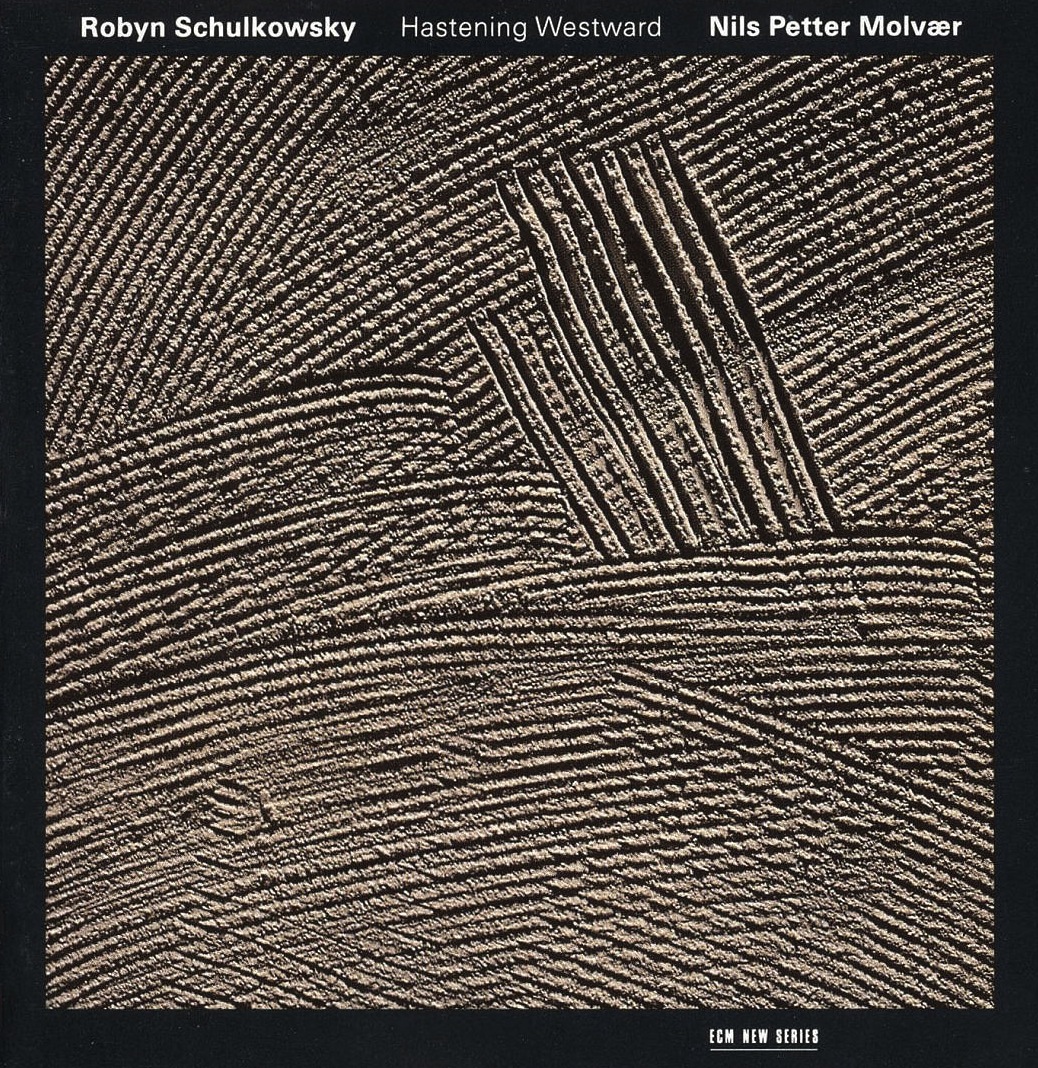
Berlin-based percussionist Robyn Schulkowsky, heard most recently with Kim Kashkashian on Hayren, joins forces with Norwegian trumpeter Nils Petter Molvær for a singular and lasting document. Schulkowsky has worked with some of the biggest names in modern music—Heinz Holliger, Karlheinz Stockhausen, John Cage, and Iannis Xenakis have all benefited from her dynamic breadth and open precision—but her performance style consistently balances humility with fortitude. In 1991, Schulkowsky composed a percussion ensemble piece entitled “Hastening westward at sundown to obtain a better view of Venus.” The title was lifted from Beckett’s final prose work, Stirrings Still, which, aside from being a vastly important book for Schulkowsky herself, sums up the feeling of this “extension” thereof most succinctly. Originally conceived as a solo project, the album was enriched with a snap decision from Manfred Eicher, who introduced Molvær into the mix. The two musicians had never met, but together they described a challenging world that remains effortless to explore.

The album is comprised of two works. Pier and Ocean, in three parts, begins freely, with more explosive drums lying in wait. Its final part is heaviest, shifting from shamanism to survivalism in a single beat. The title work fills out the bulk of the album. Over seven chapters of varying lengths, it takes its first steps in the whitened paragraphs of a wintry page. A lonesome piano airs its grievances in background. Deep drums inhale the air of mallet percussion. Yet no matter how enervated the music becomes, it always looks down at its own feet. Even the timpanic battle cries in Part 3 are laced with melancholy. Part 4 is the album’s most brilliant, as Molvær falls into a spread of echoed clangs, thus inaugurating a psychosomatic transition from rhythm into rhyme. Part 6 sounds like a seaplane landing on a lake, only we are the water receiving its foreign presence with the same yielding attention as we might give to a bird fishing from our depths. The final “hastening” is anything but, a slow drone with metallic percussion and a few brassy notes divinely attuned to the resonance of gongs.

Sadly, this project was never repeated. Considering the unusual confluence of events that produced it, however, a sequel is hardly necessary. Either way, what it has left behind is solid enough to withstand eons of peripheral development. Hastening Westward is a sublime experience that calls to you when you least expect it. It is neither the thrill of the hunt nor the agony of capture, but the single thread that connects them both.

<< Ralph Towner: Lost And Found (ECM 1563)
>> Mozart: Piano Concertos, etc. (ECM 1565/66 NS)

Evan Parker Electro-Acoustic Ensemble: Toward the Margins (ECM New Series 1612)

Evan Parker Electro-Acoustic Ensemble
Toward the Margins

Evan Parker soprano saxophone
Barry Guy double-bass
Paul Lytton percussion, live-electronics
Philipp Wachsmann violin, viola, live electronics, sound processing
Walter Prati live electronics, sound processing
Marco Vecchi live electronics, sound processing
Recorded May 1996, Gateway Studios, Surrey
Engineer: Steve Lowe
Produced by Steve Lake

What’s given:
If ECM had a musical attic, it would sound like Toward the Margins. Not to imply that the Evan Parker Electro-Acoustic Ensemble’s debut is filled with unwanted or forgotten things, but that it exists toward the margins of a human life, its shed skins stacked like boxes above our heads, waiting for a breath to blow the dust away. Parker has been with ECM almost since the beginning, having first appeared on The Music Improvisation Company and subsequently on Gavin Bryars’s After the Requiem, among others. An abiding interest in electronics as an improvisational medium led him to the present project, which draws from disparate disciplines bonded by an infatigable spirit of sound production.

What’s taken away:
Grating strings first clear out the rafters, shafting like light from behind a broken cloud. Parker’s soprano scratches gently at their back. Grumblings and sampled ether flutter and churn, tripping down sand-covered stairs like a creature covered with feet, so that it is always standing no matter how it lands. Compartmentalized echoes share their cubicles with shallow utterances of deeper assignments. Barry Guy’s double bass ties its strings into a tangle of self-awareness as Parker trembles within his own computer-augmented aftershocks. Like a flock of geese in overdrive, he burns in the upper atmosphere before he dares dream of land. Melody is but an afterthought to the sputtering multitudes, caught in the welcoming stare of an unwanted stranger. The overall sound is subdued yet robust. It inhabits the crawlspace of our dreams. The haunting final track lingers in our bones, long after the silence comes, animating a body whose only fear is cogency.

What’s left behind:
Parker is the rare musician who treats improvisation as composition—not so much an offering to the aleatoric gods as a vocabulary articulating its real-time derivations. His saxophonic work is high but far from mighty. He listens more than he plays, as the musicians faithfully tune themselves to a radio signal only they can hear. Washes of precipitation and other climatic changes stipple these aural landscapes, leaving Andy Goldsworthy-like rain shadows in their wake. Sometimes he rolls through rough detours, kicking up sparks and gravel; other times he hovers like an appraising insect, every note a kaleidoscopic cell unfolded into the whole of its vision. As the title makes unabashedly clear, this is an asymptotic experience with nowhere to hide but our ears, and there it burrows, hibernating until the next thaw.

<< Ralph Towner: ANA (ECM 1611)
>> The Hilliard Ensemble: A Hilliard Songbook (ECM 1614/15 NS
)

Federico Mompou: Música Callada (ECM New Series 1523)

Federico Mompou
Música Callada

Herbert Henck piano
Recorded August 1993, Festburgkirche Frankfurt am Main
Engineer: Andreas Neubronner
Produced by Manfred Eicher

The calm night
Announcing the advent of the dawn,
The silent music,
The sounding solitude,
The dinner that delights and enamors.
–Sister Juana Inés de la Cruz (1651-1695)

Federico Mompou (1893-1987) lived a long life filled with a quiet love for music. Although much has been said of his three decades spent in Paris, during which time he crossed paths with the likes of Debussy and Satie, it was in solitude that his crowning relic would be fashioned, already in a state of alluring dilapidation, and ultimately far from any of the geographic reference points that dotted his travels. Música Callada came into existence between 1959 and 1967, and represents one of the Catalan composer’s last major works. The untranslatability of its title (most renderings will have it as “Silent Music,” though certain nuances escape) is a key to its enigmatic construction, culled as it is from “Song between the Soul and the Beloved” of sixteenth-century Spanish Carmelite St. John of the Cross (1542-1591). This mystic poem was written as an imagined conversation between the Soul (Bride of Christ) and the Beloved (Christ the Spouse), describing in metaphor the human relationship with the transcendental word and its tangible effects. In the estimation of Nicky Losseff, “‘silent music’ can only be a conceptual audition, perceived not through the fleshy senses but directly through the soul’s inner ear, and as a concept it serves to demonstrate in a way that cannot be grasped at all—and yet cannot be grasped in any other way.” Yet we would be mistaken in thinking of this as a paradox, Losseff goes on to say, for what we hear in Mompou is anything but contradictory. Silent music exists all around us. Not only does it reside in images, dreams, and in our heads, but quite simply in the musical score itself, where notes await the touch of a bow, a fingertip, a human breath to animate them.

Of his Música Callada, Mompou wrote, “This music is silent because it is heard in one’s inner self. Restraint and discretion. The emotion remains hidden, and the sounds only take shape when they find echoes in the bareness of our solitude.” Over time, it has gelled into a slumbering touchstone of the pianistic landscape. The music bypasses all other organs and floods straight into the heart, its songs wavering like the surface of a large body of water describing its own unknowable depths. And while the effect is undeniably gorgeous, it is just as often ponderous, if not mournful. “Lento” is the operative time signature here, and threads the entire work with a tear-stained presence. That being said, no one mood dominates, for each is its own picture in a boundless physiological scrapbook. The crosshatched dissonances of No. 3 tickle the mind’s eye with a slow-motion frolic. The indeterminacy of everyday action animates No. 5, giving way to rustlings in moonlight. Such is the sadness also in No. 6, which drips like rain from the eaves of a house covered in hermetic vines. No. 9 is one of many inward glances, stunning in its honest impressionism. No. 13 haunts with its nervous expulsions of energy, while the final of the work’s four books closes its eyes in darkness.

Mompou’s atmospheres are honed to fine edges, made all the more so for their brevity and sense of direction. Brittle as they are, they manage to slice away our expectations layer by layer, until they rest on a bed of subcutaneous vulnerability. This is delicate music, to be sure, but it also thrives on sacrifice. Speaking practically, fans of his aforementioned French contemporaries will find much to love. Speaking spiritually, anyone might find something here to hold on to, tender and trembling in its infancy, but ever potent in melody and in stillness.

<< Charles Lloyd: The Call (ECM 1522)
>> Sidsel Endresen: Exile (ECM 1524)

Hommage à R.Sch. (ECM New Series 1508)

György Kurtág
Robert Schumann
Hommage à R.Sch.

Kim Kashkashian viola
Robert Levin piano
Eduard Brunner clarinet
Recorded August 1992, May and September 1994, Kammermusiksaal Beethovenhaus, Bonn
Engineer: Peter Laenger
Produced by Manfred Eicher

During his lifetime, the idiosyncrasies of Robert Schumann earned him little of the posthumous admiration that now abounds. A Romantic to the core, he found solace in the hollow spaces of his rich musical ideas, manifested to greatest effect in the potent miniatures he left behind. Perhaps no one has inherited this legacy in such a life-affirming way as György Kurtág. In this brilliantly realized album, which pairs both composers in a fortuitous program, we hear not only the bridge that arches between their worlds, but also the river that flows beneath it. Kurtág’s micro-compositional Neun Stücke für Viola solo are threaded by thinnest of intentions and a captivating dynamic contrast between nervousness and lyricism (though, to be sure, what qualifies as lyricism here exists always at the molecular level). The fragment takes on sensory completeness, compensated as it is by the symbiosis of performance and listening, so that even in absence of an audience, the performer remains the immediate receiver of the audible gesture. Jelek (Signs) op. 5 brims with the rich, heady double stops of Kim Kashkashian’s faultless phrasing, ensuring that hidden messages ring with all the robust fragility that surrounds them. Kurtág’s lines are by turns pliant and rigid, vaccinated with moribund attention. Distinctions between “interior” and “exterior” become irrelevant and fold into a shapeless entity with neither. The album is ordered in such a way as to centralize the viola, so that when the piano and clarinet emerge in Hommage à R.Sch. op. 15d, they seem to flank it from all sides. Through this transition, the music becomes more “visible.”

With the Märchenbilder (Fairy Tale Pictures) op. 113, we finally encounter Schumann in the flesh, though “stumble over” might be the more accurate term, as Kurtág’s ghostly echoes release us so effortlessly that we barely have time to breathe. These four vignettes for viola and piano melt into the ecstatic dramaturgy of the Fantasiestücke op. 73, in which the clarinet has its say before merging with the viola in the uniquely scored Märchenerzählungen (Fairy Tales) op. 132. These are profoundly embodied works that render any descriptive words mute to the touch, leaving me with little to offer for all their wonders.

Steady performances from all three musicians—but especially from Kashkashian, whose strings unravel like a mummy in the dusky light of an interstellar awakening—make for an engaging experience from front to back. Therein lies a pyramidal cycle, with the composers at its base, and a thread of life at its apex, pulled ever taut by an unseen alien hand.

<< Wadada Leo Smith: Kulture Jazz (ECM 1507)
>> Egberto Gismonti Group: Música de Sobrevivência (ECM 1509)

Jack DeJohnette’s Directions: Untitled (ECM 1074)

ECM 1074

Jack DeJohnette’s Directions
Untitled

Jack DeJohnette drums, tenor saxophone
John Abercrombie electric and acoustic guitars
Alex Foster tenor and soprano saxophones
Mike Richmond bass, electric bass
Warren Bernhardt piano, electric piano, clavinet, cowbell
Recorded February, 1976 at Talent Studios, Oslo
Engineer: Jan Erik Kongshaug
Produced by Manfred Eicher

With Untitled, Jack DeJohnette’s Directions popped a jazz milestone into ECM’s prolifically expanding oven, and it still smells as fresh as the day it was baked. Building off DeJohnette’s robust intro to the 14-minute “Flying Spirits,” a compelling quintet completed by guitar (John Abercrombie), bass (Mike Richmond), sax (Alex Foster), and keyboard (Warren Bernhardt) makes for an aerial interweaving of complementary signatures. The band kicks up a whirlwind of activity, leaving DeJohnette’s delicate applications to rustle like the last stray leaves blowing down the road, out of sight but ever in mind. “Pansori Visions” is an eccentric duet of hand drums and detuned guitar, slack strings sounding like the amplified offspring of a koto and a human voice. Not coincidentally, the title refers to a traditional Korean art form of often-satirical storytelling, also to the accompaniment of a single drummer. “Fantastic” is just that, its colorful percussive accents giving way to some infectious saxophonic action. In spite of the killer title, “The Vikings Are Coming” unfolds like something straight out of Pat Metheny’s Watercolors session, again striated by fluent reeds. “Struttin” evolves into a rather punchy face-off between saxophone and guitar, refereed superbly by DeJohnette. The only victory to be had is in the brief but bitter groove as it closes in resolute harmony. Bernhardt’s “Morning Star” begins with a duet of piano and acoustic guitar, the latter always one step behind. From these dream-like beginnings come a pronounced rhythm section and more melodic fortitude from alto. Capping off this invigorating set is “Malibu Reggae,” which slinks like a drunken dancer in slow motion, its delightfully kitsch keyboard gnawing at the edges of our curiosity with a familiar burn. A tune that would have sat easily among John Zorn’s Naked City abstractions in their heyday, it’s a whimsical ending to a powerfully direct album, ever blushing with hints of its own enigma.

These compositions—all but “Morning Star” are by DeJohnette with or without his collaborators—are bright, resilient, and vociferous. Having stood the test of three-plus decades, they will easily hold up to three more, and then some. And while our leader captivates with his usual kinesis, Foster’s vocal modulations and the unobtrusive support network of Abercrombie/Bernhardt/Richmond make this one for the ages. When you’ve had enough blues for one day, Untitled is as good a pick-me-up as you could ask for. A prime candidate for reissue.

<< Pat Metheny: Bright Size Life (ECM 1073)
>> Jan Garbarek: Dansere (ECM 1075)

Collin Walcott: Cloud Dance (ECM 1062)

ECM 1062

Collin Walcott
Cloud Dance

Collin Walcott sitar, tabla
John Abercrombie guitar
Dave Holland bass
Jack DeJohnette drums
Recorded March 1975 at Tonstudio Bauer, Ludwigsburg
Engineer: Martin Wieland
Produced by Manfred Eicher

The late, great Collin Walcott made his proper ECM debut on Cloud Dance (after an appearance three years earlier on Trios/Solos), where he was joined by the Gateway trinity—John Abercrombie, Dave Holland, and Jack DeJohnette—for one of his most powerful albums ever to grace ECM’s vinyl (and later, digital, thanks to a vital Touchstone series reissue) grooves. The marrow-warming twang of Walcott’s sitar sets up the opening “Margueritte” to be a long raga, when suddenly Abercrombie’s electric appears in kind, beckoning a chill entourage of bass and drums and touching off a pair of graceful solos from Abercrombie and Holland. The album’s remainder is fleshed out by a variety of intimate configurations. “Night Glider” and “Vadana” both feature guitar, bass, and sitar, the latter two instruments feeding beautifully off one another, the guitar weaving in and out where it may. The two duets between Walcott and Holland, however, are really where this album gilds its worth. Our frontman lays out plush carpets of tabla and sitar on “Prancing” and “Eastern Song,” respectively, over which Holland takes stock of every variation of pattern and thread count. The second of these pieces, while the briefest of the album, is also one of its most mesmerizing. Contrary to what the titles might have us believe, these are all genuinely realized pieces where the word “exotic” is but another puff of smoke in the breeze. And so, the heavy tabla and shawm-like guitar of “Scimitar” describes not the weapon wielded in the hands of countless white actors in uninformed filmic productions, but rather an exploration of the object on its own terms, tracing forms and histories, battles and silences alike, with due abandon. So, too, with the final and title cut that brings DeJohnette back into the mix for an animated closer.

The telephone wires on the cover are like the strings of some large instrument, with the sky as its sound box. Its clouds don’t so much dance as perform, caressing endless waves of voices careening through the ether. The joy of Cloud Dance is that it makes those voices intelligible. Fans of Oregon, of which Walcott was of course an integral part, need look no further for likeminded contemplation.

<< Abercrombie/Holland/DeJohnnette: Gateway (ECM 1061)
>> Enrico Rava: The Pilgrim And The Stars (ECM 1063)