Arvo Pärt: Te Deum (ECM New Series 1505)

ECM 1505

Arvo Pärt
Te Deum

Estonian Philharmonic Chamber Choir
Tallinn Chamber Orchestra
Tõnu Kaljuste conductor
Recorded January 1993 at Lohjan Kirkko, Finland
Engineers: Peter Laenger and Andreas Neubronner
Produced by Manfred Eicher

I too repented deeply and sorrowed much that I had grieved God,
And that peace and love were lost on earth because of my sin.
My tears ran down my face.
My breast was wet with my tears, and the earth under my feet;
And the desert heard the sound of my moaning.
–Staretz Silouan

It was a balmy evening on the 30th of October, 1995, as I and a throng of eager listeners filed into the Trinity College Chapel in Hartford, Connecticut. On the program: the Estonian Philharmonic Chamber Choir and the Tallinn Chamber Orchestra. It is an experience not even a lobotomy could erase from my memory. Bathed in the Chapel’s cascading acoustics, the musicians sounded nothing short of revelatory. Being in their presence after only recently having discovered the music of Arvo Pärt allowed me to appreciate at an even more visceral level the utter dedication represented by their combined forces. Whatever was in the air was beyond magic. The stillness of our hearts was surely palpable. That these brilliant singers and instrumentalists had traveled so far, carrying with them a most glorious music and message, was a miracle to me. I doubt that a single soul in that space felt anything less than all-consuming gratitude for the opportunity afforded to them.

Pärt’s Te Deum was the centerpiece of a program that also included works by Veljo Tormis, Einojuhani Rautavaara, J. S. Bach, and more from Pärt himself. While one can hardly compare the live experience to the recorded one, by no means is this album a lesser organism. The piece’s emergence hinges on a prerecorded wind harp, tuned to notes D and A, providing a constant drone that flirts with our awareness. (During the concert, I noted a few in the audience craning their necks to see where the sound was coming from, leading me to believe they were hearing it for the first time. I can only imagine what it must have been like to have one’s inaugural experience of the Te Deum in such a context, and I like to think it only added to the mystery of it all, as if hallucinating an indefinable voice from the very rock beneath their feet.) After the main “theme” is laid out, the strings climb to life from low to high registers, almost like a death throe in reverse—a resurrection, if you will. As Pärt himself explains, he felt it necessary to “draw this music gently out of silence and emptiness.” And so do we encounter hushed moments that are never entirely removed from their backdrop. To these subtle orchestral energies, Pärt adds three choirs and a prepared piano. The non-vocal instruments are like the gospel writer—or, in Pärt’s case, the composer—weaving new patterns from tattered post-Messianic threads. Text and music work in tandem, at times uniting in exultant crescendos (what theologian Frank Church Brown calls “radical transcendence”), while at others circling the central line of tintinnabular consciousness like a prophet’s quill. The piece ends with reiterations of “Sanctus” in triplicate over a sustained chord on strings, underscoring the holiness of the musical act therein. I was in tears by the end of the 1995 performance, so moved was I by the intensity of the living, breathing entity that sang through every fiber of my physical and psycho-spiritual being. I found myself floating, holding on to my earthly existence by the thinnest of tethers. At the same time, I could not deny my own gravidity, looking deep as I was into the self and finding solace in the delicate balance that is mortality. Anything that I had ever lost in life had been either regained or forgotten at that moment in favor of less tangible possessions. Neither could I help but be overwhelmed by the fact that, after chancing upon this music through the airwaves, I should be able to witness it physically, experiencing its sheer volume in the blessing of real time. The Te Deum is a statement on statement, a quantification of the utterance via the merest particle of its articulation. In reading so humbly into his sources, Pärt has rendered inspiration palatable through his own sense of hymnal adoration. One is hard-pressed to reconstruct the Te Deum for those who have yet to peer through its many windows. And though no review, however voluminous, does it a modicum of justice, I can only hope these words at least begin to express its potential effect.

Next on the album is Silouans Song, an especially moving piece for string orchestra and another I had the great fortune of hearing during the same concert. The piece is dedicated to Archimandrite Sophrony, a disciple of Staretz Silouan (1866-1938), who led a monastic life in the Russian Monastery of St. Panteleimon on Mount Athos starting in 1892. Staretz is a title given to a monk “whose God-given wisdom and insight enable him to serve as a spiritual guide for others.” And what better way to express such a life than through his musical equivalent? The melodies are drawn directly from Silouan’s psalmnodic writings, and their basis in the written word engenders a sacred sort of engagement with the listener. As one of Pärt’s most unflinching statements of faith, Silouans Song rings true as a profession of the spiritual life.

And then there is the Magnificat, an achievement that is beyond words precisely because words are its alpha and omega. The depth of Pärt’s pacing and his attention to breath and pause all forge a most distinct path toward a consciousness in which one need no longer carry the burden of self-aggrandizement. There is a stunning climax in which the tenor rises above the rest at the end of the line “Suscepit Israel puerum suum” (He hath received Israel his servant). During the choir’s performance of this piece, Kaljuste lifted his trembling hand to draw that very note forth with even greater urgency. It is an image I always carry with me when listening to it.

Closing out this vibrant album is the Berliner Messe, a profound statement of Pärt’s liturgical persuasion. Originally for SATB soloists and organ, and later (as recorded here) for mixed chorus and strings, it interpolates into the standard mass text two stunning Alleluias and a Veni Sancte Spiritus, the latter being a Pentacostal text that welcomes the redeeming qualities of the Holy Spirit. The axial Credo molds a shape not unlike his earlier Summa, while the final Agnus Dei withers like a flower in slow motion into static resolution.

Te Deum stands as one of ECM’s most enduring testaments to the powerful symbiosis between sound and silence. With this recording, label and composer transformed the aural landscape of this one faithful listener. It is unique in my life for so many reasons, from the banal (it is the only ECM recording I ever owned first on cassette) to the sacred (its sounds reformed my worldview in a way no other music has). This is a recording to change lives and one that will forever stand the test of time, for it is time incarnate.

<< The Hilliard Ensemble: Codex Speciálník (ECM 1504 NS)
>> Kim Kashkashian: Lachrymae (ECM 1506 NS)

Byrd: Motets and Mass for four voices (ECM New Series 1512)

William Byrd
Motets and Mass for four voices

The Theatre of Voices
Judith Nelson soprano
Drew Minter countertenor
Paul Elliot tenor
Paul Hillier baritone, artistic director
Christopher Bowers-Broadbent organ
Recorded February 1992, The Cathedral of the Transfiguration, Toronto
Engineer: Peter Laenger
Produced by Paul Hillier

William Byrd (1543-1623) has been called the greatest English composer, an arbiter of the sublime and master of his craft. And while discerning early music listeners have a fair number of recordings to choose from in order to put any stake into this claim, this offering from ECM is as sensitive an introduction as any into all things Byrd.

Among the selection of motets that inaugurates the album, Byrd’s gradual “Oculi ominum” stands out for its elegance. Yet it is the Mass for Four Voices that kneels so humbly at the album’s center. Composed in 1592, a time when Catholic services were deemed illegal under the banner of the Reformation, the Mass was never performed in a proper church until the nineteenth century. This backstory lends a clandestine sweetness to the work’s appearance. Its plaintive Kyrie and Gloria journey into the stunning tapestry that is its Credo, while the Sanctus and Benedictus lean back in a delicate arch of praise and humility toward an alluring, if not cryptic, Agus Dei. The notes are generally low- to mid-range, with peaks used only sparingly. As it is programmed here, the Mass is interleaved with introspective keyboard works (played here on organ) and the motet O sacrum convivium. Such a fragmentary approach emphasizes its permeability, its invisibility (the work was believed lost from 1822 to 1888).

Not to be overshadowed, however, is the handful of contemporaneous works that rounds out the program. These no-less-powerful statements from Thomas Tallis, John Taverner, Richard Edwards, and John Sheppard throw Byrd’s place in musical history into further relief. Tallis’s O Ye Tender Babes is especially poignant, harkening back to a time when musical freedom was relatively unbounded.

The Theatre of Voices has a sound that is quite distinct from the Hilliard Ensemble, ECM’s a cappella mainstay. Their vocal lines are crystal clear, allowing us to parse every moment of Byrd’s glorious grammar. The music is elegiac, even as it falls inward, charting a highly individual spiritual territory that is all the more enriched by Byrd’s attention to textual colors, transcending form as it does by unhinging the cages of his own vocabulary. There is always an audible axle around which his music revolves. Every note engenders a new spin of the wheel, and with it an unrequited aspiration. This process is ever bolstered by the constant wind of human breath, every inhalation and exhalation of which marks the music’s trajectory with the utmost craftsmanship. This is neither the alchemy of a Guillaume de Machaut nor the dense weave of a Robert Fayrfax, but rather its own foray into unraveled grace.

<< John Abercrombie Trio: Speak Of The Devil (ECM 1511)
>> Bach: The French Suites (ECM 1513/14 NS)

Jens-Peter Ostendorf: String Quartet (ECM New Series 1479)

Jens-Peter Ostendorf
String Quartet

Parnasso Quartet
Ingrid Göltl, Hans Georg Deneke violins
Thomas Oepen viola
Michael Katzenmaier cello
Recorded December 1989 at Chamaeleon Studio, Hamburg
Engineer: Jan Kirchner
Produced by Manfred Eicher

One can only hope this album will serve to heighten our awareness of Jens-Peter Ostendorf (1944-2006), a German composer whose music might otherwise be relegated to digital oblivion. Ostendorf was born in Hamburg, where he studied music and became a freelance composer. He worked with Karlheinz Stockhausen, scored films, and served a stint at IRCAM. All of these experiences deeply inform his richly varied corpus, of which the string quartets are the heart. On this disc we are treated to an all-too-rare and superbly rendered performance of his Second String Quartet. It remains a well-aged example of the anti-formula, the vow of silence lurking behind the full-blown sermon. Over three long movements, the instruments work as a whole, with only the rarest bursts of tension. The notes are light and airy and galactic in reach.

Those wary of modern classical music should find themselves on relatively safe ground here. Unlike some of Ostendorf’s orchestral and ensemble pieces, this quartet is fragile and unassuming, strangely melodic and transcendent, and wrapped in a sound that is sparse yet hauntingly detailed. If anywhere, its challenge lies in its extended pathos and seeming lack of development. The effect is anything but cumulative, if only because such an approach would spoil the delicate balance it so deftly maintains. Ostendorf’s is a music of broken circuits, a cosmos made all the more beautiful for being out of order. Fans of Stockhausen should feel at home, as might anyone with an open ear.

<< John Surman/John Warren: The Brass Project (ECM 1478)
>> Heiner Goebbels: SHADOW/Landscape With Argonauts (ECM 1480)

Kim Kashkashian: Lachrymae (ECM New Series 1506)

Lachrymae

Kim Kashkashian viola
Stuttgarter Kammerorchester
Dennis Russell Davies conductor
Recorded December 1992
Engineer: Peter Laenger

Lachrymae was my second exposure to the brilliance of violist Kim Kashkashian, after her ECM recording of Paul Hindemith’s viola sonatas. It has long been one of my favorites of hers, as its emotional and tonal complexities are high points of the New Series catalog. The program here is modest—consisting of only three pieces—but heavy. The opening strains of Hindemith’s Trauermusik paint a grave and darkening picture. Composed in a six-hour stretch of creative fervor in the afternoon following the death of King George V in 1936, the piece mourns the fall of the monarchical figurehead by describing a musical effigy in his place. Hindemith gave the premier performance that very evening in a special BBC live broadcast. And indeed, the music has that very quality: a lost message somehow regained and spread across the airwaves in a time of great sorrow.

The album’s title work comes from Benjamin Britten and is performed here in its glorious 1975 orchestrated version (for the earlier viola/piano version, check out Kashkashian’s Elegies, also on ECM). Britten has subtitled the work “Reflections on a Song of John Dowland,” thereby lending it a rather bold intertextual potency. And while it goes without saying that Kashkashian’s soloing is first rate here, the Stuttgart Chamber Orchestra casts an even more enchanting spell as it binds each motivic cell with fluid grace.

Which brings us to Krzysztof Penderecki’s Konzert für Viola und Kammerorchester. The result of a 1983 commission from the Venezuelan government in honor of freedom fighter Simón Bolívar, the concerto marks a distinct shift in the composer’s aesthetic of virtuosity. Much in contrast to the density of his earlier concertos, here Penderecki cultivates a more intimate sound palette. Yet none of the color his work is known for is lost. We still get a meticulously constructed object adorned with all manner of timbres and percussive details.

In my opinion, Lachrymae showcases some of the most powerful music written for the viola. And who better than Kashkashian to wring out every last tear from this trio of captivating scores? This music is wrought in sadness and refined through a nurturing touch from its composers and musicians alike. It is not the spirit made manifest, but the manifest made spirit.

<< Arvo Pärt: Te Deum (ECM 1505 NS)
>> Wadada Leo Smith: Kulture Jazz (ECM 1507)

Paul Giger: Schattenwelt (ECM New Series 1487)

1487

Paul Giger
Schattenwelt

Paul Giger violin
Recorded May 1992, Propstei St. Gerold
Engineer: Peter Laenger
Produced by Manfred Eicher

The Greek myth of the Minotaur and the Labyrinth lies at the heart of Schattenwelt (Shadow-world), the Swiss violinist Paul Giger’s third album for ECM and one of the label’s most enduring solo programs. The underlying narrative begins with Minos, son of Zeus and ruler of Crete, who wishes to sacrifice a bull in honor of Poseidon but cannot bring himself to do it once he beholds the glorious white creature given to him for that purpose. He decides to keep it, much to the consternation of his omniscient father, who as punishment imbues the bull with a power so dangerous that only Hercules is able to tame it. Minos’s wife Pasiphae is also struck (though not without an enraged Poseidon’s influence) by the bull’s uncanny beauty and couples with it, thus producing the bull-headed/man-bodied Minotaur. In a fit of jealousy and outrage, Minos imprisons this abomination in the labyrinth of Knossos, where the Minotaur is eventually slain by Theseus, son of Poseidon.

Giger approaches these events from the top down in his Seven Scenes from Labyrinthos, starting in the cosmos and ending in the underworld, effectively traveling in the opposite direction indicated by a rather different labyrinth in his ECM debut, Chartres. The architecture of “Dancing With The Stars” indicates a coalescence of matter out of nothingness. “Crane,” however, pulls us from its meditation into penetrating light. Notes ululate and waver like that titular bird, long associated with ancient labyrinths such as the one at Knossos. Thus do we get “Creating The Labyrinth,” a procession of rising sirens delineating an impossible path. “Birth Of The Bull” and “Fourteen Virgins” form a balanced pair. Where one is a celebration of life, the other represents the novennial sacrifice made to the Minotaur. “Death” is a chain of brooding arpeggios that beats faster toward a harmonic resolution before bleeding over into “Dancing In The World Of Shadows,” forging a seamless connection between consciousness and unconsciousness in a whirlwind of scraping stick-to-string contact.

Two refractions of the same light, Bay and Bombay (Good Night), circumscribe the program’s darkness like a compass. Where the first is airborne, its bow drawing out inner life from strings like human breath until it is but a rasp in the throat of Time, the latter expands that unseen dimension into spiritual quest. Across them all, Giger draws a careful brush.

The music of Schattenwelt possesses the kind of harmony one associates with an old stone sanctuary, its glassless windows allowing every word sung or spoken full disclosure into the world(s) beyond. His technique is outstanding yet subtle, as in a beautiful passage of Bombay during which he sustains a lead melodic line on one string while bouncing his bow for a rhythmic accompaniment on another. The result is a self-contained universe that is constantly looking in on itself, for it knows no other way. After all, what is a shadow-world but a realm in which individuals have sacrificed the light in favor of blameless creation?

<< Stephan Micus: To The Evening Child (ECM 1486)
>> Bley/Peacock/Oxley/Surman: In The Evenings Out There (ECM 1488)

The Hilliard Ensemble: Walter Frye (ECM New Series 1476)

Walter Frye

David James countertenor
Rogers Covey-Crump tenor
John Potter tenor
Gordon Jones baritone
Recorded January 1992, Stadtkirche Gönningen, Germany
Engineer: Peter Laenger
Produced by Manfred Eicher

This early ECM New Series offering chronicles the music of Walter Frye, a 15th-century English composer whose biographical details are as elusive as his music is captivating. He is survived by a significant handful of vocal works, of which the Hilliard Ensemble gives us a thoughtful cross section. Of these, the Ave regina is the most well known, though the Missa Flos regalis forms the backbone of this altogether revelatory album. The mass itself—which, in true Hilliard fashion is divided among a selection of motets—is a brooding flow of delicate harmonies, seamless “hand-offs,” and intimate exchanges. Its inward-looking tone invites the listener into a prayerful space in which worldly cares are both the source of one’s burdens and the key to absolving them. Frye’s motets are also indicative of a great craftsman at work. Sospitati dedit is a compelling processional prosa (i.e., a celebratory song chanted before the gospel during religious festivals—in this case the Feast of St. Nicholas) that is the most rhythmically adventurous piece on the album. The Salve virgo is another breathtaking setting and soothes with its melodious unfolding. Also of note are the lovely rondeau Tout a par moi and Myn hertis lust, one of the few surviving examples we have of Frye’s English ballades. As for the Ave regina, performed here in three- and four-part versions, one can only praise its brevity and exquisite construction.

The countertenor lines stand out in every piece, not only because of David James’s flawless singing but also because of the ways in which Frye weaves them into the choral fabric at hand. This top-heaviness lends the music a peculiar balance that is meticulously maintained throughout. Frye has been represented elsewhere by the Ferrara Ensemble on their fine disc Northerne Wind. Along with this effort by the Hilliards, one can only hope the future will direct more attention toward a composer who might have easily been trampled in the march of history.

<< Miroslav Vitous/Jan Garbarek: Atmos (ECM 1475)
>> Thomas Demenga: J. S. Bach/Sándor Veress (ECM 1477 NS)

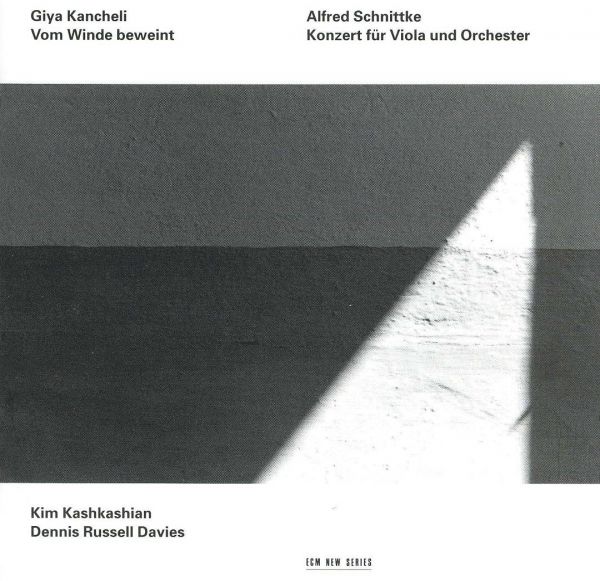
Giya Kancheli/Alfred Schnittke: Works for Viola and Orchestra (ECM New Series 1471)

Kancheli/Schnittke
Works for viola and orchestra

Kim Kashkashian viola
Orchester der Beethovenhalle Bonn
Rundfunk Sinfonie-Orchester Saarbrücken
Dennis Russell Davies conductor
Recorded November 1991, Beethovenhalle, Bonn (Kancheli)
Engineer: Peter Laenger
Recorded May 1986, Saarländischer Rundfunk, Saarbrücken (Schnittke)
Engineer: Helmut David
Remixed by Peter Laenger and Manfred Eicher
Produced by Manfred Eicher

This powerful record brings together two of the most seminal works for viola and orchestra of the twentieth century. Although these pieces are as different as they are similar, together they form a distinct balance of sentiment and execution.

Giya Kancheli: Vom Winde beweint (Mourned by the Wind)
Kancheli’s self-styled “liturgy” is an exercise in patience and surrender. Its opening slam of piano chords is a big bang in and of itself, and sets the stage for the soloist’s epic journey. Wilfred Mellers, in his liner notes, posits the viola’s emergence from such chaos as the “birth of consciousness.” And indeed, one can extrapolate from its startling abruptness the inklings of a life yet lived, fresh and devoid of self-awareness in the greater void of silence. The orchestra skirts the periphery, gradually uniting with the soloist. This contrast mimics the arbitrary stability of human values—at once sacred and mutable—so that moments of resolution always tread a downward slope. Luminous winds, a cosmic harpsichord, and trails of harmonics characterize the first movement. Brief horn blasts introduce the second, throughout which the viola wanders without fortitude into a minefield of piano and timpani, singing without carrying a tune. The harpsichord again works its galactic magic, feeding stardust into the viola’s arterial core. A passage of intense and sustained volume leads into an epic swan song. The third movement is brought forth on the strings of the harpsichord, the viola a mere flit of wings in the surrounding air. An oboe threads the hesitation like the beginning of an incomplete statement. The fourth movement is a violent implosion and balances out the first with its selfish gaze. As with seemingly every Kancheli composition, it ends as quietly as an evening breeze. One hears the rustling of leaves in the distance, only to find that it was a trick of the ears all along. Vom Winde beweint is rich with sharp dynamic peaks that are short-lived and sporadic, the hallmarks of an ode to process over progress.

Alfred Schnittke: Konzert für Viola und Orchester
For this monumental work, Schnittke has chosen to invert the standard concerto form, sandwiching an Allegro Molto between two Largos. The piece opens with a viola solo held aloft by shimmering orchestral waves. Every melodic line is like the root of an ever-growing tree of voices. In the second movement, the viola skips across a landscape of consonances and dissonances at the behest of a passively insistent harpsichord. Schnittke maintains the fascinating sense of rhythm and energy that distinguishes his faster turns, scratching at the surface of a larger unfathomable world. Harpsichord, flute, and viola congregate in a Mozartean danse macabre at the movement’s center. The strangely wooden pizzicato toward the end haunts as the piano jumps impatiently on its lower notes. The last movement gives the viola a demanding solo, which is eventually overtaken by horns and winds. A deep pause marks a change in intent. The harpsichord once again comes to the fore, the final cameo of a strong orchestral cast, before bowing to a beautifully dissonant double stop from the viola.

Schnittke would suffer a stroke just ten days after completing the score for his concerto.* Said the composer: “Like a premonition of what was to come, the music took on the character of a restless chase through life (in the second movement) and that of a slow and sad overview of life on the threshold of death (in the third movement).” Such narrative approaches to one’s own work speak of a pragmatic mind that seeks order in the flow of a creative life. Yet rather than a premonition, I experience the concerto as an affirmation of what one already knows. If Kancheli’s is an unanswered question, Schnittke’s is an unquestioned answer.

This is a profoundly emotional album, by turns confrontational and mournfully resplendent. Kashkashian brings her usual heartrending strength to even the subtlest gestures and is never afraid to betray the fragility of her pitch. The orchestras, under the direction of Dennis Russell Davies, are forces to be reckoned with that scintillate in a slightly distanced mix. A benchmark recording in all respects.

*My thanks to Christopher Culver for the correction.

<< Dmitri Shostakovich: 24 Preludes and Fugues (ECM 1469/70 NS)
>> Heinz Holliger: Scardanelli-Zyklus (ECM 1472/73 NS)

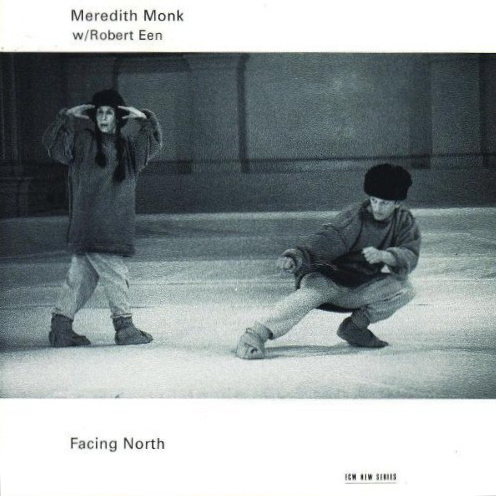
Meredith Monk: Facing North (ECM New Series 1482)

Meredith Monk
Facing North

Meredith Monk voice, piano, organ, pitch pipe
Robert Een voice, pitch pipe
Recorded April 1992, Rainbow Studio, Oslo
Engineer: Jan Erik Kongshaug
Produced by Manfred Eicher

While working on her opera Atlas during a residency in Banff, Meredith Monk found herself drawn to the Canadian wilderness just outside her window. Perhaps inspired by the stillness of snow and the silent steps of animals pressed into it, Monk developed Facing North out of a desire to evoke that same profound stasis, an opportunity to reconnect to something taken for granted. “As I worked,” she writes, “I tried to evoke the elemental, bracing clarity of the northern landscape. I realized then that ‘north’ is also a state of mind.” Monk’s multilayered compositions are always a state of mind, but Facing North is especially potent in this regard. The piece is distinguished by its dual landmarks. Two “Northern Lights” sections are played on pitch pipes and seem to function as invocations. Acting as artificial threads, they translate the breath into a vocal sound, substituting tracheae with factory-honed tubes and vibrating metal plates. Like the ritual sweeping of a temple, every strand seems to clear the stage for arrival, leading a modest procession into sacred space. The two “Long Shadows” sections, however, are vocally dominant, describing the ending of one journey and the beginning of another. These both upset and grant structure to the piece as a whole. Other movements bristle with creative fervor. “Chinook” is a medley of voiced postalveolar fricatives that circles around itself like two flies in the morning light, unable to figure out who is chasing whom. “Keeping Warm” is sung in short bursts. We hear movement, implied footsteps, some slapping of the body. It is rhythmic but not a dance; it is survival amid the elements. Sure to please is “Arctic Bear,” an open game of cries and hiccups, darkened by Een’s distant howls. In spite of its icy atmosphere, Facing North is equally about arid interiors drenched in endless daylight, illuminating the delicate cartography of the body and its relationship with the life-giving (and death-bringing) earth.

Two shorter selections round out the disc. First is a scaled-down version of Vessel: an opera epic. At its center lies the story of Joan of Arc, while at its periphery spreads the story of a landscape divided by human contact. Though it may not seem like it when caught up in the moment, Monk roams through a great number of techniques throughout this piece. An organ provides a lush backdrop to her gallery of overdubbed stuttering, fluid calls, playful cries, dirges, lullabies, overtone singing, flying leaps, and ululations. Last but not least is “Boat Song,” excerpted from the opera Recent Ruins. This is one of those quintessential Meredith Monk moments that is at once familiar and mysterious. It is the enigma of what lives and breathes inside us, veiled in darkness and in silence, yet given voice in the outer world.

Like so much of Monk’s music, everything on this album was conceived for the stage. As such, it is rife with spatial possibilities, limited only by the listener’s imagination. The melodies are extremely organic, following a path that existed long before there were feet to press it into being. Stepping into this album is like stepping into another dimension in which the same objects exist around us, seemingly unchanged, yet from which we can never completely extrapolate a sense of purposeful belonging. We may find a piece of ourselves floating above the voices of an entirely descriptive universe, yet even as we fly off into those lands where the sun shines brightest and longest, we can never find ourselves without listening to the endless nights of what our hearts prefer.

<< Keith Jarrett: Vienna Concert (ECM 1481)
>> Heiner Goebbels: La Jalousie (ECM 1483 NS)

Arvo Pärt: Miserere (ECM New Series 1430)

Miserere

Arvo Pärt
Miserere

The Hilliard Ensemble
David James countertenor
Rogers Covey-Crump tenor
John Potter tenor
Gordon Jones baritone
Paul Hillier director
Orchester der Beethovenhalle Bonn
Western Wind Chamber Choir
Dennis Russell Davies conductor
Sarah Leonard soprano
Christopher Bowers-Broadbent organ
Pierre Favre percussion
Recorded September 1990, St. Jude-on-the-Hill, London (Miserere, Sarah Was Ninety Years Old)
Engineer: Peter Laenger
Recorded December 1990 at Beethovenhalle, Bonn (Festina Lente)
Engineers: Peter Laenger and Andreas Neubronner
Produced by Manfred Eicher

For reasons perhaps too numerous to list here in full, Arvo Pärt’s Miserere remains my most cherished of the Estonian composer’s ever-growing book of masterworks. Suffice it to say that its magic lies in its stillness. For such an expansive piece—scored as it is for choir, soloists, organ, and ensemble—it is remarkably introspective. Its opening invocation of Psalm 51 fleshes out a corpus of spoken language made melody. A statement from the clarinet follows every word, not so much commentative as dialogic. Once harmony is introduced in the second vocal line, the pauses become even more gravid and rich in spatial detail. The soloists gather up all remaining threads, persevering through mounting tensions with the blunt instrument that is the interjected “Dies irae.” This is more than just a thunderous meditation. It is a wringing-out of the heavens, the earth a mouth gaping to catch all that drips down. Voices burst like supernovas around thunderous timpani, crashing into the oceans until only a tubular bell is left to caress the newly razed soil. The heartfelt baritone of Gordon Jones describes the ruins with mellifluous sensitivity. A wind section breathes through every pause like a ghostly antiphon and provides a dark interlude. As the soloists arise en masse, David James flares with his resplendent countertenor colors, whereas the deep intonation of soprano Sarah Leonard marvels amid the fumes of destruction. Another stunning interlude, this time introduced by Christopher Bowers-Broadbent on organ, coaxes the winds into more independent recitations, accentuated by a crystalline tambourine and triangle. We arrive to an a cappella passage that is transfiguration incarnate, each soloist pawing the air like a sleeping lion. The winds slog through the valleys, heavy sins in tow, while voices linger in the firmament. Leonard is unmatched in her ability to put her entire being into a high note, and the moment one finds at the 30:13 mark is perhaps her finest example. This touches off one of the most breathtaking lifts ever set to music, as all the voices scale a ladder of chaos into a world of silent order. Miserere is all about the “in between,” the lesson of interrupted thought, and our fearful awe over the mystery of creation.

Festina Lente (1988) for orchestra and harp is dedicated to Manfred Eicher. The title means “make haste slowly” and acknowledges the importance of flux in any creative endeavor. Like Eicher’s own aesthetic path, it is a resonant spiral that goes both downward and upward.

Awe is the operative concept in Sarah Was Ninety Years Old (1977/90). Drums cycle through an arithmetic exploration of high and low beats, cradling wordless passages from tenors Rogers Covey-Crump and John Potter. This process repeats until the organ makes its humble entrance, even as Leonard pushes her voice to dizzying heights. One would think such a piece might escape today’s trigger-happy musical culture, but I have recently encountered the drums from Sarah, as effective as they are surprising, being sampled by German electronic artist HECQ in his track “Aback,” off the wonderful album Night Falls.

This disc has been with me for nearly half my life. The Miserere in particular drew me into a love of singing. As a teenager I used to spend hours singing along alternately with the baritone and alto lines until the booklet yellowed and nearly fell apart from excessive handling (I even went so far as to purchase a backup, just so I would have a pristine copy on my shelf). After so much physiological engagement with its textual and aural shapes, it has become an integral part of my person. Listening reminds me that with each new step I take on the path to independence, I grow closer to who I have always been: a human soul sustained by all others in a world where time is infinitely malleable, and the only thing that’s real is my surrender to the moment.

<< Eleni Karaindrou: Music For Films (ECM 1429)
>> Christopher Bowers-Broadbent: Trivium (ECM 1431 NS)