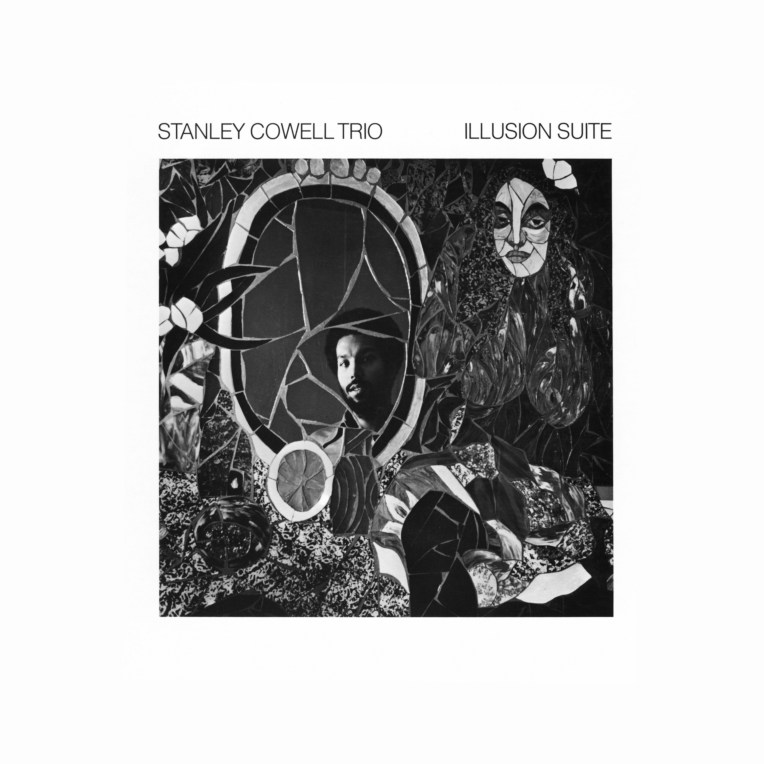
Stanley Cowell Trio: Illusion Suite (ECM 1026)

ECM 1026

Stanley Cowell
Illusion Suite

Stanley Cowell piano
Stanley Clarke bass
Jimmy Hopps drums
Recorded November 29, 1972, Sound Ideas Studio, New York
Engineer: George Klabin
Produced by Manfred Eicher

Human beings are adventurous eaters. We are constantly trying new things, loving some and hating others. We change our diets drastically, watching our calories and tallying every morsel we ingest. But sometimes, in the throes and woes of a food culture gone horribly awry, we just want to sit down to a good plate of comfort food, for nothing seems able to replicate the psychological benefits it provides. Stanley Cowell’s Illusion Suite is like that: a heaping portion of comfort food.

Backed by steady support from Stanley Clarke on bass and Jimmy Hopps on drums, Cowell delivers the goods and then some. The timid opening strains of “Maimoun” betray none of the album’s subsequent drive. A confident beat and bowed bass ease us into Cowell’s denser style, made all the more elegiac for its frequent use of octaval doublings in the right hand. (Incidentally, an alternate version of this track worth checking out can be found on Marion Brown’s 1975 Vista.) Cowell kicks off “Ibn Mukhtarr Mustapha” with a sporadic run across the piano before making a deft switch to his electric. Before long, this arid groove quiets into a percussion-heavy outro, bristling with African thumb piano. “Cal Massey” brings us into bop territory, with a great drum kick and deliciously twangy bass line to boot. Smooth is the name of the game is “Miss Viki.” Its fluid bass and wah-pedaled electric piano show off a cool sense of style and finesse. “Emil Danenberg,” named for a former director of the Music Conservatory at Oberlin College in Cowell’s home state of Ohio, is the album’s only ballad to speak of. Its raw, complex chords run straight into the darkest alleys of our internal cities. “Astral Spiritual” is a bit more straightforward, and features some quick turns and fancy musicianship all around. Spectacular drumming and astute pianism abound, ending unexpectedly on a downtempo turn, like an abandoned swing coming to rest. Nostalgic, thought-provoking, and tender, this is fantastic music from a gifted composer and performer that is now easily available thanks to an ECM digital reissue.

<< Ralph Towner with Glen Moore: Trios/Solos (ECM 1025)
>> Dave Holland Quartet: Conference Of The Birds (ECM 1027)

Christopher Bowers-Broadbent: Trivium (ECM New Series 1431)

Trivium

Christopher Bowers-Broadbent organ
Recorded October 1990, Grossmünster, Zürich
Engineer: Peter Laenger
Produced by Manfred Eicher

I am a rider without mount, an ocean without waves, a horizon without dawn, nailed to myself, nailed to an absence in time which, after me, becomes the time of absence.
–Edmond Jabés, The Book of Questions

Avid Arvo Pärt listeners will be more than familiar with the profound talents of Christopher Bowers-Broadbent. The English organist has long held contemporary music in high regard, and has enriched the liturgical landscape with numerous commissions as well as his own compositions. With such a wealth of music available at the tips of his fingers (and toes), Bowers-Broadbent was faced with a daunting task: namely, crafting a personal take on music’s creative intimacy through one of its most leviathan instruments. The end result is, in his own words, a “performance about time and space.” As such, the reach, not the fleeting emotional effect, of his selections becomes paramount. Rather than lay out a program of short, varied pieces, he has turned inward, finding in the works of only three composers enough to describe a universe of ideas.

He first unveils the night sky with a quartet of pieces by Arvo Pärt. Trivium (1988) is like a constellation burning silently for our scrutiny. What remains flat on the stargazer’s map becomes three-dimensional in Bowers-Broadbent’s care. As with Pärt’s other tintinnabular quests, Trivium is both explorer and the landscape being explored. Its powerful middle section connotes a triune infrastructure, embodying the balance of divine order in every disturbance. The steady pulse of Mein Weg hat Gipfel und Wellentäler (1989) breathes with earthly lungs, even as it cradles a heart that can only be seen with a telescope. Its path stays true to the peaks and valleys of its title, taken from a poem by Edmond Jabés (Pärt would later rescore this piece in a version for strings and percussion that can be found on the ECM recording In Principio). Annum per annum (1980) is structured like a mass and brings that same sort of complementary vision to its stark dynamic contrasts. Pari Intervallo, composed in 1981, layers intonations in the higher register over a slow chromatic sway of transfiguration.

We are slowly brought back into our bodies with two of three voluntaries composed by Peter Maxwell Davies in 1976. These arrangements of sixteenth-century Scottish hymns seem to unpack, in a brief span of time, the mystery of faith. With enigmatic precision, Psalm 124 (after David Peebles) traces the contours of God’s raging waters with a touch of resignation, glorying in the safety of grace and retribution, while O God Abufe (after John Fethy) expresses even more succinctly the awe of a prayerful mind.

By the time we arrive at the final two pieces, each a spectacular arrangement of music by Philip Glass, we are well primed for the metamorphoses implied therein. Satyagraha renders the finale of Act III from the selfsame opera into a whirling dervish of stratospheric proportions. One can almost feel the air coursing through the organ’s pipes with every recapitulation. Dance IV, on the other hand, is a more extroverted piece that populates its periphery with movement and attractive forces. It ecstatically forms the center of the album’s galactic structure, drawing in countless voices until it reaches critical mass.

Bowers-Broadbent has the uncanny ability to take music that is seemingly histrionic and forge from it a host of instinctual meanings. From the wafting strains of Pärt’s sublime prostrations to the enlivening regularity of Glass’s exuberant leaps, we are treated at every moment to an august evocation of music for its own sake. All too often, it seems, organ recitals fall under our radar. Albums like this become the radar, and we the blips upon its screen: transient yet unmistakably there.

<< Arvo Pärt: Miserere (ECM 1430 NS)
>> Anouar Brahem: Barzakh (ECM 1432)

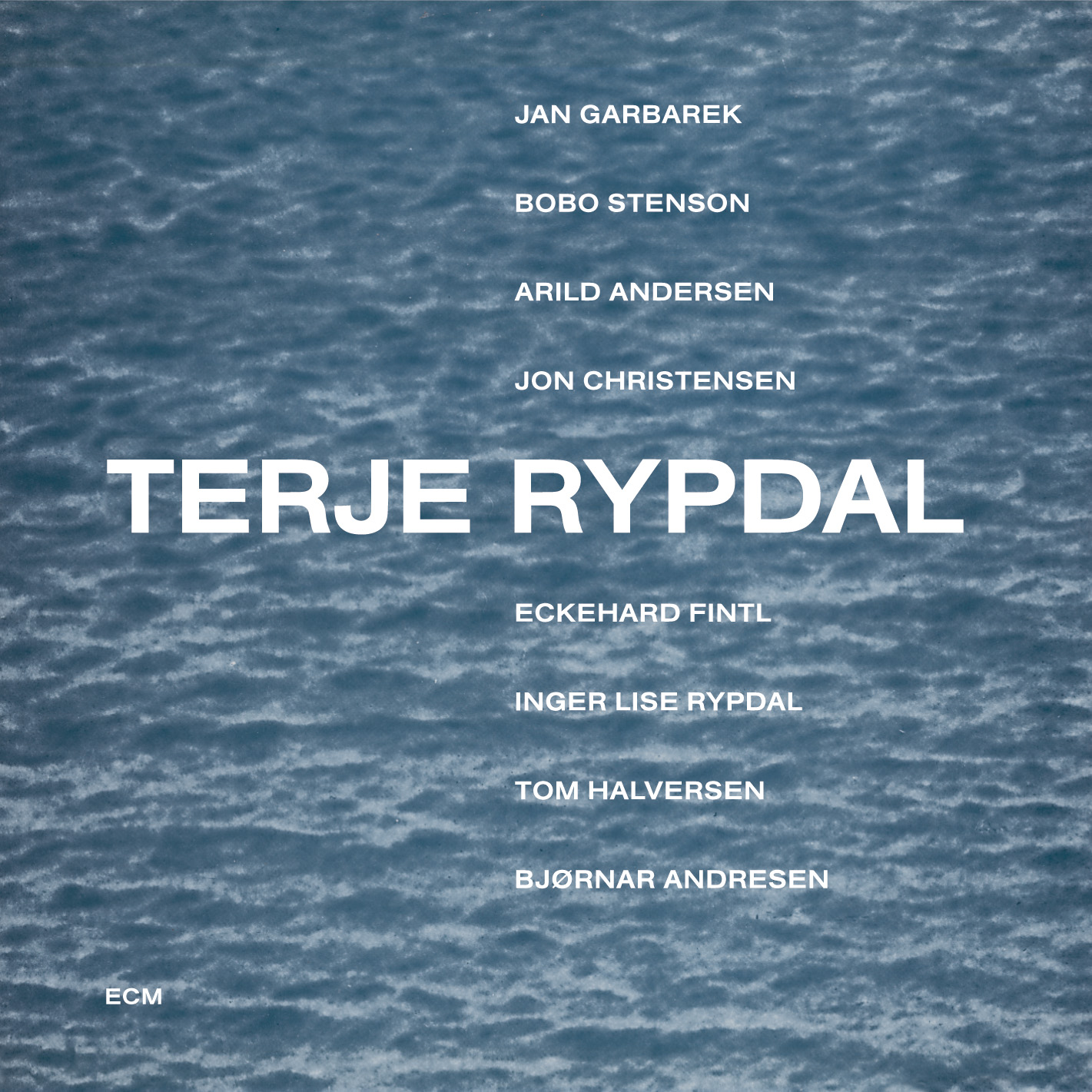
Terje Rypdal: s/t (ECM 1016)

ECM 1016

Terje Rypdal

Terje Rypdal guitar, flute
Inger Lise Rypdal voice
Ekkehard Fintl oboe, English horn
Jan Garbarek tenor saxophone, flute, clarinet
Bobo Stenson electric piano
Tom Halversen electric piano
Arild Andersen electric bass, double-bass
Bjørnar Andresen electric bass
Jon Christensen percussion
Recorded August 12 & 13, 1971, Bendiksen Studio, Oslo
Engineer: Jan Erik Kongshaug
Produced by Manfred Eicher

Terje Rypdal’s first ECM effort as frontman is a bewitching look into the Norwegian guitarist’s formative years. With a bevy of talented musicians in tow, he forges a mercurial portrait of late-night melodies and hidden desires. “Keep It Like That – Tight” is stifling and seedy, buffeted by cooling fans and laced with the fumes of an alcoholic haze. It’s a desolate hotel room where more than evening falls, a cigarette put out on the skin, incoherent words spilling from warm lips. The atmosphere is acutely palpable, oozing with film noir charisma and slurred speech. Garbarek spins a notable solo here, only to be overtaken all too soon by Rypdal’s drunken swagger. One might think this would be a taste of things to come, but Rypdal surprises with “Rainbow,” a most ethereal track laden with reverb and stratospheric beauty, dominated by oboe for a more classical sound. The background clinks and hums with a variety of percussion, bowed electric bass, and flute. The third track, “Electric Fantasy,” lies somewhere between the first two, a jazz suite with symphonic flavor. Rypdal’s former wife Inger Lise adds some moody vocals as an English horn expands the sound even further. Illusive drumming from Christensen and the occasional wah-wah guitar add dynamic touches of their own. The ambient crawl of “Lontano II” reverses the opening effect by leading into the more blues-oriented “Tough Enough,” leaving a grittier aftertaste.

The striking differences in instrumentation between tracks may be off-putting to some, while others may see it as part of a larger concept. Either way, this self-titled album is thematically rich and more than worth the listen.

<< Jan Garbarek Quintet: Sart (ECM 1015)
>> Keith Jarrett: Facing You (ECM 1017)

Hans Otte: Das Buch der Klänge (ECM New Series 1659)

Hans Otte
Das Buch der Klänge

Herbert Henck piano
Recorded September 1997, Festeburgkirche, Frankfurt am Main
Engineer: Markus Heiland
Produced by Manfred Eicher

“It is an old dream of mine that the nature of sounds is discovered and that they are not used in order to express something else.”
–Hans Otte

Hans Otte (1926-2007) was a German composer, pianist, and sound installation artist. A student of Paul Hindemith, he came to see the role of sound as a phenomenon in its own right, and seems to have treated his piano music as a crucible in which musical lexicons might be boiled down to their essential vocabularies.

Herbert Henck offers up this sweeping interpretation of Otte’s twelve-part masterwork, Das Buch der Klänge (The Book of Sounds), as a stunning example of what piano music can grow into when loosed from its binds and allowed to breathe of its own volition. The cycle was three years in the making, and exudes gentle and attentive care. Part I is remarkably consonant, seesawing between the same two chords while alternating with more quickly syncopated passages. From these first moments we get the sense of travel that comes to characterize the trajectory to follow. There is also a nostalgic air that one finds in many of John Adams’s earlier compositions (and especially in Phrygian Gates). Part II undulates in cascades, from which single notes call out with assurance and clarity. Part III returns us to the journey, its slowly applied chords pressing like footsteps into the soil. Part IV erupts in dramatic cloudbursts, bleeding into Part V, in which the same chords are deployed with more urgency. The piano sings here, knitting between its open strings the makings of a vocal tract. Part VI is a linear melody, each note dotting the darkness with a distant galaxy. Part VII is one of the most spiritual sections of the piece, and is like the ostinato of a more expansive composition that never develops into a lead line, but rather looks inward via more pinpointed notes within arpeggiated clusters. In dispensing with the imagined right hand, the music speaks for itself, as if to untie the binds of its inner heart so that each note may flow freely through its ventricles. Part VIII marks the return of cautious footsteps. This is the frustration of travel, the annoyances, delays, and logistic disconnects that are inevitable when experiencing any new culture, however adored. Part IX at last offers some reprieve, giving itself over into rest. It is the time of reflection, when the return seems all too imminent and the lessons learned have hardly had time to take root, and we come to realize that those moments of misunderstanding are the ones we cherish the most. Part X shines like the dawn. Only now do we realize this landscape may be forever lost to us, so we glory in every flaw and perfection alike while we still can, in the hopes of carrying it inside us when we leave. Throughout Part XII, one hears a little Satie peeking through in the finality of its playful departure. It is the quiet checkered landscape below on the return flight, the silent coastline receding behind the ship, the cloud of dust churning behind the bus, the slowly waving hand left behind at the train station. All such moments are brought to bear in Otte’s Buch, so that all we have left is this audible postcard on the back of which Henck has inscribed as much as could possibly fit in such a limited space. But the real beauty of this recording is that, as a tangible object, it can be held, turned in the hands, admired for its cover art, intellectually fed upon through its liner notes, and the journey repeated at any moment one wishes. It is music like this that reminds us of the pleasurable luxury of recordings and their didactic effect. They transport us to unseen locations, or conversely reconstruct those locations stone by stone in our very minds without us having to lift a finger. Most importantly, they allow us to appreciate the very real experiences we have in our own travels, and in doing so give us the gift of hindsight, reminding us of how memory shapes who we are.

Considering Henck’s often-eclectic approach, I was both surprised and reassured by his championing of Otte. Although Henck has always chosen fascinating material, the reductive power of this music is nothing short of revelatory. These sounds speak directly to the heart and feel as if they grew out of solitary nocturnal improvisations. Notions of minimalism are easily vanquished with a careful listen, which reveals a wealth of subtle details and variations peppered throughout. Through the infliction of its uneven terrain, the joys of arrival and the memories that linger once the destination has been found become one and the same. Henck plays with grace and fortitude, making explicit use of the sustain pedal and the instrument’s own internal space. This is music that looks simple on paper, but requires personal commitment to articulation, speed, timing, and volume. Thus, it becomes a magnifying glass into the musician’s, and the listener’s, sense of being. By far one of ECM’s finest achievements.

<< The Hilliard Ensemble: Lassus (ECM 1658 NS)
>> Mats Edén: Milvus (ECM 1660
)

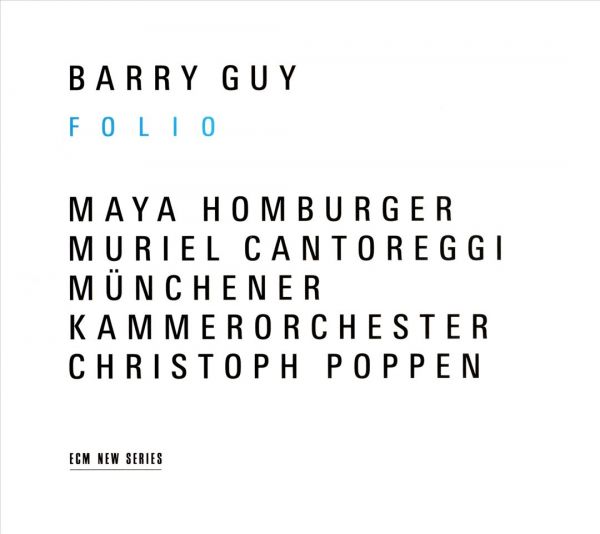
Barry Guy: Folio (ECM New Series 1931)


Barry Guy
Folio

Maya Homburger baroque violin
Muriel Cantoreggi violin
Barry Guy double-bass
Münchener Kammerorchester
Christoph Poppen conductor
Recorded February 2005, Himmelfahrtskirche, München
Engineer: Peter Laenger
Produced by Manfred Eicher

Over the years, ECM New Series listeners will have variously encountered Barry Guy as composer, performer, and improviser. In Folio, we get to experience all three. I have always found his improvisatory role to be the most compelling, for it stirs my heart with communicative possibilities. And so, in the spirit of living in the moment, I share this review verbatim, as I dictated it while listening:

“Barry Guy is very much concerned with the internal, the biological nature of music. The seemingly sourceless energy it evokes through human contact enables us to question our own energy: whether it is divinely given or naturally ordained. While his epic explorations of thematic material by Diego Ortiz betray a more honed compositional reach, Guy still inhales the oxygen of indeterminacy. This music functions very much like memory: when one focuses on one memory, others try to creep in, sometimes courting unwanted associations, secrets we would rather not acknowledge…. Even at its most dynamic moments, this music is all about gentility and caution—not as a sign of fear…but as a way of life, a philosophy. The improvised ‘commentaries’ peppered throughout add a rich sense of bulk to the album’s presence…but one shouldn’t think they are any less substantial, for they wouldn’t be what they are without their source texts. They give the musicians a crisp field in which to ponder the emotional implications of what they have just played…to share those feelings with the listener rather than covet them unceremoniously. The ‘Folio’ pieces are richer in orchestral texture. They tap into a broader sensibility of the music’s own potential while also burying the possible egotism of the solo artist…in a lush balance of restraint and emotional surrender. Guy uses gimmicks briefly and wisely, and is never afraid to stutter. This is music that never edits itself. The commentaries are immediate responses. They do not simply act as arbitrary filler material, but rather speak to the lingering effects…grasping on to those effects before they fade out of sight and out of mind. And so, I think this is why Track 13 is called ‘Memory,’ for what is commentary but solidified memory shared with others…? And similarly, what is a review but a memory…a conscious chronicling of an experience that can never be recaptured, but only inadequately preserved in one person’s thought. For rather than a simple memory, I should like to share a record of my experience. This track also speaks to me in the same way we often search through our memories for an originating thought. Oftentimes, especially as we are going to sleep, we let our minds wander, only to backtrack, looking for that one sound or image or word or impression that launched our mental exploration…and this is perhaps what we stumble into in ‘Ortiz II,’ which in some way charts the frustration of our psychological imperfections, while also exploiting those imperfections to audible effect. This is an altogether intriguing album, which is always greater than the some of its parts, as it allows for the listener’s own reflection and for the compositional nature of personality to run amok, or slumber as it may, in pockets of empty space.”

Food: Quiet Inlet (ECM 2163)

Food
Quiet Inlet

Thomas Strønen drums, live-electronics
Iain Ballamy tenor and soprano saxophones
Nils Petter Molvær trumpet, electronics
Christian Fennesz guitar, electronics
Recorded live in Norway, 2007/08
Produced by Food and Manfred Eicher

The earth is very still, like an infant asleep. Into a quiet inlet, a streamlet is falling. It is singing to the sleeping earth, telling it of the days to come when the great silence shall be broken by the voice of man, and life shall fill alike the darkling wave and the sunlit field.
–T. A. Rickard, “A Story in Stone”

Considering the distinct lyrical path Food has been forging since 1998, it was perhaps only a matter of time before the group would migrate into ECM territory. The guest appearance of Nils Petter Molvær is therefore a no-brainer. Fans of Molvær’s work will feel like they are slowly falling into the Norwegian trumpeter’s waking dreams. The results are an undeniably unique blend of nu jazz sensibilities and ritual melodic power.

“Tobiko” opens with metallic percussion against a cascade of synths and muted beats. A radio dial is tuned, reaching through the airwaves as if for a familiar voice to latch onto. Only then does Ballamy’s sax rise to the surface of this oceanic passage: if our ears are vessels, then here is the dolphin swimming silently alongside them. Before long, live drums make their presence known and lead us out of the fog. Having shown us the way, our guides then recede into the darkness, where light and sonar dare not venture. “Chimaera” is a gentler number. Sax lines continue their passage as percussion and electronics cocoon them with deep thematic threads, free-flowing and heavenly. “Mictyris” is distinguished by Strønen’s intense rhythmic drive, over which we encounter some fantastic electronics that sound as if a sax were being torn apart and rebuilt as a train whistle. Tight drumming, combined with the protracted ambient wash in the background, meshes wonderfully with Ballamy’s constellate reed work. “Becalmed” builds itself around a repetitive leads motif, its aftereffects ever ghostly and omnipresent. Whether intentional or not, this track also contains oblique references to Eleni Karaindrou’s “Parade” from the film Happy Homecoming, Comrade. “Cirrina” and “Dweller” both flow with Molvaer’s distinct sound, seeming to revel in their grace and liberation from formulaic constraints, while “Fathom” ends the album bittersweetly, as if the music were looking into a mirror, unsure of what it sees.

The electro-acoustic sound honed on Quiet Inlet works wonders at every turn. And on that note, it’s inspiring to see a wonderful artist like Fennesz crossing over into the ECM circuit. Let’s hope this is a sign of things to come.

(To hear samples of Quiet Inlet, click here.)

Werner Bärtschi: W.A. Mozart/G. Scelsi/A. Pärt/F. Busoni/W. Bärtschi (ECM New Series 1377)


W.A. Mozart/G. Scelsi/A. Pärt/F. Busoni/W. Bärtschi

Werner Bärtschi piano
Recorded July 1988 at Kirche Blumenstein, Switzerland
Engineer: Andreas Neubronner
Produced by Manfred Eicher

In this ECM debut, Swiss pianist Werner Bärtschi offers up an intriguing and carefully conceived program. Having studied with Klaus Huber and Rudolf Kelterborn, Bärtschi brings a decidedly compositional attention to his playing that lends itself well to the material at hand. He begins with Mozart’s C minor Fantasie (1785), which, as the longest piece, reads like a single human life. It is not a simple reimagining of the past but a reliving of it, for to play the piano is to articulate a biography in sound, using the body in imitation of what bore those same feelings in “real time.” After such a piece, the Four Illustrations on the Metamorphoses of Vishnu (1953) by Scelsi may seem like a startling transition. Yet humble quartet presents us with a rare programmatic gesture from the Italian, whose microscopic approach actually balances out Mozart’s broader strokes and veils the turmoil of mortality behind the surface of the spirit made flesh. Bärtshi surprises us yet again with Arvo Pärt’s Für Alina. This early 1976 version is like a dream we question upon waking: Did we really hear it, or did the music rise in our minds out of an unspoken memory? And so, when we next encounter Mozart in the 1788 B minor Adagio, we hear him with fresh ears and open hearts. Rather that scoping out the Mozartean influence in the surrounding works, we see the latter funneling into the former. Bärtschi follows with a piece of his own, Frühmorgens am Daubensee (1986/88), realized during an early morning hike in the mountains surrounding the eponymous lake. In it we hear snatches of something upon the wind, distant conversations, activities, worldly movements, the beginning of an avalanche that never quite forms. This salves us nicely for the relative onslaught of Busoni’s 1921 Toccata, a masterful yet demanding unfolding of theme and counterpoint. After such a towering cascade of notes, Mozart’s B major Sonata (1783) is like a gentle return, a pair of hands lowering us slowly to the earth, leaving us to slumber in a blanket of solid ground.

Hans-Klaus Jungheinrich provides a beautifully conceived essay which, despite risking an overuse of the word “oriental” (it appears no less than five times in the liner notes), makes a viable case for Bärtschi’s musical choices as being firmly rooted in the spirit of magic and fantasy that engenders the program as a whole. Where Jungheinrich characterizes this as a piano recital of “Mozart and…,” I would go a step further and say it is equal parts “…and Mozart.” yet although Mozart bookends the recital and inhabits its fulcrum, his infrastructural presence is no more significant than the validation of the superstructure. As such, the continuity between these pieces is a narrative rather than formal concern—not a linear continuity, but one in which the potential for speech is equally present at every stage.

<< Dino Saluzzi: Andina (ECM 1375)
>> Heinz Reber: MNAOMAI, MNOMAI (ECM 1378 NS)

Gary Burton: The New Quartet (ECM 1030)

1030 X

Gary Burton
The New Quartet

Gary Burton vibraphone
Mick Goodrick guitar
Abraham Laboriel bass
Harry Blazer drums
Recorded March 5/6, 1973 at Aengus Studios, Fayville, Massachusetts
Engineer: John Nagy
Produced by Manfred Eicher

One needs only to catch the first few licks of “Open Your Eyes, You Can Fly” to know this album represents an era that can never be recaptured. Burton does wonders with the Chick Corea tune, lifting its upbeat soul to the greatest heights of creative pleasure. One can almost taste the freshness of his sound, the sheer newness of vision and synergy of musicianship ingrained into every moment of this phenomenal record. This was another early disc that managed to fall under my radar until I sought to review it. Burton is always a supreme joy to listen to, and with this, his second ECM appearance, he certainly made a profound statement. Burton himself contributes one composition, the enchanting “Brownout,” which takes full advantage of the rhythmic precision of his backing trio for a deft volley of restraint and abandon. Two Gordon Beck tunes provide the most robust flavors in this thickening stew, balancing the smooth full-ensemble nosh of “Tying Up Loose Ends” with the infectious full course of blistering key changes and nimble flair that is “Mallet Man,” the album’s centerpiece. The ballads are haunting and moody. “Coral” (Keith Jarrett) proves just how soulful vibes can be, while “Olhos De Gato” (Carla Bley), with its seedy undercurrent and humid climate, slinks like its namesake, stalking the edges of the night. Two Mike Gibbs tunes, “Four Or Less” and “Nonsequence,” round out the set on a more playful note, making dramatic use of pauses and a wider variety of textures.

Gary Burton is synonymous with the vibes. And while I had long been one of countless admirers of his technical and melodic acuity, this album was nothing short of a revelation for me. The technique is flawless all around and glistens with Burton’s Midas touch. He contacts his instrument like fingers walking up a spine, never missing a single nerve along the way. Yet one cannot commend this album without also praising Goodrick’s phenomenal guitar work, Laboriel’s quick-witted ornaments, Blazer’s unrelenting dedication to the moment, and the astounding unity the ensemble as a whole manages to uphold. The overall balance comes across as joyously democratic, and all with a fresh-off-the-boat sound that surprises at every turn. There isn’t a single errant note, gesture, or idea to be found on The New Quartet. From start to finish, an inimitable achievement.

<< Garbarek/Andersen/Vesala: Triptykon (ECM 1029)
>> Terje Rypdal: What Comes After (ECM 1031)

Marilyn Crispell/David Rothenberg: One Dark Night I Left My Silent House (ECM 2089)


One Dark Night I Left My Silent House

Marilyn Crispell piano, soundboard, percussion
David Rothenberg bass clarinet, clarinet
Recorded March 2008 by Chris Andersen at Nevessa Production, Woodstock
Produced by Marilyn Crispell and David Rothenberg

In the dark I the bird can pretend, in light I am overdoing it,
pretending to be what I’m not, like art, like imagination.
–David Rothenberg, Always the Mountains

Having only been familiar with David Rothenberg through my own interest in animal studies, which had already led me to his unique book Why Birds Sing, imagine my delight when his name showed up on the latest release from my favorite label—and alongside one of its most singular talents, no less. His meditative improvisations with Marilyn Crispell have produced one of the most delightful surprises of 2010.

This album is fluid yet abstract, often devoid of melodic traction, but is bound by a certain poignancy that I find utterly engaging. Take, for example, “Stay, Stray,” which begins with airy chords but quickly turns introspective, even regretful, but is nevertheless boldly committed to its indeterminate purpose. Goal-oriented is what this music most certainly is not. Rather, it surrenders to the dynamics of the moment, to the gravity of performance, and to the possibilities of material interaction. In the latter vein, a number of tracks feature Crispell playing an old upright piano soundboard, from which she elicits a playful metallic accompaniment. It is part of her attempt, in Rothenberg’s words, to “get away from the keyboard, more into the realm of pure sound.” In tracks like “Still Life With Woodpeckers,” these sounds are blatantly foregrounded, while in others they linger like ghosts. “The Way Of The Pure Sound (for Joe Maneri)” begins with low-blown notes, sounding almost like a didgeridoo, and walks its line faithfully over Crispell’s exploratory ruminations on the very innards of her chosen instrument. “Tsering” lies somewhere between the two, featuring strings plucked with the fingertips and a few carefully placed notes on the keyboard proper. The unspoken communication between the two musicians is always clear, especially in “What Birds Sing,” “Companion: Silence,” and “Owl Moon.” Even in the more adventurous moments found in “The Hawk And The Mouse,” “Motmot,” “Grosbeak,” and “Snow Suddenly Stopping Without Notice” maintain a mutual delicacy that binds them as a whole. And it’s hard not to be won over by the frailty of “Evocation,” which sets the album adrift on a most dreamlike reverie.

Despite the nocturnal imagery implied by its title and cover art, One Dark Night fills my imagination with summer. The opening “Invocation” in particular drips like molasses in sunlight, evoking a hot and humid environment, somewhere rich in agriculture. The piano is like a planted seed, resting quietly in the soil, and the clarinet its first shoots, caressed by the wind, fed by the rain, and pulled from silence by the unblinking eye of the sun. Rothenberg always seems to be putting on a severe frown, like that of a tragedy mask—which is to say his sound is carefully sculpted and symbolic of a long dramatic history. His approach is rooted in nature and survival and rests comfortably on the organic foundation Crispell so lovingly provides. Both of them seem to grasp every ribbon of sound and to blindly follow wherever it might lead. If anywhere, this is where the darkness comes in, forging through that blindness a light of one’s own making, a certain sense of being that is internally of the night, even as it basks in the nourishing glare of its harvest. This may not be the most versatile music, but I think for the right mood and occasion it captures something that cannot be expressed any other way.