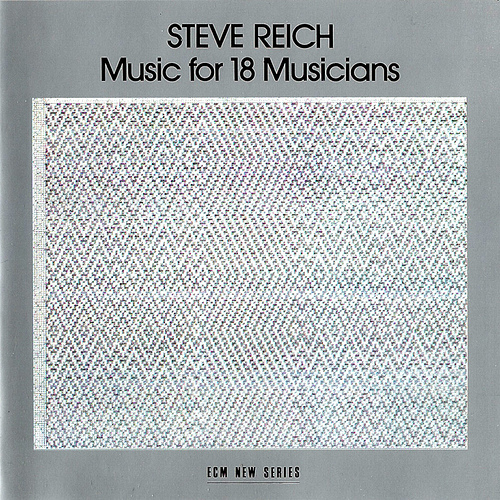
Steve Reich: Music for 18 Musicians (ECM New Series 1129)


Steve Reich
Music for 18 Musicians

Shem Guibbory violin
Ken Ishii cello
Elizabeth Arnold voice
Rebecca Armstrong voice
Pamela Fraley voice
Nurit Tilles piano
Steve Chambers piano
Larry Karush piano, maracas
Gary Schall marimba, maracas
Bob Becker marimba, xylophone
Russ Hartenberger marimba, xylophone
Glen Velez marimba, xylophone
James Preiss metallophone, piano
Steve Reich piano, marimba
David Van Tieghem marimba, xylophone, piano
Virgil Blackwell clarinet, bass clarinet
Richard Cohen clarinet, bass clarinet
Jay Clayton voice, piano
Recorded April 1976 at Town Hall, New York [?]
Engineer: Klaus Hiemann
Produced by Rudolph Werner

Music for 18 Musicians makes no efforts to obscure the methods behind its construction. As such, it reveals a wealth of mysteries never notated on the printed page. The piece is scored for violin, cello, 2 clarinets doubling bass clarinet, 4 women’s voices, 4 pianos, 3 marimbas, 2 xylophones and metallophone (vibraphone with no motor). With his characteristic attention to detail, Reich utilizes these instruments not necessarily for their evocativeness, but for the unique and varied ways in which their timbres can be blended in a nearly hour-long wash of sound. Calling this “minimalism” would be unfair both to Reich and to the musicians among whom he makes this demanding journey. There is a sense of movement here that is both linear and multidirectional. I say this not for the sake of verbosity, but because Reich’s notecraft commits to its own agenda while latching on to so many others along the way.

The piece begins with a seamless blend of piano and mallet instruments threading its full length like a living metronome. Joining this is a chorus of breaths from human voices and winds. The interweaving of these substantial strands reinforces the compositional density, like marrow and nerves cohering into a spinal c(h)ord of decidedly aural design. At the risk of belaboring this analogy, I venture to see this piece as one active body in which each instrument writes the genetic code of its musical biology. This dynamic is further heightened by the presence of vocal utterances. Although these function as egalitarian extensions of manufactured instruments, they lend fragility to the underlying spirit of the music at hand. These voices rise and fall, slowly replaced by clarinets as if one and the same.

Sudden changes in rhythm serve to reconfigure our attention to the intervention of the composer’s hand: just as we are being lulled into a sense of perpetuity, akin to a natural cycle studied from afar, we are reminded that what we are listening to has been contrived at the whim of a single human mind. Far from undermining the piece, this awareness invites us to share in its re-creation through the very act of listening. Like much of Reich’s music, Music for 18 Musicians is nothing if not accommodating. Rather than patronize or proselytize, it lays itself bare. This brackets Music for 18 Musicians off from much of the histrionic art music in vogue at the time of its creation (1974-76). One could argue that it is scientific in its approach to structure. I prefer to see it as simply honest.

The recording quality of this album is ideally suited to its subject matter. There is a sense of “clusteredness” throughout, so that the performers never stray too far from the nexus of their unity, while also providing just enough breathing room (the performers’ lung capacities determine the length of sonic pulses throughout) for individual elements to shine. Most of the mixing, as it were, is done live through the sheer skill of Reich’s assembly of dedicated musicians, and requires meticulous attentiveness on the part of the recording engineer to highlight that complex interplay without overpowering the core. A beautiful and compelling landmark achievement.
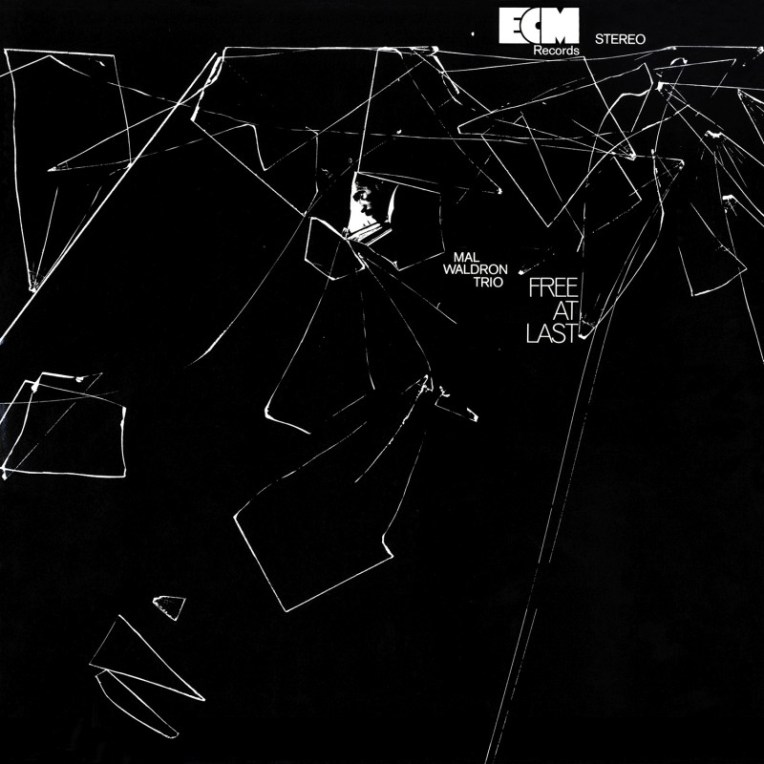
Mal Waldron Trio: Free at Last (ECM 1001)

1001

Mal Waldron Trio
Free at Last

Mal Waldron piano
Isla Eckinger bass
Clarence Becton drums
Recorded November 24, 1969 at Tonstudio Bauer, Ludwigsburg
Engineer: Kurt Rapp
Supervision: Manfred Eicher
Produced by Manfred Scheffner* + Jazz by Post
Release date: January 1, 1970

A cymbal riff from Clarence Becton introduces this respectable outing from Mal Waldron and company as bassist Isla Eckinger and the bandleader jump in for some enjoyable interplay. Yet what begins as an energetic ride turns somber through Eckinger’s rumination. Such solos lend deeper insight into the goings on, underscored by Waldron’s staccato mastication. Ballads are the album’s ventricles. A sweltering slog through love and darkened streets, “Balladina” shines with a hardened beauty all its own, while “Willow Weep for Me” is therapeutic like a good long cry. Both tracks have been strategically placed as penultimate bookends and serve as two-way doors into the struggles on either side. Others, like “1-3-234,” center the listener with needed uplift from these brooding asides, culminating in the concise and playful “Boo.”

This recording, ECM’s first, represents what was to become the label’s defining edge: namely, the allowance for (and foregrounding of) space in the recording of jazz. Seeing as this was already part of Waldron’s base approach, selectively pulling at roots while grafting on new ones, this disc was a suitable vehicle for his raw aesthetic. Its melodies may not stick in your head, but are stepping-stones toward a careful melancholy. And while ECM would vastly improve and enlarge its recording repertoire in the decades to come, there remains something comforting—just shy of innocent—about this album. If anything, this is a jazz of introversion, an intimate and myopic exposition of fleeting interactions that neither invites nor pushes away.

As Peter Rüedi has it, “free” meant something quite different to Waldron than it did to the more overtly anarchic figureheads of the waning sixties. It was, rather, “a quality that starts with structure and comes back to structure.” In light of this, Free at Last is the point of departure for a label that has since never looked back, even as it carries these sounds in its heart.

*Scheffner’s name is incorrectly spelled as “Scheffnfr” on the original LP.

For my thoughts on the 2019 vinyl reissue, click here.

>> Just Music: s/t (ECM 1002)

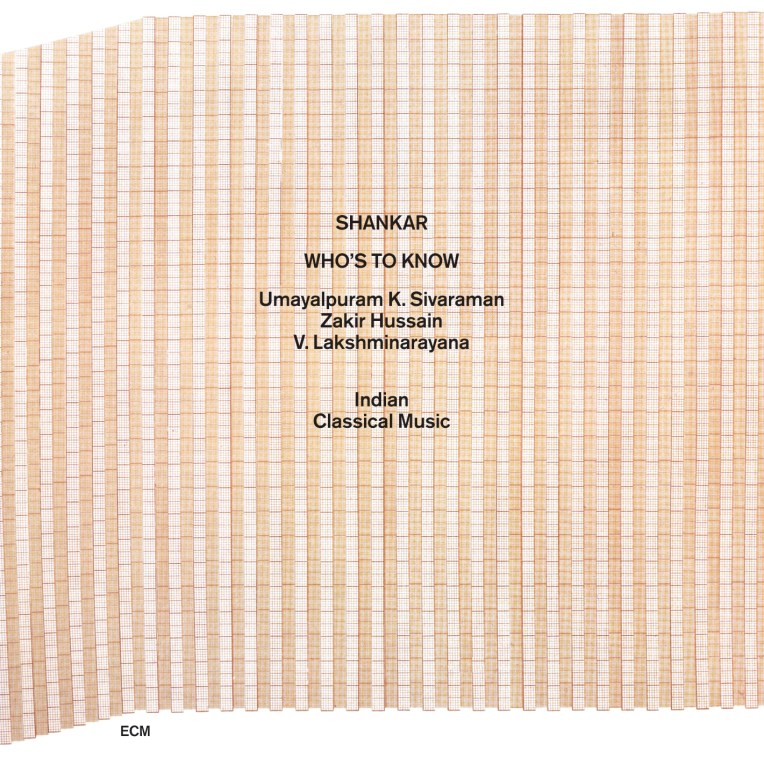
Shankar: Who’s To Know (ECM 1195)

ECM 1195

Shankar
Who’s To Know

Shankar 10-string double violin, tamboura
Umayalpuram K. Sivaraman mridangam
Zakir Hussain tabla
V. Lakshminarayana conductor (tala keeping)
Recorded November 1980 at Tonstudio Bauer, Ludwigsburg
Engineer: Martin Wieland
Produced by Shankar and Manfred Eicher

Tamilian violinist Lakshminarayana Shankar offers listeners a beautiful and powerful experience in this, his first outing for ECM. Shankar plays a 10-stringed instrument of his own design, and his personal hand in its construction is as deeply evident as his playing of it. Over a steady drone of tamboura and attuned rhythmic support from Zakir Hussain and Umayalpuram K. Sivaraman, Shankar’s flights of improvisation are free to soar. His melodies are driven by deep recognition of intent, visceral and immediate.

We are treated here to two long-form pieces, averaging 23 minutes each. Though distinct in form and mood, they are unified by an overarching sense of commitment and, I daresay, surrender. The first, Ragam-Tanam-Pallavi, introduces its theme with fluid precision. Shankar’s fingers seem never to rest on any single note for long, carried as they are by the as-yet-unspoken rhythms lurking just beyond the horizon. And so, when those rhythms do at last come to be articulated, the listener is salved by the comfort of a promise fulfilled. Ananda Nadamadum Tillai Sankara, on the other hand, carries itself forward with a touch of vulnerability, offering itself to the fate of its own musical environment. This is a more somber companion piece that slips into more adventurous registers and changes of key, and with a determination all its own. Eventually the violin turns in on itself, leaving our percussionists to play us out in an intimate call and response, culminating in the violin’s lilting swan song before the tamboura fades into silence.

Those familiar with Carnatic music will find much to admire in Shankar’s signature style and inexhaustible virtuosity. This is arguably his least “fusionesque” album to date, drawing its borders with reliable pigments that clearly serve its musicians well. Brimming with inspired playing, effortless execution, and a singular melodic sensibility, this is an impassioned and vivid record from start to finish and will ever remain an ECM jewel.

<< Goodhew/Jensen/Knapp: First Avenue (ECM 1194)
>> Thomas Demenga/Heinz Reber: Cellorganics (ECM 1196 NS)

Thomas Demenga/Heinz Reber: Cellorganics (ECM New Series 1196)

ECM 1196 LP

Cellorganics

Thomas Demenga cello
Heinz Reber pipe organ
Recorded October 1980 at Pauluskirche Bern, Switzerland
Engineer: Martin Wieland
Produced by Manfred Eicher

Cellorganics is exemplary of what I see to be ECM’s primary aesthetic: the dialectic possibilities of seemingly disparate instrumental voices, cultures, and sociopolitical contexts. The pairing of cello with organ is but a step away from the former’s canonic place beside the piano. And yet this juxtaposition opens us to entirely new areas of sonic creation, dramatically enhanced by the lofty recording space.

The album arises as if from slumber with the lone cello, whereupon it is gently accosted by the organ. Thus begins a delicate conversation that before long erupts into a frenzied catharsis. At this point Reber repositions himself, providing a dense and layered backdrop for Demenga’s no less contemplative phrasing. This stichomythic structure continues, interspersed with stunning moments of confluence—occasionally dipping into reverberant depths of scraping and sustained chords—before the cello works through its own degradation into a sort of intertextual improvisation.

The album’s center finds the two musicians in an exuberant melancholy; one suffused with both rhythmic buoyancy and introspective caution. The organ’s pointillism becomes a comforting counterpoint to the cello’s harmonic glissandi, giving way to an expansive exposition and coda.

Ultimately, this album is about power relationships and their reconfigurations. The organ’s long-held position as a vessel for moral weight, as imposing as it is transcendent, is challenged here in its pairing with a “lowly” string. This is not a cello that yearns to be heard, but one that sings out of its own self-sufficiency. The pizzicato passages that open the final chapter in this narrative are like footsteps, neither approaching nor receding, dancing in place to the tune of their own inner voices. The organ, too, becomes a living organism, literally breathing life through a forest of esophagi.

This recording invites us not only to listen, but also to speak.

<< Shankar: Who’s To Know (ECM 1195)
>> Meredith Monk: Dolmen Music (ECM 1197 NS)

My life with ECM

When I was 13 years old I fell in love with classical music. At the time I was, like most of my peers, listening exclusively to popular music: Michael Jackson, LL Cool J, Boyz II Men, George Michael, and Mariah Carey were among the many artists in constant rotation through my Walkman. Then one day I decided that these soulful, albeit commercial, stylings just weren’t cutting it for me anymore. In retrospect, this was as much a conscious decision on my part to break from the mainstream as it was simply a means of defining my sense of self in the throes of adolescence. My teens may not have been especially difficult, yet I wanted to broaden my horizons as I saw them under threat of constriction. Put another way: it wasn’t that I felt misunderstood, but that I felt I didn’t understand enough. To this end, I found myself in a state of agitated boredom one Saturday afternoon and decided to relieve that boredom by poring through my father’s old record collection. It was then that I discovered a recording of Vivaldi’s The Four Seasons as performed by I Musici. From that moment on, I shunned my shiny cassettes in favor of aged vinyl (I have since learned to appreciate pop music in many forms—not as a compromise, but as a genuine field of interest—and have “recovered” many of those same artists). Classical music provided me the safe space I had been seeking in my youth; a realm of sound in which I would never have to be afraid of reveling in the emotions I was being socially coerced to avoid.

It was not until high school, however, that I would discover ECM, when my world was transformed by a radio broadcast of Arvo Pärt’s Te Deum. Hearing this music for the first time awakened me, as I am sure it has many others, to a blissful state of self-awareness. Its supremely bipolar beauty allowed me to recognize the necessity of life’s contradictions at a time when such conflicts were leading me down a pessimistic path. Pärt’s musical gestures were not only bursting with spirituality, but also caked with the dirt of human touch as they tore at the flimsy façade I had constructed for myself. My encounters with this music hollowed me out completely.

This led me to my first ECM purchase of the selfsame album. I haven’t looked back since.