

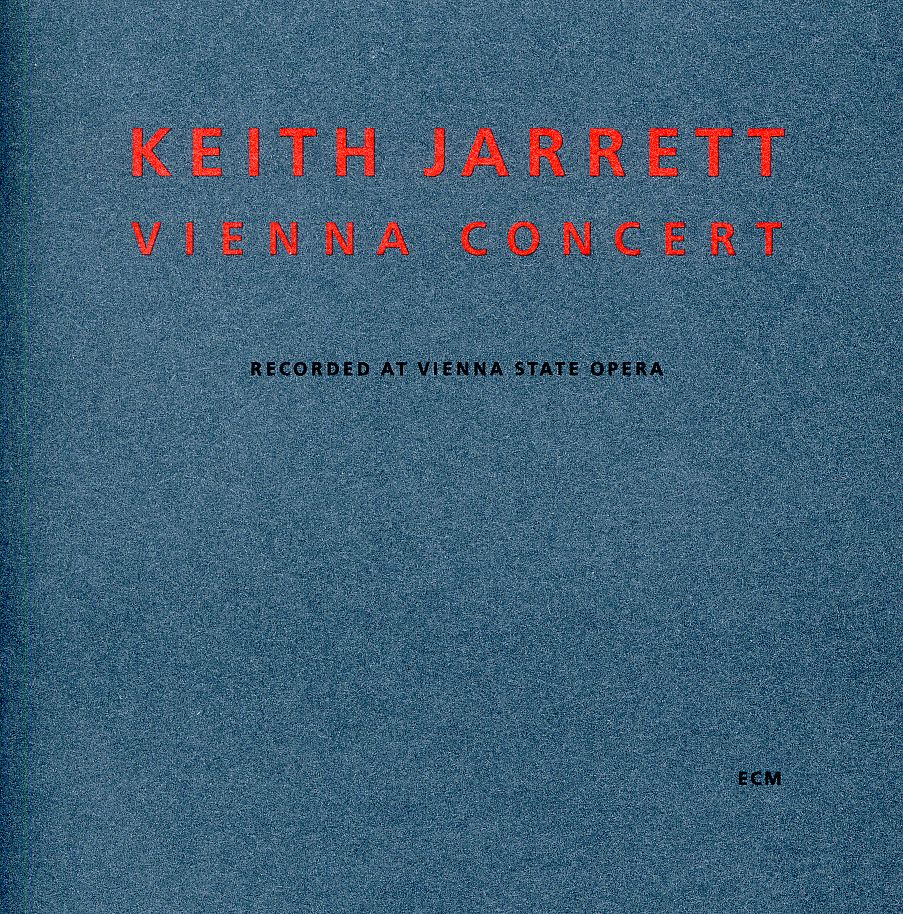
Keith Jarrett
Vienna Concert
Keith Jarrett piano
Recorded July 13, 1991 at the Vienna State Opera
Engineer: Peter Laenger
Produced by Manfred Eicher and Keith Jarrett
“I have courted the fire for a very long time, and many sparks have flown in the past, but the music on this recording speaks, finally, the language of the flame itself.” So writes Keith Jarrett in the liner notes to a stunning account of his solo improvised performance at the Vienna State Opera in July of 1991. In expressing as much, Jarrett articulates what is so difficult to articulate: that intangible source from which he gathers the energy to emote so freely at the keyboard.
Part I begins in solitude before a clearly rapt audience. Its sweet and comforting lullaby draws a paternal curtain around a prelude for the rolling dream to come. Jarrett digs his left hand into the soil, planting with his right a prairie’s worth of flowers, weeds, and wildlife. It is a plodding journey whose trail is brought about by many feet pulled from the muddy undertow and spun from threads of almost obsessive reflection. The comportment of this music plunges deeper even as it arches its neck ever skyward, arms lost and wings gained. Knowledge of how to use those wings is what Jarrett seems after, for the moment he sets feet to ground, he makes of the world a runway for the soul, tumbling his way into learning. His fingers dance in circles, kicking up a cyclone of activity and opening into a sweeping aerial view. He breaks apart the sun and shows us its inner shadows. In the end: only triumph and rapture, a body torn in two to unify the above and below, showing a harp-like touch in those final breaths. Like an expertly shucked cob of corn, it owes its life to weathered hands and grains hungry for mineral earth.
Part II is more suspended, forlorn and characterized by a watery, Byzantine touch. Jarrett plays the piano here as if strumming it, weaving a fairytale’s spell, light through a window whose glass is molten and alive. Tracing smiles through the sky in a swing built for tintinnabulation, he brands a sunset dotted and dashed by recollection. Quiet houses on the horizon, children’s laughter long-faded between them. Sticks that once were swords hunch into gnarled canes. Jarrett’s unfolding flower reaches its peak of sonic pollination and blends into a folk song from afar, from deep within, from inside and outside, from no one and all of us.
At some point, I’ve learned to stop comparing every Jarrett solo concert to the Köln. If the imagery it inspires in me is any indication, each is its own story. His is not a creative life spent climbing a single peak, but one that, by its end, will have left a landscape filled with them for as far as the eye can see.
<< Heiner Goebbels: SHADOW/Landscape With Argonauts (ECM 1480)
>> Meredith Monk: Facing North (ECM 1482 NS)
 Between Sound and Space: ECM Records and Beyond
since you never dislike anything on the label, it’s all rather pointless…
That’s an interesting take, Simon, and one that I think begs further examination.
I fail to see why there’s anything fundamentally wrong with liking everything under an overarching category. If a Baroque music historian likes everything written by Johann Sebastian Bach, is it then pointless to write about his music? Or, if a film critic is a huge Criterion Collection fan and finds something to appreciate in every release, is it necessarily a meaningless exercise in self-indulgence to flesh that out in writing?
More importantly, just because I review an album positively doesn’t mean I “like” it, and there are albums in the ECM catalog that I would be happy never to hear again (and even one that I can’t stand). However, early on in this project, I decided to make it less about rating albums and more about creating a listening diary through the label. In that respect, my goal has always been to get as close as possible, in words, to what the music “feels” like by getting into the spirit of what I’m hearing. That way, if someone likes what they’re reading, they might find the album enjoyable. For example, take the following line from my review above, since you left a comment on it: “In the end: only triumph and rapture, a body torn in two to unify the above and below, showing a harp-like touch in those final breaths.” Now, if that reads like a pretentious word salad (as I’m sure it does to some), then maybe they won’t like the music. But if that reads as poetically relevant to another, they may want to check it out. If I just said something like, “Here’s yet another album of Keith Jarrett improvising in front of a live audience. Some of it is lyrical, some abstract and incomprehensible. We already have The Köln Concert, so why do we need yet another attempt to live up to that standard? A hard pass for me,” then I might deprive someone of the discovery of listening to it because I didn’t let the music speak for itself. For me, a review should be a conversation, not a debate.
I also see my style of reviewing as a way to give props to the musicians (who clearly “liked” recording their creations) and producer Manfred Eicher (who clearly “liked” what he recorded) in acknowledgment of the dedication they put into creating these works of art. That is what I adore most about ECM and where I see great consistency over the past 50+ years, which is a remarkable accomplishment.
To be sure, I do indeed feel a close creative connection to a huge portion of the catalog, but it’s not always about “liking” it. It’s about being honest in expressing how it all makes me feel. I can only hope it resonates. So while I understand the point you’re making (and I don’t discount it; I just disagree), I hope it won’t deprive you of making some genuine discoveries in an oeuvre that is as varied as it is vast.
Happy listening!