Arild Andersen: Sagn (ECM 1435)

Arild Andersen
Sagn

Arild Andersen bass
Kirsten Bråten Berg vocals
Bendik Hofseth tenor and soprano saxophones
Frode Alnæs guitar
Bugge Wesseltoft keyboards
Nana Vasconcelos percussion, vocals
Recorded August 1990 at Rainbow Studio, Oslo
Engineer: Jan Erik Kongshaug
Produced by Arild Andersen

Sagn was the result of a commission for the 1990 Vossajazz festival that sealed the collaborative spirits of singer Kirsten Bråten Berg and bassist Arild Andersen. Blending folk songs from their native Norway, along with jazz and rock elements, the two shared the stage with percussionist Nana Vasconcelos, saxophonist Bendik Hofseth, pianist Bugge Wesseltoft, and guitarist Frode Alnæs. While we don’t have (so far as I’m aware) a live recording of what was surely an historic occasion, we do have this ECM studio rendition, buffed and polished to a mirror’s shine.

The album’s multilayered concept is perhaps best demonstrated in the title track, which opens with an ambient drone (something akin to the lull of train tracks) before awakening to the rhythm of Vasconcelos’s touches and Berg’s unmistakably equally earthy elements. Her voice binds this album together, even as it scatters its pages to the wind. Hofseth, bearing a proud stamp of influence from Jan Garbarek while being no mere epigon, traces lines in the sand with his tenor. These Andersen is happy to overstep in that gentle way he has.

From here we travel the length of an entire seasonal cycle, each point on the compass like a year divided. “Gardsjenta” continues this wintry mix, whitewashing us into the young dawn of “Eisemo,” in which Andersen’s lyrical swings first come into prominence amid Vasconcelos’s scrapings. The latter offers a deeper, worldly feel throughout “Toll,” for which Andersen offers a head nod to Eberhard Weber. ECM artist influences continue in “Draum,” in which Alnæs lends a Terje Rypdal brand of melancholy to the album’s first intimations of spring before opening into some powerful screaming from Hofseth (a cathartic moment). Wesseltoft cradles the past in the vocal territories of “Laurdagskveld,” while “Tjovane” (heard more recently on Trio Mediaeval’s Folk Songs) sends us forward into the band’s ecstatic synergies. “Sorgmild” is by far the album’s most breathtaking. Hofseth’s tenor sings like the wind and primes us for a tender solo from Andersen. After the diffusion of “Svarm” and “Gamlestev,” the syncopations of “Reven” bring us into a lively summer. It is also a mysterious summer, whose dreams are played out in a smattering of rounded tracks until the winds of “Belare” whip up a storm of leaves, bringing us full circle into the icy depths and ending this masterful album on a trailing brushstroke.

Sagn is a massive effort, one of ECM’s fullest on a single disc, and stands as Andersen’s most personal statement to date.

<< Bach: Das Wohltemperierte Klavier, Buch II – Jarrett (ECM 1433/34 NS)
>> Doran/Studer/Burri/Magnenat: Musik für… (ECM 1436)
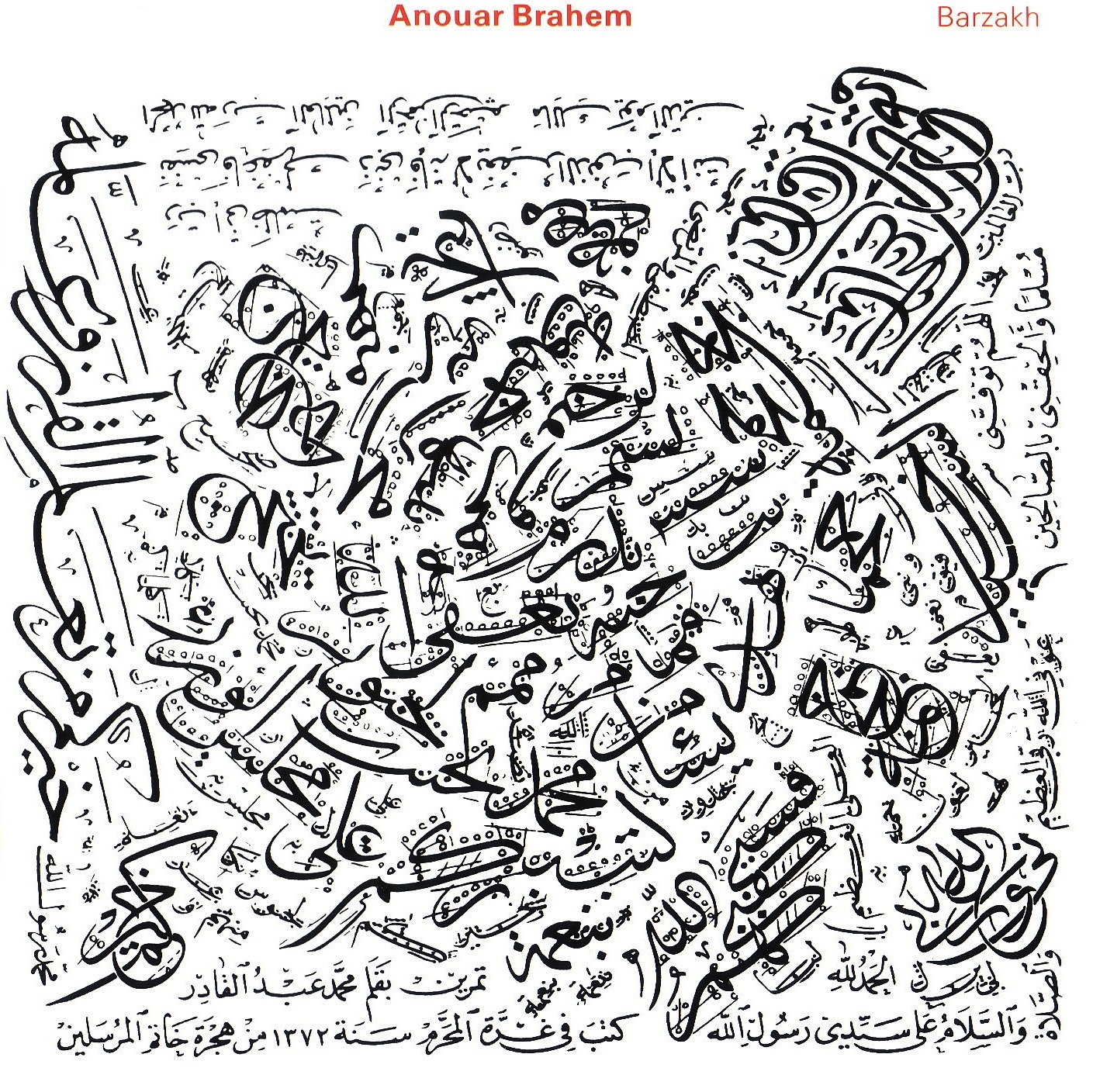
Anouar Brahem: Barzakh (ECM 1432)

Anouar Brahem
Barzakh

Anouar Brahem oud
Béchir Selmi violin
Lassad Hosni percussion
Recorded September 1990 at Rainbow Studio, Oslo
Engineer: Jan Erik Kongshaug
Produced by Manfred Eicher

This album marks the beginning of an ongoing and fruitful relationship between Tunisian oud master/composer Anouar Brahem and the ECM label. From the exhilarating solo “Raf Raf,” we know we are in the presence of someone whose sense of touch, rhythm, melody, and atmosphere speaks straight to the heart from the mind of a visionary. This first track puts us into a time and place where only melody speaks, and the sands of time flow like blood in an infinitely chambered heart. The title track introduces the violin of Béchir Selmi, whose tender ribbons bind volumes. Brahem unfurls a ponderous firmament for which Selmi strings the clouds together in a necklace—a smile arcing across some divine collarbone. So begins a mournful, loving diatribe of sand and air. The synergy of this trio is honed to a golden edge in “Parfum De Gitane,” which exemplifies the album’s organic progression from soliloquy to chorus, and which is couched by two solo excursions from percussionist Lassad Hosni. These float us down the river of “Kerkenah,” which again spreads its warmth wide.

A tapestry of colors fills out the album, including the lullaby-like “Sadir” and “Hou,” as well as the fresh energies of “Ronda” and “Sarandib.” Brahem shines most, however, in the solo pieces, of which “La Nuit Des Yeux” is an incredibly programmatic example that works at the level of fantasy. And in “Le Belvédère Assiége” we find in the intimate confines of that hollow body a shelter for all of us, where the sustenance of “Qaf” is given on a sonic platter as ephemeral as the drink that nurtures us from its plane.

Barzakh balances itself on the fulcrum of tradition, in the process bidding us to follow the lessons of the every day.

<< Christopher Bowers-Broadbent: Trivium (ECM 1431 NS)
>> Bach: Das Wohltemperierte Klavier, Buch II – Jarrett (ECM 1433/34 NS)

Eleni Karaindrou: Music For Films (ECM 1429)


Eleni Karaindrou
Music For Films

Jan Garbarek tenor saxophone
Vangelis Christopoulos oboe
Eleni Karaindrou piano, vocal
Anthis Sokratis trumpet
Nikos Guinos clarinet
Tassos Diakoyiorgis santouri
Eleni Karaindrou director String Ensemble
Recorded August 1990, Polysound, Athens
Engineer: Yannis Symrneos
Produced by Manfred Eicher

Once we are aware that certain music has been written for film, it’s easy to wax poetic about said music’s visual associations. Yet I believe that one needn’t be aware of Greek composer Elenei Karaindrou’s filmic motivations in order to feel it in the same way, for hers imagines, recites, and sings the lament of a zeitgeist in decay.

Saxophonist Jan Garbarek is very much at home in the quiet throes of “Farewell Theme” and lends his focused energy to a nexus of strings and santouri that, in a short span, scales the heart’s deepest cliffs. This piece both begins and ends a disc comprised of Karaindrou’s best from the 1980s, and is also the longest. “Elegy For Rosa” and “The Journey” are among the briefer portals into the album’s blinding refractions, such as “The Scream” and “Return,” the latter something of an anthem in its present context. The chromatically inflected evocations of “Wandering In Alexandria” quiver with curiosities, as if lost in a land one has forgotten. The oboe of “Adagio” spins a rope of travel across the sky, sending down threads of hope into “Fairytale” and “Parade.” These recurring themes bow in deference to the cradle of “Rosa’s Song,” in which Karaindrou’s own voice rings like a slow-motion slingshot into the improvisation that follows. This collection pours its remaining jewels from a silken pouch, bringing us back through Alexandria and into the folds where we began.

Karaindrou’s themes are potent yet familiar, even (if not especially) to those who’ve never heard them before. Brimming with tragedy and triumph alike, this is music not only for the fictional, but also for real strangers crossing paths in a world of mist and shadows.

<< Egberto Gismonti Group: Infância (ECM 1428)
>> Arvo Pärt: Miserere (ECM 1430 NS)

Egberto Gismonti Group: Infância (ECM 1428)

Egberto Gismonti Group
Infância

Egberto Gismonti piano, guitars
Nando Carneiro synthesizers, guitar
Zeca Assumpção bass
Jacques Morelenbaum cello
Recorded November 1990 at Rainbow Studio, Oslo
Engineer: Jan Erik Kongshaug
Produced by Manfred Eicher

Egberto Gismonti cuts a fascinating figure, even among ECM’s already populous roster. The Brazilian multi-instrumentalist never fails to delight with his nostalgic mix of folk and personal melodic elements. In this sense, the opening “Ensaio de escola de samba (Dança dos Escravos)” is emblematic. Combining the Ralph Towner-like flurry of his guitar with bass and cello (the latter courtesy of Jacques Morelenbaum, of Morelenbaumfame) riding musical waves into an oncoming storm, we visualize a deep and colorful ocean. Gismonti’s pianism is even more inspiring. His sound—every bit as lush as Keith Jarrett’s—levels the playing field in the carnivalesque of “7 Anéis” and in the lushness of “A fala da paixão,” throughout which he pulls the past through the sky like a thread through a needle. He is joined by a cello’s comet and distant supernovas of bass for an ascent toward blissful stillness.

“Meninas” finds Gismonti in ghosted form, providing both the pianistic scenography and the raindrop guitar that populates its stage. Bass and cello continue stringing their pearls, moving in gusts and pauses like the wind. The title track floats a cello over a Steve Reichean ostinato. One finds also a Chick Corea exuberance at play here, both in the sparkling musicianship and in the writing. Some turns from synth add a darker side to this bright memory. “Recife & O amor que move o sol e outras estrelas” then offers a chance to hear Gismonti’s skills at the keyboard in fuller bloom. This track is yet another sparkling jewel, theatrical and full of contrast. We close with two dances for guitar and cello, invigorating and prickling the sunset like a silhouetted cactus, and joins its playful dissonances to the calls of children at play.

This album shows the maturity of Gismonti’s writing, his evolution as melody-maker and musician. This huge slice of life treads its past as might a youth through a jar of marbles, picking out only those clearest and most aesthetically pleasing to click among the rest.

<< Stephan Micus: Darkness And Light (ECM 1427)
>> Eleni Karaindrou: Music For Films (ECM 1429)

Stephan Micus: Darkness And Light (ECM 1427)

Stephan Micus
Darkness And Light

Stephan Micus dilruba, guitar, kortholt, suling, ki un ki, ballast-strings, tin whistle, balinese gong, sho
Recorded January/February 1990 at MCM Studios and Studio Giesing, München
Engineer: Tom Batoy

Listening to a Stephan Micus album is always like taking a journey through darkness and light, and so it is no wonder that his fourth album for ECM should bear that very title. The sarangi-like tones of the dilrubi of Part 1 open up a pathway that is indeed by turns bright and shaded. The path is circular, leading forever back to where it began, as if to say, “Birth and death issue from the same step.” From this mouth agape we get the insular sutras of guitar. Its chain of arpeggios carries in its arms a bouquet of memories and rests it in the crook of a tree, where it plays for the sake of Nature. From that whispered cove arises a mermaid holding a bow at the edge of a string. With every splitting of voice we are veiled in deeper solitude. Mournful songs shape a still heart, hanging on to certain threads longer than others. The guitar helps us to nourish ourselves with what remains in its chamber, stenciling the periphery with every pluck and unearthing in the afterlife all that is yet to come. Even in the absence of a bow, we feel our voices continuing to spin novel draws in the ether.

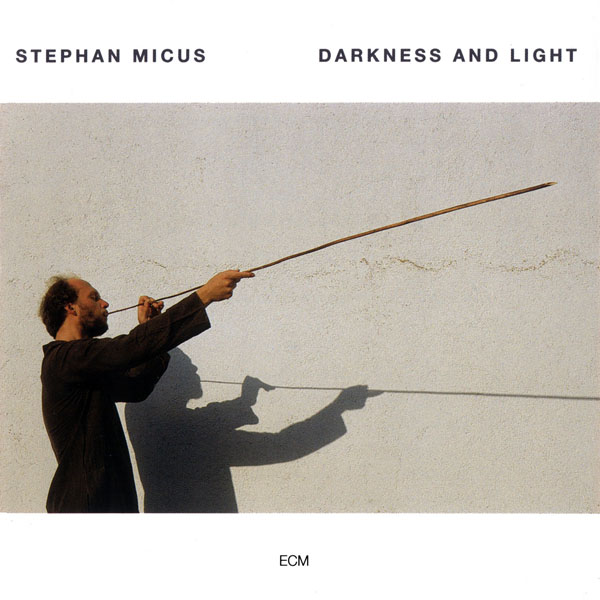
Part 2 takes a rawer approach to the dilrubi, giving rise to the call of the ki un ki, the Siberian cane trumpet pictured on the album’s cover. Played by inhaling, it sounds like a combination between a Theremin, a split and blown grass blade, and an elephant calling out to the cosmos. Part 3 scrapes the edge of darkness on its climb toward a trembling song. A flute cries as if in dialogue, two lovers parted on either side of the Milky Way unifying at last in a hopeful vein, tracing light back to the nebula that birthed them both.

Darkness And Light is as fleeting as its message, transparent as water and betraying its presence only through reflections. Still, its elemental forces sweep us away in the depth of Micus’s human touch, such that when they stop, one feels they might linger forever.

<< Paul Giger: Alpstein (ECM 1426)
>> Egberto Gismonti Group: Infância (ECM 1428)

Keith Jarrett Trio: Tribute (ECM 1420/21)


Keith Jarrett Trio
Tribute

Keith Jarrett piano
Gary Peacock bass
Jack DeJohnette drums
Recorded October 15, 1989, Philharmonie, Köln
Engineers: Jan Erik Kongshaug and O. Fries
Produced by Manfred Eicher

No one makes live records quite like the Keith Jarrett Trio, whose inimitable skills and synergy ensure us that every tune breathes with all the life it deserves. As one of the few groups that can draw in a crowd thousands of miles and years away into that indefinable moment of expression, it transcends the confines of the concert hall, of the jazz club, of the audience’s adoration. All of these recede the moment you put this music on and let it fill your own space and time with the love and passion what bore it. We hear this especially in the balladry, of which Jarrett proves an adept exponent in “Lover Man.” Dedicated (as all pieces on Tribute are to those who once performed them, hereafter in parentheses) to Lee Konitz, the piece expands such notions of genre to begin with, unraveling from characteristically somber piano intros a world of sentiment. Peacock is especially notable in his first solo of the night, tracing an outline that DeJohnette is more than happy to color in. Jarrett maintains enviable subtlety in his improvisations, working in a clever nod to “The Girl from Ipanema.” He dances on air, even as he plunges his hands into a watery keyboard and mixes the sediments until they shine. DeJohnette, meanwhile, works wonders with his snare, unfolding a ponderous yet somehow buoyant solo: a drop of melancholy in an otherwise joyful sea. All this in the opening number? Yes, it’s that good.

Such things are de rigueur in Jarrett Land. One could expound at great length, for example, on “I Hear A Rhapsody” (Jim Hall). From the fluid intro and swinging groove it dovetails to DeJohnette’s popcorn bursts, there’s so much to acknowledge for fear of doing the music injustice. DeJohnette and Peacock generally keep the flame low and steady as Jarrett turns all manner of somersaults, each a storm cloud waiting to burst, yet which instead couches rainbows. Down one of these Jarrett slides into a pot of golden applause. “Little Girl Blue” (Nancy Wilson) turns with the grace of a plumed bird bowing into the wind. Peacock again walks that fine line between heartbeat and fluster. The more up-tempo “Solar” (Bill Evans) finds Jarrett working his usual eddies into relief. One really notices the acoustics of the concert space, linking Jarrett’s submissions to the rhythm section’s stellar flip-flopping and moving us seamlessly into the exhilarating, sparkling piece of music-making that is “Sun Prayer.” A quintessential Jarrett tune if ever there was one, one feels in its shape a musical life lived to its fullest. DeJohnette flashes his powers as Jarrett weaves some of his densest pianism yet before baying into a translucent cove, where floats the detritus of a promise so enormous that it cannot help but embrace the world. “Just In Time” (Charlie Parker) delights with its odd timing, which sends Jarrett on a simply unstoppable journey as Peacock rides the DeJohnette train to Smoothville. The trio digs even deeper in quiet stunners like “Smoke Gets In Your Eyes” (Coleman Hawkins), “All Of You” (Miles Davis), “It’s Easy To Remember” (John Coltrane), and “Ballad Of The Sad Young Men” (Anita O’Day), the latter graced by DeJohnette’s steam-engine brushes. A highlight in the album’s second half.

From the buoyant piano intro, “All The Things You Are” (Sonny Rollins) puts one in mind first of Gary Burton at the vibes before unleashing a rhythm section aflame, making for one of the trio’s most exhilarating tracks anywhere. More pure Jarrett follows in “U Dance.” This joyous romp seems porous, but would withstand even the sharpest bullets of criticism. A spirited turn from DeJohnette bridges us into the tune’s closing half, where we find ourselves still dancing even as the music recedes into the distance from which it spoke.

I typically don’t read other reviews before writing mine, but in my gathering of information for this one I took a look at the comments on Amazon, only to be shocked at one customer who proceeds to tell us how, listening to “Ballad Of The Sad Young Men” while driving, he (?) became so fed up with DeJohnette’s drumming that he rolled down his window and threw the CD onto the highway. Everyone is, of course, entitled to personal opinion, and my reviews are never meant to be prescriptive, but I find it baffling that anyone could react against DeJohnette so strongly on the basis of such an exhilarating album. Chalk it up to my drumming ignorance, but I daresay that DeJohnette’s is some of the best around. Among other things, on this recording he seems to have upped his snare work to something special in the grammar of his kit. I underscore this point only to prevent potential listeners from missing out on a tremendous experience.

Gorgeous to the last drop.

<< Jan Garbarek: I Took Up The Runes (ECM 1419)
>> Gesualdo: Tenebrae (ECM 1422/23 NS)

Jan Garbarek: I Took Up The Runes (ECM 1419)

Jan Garbarek
I Took Up The Runes

Jan Garbarek soprano and tenor saxophones
Rainer Brüninghaus piano
Eberhard Weber bass
Nana Vasconcelos percussion
Manu Katché drums
Bugge Wesseltoft synthesizer
Ingor Ántte Áilu Gaup voice
Recorded August 1990 at Rainbow Studio, Oslo
Engineer: Jan Erik Kongshaug
Produced by Manfred Eicher

By 1990, Jan Garbarek had for decades been searching for that one key, navigating a landscape of peaks and valleys, only to find it slumbering within the runes which, with this album, he eponymously took up. A snaking version of Mari Boine Persen’s “Gula Gula” outlines the album’s perfectly proportioned ritual space for a sound that has come to define the Norwegian saxophonist’s output since. With Runes his tone had achieved a luminescence that fell like liquid onto the keyboard of Rainer Brüninghaus.

Balancing note and movement, Garbarek hones something truly special in the five-part “Molde Canticle,” which draws out the album’s deepest anatomies. Above all, the piece is about time. It speaks in a language that moves us. The gyroscopic quality of Part 2 hums around the centrifugal force of Garbarek’s lyricism as he scales ever higher. Part 3 features a singsong solo from bassist Eberhard Weber, who elicits bird-like harmonics from the soft glide of his bow. These enchantments are but a prelude to a round of wind and pianistic musings. Part 4 is a more rhythmic showcase (percussionist Nana Vasconcelos’s influence is also clear on tracks like “Buena Hora, Buenos Vientos”), and features some heavy blowing from Garbarek, at once whimsical and weighty, while Part 5 finds him weaving a simple wave over a harp-like ostinato.

These melodies all have the makings of folk songs (sometimes the other way around, as in “His Eyes Were Suns”), so vivid is each in its evocation of peoples and traditions. The title track is a more groove-oriented spectacle and finds Garbarek freeing himself even further. This leaves only “Rahkki Sruvvis,” another chanting piece with some overdubbed saxes for a final skyward glance.

Many have criticized Garbarek for going soft. I Took Up The Runes proves that he has simply channeled that dynamic energy through different rivulets of intensity. Like smoke, they need fire to soar, but fire in its natural state requires time and care to catch.

A masterpiece.

<< John Surman: Road To Saint Ives (ECM 1418)
>> Keith Jarrett Trio: Tribute (ECM 1420/21)

The Dowland Project: Romaria (ECM New Series 1970)


The Dowland Project
Romaria

John Potter tenor
Miloš Valent violin, viola
John Surman soprano saxophone, bass clarinet, tenor and bass recorders
Stephen Stubbs baroque guitar, vihuela
Recorded January 2006 at Propstei St. Gerold
Engineer: Markus Heiland
Produced by Manfred Eicher

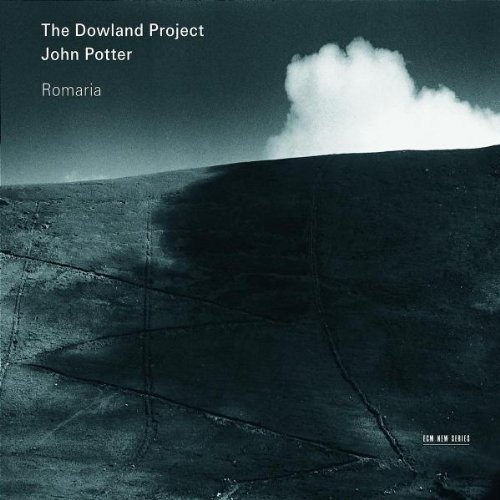
The atmosphere of Romaria, the Dowland Project’s third album for ECM, is exactly like its cover: monochromatic, with a splash of cloud over a stretch of scored earth. Stripping down its ethos to barest elements, the Project takes up plainchant, anonymous monody from the Carmina Burana manuscript, and Iberian folk songs, spinning from them a lush improvisatory world sprinkled with troubadour songs and motets from, among others, Orlando di Lasso and Josquin Desprez. The new addition of Slovak violinist Miloš Valent makes for a sustained and burrowing sound that blends uncannily with Stephen Stubb’s strings.

Got schepfer aller dingen starts us off with a brood, setting the tone for a somber yet somehow vigorous album. Where this vigor comes from is hard to say. Could it be in John Surman’s hopeful bass clarinet in Veris dulcis? Or perhaps in Stubb’s plucked accompaniment in Ora pro nobis? Yet further in John Potter’s aching vulnerability in Lá lume? Whatever the source, it’s clear that the versatility and depth of songcraft here is as delicate as a moth’s wing in a lantern’s flame.

Potter, it must be said, is the heartbeat of this album, drawing out from the instrumental surroundings a most thorough vocal line. The instruments seem to grow from his soil, particularly in Dulce solum, seeming to constitute the touch of breath through lips and mind. Similarly, Der oben swebt sways like the wind in the barley, carrying up in its wisps of recollection the promise of a lively day.

Much of the album is free-flowing and at times so organically realized (note, for example, In flagellis) that one wonders if the original melodies didn’t also arise in this unscripted fashion.The instrumental Saudade is another highlight that showcases the inspiring talents of Surman, whose soprano enlivens the darkest corners of Kyrie Jesus autem transiens and Ein iberisch Postambel to mesmerizing effect. Sometimes, the instruments recede just slightly, as in O beata infantia, allowing for Potter’s voice to carve its own tracks.

Listening to an album like this, one realizes the potency of the songs chosen, existing either in fragments or thicker sketches. Freedom is given to the performer, allowing new voices to come through. Each is but a drop in a larger body of water, necessary yet invisible in its surroundings.

Heinz Holliger: Lieder ohne Worte (ECM New Series 1618)

Heinz Holliger
Lieder ohne Worte

Thomas Zehetmair violin
Thomas Larcher piano
Ursula Holliger harp
Recorded June 1996 at Radio DRS, Zürich
Engineer: Stephan Schellmann
Produced by Manfred Eicher

After an already healthy representation of the compositional prowess of Heinz Holliger, ECM decided to put out this disc pairing some of his earliest work from the sixties with that of decades later, thereby providing an engaging survey of a musical mind that turns like a kaleidoscope: holding tight to symmetries so that it might fragment their interiors in ever-novel, I would say linguistic, combinations. For indeed, language is what Holliger is all about. From the poetry that inspired him as a youth to the poetry that he creates as an adult, the Swiss composer revels in every portion of his mental reserve to fish out some of the most heartfelt music of the twentieth century.

The tactility of Holliger’s instrumental renderings always seem to have something of the human voice about them. Every cell is marked by the potentially vulnerable transfiguration of form, a breaking down or “clearing of the throat” by which the musical moment is rendered chalk-like in the face of its own palimpsestial illusions. The two sets of Lieder ohne Worte that embrace this disc turn the standard violin/piano duo inward, ever refracted toward a conversation comprised entirely of afterthoughts. Although generally light, it sometimes dips into urgent proposals to which the only desired answer can be a heavy silence. Both instruments become frames. The two Intermezzi recall Holliger’s 1982 Duo for violin and cello, linking adverbial phrases with descriptive trails. Songs without words, yes, but aren’t they always, for once they escape the lips they have already transcended the limitations of their shaping toward more distant reverberations.

In the Sequenzen über Johannes I, 23 for harp (played to perfection by wife Ursula), Holliger’s trademark fractures are filled by the plasma of fingertips, while the Präludium, Arioso und Passacaglia for the sameblush with savory dexterity. With the restrained ferocity of a classical guitarist, Ursula evokes an elastic space in which the life of any single note is determined by its distance from the body.

Two solo pieces fill in the eye sockets of this sonic skull. On the left is the winking Trema in a version for violin. Anyone used to the original for cello is sure to be caught up in the stark new textures. Where the cello draws that trembling forth from deep within its bowels, here it issues from the nostrils of a head animated by vehement denial. Yet in that denial is an unspoken (and unspeakable) commitment to self-reformation, to the idea that within the brain there is enough room to squeeze in all life experience into a single synapsial firing. The expediency of the lie is betrayed by its brevity. On the right are the three drowsy piano miniatures that make up Elis. In these vibrant fits there are only dreams. Rather than try to smooth them into a unified narrative, Holliger allows their worth to come clambering into our attention at whatever pace it chooses. A few extended techniques, like the hitting of a dampened string, emit flashes of color in an otherwise monochromatic field.

Holliger is notable for being a composer duly aware of the importance of space: between notes, between pieces, between selves. The stillness thereof is so heavy that, rather than falling like a stone, every note floats like a particle of windblown pollen. And in the hands of such astute performers, we begin to feel windblown ourselves.

<< Joe Maneri Quartet: In Full Cry (ECM 1617)
>> György Kurtág: Játékok (ECM 1619 NS
)