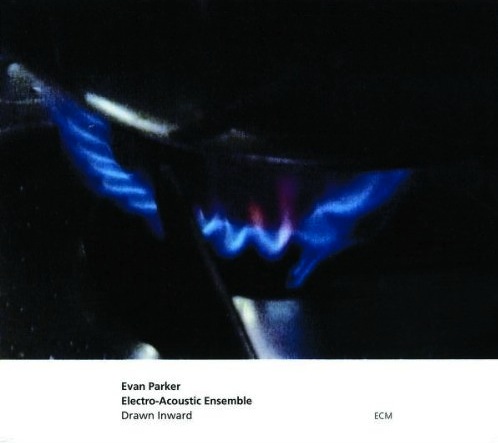
Evan Parker Electro-Acoustic Ensemble: Drawn Inward (ECM 1693)

Evan Parker Electro-Acoustic Ensemble
Drawn Inward

Evan Parker tenor and soprano saxophones, khene
Philipp Wachsmann violin, viola, live electronics, sound processing
Barry Guy double-bass
Paul Lytton percussion, live electronics
Lawrence Casserley live electronics, sound processing
Walter Prati live electronics, sound processing
Marco Vecchi live electronics, sound processing
Recorded December 1998 at Gateway Studio, Kingston
Engineer: Steve Lowe
Produced by Steve Lake

The spheres of composition and improvisation are not so far apart. In fact, Evan Parker and his Electro-Acoustic Ensemble seem to say, they are as inseparable as water from the ocean. Since 1992 the Ensemble has gone, as the title of its 1997 debut suggests, toward the margins, and is content in the asymptotic nature of those margins. This follow-up welcomes Lawrence Casserley and his computer wizardry into an already eclectic admixture of sound processors, thus enhancing the overall atmosphere with real-time entanglements. Because the result feels so much like an aural diary, I can only offer a written one in return.

(1) there is a jagged line in the egg, and the light that spills from it sings, crackling like rain on tarp. in the crooner’s sigh there are wounds, in his laughter there is healing.

(2) aroused from my dream, i creep like a shadow toward the lighted window, throw open its transparent lungs and breathe in the dew-kissed air. but a serpent in the sky mars this otherwise idyllic dawn with S-curved passage, the only afterimage to linger in these eyes as it wriggles through gauzy cloud cover and parhelia. Parker’s lockdown is arresting, a Glassean riff turned on its head and spun like a top.

(3) to travel in the homeland is to walk away from yourself. catharsis of will and locomotion. in the absence of progress, the feet quicken their pace. in the absence of goals, they slumber even as they ambulate. hidden in the watering can behind the barn is the drop i left before parting for the city, where only sewer drains collected the tears of so many others and stirred them into an underground cocktail, never again to be tasted. it is not so radical to think that one might live here, but to think that one might die here. i can turn the radio dial however much i want, but will never find the beacon that i crave. instead, a diffuse comfort whereby the winds of opportunity blanket me with their hush.

(4) to look into the spouting bowl is to blind yourself to the truths of which it is an indifferent receptacle. i can lasso these words to its underwater circus yet fear i might not have the strength to hold on ’til i reach bottom. a fidgety existence i lead when it’s all i can do not to fall away from others’ attention.

(5) the music tells me i can deploy my love as an agent of unrest and offers in that possibility a temptation in whose surface i cannot see myself reflected. my heart is already lost to the cause. i stand in a booth on the corner making collect calls to strangers, my fingers all a-blur at the number pad in their furious attempts to communicate.

(6) i have found it: the spinning globe of circumstance on which i was trapped like a drone on a treadmill. now i can hold it, toss it as a child would a ball. but in so being endowed, i find there is only guilt and discomfort, and the knowledge that the top of the pyramid is a lonely place. i can only follow my wayward guides, playing the part of the child again as i slide down its brick-laid slope.

(7) back to concrete, i run pell-mell, pushing the capabilities of my social craft to the flexible limits of their stature, dangling before myself a carrot of progress. i cannot want this; i must let it want me. somewhere in the body of a cello, my bones are breaking and mending by the laser vision of gas stove flame.

(8) at home in the universe…nowhere else i’d rather be. it is our terrarium, our humid sanctuary, our light and love.

(9) i am writing on ice, using the ink my mother gave me. i let myself seep into the surface, tracing imperfections with newfound script.

(10) they have captured something in the frame, glued it inside with the adhesive of acceptance. timetables and train tracks curl into a tangled ball, it’s shadow the signature in the lower left-hand corner.

(11) the thread has unraveled and the secret is out. i am here only so long as i write myself to be. i take your hand and bid you to take another’s, so that by the end we stand as one. this is the music that goes on in the attic when we are asleep, in concerts attended by mice and other wall dwellers. if we are drawn inward to anything, it is ourselves.

<< Eleni Karaindrou: Eternity and a Day (ECM 1692 NS)
>> Peter Ruzicka: String Quartets (ECM 1694 NS
)

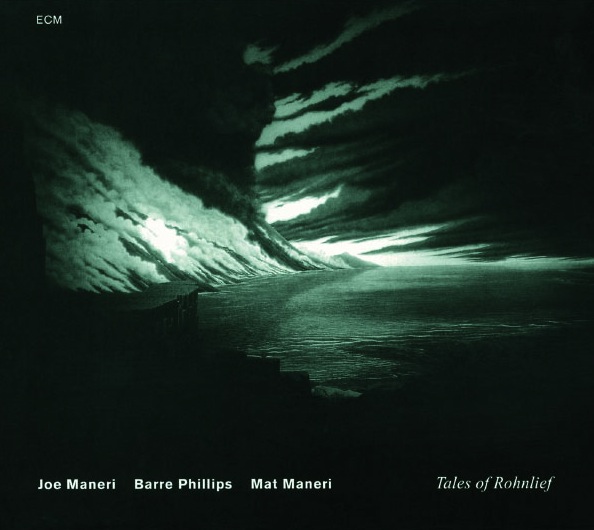
Maneri/Phillips/Maneri: Tales of Rohnlief (ECM 1678)

Tales of Rohnlief

Joe Maneri alto and tenor saxophones, clarinet, piano, voice
Barre Phillips double-bass
Mat Maneri electric 6-string and baritone violins
Recorded June 1998 at Hardstudios, Winterthur
Engineer: Martin Pearson
Produced by Steve Lake

Tales of Rohnlief is an exercise in recitation. Joe Maneri’s histrionics call out to grasslands and briny spray. He preaches at the edge of the world, where rocks cut like scissors through wrapping paper: only a push and not a squeeze. In his voice is all the landscape one needs to find purchase for the journey that follows. The voice expresses itself by way of throat and reed, a pitch-bent nightmare turned frosty and sweet. It pales into a spontaneous croak as Barre Phillips and Mat Maneri press their palms to an elaboration of surrender. And with that, these three uncannily attuned improvisers touch the sky with more sky. A break in the clouds reveals a backdrop of revelry.

“A Long Way From Home” feels like anything but, so intimate is its delivery. It whisks us through points of contact as familiar as our subcutaneous selves, and just as sensitive to the errant touch. Mewing cats trade places with stone idols flicking their tongues in the face of condemnation, licking away the possibility of failure as a hand wipes away condensation. Paltry rhyme schemes fail, however, to express the depth of this game of halos. We may, then, search for another method to the genius we now face. I propose that we turn our ears away from what is being told and focus rather on the telling itself. For if we look beyond titles like “When The Ship Went Down” and “The Aftermath,” neither of which help us despite the wonders of their contents, we realize that the inaugural voice has never left us. Its register curls a ghost’s hand and guides us through the gnarled lessons of “Bonewith” until, lo!, it casts its oracle shadow across the “Flaull Clon Sleare” and watches, silent, as we attempt to “Hold The Tiger” (a particularly brilliant pop-up). Watery yet never watered down, the song cackles. “The Field” is another notable mention, if not for its mournful qualities then for the color of its blood. Three dark and winding paths bring us to the tongue-tied destination of “Pilvetslednah.” Now that he’s shown us the yard, Joe welcomes us into his home, forever full of warmth.

There is so much sincerity in this music that it hurts.

<< András Schiff/Peter Serkin: Music for Two Pianos (ECM 1676/77 NS)
>> Alexei Lubimov: Messe Noire (ECM 1679 NS
)

Philipp Wachsmann/Paul Lytton: Some Other Season (ECM 1662)

Philipp Wachsmann
Paul Lytton
Some Other Season

Philipp Wachsmann violin, viola, live electronics
Paul Lytton percussion, live electronics
Recorded October 1997 at Hardstudios, Winterthur
Engineer: Martin Pearson
Produced by Steve Lake

Following one untouchable duo with another, producer Steve Lake and engineer Martin Pearson fly ECM’s banner into further uncharted waters. Taking the label’s exploratory spirit to heart, they bring us Some Other Season. Last heard among the roaring mitochondria of Toward The Margins, here Philipp Wachsmann and Paul Lytton render that flame blue, gaseous. The two are more than experimental pioneers of their respective instruments, violin and percussion. They are, too, more than the electronic parasites that have grafted themselves so organically on to their craft.

The title of “The Re(de)fining of Methods and Means” says it all: the hermetic tinkerer must splash his craft against the earth and revel in the sounds. There is treatment to be had, to be discovered in the walls, lurking among asbestos and frayed electrical wire. It is the voice of a profound past cloaked in future guise. One can almost hear fingers tapping in the interstices, flipping signatures like fuses of the brain. In “Shuffle,” the violin sheds a skin with every utterance, stirring its accoutrements with impending fury while bells and cymbals dance in the upper atmosphere. Lytton dips “Leonardo’s Spoon” into the shadow of a painted veil, and from this ladles the prompt for Wachsmann’s solo “Choisya.” Like “The Peacock’s Tale,” it finds a choir in the single string, fanned and feathered.

This duo, then, is redefining at every turn, tapping the fractures of “Shell” to reveal the five-part “The Lightning Fields.” At its core is the ecstatic interaction of Field 3, which bubbles over into something like an Ikue Mori experiment in Field 4. Hereafter the session reveals its deepest biological secrets. From the thin, gurgling colors of “Whispering Chambers,” essential to what the album is (not) trying to achieve, to the final title track, which contrasts drones with the skittering vocabulary of finality, it rolls its tongue through a series of linguistic asterisks.

Sounding at times a hurdy-gurdy’s dream, at others a biological nightmare, Some Other Season wafts through our aortas with the wind of Luigi Nono’s La Lontananza Nostalgica Utopica Futura and the immediacy of a London Improvisers Orchestra bonfire. A scraping and gravelly spelunk into the depths of communication, it skates along the surface of consciousness with a playfulness at once mammalian and insectile. This music is four-dimensional. One can smell it burning.

<< Joe Maneri/Mat Maneri: Blessed (ECM 1661)
>> Dave Holland Quintet: Points of View (ECM 1663
)