Giovanni Guidi Trio: City of Broken Dreams (ECM 2274)

City of Broken Dreams

Giovanni Guidi Trio
City of Broken Dreams

Giovanni Guidi piano
Thomas Morgan double bass
João Lobo drums
Recorded December 2011, Auditorio Radiotelevisione svizzera, Lugano
Producer: Stefano Amerio
Produced by Manfred Eicher

Italian pianist Giovanni Guidi was not yet 30 when he recorded City of Broken Dreams, his ECM leader debut. Not only is it a trio album of crisp technical edges; it also welcomes to the fold an artist coming into his own as a composer. Fully schooled on Enrico Rava’s Tribe, he joins bassist Thomas Morgan and drummer João Lobo for a set of itinerant balladry.

Broken Trio

The title track and its variation begin and end the album’s journey. Snaking contours therein describe passage from gentle introduction to long goodnight. Like the outer frame, the inner picture is one of gentle spells and molecular grooves. From the lyrical and emotionally honest “Leonie,” one might think this was a trio decades in the making. The musicians’ democratic finger-painting renders speed a non-variable on the path of expression, working toward a unity not heard on the label since the Tord Gustavsen Trio made its own debut with 2003’s Changing Places.

Still, one can’t help but squint into individual floodlights breaking through the haze. Morgan stands firmly the center of this album. His contributions alone make the album a must-have for fans of the instrument and/or its player. He is just as comfortable feeling his way through the geometric interplay of “No Other Possibility” as he is wavering like a reflection behind the sweeping pianism of “The Way Some People Live.” Lobo, for his part, is a drummer of scope. On “Just One More Time” he swings in the way that Paul Motian did before him—that is, with a meticulous stagger. His penchant for subtlety on the cymbals is thusly noted, evoking a cautious stroll through “The Forbidden Zone” and revealing images in the afterglow of “Late Blue” as if it were a scratchboard. Not to be overpowered, Guidi dialogues with his bandmates in “The Impossible Divorce” with a synergy of wing and wind and waxes poetic on the nature of waves in “Ocean View.” He is one possessed of an explorer’s intuition and, like the album as a whole, is far more interested what lies beneath the rubble than what that rubble once signified.

(To hear samples of City of Broken Dreams, click here.)

Stephan Micus: Panagia (ECM 2308)

2308 X

Stephan Micus
Panagia

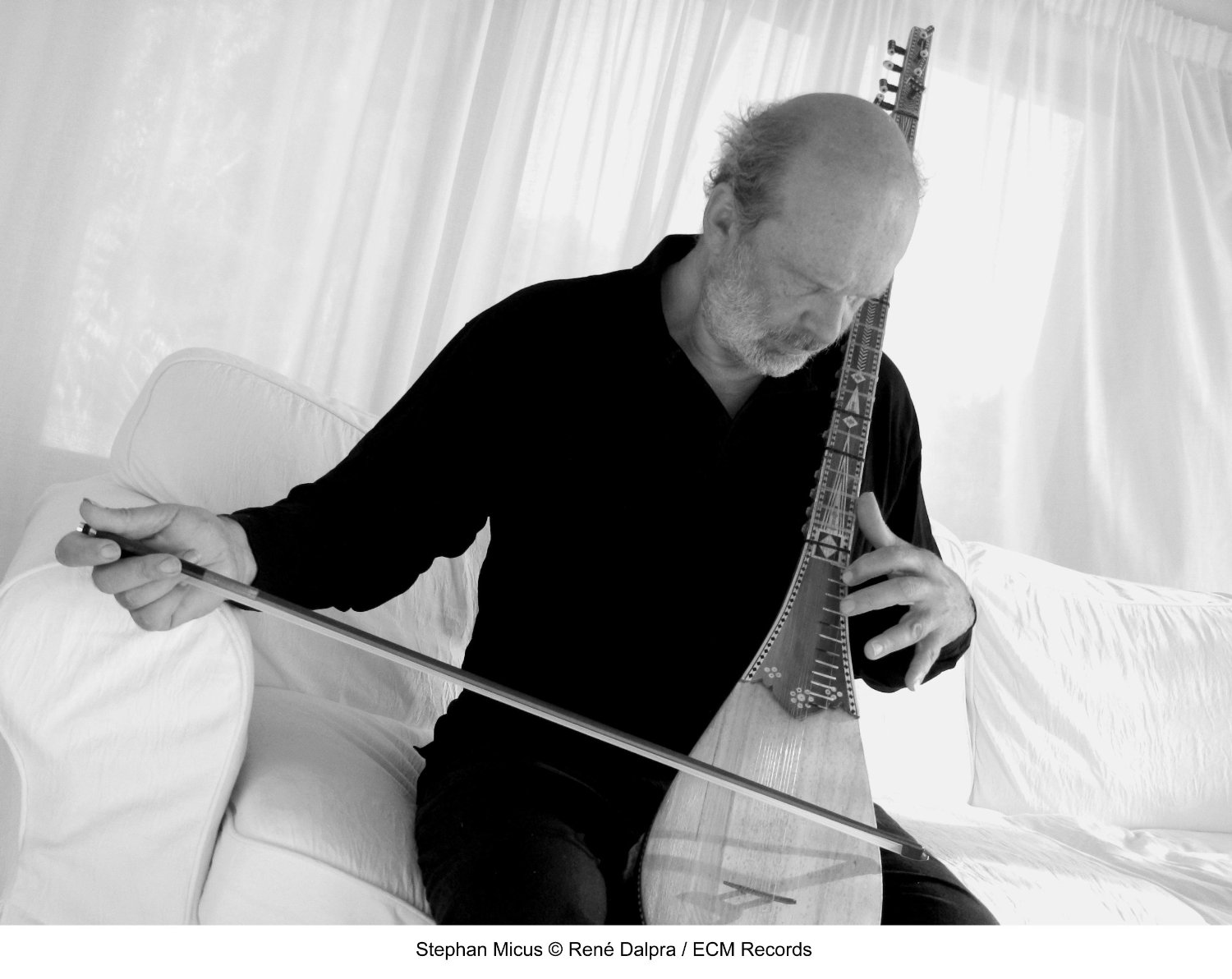
Stephan Micus Bavarian zither, dilruba, chitrali sitar, sattar, 14-string guitar, nay, voice
Recorded 2009-2012 at MCM Studios
An ECM Production

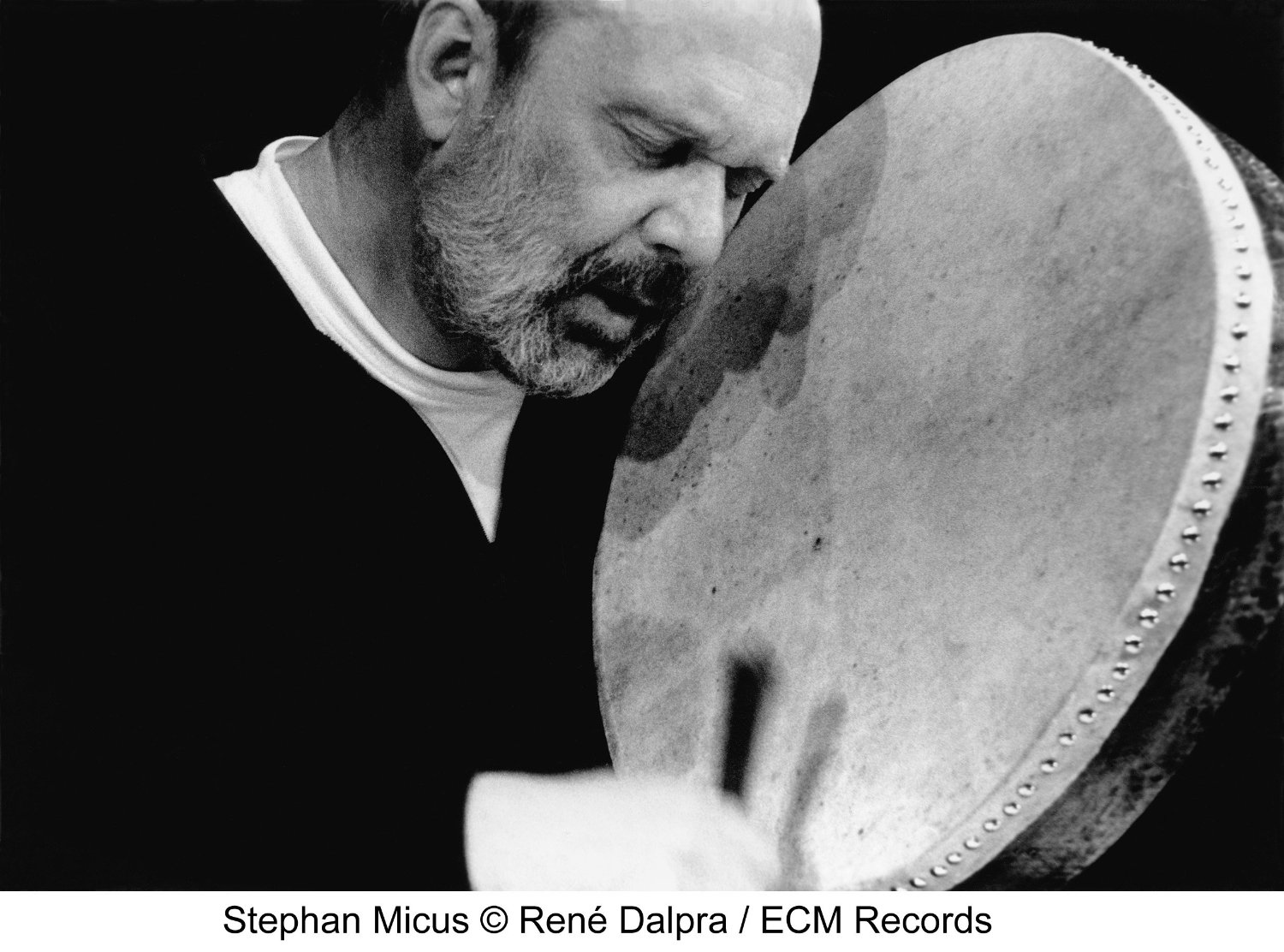
Panagia may be heard as the divine counterpart to Stephan Micus’s earthly album Athos of two decades before, and revisits the Greek peninsula that inspired its predecessor. As with all Micus projects, the focus here is crystalline and spiritual in a way that shuns any specific label or dogma. That being said, one can surely feel the personal histories that go into the many instruments with which he births his universal sounds, their ties to places rendered frozen by time. Micus’s magic—his rite, if you will—is to blend those variant histories into a singularity that few world travelers have ever translated so nakedly into the language of music.

Micus 1

Micus demonstrates this personal ethos in a brief album statement: “Throughout the world people have put their trust in a female goddess. In Greece she is called Panagia,” thus invoking an all-encompassing goddess even as he locates her within a particular faith. According to Evy Johanne Håland in her book Rituals of Death and Dying in Modern and Ancient Greece, Greek orthodoxy calls her Ē Prōtē (The First) and places her at the pinnacle of sainthood. Hence the seventh-century Byzantine prayers to Panagia of which Micus sings his verses, and in which Panagia is called, among other things, “Virgin Mary,” “blissful swallow,” “radiant cloud,” and, in Christ-like fashion, “the joy of the distressed, the guide of the blind and the refuge of orphans.” Where normally Micus falls into the histrionics of his own phonetic language, here a certain thematic vividness of worship lends his singing fresh anchorage.

Through its 11-part traversal, the album shuffles vocal tracks into instrumentals. The former are songs of praise, as indicated by their liturgical titles, while the latter are analogic poems in and of themselves. “I Praise You, Unfading Rose” and “I Praise You, Cloud of Light” open and close the circle with Micus accompanying himself on the Bavarian zither. The zither’s sparkle, in combination with the words, draws flesh from vibrational frequencies. It is as if the world were cradled in a giant hammock and swung from soul to soul like a pendulum of fate, leaving the solitary voice to twist like knots of meditation where tether meets tree. “I Praise You, Shelter of the World” is also bifurcated, only now we encounter 10 voices accompanied by Chinese gongs in a tangle of vapor and vine. In “I Praise You, Sweet-Smelling Cypress,” Micus adds to that number of voices his custom-built 14-string guitar, 8 dilruba (a bowed Indian instrument similar to the sarangi and prominently featured in Desert Poems), 3 sattar (Uyghur violin), and 5 Egyptian nay flutes for a thoroughly spectral palette. Two further tracks—“I Praise You, Lady of Passion” and “I Praise You, Sacred Mother”—feature 22 voices and 20 voices, respectively. Both are deeply hymnal.

Micus 2

The rebec-like sonority of 3 sattar in “You are like Fragrant Incense” (3 sattar) adds new timbres to Micus’s sound-world. With only their wordlessness to reckon with, the listener can feel their shape in a performance that travels like a pheromone: just below the radar of perception yet overflowing with connectivity. Whether doubled and joined by 2 Chitrali sitar in “You are Full of Grace” or with one sitar and 6 dilruba in “You are the Life-Giving Rain,” their topographical consistency attends to every leaf and branch and reveals the love necessary for self-enclosure. In a different stroke, both “You are the Treasure of Life” and “You are a Shining Spring” engage the same instrumentation of Tibetan chimes, Burmese temple bells, Zanskari horsebells, and 2 dilruba. The contrast between bell dust and dilruba soil mirrors that between sleeping and waking.

If pressed for a comparison, I would say that Panagia resembles Japanese classical gagaku in its arrangement and color, even if it is devoid of gagaku’s exclusivity. Rather, it makes of this big blue ball a royal court where we live not as servants but as purveyors of destiny. Its play of light on reflective surfaces makes it one of the best-recorded albums in the Micus catalogue. It is the meta-statement of a meta-statement, an expression of Gaia through cycles of human thought.

(To hear samples of Panagia, click here.)

Back, and here to stay

For those of you wondering where I’ve gone, and especially those who so kindly inquired, I just want to assure you that I’ve officially returned to my labors of reviewing love. As longtime readers will know, by day I’m pursuing a Ph.D. in Japanese Literature at Cornell University, and in that guise I’ve spent the better part of two months working on a rigorous and possibly career-defining fellowship application to conduct dissertational research in Japan. Now that said application is finished and has been submitted, I can return both to my academic and musical ramblings with renewed vigor. Onward I go.

Jordi Savall: A Melancholy Rose

Jordi Savall
(Photo credit: Molina Visuals)

On 24 January 2003, I witnessed a vibrant soul at play on Vienna’s Konzerthaus stage. Leading La Capella Reial de Catalunya and Le Concert des Nations in a program of madrigals and sinfonias by Claudio Monteverdi, Johann Hermann Schein and Samuel Scheidt, Jordi Savall’s performance was everything the music was: thrilling, captivating and, above all, inviting. On April 15, hunched over his bass viol (the fretted, cello-like instrument of which he is a legendary virtuoso) and accompanied by soloists from Le Concert des Nations, I saw a changed man—a man playing for himself, as if into a mirror.

It was more than a little surprising that, from a musician who boasts nearly 200 recordings, we should encounter such a pedantic program. Composers Jean de Sainte-Colombe and protégé Marin Marais were surely familiar to anyone who has at least glanced at Savall’s 40-year career, which broke international waters when he provided the soundtrack for the 1991 film Tous les Matins du Monde, a dramatization of Marais’s relationship with his reclusive teacher. By far, the musical offerings from those masters of the instrument were highlights of the evening’s performance. Sainte-Colombe’s brooding Tombeau les Regrets was a rare chance to hear Savall in duet. The sound of two bass viols alone was nothing short of transportive. Even the leading violin of Marais’s Sonnerie de Ste-Geneviève du Mont-de-Paris, an inventive piece meant to evoke the din of church bells, could do nothing to undermine their resonance.

The same could not be said for the rest of the program, which distilled unremarkable background music from some of the biggest names in the 17th-century French Baroque. Anonymous selections from the era of Louis XIII set the tone for the program’s theme, which sought to articulate the splendor of the French Bourbon court. And yet, what began as a royal affair settled into what felt like a glorified rehearsal. This was not only because of the awkward staging (the musicians were, for instance, left floundering without assistance when a music stand broke), but also because court music was for the most part incidental and not designed to be heard out of context. And so, whatever stateliness might have infused its origins, this music came across not as regal but as dolorous. This rendered the listening experience both intriguing and depressing. While on the one hand we could feel ourselves traveling back in time, on the other it reminded us of the transience of power and arbitrariness of kingly life. It was like hearing history crumble before our very ears, leaving only a handful of extant sonic monuments to an unrecoverable age. Even the jewelry of violin and flute seemed to harbor shadows of doubt. It was a strange thing: this music would not have existed without the power structures that engendered it, but its occasional beauties spoke of realms far beyond any artifice of courtly refinement.

From a curatorial perspective, missed opportunities abounded. For one, there was no chance to hear the unaccompanied solo viol, and two duo miniatures by Antoine Forqueray and his son Jean-Baptiste were etudinal at best, further diluted by a superfluous keyboard backbone. Despite father Forqueray being once called by Savall “a knight who is always on the verge of working his horse to death, but who knows his horse too well to go quite that far,” there was little proof of concept. For another, to be in the presence of renowned harpsichordist Pierre Hantaï, only to find him relegated to a continuo (i.e., supporting) role was curious, even if we did hear some of his brilliance come through in three selections from Jean-Philippe Rameau’s 1741 Pièces de Clavecin en Concerts. Yet with so much rich keyboard literature to choose from among the likes of Rameau and François Couperin, I couldn’t help but scratch my head over the latter’s Les Concerts Royaux, of which the three sections played were like the courtiers they were meant to entertain: passive and overdressed. (Far more active, though no less dressed, was the suite from Jean-Baptiste Lully’s 1670 Le Bourgeois Gentilhomme, after which the musicians were, for once, visibly satisfied.) Why not choose from something more suitable for a live setting, such as Couperin’s 1728 collection of suites for viol? Likewise, the inclusion of Jean-Marie Leclair’s Sonata in D Major, Op. 2, No. 8 was apocryphal at best, especially when one considers the lack of any credible evidence suggesting that Leclair even played at the court of Louis XIV. Why not instead bring another violinist and play the far more mature fascinations of his Opus 5?

In light of the fact that Savall has become increasingly known as an artist of difference, weaving together wide-ranging faiths, histories and spiritual threads through the loom of his musical vision, perhaps there was too much similarity. In the end, the playing, while effortless, was self-contained and the virtuosity incidental. And while one may never fully see into the heart of another, it was impossible to watch Savall and not mourn for him. Since facing immeasurable personal tragedy in 2011, we may only speculate about the depth of his loss and stand in awe at his creative resolve. Having recently lost someone close to me, I am admittedly primed to give such a reading, but I couldn’t help but feel the melancholy rose of his heart wilting just a little under the spotlight. It made me want to hear him play alone, if only to let that heart sing without obstacle, so that it might throw open a window into its own unrecoverable past. With this realization—or projection, if you will—in tow, I left the concert hall berating myself for the above criticisms and share them here only in the interest of full disclosure. It was a sobering reminder that there is far more to gain in this world than there is to lose. And at any rate, the world has gained so much from Savall already that one mere lackluster performance will leave no dent in his legacy.