Shai Maestro: The Dream Thief (ECM 2616)

2616 X

Shai Maestro
The Dream Thief

Shai Maestro piano
Jorge Roeder double bass
Ofri Nehemya drums
Recorded April 2018, Auditorio Stelio Molo RSI, Lugano
Engineer: Stefano Amerio
Produced by Manfred Eicher
Release date: September 28, 2018

The Dream Thief is Shai Maestro’s welcome leader debut for ECM. First heard on the label as sideman for Theo Bleckmann’s Elegy, the pianist now gets the full thermals of Lugano’s Auditorio Stelio Molo RSI studio to lift his wings skyward.

Although the lion’s share of composing credit goes to Maestro, two outliers peel back personal layers of his craft. “My Second Childhood,” by Israeli singer-songwriter Matti Caspi, opens the set with palpable nostalgia, a feeling of not only reviving but reliving the past with fresh eyes. Like the standard “These Foolish Things (Remind Me of You),” he plays it solo, as if to hold only himself accountable for every vulnerable detail. As Maestro himself notes: “The tremendous history of jazz is a great inspiration but also a great challenge. We each have our own individual gift, which is the choices we make—whether we turn to major or minor, whether we play pianissimo or fortissimo at a key moment. I always try to remember to embrace history while not trying to be anything or anyone else—to let the music come out of me.”

With regard to his own writing, he lives up to his surname in concept and execution. The holistic narratives of “The Forgotten Village” and the title track are allowed to expand their lungs before communicating a single concept. Nehemya, a recent addition to the group at the time of this recording, is a revelation of subtlety throughout, and Roeder’s soloing is the perfect complement: buoyant yet open, comforting yet daring, extroverted yet welcoming. As a rhythm section, they treat shadows and brighter persuasions with equal care, giving every note a surface on which to run.

As for Maestro’s playing, one need only witness what he does with a simple ostinato in “Lifeline” and a balance of synchronicity with Roeder in “New River, New Water” to feel guided along a true path of discovery. Between these are the parabolic connective tissues of “A Moon’s Tale” and “Choral,” both of which elicit a oneness of medium and message while gifting something sacred.

All of this makes “What Else Needs to Happen” an especially hard-hitting conclusion. Written for saxophonist Jimmy Greene’s daughter Ana, a victim of the Sandy Hook shooting, it stencils excerpts from President Obama’s speeches on gun control from 2015 and 2016 over a prayerful theme. More relevant than ever, it magnifies the need for conversation in a world with tape over its mouth. Let this music, at least, be the first step toward ripping it off.
Keith Jarrett: La Fenice (ECM 2601)

2601|02 X

Keith Jarrett
La Fenice

Keith Jarrett piano
Recorded live in concert July 19, 2006 at Gran Teatro La Fenice, Venice
Producer: Keith Jarrett
Engineer: Martin Pearson
Mastering: Christoph Stickel and Manfred Eicher at MSM Studio, München
Executive producer: Manfred Eicher
Release date: October 19, 2018

In his 2014 book, Listen to Keith Jarrett! (available only in Japanese as: キース・ジャレットを聴け!), author Yasuki Nakayama doesn’t see the pianist as a “jazz” musician per se, but as one more closely aligned with the tradition of Bob Dylan. Not merely because he played Dylan on his early albums (“My Back Pages” and “Lay Lady Lay”), but because there’s a folk-rock groove common to both. This double-disc gem from the Jarrett solo archives, documenting a concert given on 19 July 2006 at Venice’s Gran Teatro, speaks truth to that spirit, casting a backward glance to some formative ECM ventures and beyond.

Parts I and II drop us into the flow of Jarrett’s unstoppable creativity, and it’s all we can do to achieve flotation in the wake of his improvisational vessel. That said, he isn’t out to drown us with his prowess or leave us dogpaddling for meaning. Rather, the purpose of his art is as naked as it is spontaneous. Every note conveys its inevitability: an answer to a question we never needed to ask in the first place. His frames have porous edges, each a sentient microbiome hungering for communication.

Where Part III brings us into an urgent yet bluesy solar system, slowing from a run to a crawl until a life has been fulfilled by its own telling, Part IV yields ecliptic lyricism. Jarrett cuts away each motif one umbilical cord at a time so that its own personality traits can emerge. Thus, he takes lessons of love and turns them into opportunities for self-assessment, growth, and milestones. Part V is a boppish affair with plenty of twists and turns to satisfy the eager listener. Its wondrous energy is superseded only by Part VIII. With feet stomping and voice churning, Jarrett transforms the piano into metaphysical substance, whereby the path to harmony must be paved with commitment.

The performance is consummated by a few inspired pieces. “The Sun Whose Rays,” from Gilbert and Sullivan’s The Mikado, acts as a fulcrum between the cinematic drama of Part VI and the family photograph developing in the solution of VII. It fits seamlessly into its surroundings, a drop of the terrestrial in a realm otherwise all its own. “My Wild Irish Rose” receives a heartfelt treatment. Poised yet dramatic, Jarrett is unafraid to unravel it with all its might. “Stella by Starlight” is a standard of a different stripe. Just in the way Jarrett plays it, one can feel the decades spent with his trio bubbling up from a thick broth of ideas. Lastly, we have “Blossom,” a deep nod to his 1974 classic Belonging. The title is more than appropriate, for his music likewise releases pollen to populate the world with its songs.

Eleni Karaindrou: Tous des oiseaux (ECM New Series 2634)

2634 X

Eleni Karaindrou
Tous des oiseaux

Savina Yannatou voice
Alexandros Botinis violoncello
Stella Gadedi flute
Vangelis Christopoulos oboe
Yannis Evangelatos bassoon
Dinos Hadjiiordanou accordion
Aris Dimitriadis mandolin
Maria Bildea harp
Eleni Karaindrou piano
Sokratis Sinopoulos Constantinople lyra, lute
Nikos Paraoulakis ney
Stefanos Dorbarakis kanonaki
Giorgos Kontoyannis percussion, Cretan lyra
String Orchestra
Argyro Seira concertmaster
Recorded October 2017 and January 2018 at Studio Sierra, Athens
Recording engineer: Giorgos Karyotis
Edited and mixed September 2018 by Manfred Eicher and Giorgos Karyotis
Produced by Manfred Eicher
Release date: January 25, 2019

“Why little birdy don’t you sing
As you used to sing before?
Oh, how could I,
They had my wings severed.”

In her eleventh album for ECM, Greek composer Eleni Karaindrou gifts us with some of her most poignant music yet. Poignant because, on a political level, it intersects with issues deeply relevant to today’s social climate and, while on a personal level shifting from the Theo Angelopoulos era that quietly ushered her artistry into global imagination.

Music for the play Tous des oiseaux by Lebanese-Canadian writer Wajdi Mouawad is subject of the album’s first half. As is characteristic of Karaindrou, it’s more than incidental but a living part of the dramaturgical landscape. And despite a wide array of instruments, including string orchestra, lyra, kanonaki, oboe, harp, flute, accordion, and cello, the mood is as intimate as it should be for a play centering on the love shared between an Arab American and a German-born Jew. The latter’s Zionist father, David, despite his anger over the relationship, must deal with the revelation of his own Palestinian birth, thereby sending him into a vicious spiral of identity politics.

The drone in which opener “The Wind of War” rests is an accurate representation of that spiritual unrest, the symbolic backdrop against which this story unfolds. As with any history, if you zoom back, it seems to unify in texture. But get close enough to regard individual lives within it, and suddenly conflicts of human error become obvious. Vocalist Savina Yannatou, familiar to ECM listeners as a bandleader in her own right, sings wordlessly, here as also in “Encounter” and “The Impossible Journey”—a voice still voiceless, because it is heard from afar. Even in Yannatou’s unaccompanied “Lament,” a 13th-century Greek song, she cannot pull words from their graves. As one of three solos, along with “Towards the Unknown” for flute and “Je ne me consolerai jamais” for cello, it consigns the fate of an entire people, grazed by breath and weaponry of chance.

In “The Dark Secret” and “David’s Dream,” both for string orchestra, individuals vie subtly for attention, but are drowned by collective trauma. Time becomes timeless, a variation on a theme, just familiar enough to feel real yet off-kilter enough to illuminate mysteries of waking life. “The Confession” adds to that milieu the beat of a drum: reality calling. Like the intersection of oboe and harp in “Why?” or the lyra, ney, and kanonaki of “Between Two Worlds,” it’s a dance without ground. A love divided by self.

Music for Iranian auteur Payman Maadi’s film Bomb, A Love Story constitutes the second half. As the first film Karaindrou has scored since Angelopoulos’s death, it’s a bittersweet milestone. Using the Israeli-Palestinian conflict to set in motion its narrative of self-searching, the film shows us not only that the personal is political, but also that the political is personal. Karaindrou’s soundtrack mirrors that philosophy by foregrounding the bassoon of Yannis Evangelatos, whose instrument—a marginal one in the woodwind family—echoes the marginality of the film’s characters. In this instance, the orchestra serves as omniscient narrator, sending shimmers of hope through “Love Theme,” in which the oboe of Vangelis Christopoulos and the piano of Karaindrou herself fall into shadow: dreams never realized. If not for that, “The Waltz of Hope” might not come across so much as a fantasy and “Lonely Lives” as truth. Further sentiments of travel (“Mitra’s Theme – Walking in Tehran”) and innocence (“Love’s First Call”) touch and part across maps of indifference. Which is why in the “Reconciliation Theme” we find the most instruments deployed at once, recalling the richness of Angelopoulos’s character studies. Only now that mist has been lifted, exposing figures whose every feature cries with vivid detail.

Dominique Pifarély: Time Before And Time After (ECM 2411)

2411 X

Dominique Pifarély
Time Before And Time After

Dominique Pifarély violin
Recorded in concerts in September 2012
at Auditorium Saint-Germain, Poitiers (France)
and in February 2013
at Cave Dimière, Argenteuil (France)
Engineer: Gérard de Haro
Produced by Manfred Eicher
Release date: August 28, 2015

Here is a place of disaffection
Time before and time after
In a dim light: neither daylight
Investing form with lucid stillness
Turning shadow into transient beauty…
–T. S. Eliot, “Burnt Norton”

After leading a string of caravans across the sands of ECM, Dominique Pifarély enchants on this set of solo recordings taken from French concerts in 2012 and 2013 at Auditorium Saint-Germain (Poitiers) and Cave Dimière (Argenteuil). Although nearly everything is improvised, the violinist dedicated each piece in retrospect to a certain poet, from whose verses he also chose a title. More than highlighting personal connections between literature and music, this artistic decision reveals an agency of spontaneous creation.

The Near Eastern quality of “Sur terre” (for Mahmoud Darwich) makes for a poignant introduction to this border zone where motifs converse for want of being equally heard. Every color and texture is like the seed of a new community, touched by horizons yet to be unfolded, and in this respect shares kindship with “L’air soudain” (for André du Bouchet). The latter’s robust yet plaintive cry yearns to be acknowledged in a place uninhabited except by its own singing. Arid climates are evoked in the rasp of a bow: a gargantuan tongue scraping along the earth in search of nourishment but finding only dust and ruins.

“Meu ser elástico” (for Fernando Pessoa) and “D’une main distraite” (for Henri Michaux) are both jagged wonders, wherein leaping suggestions of dance are constantly pulled back to origins, while the masterful“Gegenlicht” (for Paul Celan) shows us thefull scope of Pifarély’s technical and artistic capabilities. Like a prisoner who succeeds in digging his way through a wall with bare hands, he peels away the barrier to freedom one granule at a time. But before he inhales fresh air again, he must pass through “Violin y otras cuestiones” (for Juan Gelman). A struggle that is as political as it is personal, it finds temperance only in the sul ponticellosalvations of “Avant le regard” (for Jacques Dupin) and “L’oubli” (for Bernard Noël).

If shades of the Baroque are present, they’re no illusion, as even Pifarély admits: “[O]f course Bach is in the air because Bach is polyphonic, and the violin is polyphonic.” Bach also informs his decision to close his solo performances with a standard—in this instance Victor Young’s “My Foolish Heart”—to assert the violin’s autonomy. His interpretation thereof looks in the proverbial mirror, hoping to recognize itself but instead finding awe in what it has become.

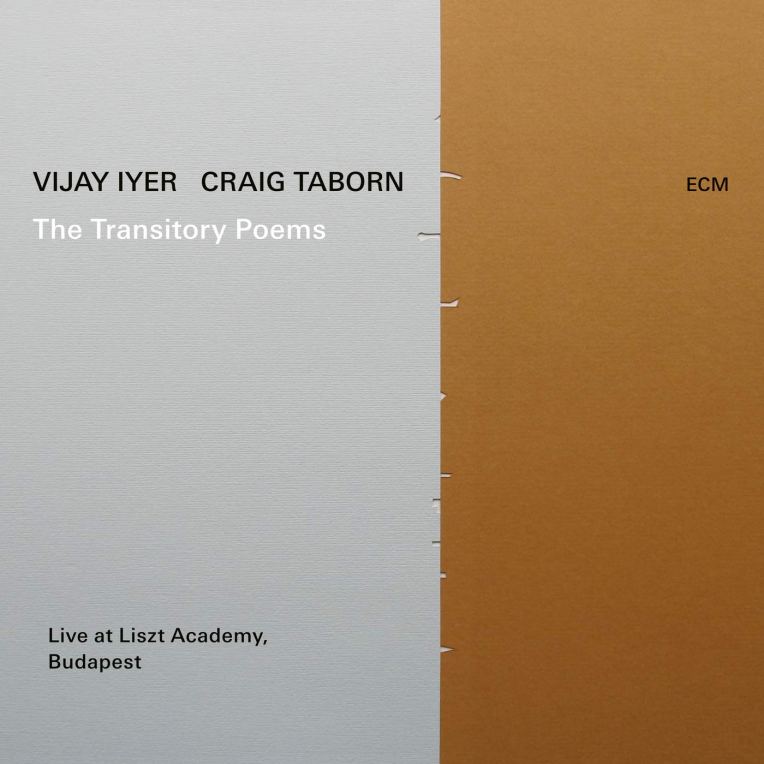
Vijay Iyer/Craig Taborn: The Transitory Poems (ECM 2644)

The Transitory Poems

The Transitory Poems

Vijay Iyer piano
Craig Taborn piano
Recorded live March 12, 2018
at the concert hall of the Franz Liszt Academy of Music, Budapest
Engineer: Stefano Amerio
Produced by Manfred Eicher
Release date: March 15, 2019

The duo of pianists Vijay Iyer and Craig Taborn, documented on this March 2018 live recording at Budapest’s Franz Liszt Academy of Music, came out of an involvement in Roscoe Mitchell’s Note Factory. In that context they balanced prewritten knotwork with improvisational unraveling and acted as likeminded catalysts for spontaneous composition.

The opening “Life Line (Seven Tensions)” bears an appropriate subtitle, which, by gentle force of suggestion, allows one to imagine the physiological give and take required to bring this music to fruition. Interplays between passages of both intense abstraction and synchronicity feel as much indicative of where Iyer and Taborn came from as where they are going. With actorly sense of space they mold the stage as inspirational substance. They move as if stationary, posing as if never settling for one meaning.

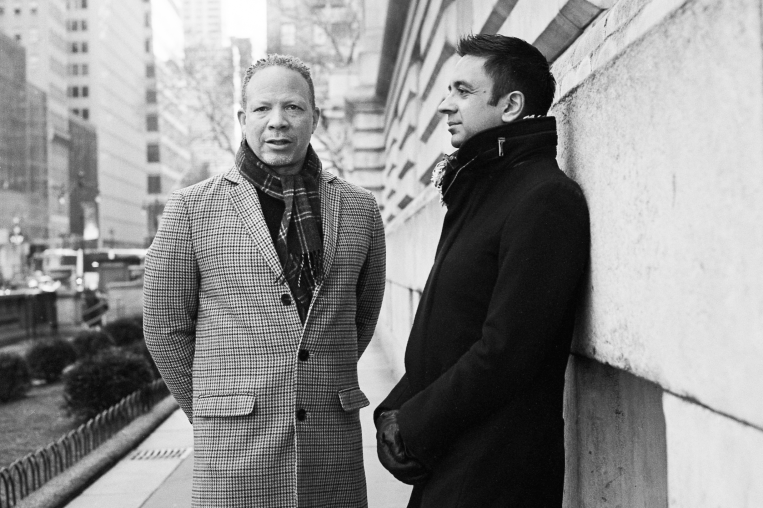
Iyer Taborn
(Photo credit: Monica Jane Frisell)

Although subsequent tracks have their distinctions, as a whole they form an album of immense coherence. This didn’t stop the musicians from hearing much of what they rendered as impromptu panegyrics for legends lost that same year. “Sensorium,” for Jack Whitten, evokes the artist’s complex inner worlds and fractal obsessions; “Clear Monolith,” for Muhal Richard Abrams, allows light to pass through its latticed notes; and “Luminous Brew,” for Cecil Taylor, boils highs and lows over a campfire until their ingredients are indistinguishable. But nowhere is the feeling of dedication so palpable as in Geri Allen’s “When Kabuya Dances,” which crystallizes themes hinted at in a preceding improvisation and leaves listeners suspended far above where they started.

Beyond assertions of technical skill, Iyer and Taborn are purveyors of the metaphysical, listening more than making. Whether in sporadic (“Kairòs”) or rhythmically-driven (“Shake Down”) dialects, they speak in a supremely translatable language. This, if anything, is what makes these transitory poems more than freely made: rather, they’re made free.

(This article originally appeared in the July 2019 issue of The New York City Jazz Record, a full PDF of which is available for download here.)

Book Giveaway Winners!

After feeding the names through CommentPicker.com, I’ve randomly chosen three winners:

Hamish
Daniel Diaz
Uros Spasojevic

Please send me your contact information, and I will send your books out right away. Congratulations to the winners!

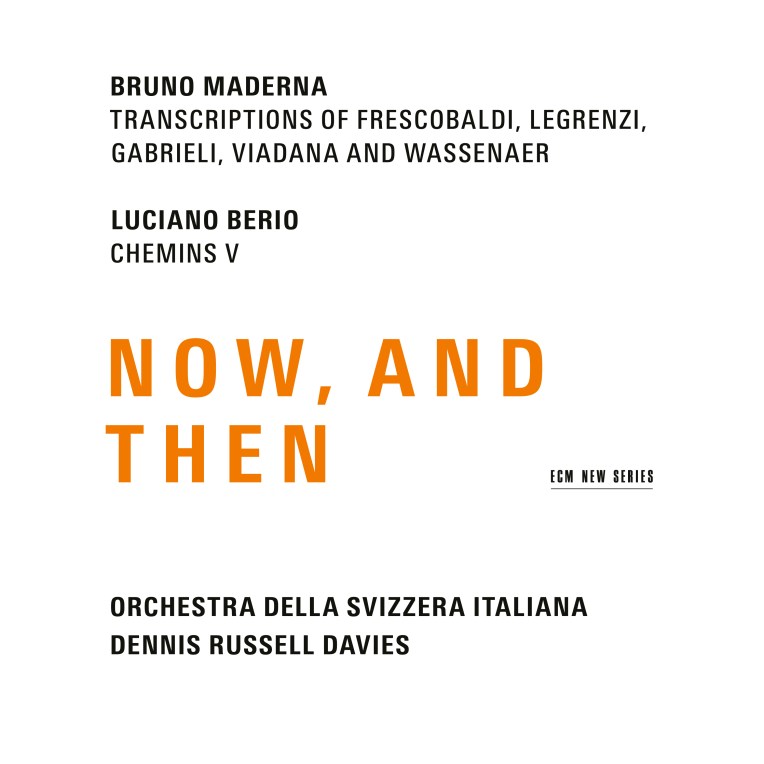
Bruno Maderna/Luciano Berio: Now, And Then (ECM New Series 2485)

2485 X

Bruno Maderna
Luciano Berio
Now, And Then

Orchestra della Szizzera italiana
Dennis Russell Davies
conductor
Pablo Márquezguitar
Recorded August 2015, Auditorio Stelio Molo RSI, Lugano
Engineer: Michael Rast (RSI)
Editing and mixing: Michael Rast and Manfred Eicher
Produced by Manfred Eicher
Release date: October 27, 2017

Bruno Maderna (1920-1973) was an instrumental force in contemporary music throughout the 1950s, when composers of “modern” persuasion were still struggling to at once uphold and break open the secrets of bygone masters. Maderna was no stranger to the past and had a particular fondness for the clarity of the Italian Baroque, as evidenced in his transcriptions of Girolamo Frescobaldi, Giovanni Legrenzi, Giovanni Gabrieli, Tommaso Lodovico da Viadana, and Unico Wilhelm van Wassenaer presented by the Orchestra della Szizzera italiana under the baton of Dennis Russell Davies.

It should come as no surprise that Maderna had a love for the theatre, as these pieces breathe like dramaturgical backdrops to well-studied action. While nearly all of them date from 1952, the sole exception is Gabrieli’s Canzone a tre cori (1969/72), of which Maderna’s recrafting turns glory into lyrical shadow. Frescobaldi’s Tre Pezzi (1952), by contrast, constitute an exercise in contradiction. Robust yet naïve, they move fluidly across and between planes of exposition. The liturgical center, comprised of a brief “Christe” and “Kyrie,” hints at a spiritual undercurrent before deferring to a regal finish. Against this, La Basadonna (1951-52) is a delightful interlude that dances with delicate assurance across this dioramic stage. As heartbeats of golden ages mesh into an elegy for silver futures, Viadana’s Le Sinfonie (1952) reads like an archive of memory. It’s portrait of Italian cities bustles with life and character. Of these, the buoyant “La Venetiana” recalls the programmatic brilliance of Carlo Farina. Last is the “Palestrina-Konzert” (1952) by Wassenaer. Once attributed to Pergolesi, this gorgeous triptych sets up an alluring Vivace through two slower precursors. Enchanting sonorities abound.

From all of these, we know that Maderna understood Baroque music as a giant wheel, sporting a clearly defined center from which regular spokes extended to an more open perimeter. His respect for that underlying architecture reveals its own.

Lodged therein, between the Legrenzi and Gabrieli, is Chemins V, a self-transcription of Sequenza XI (1987-88) by Luciano Berio (1925-2003), with whom Maderna founded Europe’s first electronic music studio, the Studio de fonologia musicale di Radio Milano. This piece, composed in 1992, receives its premiere recording here. Featuring guitarist Pablo Márquez on the instrument for which it was originally written, it’s a deeply psychological journey. Márquez navigates every topographical change with confidence, finding purchase on the narrowest of cliffs and staying grounded on the slipperiest of terrain. Brimming with Berio’s uncanny ability to make the beautiful eerie and vice versa, it treats the guitar as leading voice and internal percussion, ambulating without apparent direction until the subdued, shimmering finale. Worth the price of entry alone, this rare morsel in an already-rich covering speaks to the core of our being as a species at a time when uncertainty rules the day.

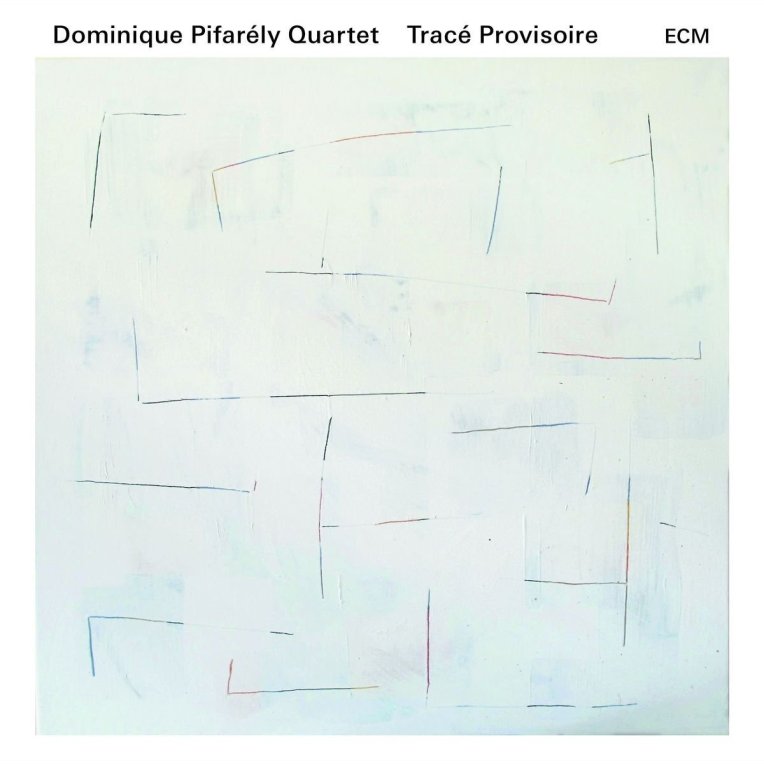
Dominique Pifarély Quartet: Tracé Provisoire (ECM 2481)

Tracé Provisoire

Dominique Pifarély Quartet
Tracé Provisoire

Dominique Pifarély violin
Antonin Rayon piano
Bruno Chevillon double bass
François Merville drums
Recorded July 2015, Studios La Buissonne, Pernes-les-Fontaines
Engineers: Gérard de Haro and Nicolas Baillard
Produced by Manfred Eicher
Release date: June 3, 2016

In the immediate wake of his solo album Time Before And Time After, violinist Dominique Pifarély returns to ECM leading a fearless quartet with pianist Antonin Rayon, bassist Bruno Chevillon, and drummer François Merville. The album’s title, which translates into English as “Provisional Layout,” is at once accurate and a misnomer. Accurate because Pifarély’s stoic humility allows no leeway for ego. Misnomer because this music is anything but provisional, archived as it is for posterity in this crisp recording.

The album is mostly populated by three diptychs, each split throughout the program. “Le peuple effacé” opens the ears to an honest exploration of space, Pifarély’s bow trembling like the feeler of an insect. Its second part extends a steadier hand, hennaed with designs and motifs that, despite having lost their original meanings, take on new ones by virtue of clinging to flesh. With rhythmic acuity in spades, Pifarély navigates every twist without so much as grazing his instrument along the way. Just as forthrightly, he settles into a lethargic meditation.

DPQ
(Photo credit: Jean-Baptiste Millot)

The title dyad abides by an even more exploratory grammar, wherein orthography is found lurking in every pause. The groovier settlement into which once-nomadic impulses find themselves collapsing is as haunting as it is energizing. The rhythm section is on point here, transitioning from robust to delicate maneuvers with nary a blink to be sensed. Part II is Rayon’s realm. Here the pianist diverts attention to shadow with light, and vice versa, before leaving the other three to dance until their bodies disappear.

“Vague” is a rich soundscape of breathy violin and percussive details, a progression from womb to tomb that consumes philosophies as if they were food. This leaves two standalones. Where “Le regard de Lenz” is an exploded geometry of pent-up force, and as such is the album’s fulfillment of rupture, “Tout a déjà commencé” is a thirteen-and-a-half-minute mosaic of elegiac and celebratory influences. Chevillon ups the bassing quotient significantly, leaving room for a ripple effect to sing. In this regard, the band’s willingness to go as deep as they need to in order to unearth what it is they’re searching for is admirable, and leaves us feeling filled to the brim.

Markus Stockhausen/Florian Weber: Alba (ECM 2477)

Alba

Alba

Markus Stockhausen flugelhorn, trumpet
Florian Weber piano
Recorded July 2015, Auditorio Stelio Molo RSI, Lugano
Engineer: Stefano Amerio
Produced by Manfred Eicher
Release date: April 1, 2016

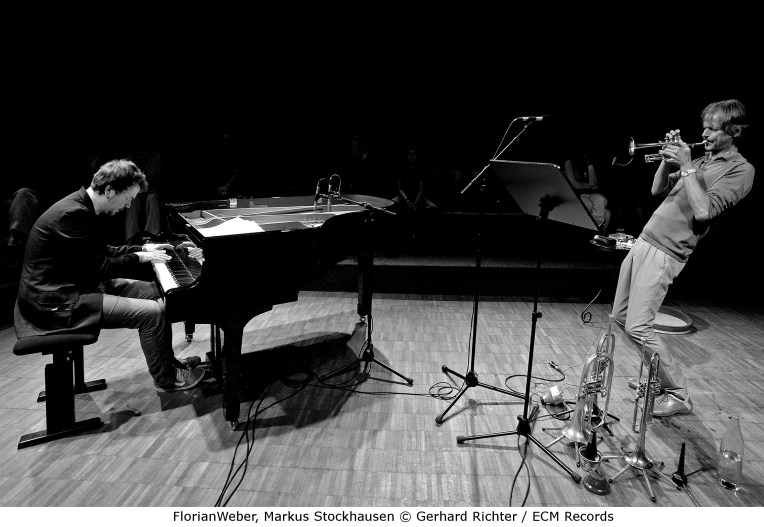
Markus Stockhausen has walked a jagged path through the annals of ECM, but the German trumpeter can always be counted on to provide an experience that is unique, unforced, and above all genuine. On Alba, he presents for the first time in studio his collaboration with pianist Florian Weber. Six years in the making, this music and the interactions built around it are vessels of experiential intensity rounded by currents of thoughtfulness.

Weber Stockhausen

The album’s 15-track program shuffles originals and improvisations from both musicians in a stacked deck of melodic beauty. Weber’s end of the spectrum is concerned with honor and past reflections. In the latter vein, his opener “What can I do for you?” is dedicated to the late John Taylor, a vital ECM presence under whom he first studied as a young piano student. Like Taylor, he realizes that, in order to access the piano’s inner voice, those playing it must be willing to let go of their own.

Weber is a painter in sound. Whether evoking shifting granules of sand in “Emergenzen” or fantastical impressions in “Die weise Zauberin,” he wields every key as one would a brush. He’s also more prone to playfulness, as in “Surfboard,” a tune that precisely illustrates the duo’s creative process. As musical surfers, they know firsthand the value of a reliable board and choice wave, but use those parameters as prerequisites for joyful freedom. Weber’s “Emilio” is a highlight for turning a familiar arpeggio into a surprising vehicle for Stockhausen, who reaches expansively across intimate geographies.

Stockhausen Weber

Stockhausen’s universe combines the theoretical and the spontaneous. His “Mondtraum,” “Synergy Melody,” and “Zehpir” have their genesis in classical contexts, but here are pared to their base elements. His own whimsy emerges in “Befreiung,” albeit in a more cleanly predetermined vein, while “Better World” serves as a poignant expression of hope, transitioning from mournful reflection to twirling dance in a masterful turn of phrase.

Scattered improvisations round out the proceedings. Of these, the duetted “Ishta” is heartfelt to the extreme. In “Resonances,” Stockhausen plays directly into the piano, wherein untouched strings reverberate sympathetically, while “Barycenter,” “Possibility I,” and “Today” finds Weber alone with nothing but intuition to lead the way.

In addition to the richly flowing music, Alba is significant for being Stockhausen’s first for ECM in 16 years and for being Weber’s label debut. A release to be treasured.