The Carla Bley Band: I Hate To Sing (WATT/12½)

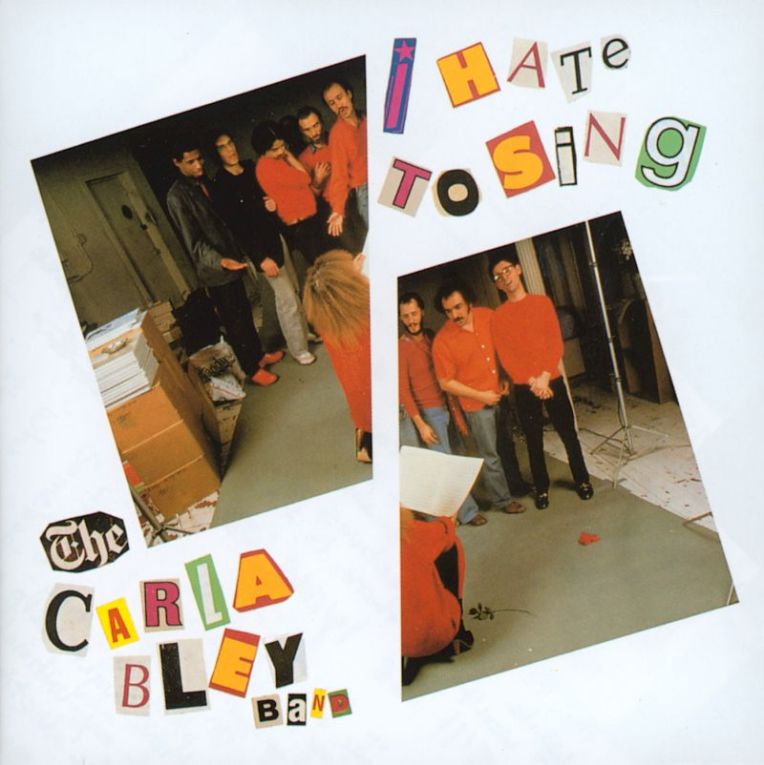
I Hate To Sing

The Carla Bley Band
I Hate To Sing

Michael Mantler trumpet
Steve Slagle alto and soprano saxophones (voice on “The Lone Arranger”)
Tony Dagradi tenor saxophone
Gary Valente trombone (voice on “The Lone Arranger”)
Vincent Chancey French horn
Earl McIntyre tuba (on 1 only; bass trombone and background voice in “Murder”)
Bob Stewart tuba (on 2 only)
Carla Bley organ, glockenspiel (piano on “Very Very Simple” and voice on “The Lone Arranger”)
Arturo O’Farrill piano (voice and organ on “Very Very Simple”)
Steve Swallow bass (voice on “The Lone Arranger” and drums on “I Hate To Sing”)
D. Sharpe
drums (voice on “I Hate To Sing”)
Side 1 recorded live August 19-21, 1981 at The Great American Music Hall, San Francisco, California
Mixed December 1981 at Grog Kill Studio, Willow, New York
Side 2 recorded live January 11-13, 1983 at Grog Kill Studio
Mixed 1984, Willow, New York
Engineer: Tom Mark
Produced by Carla Bley

Until this point, Carla Bley has been known to throw in a shot of wry humor into almost every cocktail she mixes. But it’s not until I Hate To Sing that she fashions her live persona into that of a standup comedian. The limited vinyl release from 1984 (reissued on CD in 1996) exhibits some of the bandleader’s slyest compositions via her ability to craft an entire world out of notes and materials.

Despite the talented instrumentarium she has assembled this time around, including such constant companions as trumpeter Michael Mantler, trombonist Gary Valente, bassist Steve Swallow, and drummer D. Sharpe, Bley’s focus is on the very thing the album’s title professes to hate. Such a setup in any other hands might come across as dated, but there’s something undeniably apposite about her songcraft. In “The Internationale,” for example, we find ourselves people watching in the selfsame hotel’s lobby as itinerant travelers from all over the world struggle to understand each other in an ivory Tower of Babel. Its refrain of “What did he say?” feels all too prescient in a politically divided world such as ours. Further highpoints of lowbrow include “Very Very Simple,” in which pianist Arturo O’Farrill sings about the rudimentary song Bley has graciously allowed. Its self-deprecating air would not be out of place on a vaudeville stage. A comically unremarkable drum solo seals the deal. “Murder” is also memorable for its tongue-in-cheek twist on stalking. Background vocals by tuba player Earl McIntyre, assuming the role of impending doom, are spot-on and rile the audience in this live recording to bubbling laughter.

A few non-vocal passages sprinkled in for good measure remind us who we’re dealing with. “The Piano Lesson” is a chain of unsuccessful piano runs, held together by spurts of competence from the whole band; “The Lone Arranger” (one of my favorite Bley titles) is a gentle romp; and “Battleship” threads an SOS signal and explosions through a vivid free-for-all tapestry.

The end effect, as overtly comedic as it is covertly philosophical, is a master class in social commentary. Still, it is sure to polarize listeners. And while it may not share a spotlight with some of Bley’s more recognized albums, it’s a historical jewel and one of the few successful amalgamations of jazz and comedy that I’ve ever heard (for comparison, click here to read my take on Jon Benjamin’s Well I Should Have…). This is nowhere truer than in the title track, in which Swallow takes over on drums to allow Sharpe the microphone, thus adding some uproarious touches to Bley’s swing. A noteworthy moment occurs when the music stops and Sharpe says, “Can I have something to drink please?” And again: “I need a more professional group to back me up when I sing. Get some West Coast cats.” Even at her most audacious, Bley proves the value of balance. In this instance, every element knows its place.

Carla Bley: Live! (WATT/12)

Live!

The Carla Bley Band
Live!

Michael Mantler trumpet
Steve Slagle alto and soprano saxophones, flute
Tony Dagradi tenor saxophone
Gary Valente trombone
Vincent Chancey French horn
Earl McIntyre tuba, bass trombone (solo on “Blunt Object)
Carla Bley organ, glockenspiel, piano (on “Time And Us”)
Arturo O’Farrill piano, organ (on “Time And Us” only)
Steve Swallow bass
D. Sharpe
drums
Recorded August 19-21, 1981 at the Great American Music Hall, San Francisco, California by Phil Edwards
Recording/Engineer: Ron Davis
Mixed December 1981 at Grog Kill Studio, Willow, New York
Engineer: Tom Mark
Produced by Carla Bley
Release date: April 1, 1982

Carla Bley’s phenomenal ten-tet returns on Live! And with it, the assurance that the next stage in our trek through the WATT catalog has laid a fruitful path before us. Sporting one of her most iconic album covers, infamous red sweater and all, this collection, recorded in August 1981 at San Francisco’s Great American Music Hall, is a fascination that keeps on giving. One can feel Bley moving (in the most physical sense) into every tune, letting it speak for itself.

What I love about this album is its self-aware presentation, sheer variety, and musical derring-do. To be sure, there’s plenty of smooth surfaces on which to walk. Whether we’re talking about the classic vibe of “Time And Us” (though one can hardly discount the slight edginess of Tony Dagradi’s tenor) or Steve Swallow’s dedicated bass line in “Song Sung Long” (noteworthy also for the soprano saxophone of new recruit Steve Slagle), a feeling of living in the moment prevails, as also in the domestic romance of “Still In The Room.” But chances are meant to be taken, and that Bley does through her application of Latin flavors in “Real Life Hits” and full-on gospel attempt in “The Lord Is Listenin’ To Ya, Hallelujah!” With her low and slow approach to the organ, Bley wraps us in a blanket of worship, at once soothing and energizing.

But for me it’s opener “Blunt Object” that plows the deepest field. From Swallow’s ear-catching intro to its driven sense of drama, it recalls for me the Maria Schneider arrangement of David Bowie’s “Sue,” a sister energy of which is pushed out like sunshine through Dagradi’s tenor.

Recorded as if we were right there on stage, Live! invites us to be a part of the action. Little do we know this was barely half the fun that awaits us in the next album.

Carla Bley: Social Studies (WATT/11)

Social Studies

Carla Bley
Social Studies

Michael Mantler trumpet
Carlos Ward soprano and alto saxophones
Tony Dagradi tenor saxophone, clarinet
Gary Valente trombone
Joe Daley euphonium
Earl McIntyre tuba
Carla Bley organ, piano
Steve Swallow bass
D. Sharpe drums
Recorded September through December 1980
Mixed January 1981 at Grog Kill Studio, Willow, New York
Engineer: Tom Mark
Produced by Carla Bley
Release date: April 1, 1981

After leaving the matinee showing of Michael Mantler’s More Movies, there’s no better place to go than the library to check out Carla Bley’s Social Studies. Though distinguished by many features, this 1981 session is the timeless embodiment of what a classic should be. Not only is every tune a staple of her repertoire; it also introduces yet another talented reed player to the Bley family in Tony Dagradi, whose clarinet lends nostalgic warmth to the flirtatious “Copyright Royalties” and whose hickory tenor gives defining flavor to “Útviklingssang.” The latter, one of Bley’s highest compositional peaks, plays further to the strengths of fellow saxophonist Carlos Ward and bassist Steve Swallow. It floats, slumbers, and moves in sequence with time itself. It is the speed of life, personified in melody.

Flip to any page of this set, and you’ll find something as emblematic as a sigil, watermark, or ring seal pressed into wax. “Reactionary Tango” is as social as any of these studies. The horns are precise and delicate (especially Ward’s soprano), as is the snare of drummer D. Sharpe and Swallow’s exquisite bassing. Just when you think it ends, it continues with gentle persistence, as if it were a chapter in a Choose Your Own Adventure book. “Valse Sinistre” balances the groove of Bley’s organ with Swallow’s propulsive (but never overbearing) bassing. Swallow also picks up the first needle of “Floater” and threads his way with confidence. In lockstep with Sharpe at every turn, he exhibits a rainbow of colors. Finally, in “Walking Batteriewoman” we get the most vital of footnotes. Its shaded whimsy shifts into high gear halfway through, finishing in artful post-bop wisdom.

Of all the albums in the Bley catalog, this one is for me the most cohesive in terms of concept, aesthetic, and execution. Social Studies is more than a catchy title, but the very ethos of everything she lays her hands to.

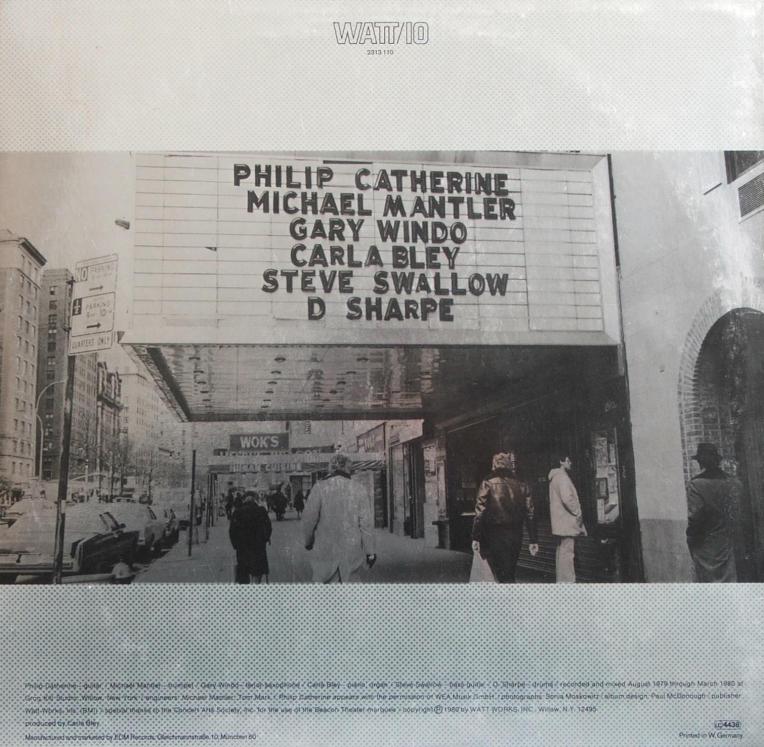
Michael Mantler: More Movies (WATT/10)

WATT-10_LP-front

Michael Mantler
More Movies

Michael Mantler trumpet
Philip Catherine guitar
Gary Windo tenor saxophone
Carla Bley piano, organ
Steve Swallow bass
D. Sharpe drums
Recorded and mixed August 1979 through March 1980 at Grog Kill Studio, Willow, New York
Engineers: Michael Mantler and Tom Mark
Produced by Carla Bley

This companion to 1978’s Movies isn’t so much a sequel as a direct continuation of Michael Mantler’s wonderful predecessor after a two-year intermission. In addition to screening further sonic films, it includes three short subjects under overt titles. “Movie Nine” is the first of the former, one of seven in scattered order on the program, and introduces a palette similar to the first album. Mantler is back on trumpet, while Carla Bley rejoins on piano (and organ), and Steve Swallow on bass. Drummer Tony Williams is replaced here by D. Sharpe, and guitarist Larry Coryell by his onetime acoustic touring partner Philip Catherine. Yet what separates an already expansive soundtrack without images is the addition of Gary Windo on tenor saxophone. His soulful reed work is a strong counterpart to the lively precision of the rhythm section and to Catherine’s own committed readings. Throughout numbers Ten through Fifteen, we encounter a range of directorial styles, from the smoldering noir of “Movie Eleven” and rich exposition of “Movie Fourteen” to the spacious ride of “Movie Twelve.”

“The Sinking Spell” is the first of the explicitly themed tracks, and the mere inclusion of these implicatory words does much to nuance our interpretation of the scenes at hand. Swallow and Sharpe crush it right out of the gate, launching a sophisticated groove made all the tenser by Bley’s pianism. “Will We Meet Tonight?” is another full wave that casts Windo in a bluesy leading role. “The Doubtful Guest” brings magical realism to the fore and opens the frame for Catherine’s blistering method acting. Common to all of these is an intensity of build-up and narrative consummation.

Despite the success of Movies, this follow-up was apparently a flop at the proverbial box office. All I can say is that it’s one of my favorites from Mantler and worthy of repeat viewings.

WATT-10_LP-back

The Carla Bley Band: Musique Mecanique (WATT/9)

Musique Mecanique

The Carla Bley Band
Musique Mecanique

Michael Mantler trumpet
Alan Braufman alto saxophone, clarinet, flute
Gary Windo tenor saxophone, bass clarinet
John Clark French horn
Roswell Rudd trombone, vocals
Bob Stewart tuba
Terry Adams piano
Carla Bley organ
Steve Swallow bass guitar
D. Sharpe drums
Charlie Haden acoustic bass
Eugene Chadbourne acoustic and electric guitars
Karen Mantler glockenspiel
Recorded August through November and mixed December 1978 at Grog Kill Studio, Willow, New York
Engineer: Michael Mantler
Produced by Carla Bley
Release date: April 1, 1979

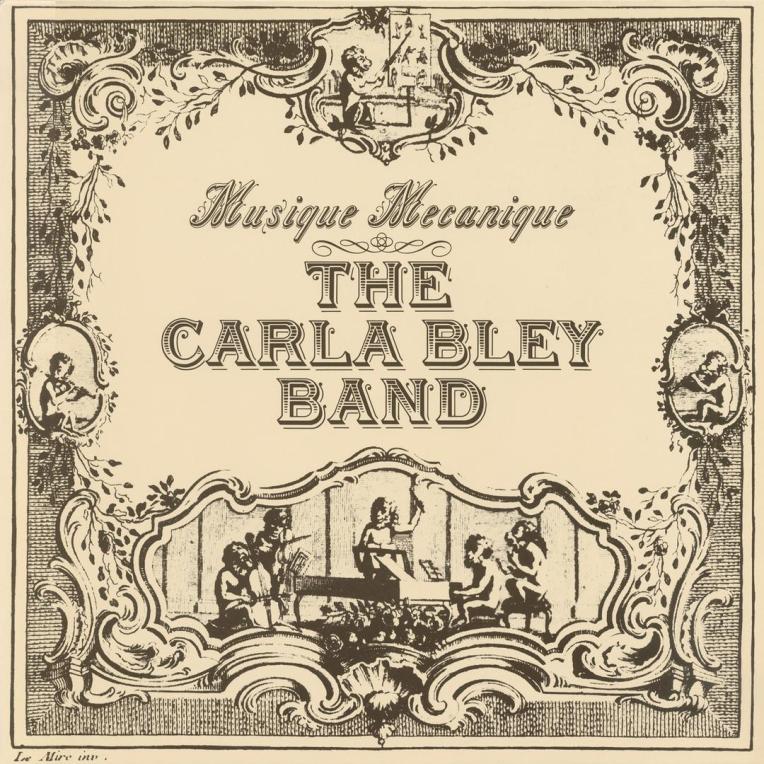
Hot on the heels of European Tour 1977, Musique Mecanique follows a classic with a classic. Clearly fueled by the energy put forth in that predecessor, Carla Bley funneled a wealth of inspiration from being on the road into her New York studio. Expanding her ten-tet to a 13-piece band, she drops some of her densest compositions to date in an audio time capsule for the ages.

The title of “440” references the modern orchestral pitch standard of A440. Appropriately, the piece begins with the cacophony of a tuning orchestra. From this emerges an insistent pulse and, by extension, a three-dimensional theme. Drummer D. Sharpe signs in as a new team member, and he will prove to be a vital one as the years wear on. Pianist Terry Adams embodies his duties to the fullest, as does Gary Windo on tenor and Alan Braufman on alto, while Bley embraces them all with the expansive wingspan of her organ in trombonist Roswell Rudd’s jet stream.

“Jesus Maria And Other Spanish Strains” is an even more horn-centric gallery of images. Though initially occupying the darker end of a synesthetic spectrum, before long it sports choice solos from tuba virtuoso Bob Stewart and bassist Charlie Haden, who clearly understands Bley’s music from the inside out. As things develop, those robustly whimsical touches we come to expect from Bley creep out of frame, held together by Sharpe’s gorgeous detailing and trumpeter Michael Mantler’s mariachi marinade before ending with a nocturnal stare.

The three-part title suite is one of Bley’s grandest achievements. The first part, sounding for all like a calliope machine struggling to come out of a coma, features Karen Mantler on glockenspiel for a decidedly three-ring vibe. The second part, subtitled “At Midnight,” begins with a clock ticking and chiming the hour. Bley enhances the mood. Rudd puts down the trombone and sings of two souls lost in the night, each opening the door to the room of the other in an endless cycle of unrequited action. The final part is a splash of genius in an already prodigious cocktail. Glacial organ, screeching saxophone, and an earworm of a melody draw us a treasure map to keep in our rucksacks for future outings.

The Carla Bley Band: European Tour 1977 (WATT/8)

European Tour 1977

The Carla Bley Band
European Tour 1977

Michael Mantler trumpet
Elton Dean alto saxophone
Gary Windo tenor saxophone
John Clark French horn, guitar
Roswell Rudd trombone
Bob Stewart tuba
Terry Adams piano
Carla Bley organ, tenor saxophone
Hugh Hopper bass guitar (bass drum on “Drinking Music”)
Andrew Cyrille drums
Recorded September 1977 at Bavaria Musik Studios, Munich
Engineer: Jörg Scheuermann
Assistant: Robert Wedel
Mixed October 1977 at Grog Kill Studio, Willow, New York
Engineer: Michael Mantler
Produced by Carla Bley
Release date: February 1, 1978

European Tour 1977 documents that very event—a significant one in the life of the Carla Bley Band, debuting like a boulder thrown into the ocean of the late 1970s. As per her last project, Dinner Music, Bley takes the opportunity to introduce a perennial tune of the WATT universe. “Wrong Key Donkey” is a wry congregation of dissonant horns, bass guitar (Hugh Hopper this time, with no Swallow in sight), drums (the one and only Andrew Cyrille), piano (Bley), and guitar (John Clark). It’s also the first appearance of tenor saxophonist Gary Windo on the recorded Bley roster, and his presence serves to emphasize a playfulness that invites the listener to be a cocreator rather than a mere spectator. If it takes two to tango, then it takes a legion to donkey.

Before that we are laid to premature rest in the plush coffin of “Rose And Sad Song.” Or so we might think, as the mournful combination of piano and trumpet (courtesy of Michael Mantler) that ushers us into the album proper lays the groundwork for a downtown groove from the rhythm section. With such vivid colors to paint with, deepest among them being Roswell Rudd’s trombone, this canvas of spirits glows the night away with almost religious faith in the music at hand.

The title of “Drinking Music” would seem to be an overt nod to Dinner, its romping horns bringing out a cinematic materiality in preparation for the 19-minute “Spangled Banner Minor And Other Patriotic Songs.” With its flowering allusions (a Beethovenian take on “The Star-Spangled Banner” most brilliant among them) and campy overtones, the suite wears a tongue in cheek as its logo. Alto saxophonist Elton Dean hits a home run with is madly dancing solo before Rudd leads the way to the finish.

This is deconstruction as reconstruction. Another Bley essential.

Michael Mantler: Movies (WATT/7)

Movies

Michael Mantler
Movies

Michael Mantler trumpet
Larry Coryell guitar
Carla Bley piano, synthesizer, tenor saxophone
Steve Swallow bass
Tony Williams drums
Recorded March and mixed November 1977 at Grog Kill Studio, Willow, New York
Engineer: Michael Mantler
Mastered by HR
Produced by Carla Bley

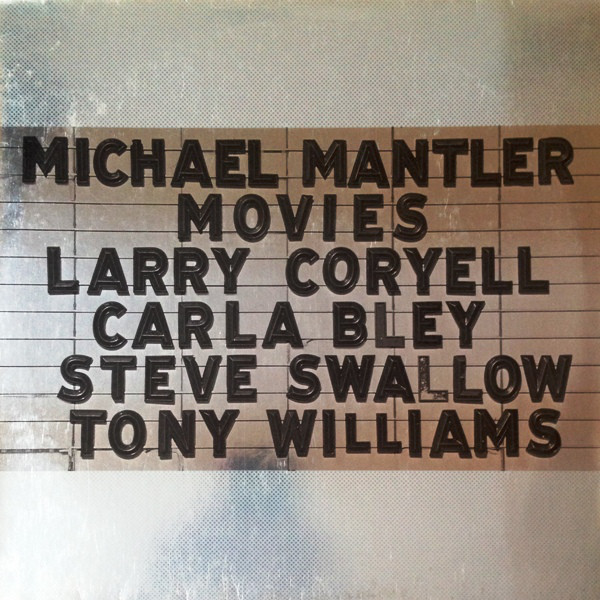
After enjoying a lavish dinner with Carla Bley and her band, what could be better than watching a movie? While we may not have visuals to accompany what we hear in this case, what is a movie if not a sonic entity? Even so-called silent films are nothing without their sounds—described, implied, and visualized. Michael Mantler likewise makes action audible, laying out eight narrative sketches for a silvery quintet consisting of himself on trumpet, Bley on piano (as well as synth and tenor saxophone), Larry Coryell on guitar, Steve Swallow on electric bass, and Tony Williams on drums.

“Movie One” establishes an orchestral sound from this small group of musicians, planting feet firmly in a crisp, mineral-rich soil. Coryell makes a welcome cameo in the WATT roster, fleeting though it may be, in that he brings to the fore a depth of philosophy that transcends its own historical moment (be sure to check out his character role in “Movie Seven” as well). Williams and Swallow are a fluid rhythm section, while Bley rocks the keyboards in harmony with Mantler, whose trumpet sharpens a leading blade that cuts through “Movie Three” (which would seem to move across the same whetstone as Steve Kuhn’s Trance) and “Movie Six.”

Of especial note are “Movie Four,” for Coryell’s ricochet effect and Bley’s mechanical undercurrent, and “Movie Five,” for Swallow’s swing and Mantler’s textural skill. But the Palme d’Or goes to “Movie Two.” ECM listeners may know it from the Mantler playlist that is 2006’s Review. Blistering yet always within view of the camera, its actors punch out a tenuous beginning until it grooves. As Swallow and Williams lead the way with Mantler bringing up the rear, Coryell burns a hole in the celluloid until disbelief can no longer be suspended. Like “Movie Eight” that ends it all, it glows with mortal finality. Then again, what finality is not mortal?

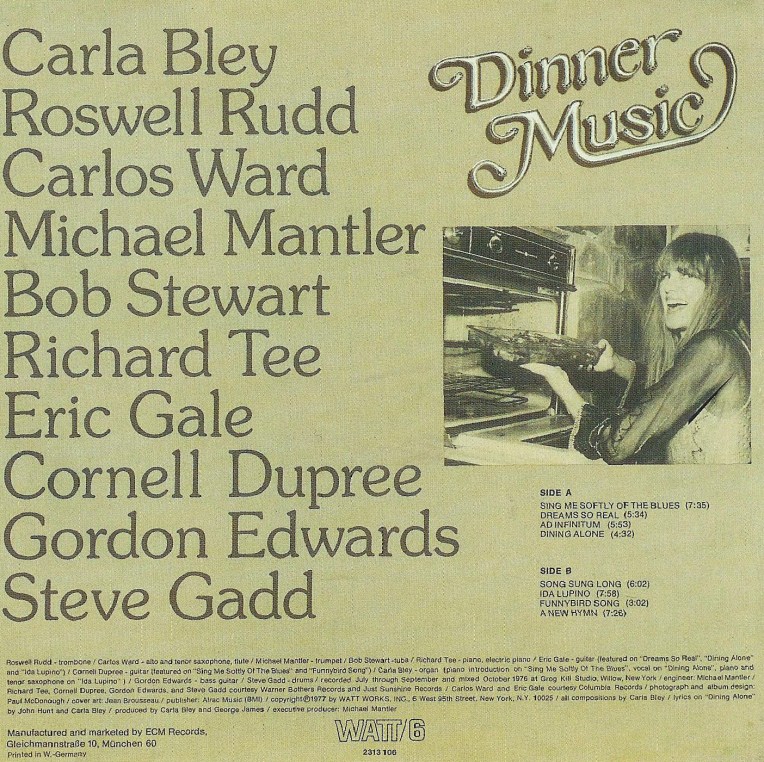
Carla Bley: Dinner Music (WATT/6)

WATT-6-front

Carla Bley
Dinner Music

Roswell Rudd trombone
Carlos Ward alto and tenor saxophones, flute
Michael Mantler trumpet
Bob Stewart tuba
Richard Tee piano, electric bass
Eric Gale guitar (on “Dreams So Real,” “Dining Alone,” and “Ida Lupino”)
Cornell Dupree guitar (on “Sing Me Softly Of The Blues” and “Funnybird Song”)
Carla Bley organ (piano introduction on “Sing Me Softly Of The Blues,” vocal on “Dining Alone,” piano and tenor saxophone on “Ida Lupino”)
Gordon Edwards bass guitar
Steve Gadd drums
Recorded July through September and mixed October 1976 at Grog Kill Studio, Willow, New York
Engineer: Michael Mantler
Produced by Carla Bley and George James
Executive producer: Michael Mantler
Release date: September 1, 1977

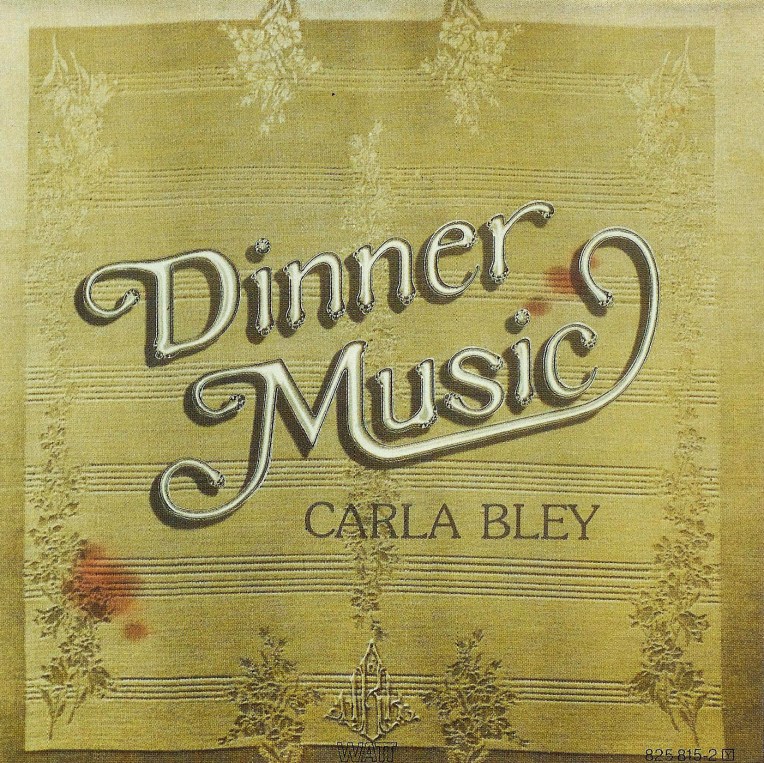
Now that we have been thoroughly psychoanalyzed by Michael Mantler’s dramaturgical shadows, leaving behind the jetlag from our trip, we can at last eat our fill and bask in the glow of Carla Bley’s Dinner Music. Our date with this ten-tet falls under the banner of CLASSIC for several reasons. First, it introduces a big band format that will serve Bley well in the decades to come. Second, it gives her room to interpret some of her most inspired tunes for the first time in the studio (after having been recorded by Paul Bley and others). Third, it welcomes saxophonist Carlos Ward, trombonist Roswell Rudd, and tuba player Bob Stewart into the fold. Fourth, it sets the tonal balance of wit and rigor that defines a particularly fruitful era of her genius.

This time around, the bandleader and composer relegates the pianistic duties to Richard Tee and opts mostly for organ, thereby adding warmth of character and a tingling personality. That said, she does use the piano to heat up the appetizer of “Sing Me Softly Of The Blues.” The sounds of a meal serve as backdrop while joy and self-derision pass around the same funky libation, compelling Rudd to raise an early toast (also check out his dialogue with a trumpeting Mantler on “Song Sung Long”). “Sing Me Softly Of The Blues” also happens to be the title of record by the Art Farmer Quartet, which included the timeless “Ad Infinitum,” also heard here. Though smoother than its surrounding courses, Bley keeps us on our aural toes with some interesting changes in the organ.

“Dreams So Real” (recorded the year before on the eponymous album by Gary Burton for ECM) is another laid-back beauty, replete with electric undercurrent, as is “Dining Alone.” Rudd and Ward are a lovely leading pair, while the electric guitar of Eric Gale is incisive and intriguing. Yet what on the surface appears to be even-tempered teems with chaos and fascinations beneath. Bley sings on the latter tune with a touch of melancholy that cannot be washed away with any amount of champagne. “Ida Lupino” is the standout dish. The sound of a crowd sets the scene as Bley warms up on the piano (she also plays tenor saxophone). And when the rhythm section of bassist Gordon Edwards and drummer Steve Gadd kicks in with a solid groove, and the flute of Carlos Ward draws out the sunset just a little longer than physics will allow, the band unravels a pioneering atmosphere. Bley even references herself by reprising “Funnybird Song” from Tropic Appetites. In this instance it is instrumental, upbeat, and optimistic. Our aperitif is served in a glass etched with the words “A New Hymn.” This anthemic wonder, swirling with full-bodied horns, goes down easy.

Looking back on the meal, I only wish the spices of Edwards and Gadd had been applied more liberally throughout this quintessential meal, as they seem relatively faint in the mix. Otherwise, every flavor stands out in relation to the rest. This is also one of Bley’s best titles for conveying the sheer amount of effort that goes into preparing a dinner, especially for a large group. And despite the energy spent, chef Bley must be “on” for the dinner itself, prolonging her rest that much longer for the sake of her honored guests. In that sense, the music leans against desperation, even as it succeeds in cleaning every plate as if it were the last. This is Bley at her most delectable.

WATT-6-inside-1

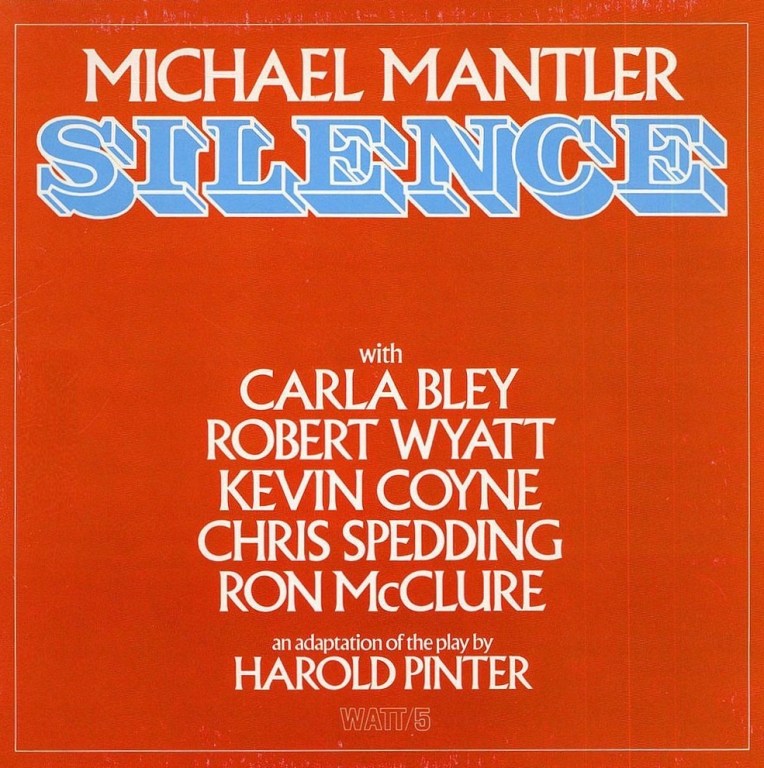
Michael Mantler: Silence (WATT/5)

Silence

Michael Mantler
Silence

Robert Wyatt voice, percussion
Carla Bley piano, voice, organ
Kevin Coyne voice
Chris Spedding guitar
Ron McClure bass
Clare Maher cello
Recorded during January 1976 at Grog Kill Studio, Willow, New York
Engineer: Michael Mantler
Robert Wyatt and Chris Spedding recorded during February with the Manor Mobile at Delfina’s farm, Little Bedwin, Wiltshire, England
Engineer: Alan Perkins
Kevin Coyne recorded during April with the Virgin Mobile at the Gong Farm, Whitney, Oxfordshire, England
Engineer: Steve Cox
Additional strings recorded during June and mixed during November at Grog Kill Studio
Engineer: Michael Mantler
Produced by Carla Bley

“One way of looking at speech is to say that it is a constant stratagem to cover nakedness.”
–Harold Pinter

Upon waking from the fever dream of Michael Mantler’s The Hapless Child, we might be forgiven for expecting reality to welcome us back with comforting arms. Instead, Silence throws us into the bore of everyday life, so that by the end we’re left wondering why anything that mattered ever mattered at all. In this musical, though far from incidental, setting of the eponymous play by the ever-contrarian Harold Pinter, we find ourselves in the company of Rumsey (Kevin Coyne), Ellen (Carla Bley), and Bates (Robert Wyatt). Rumsey is brash and self-confident, happy to have a girl on one arm—“She dresses for my eyes,” he sings—and a blissful disregard for mortality on the other. The environment Mantler composes around him creeps in with inevitable foreboding. The dialogue, such as it is, is more internal than external, chillingly honest yet indifferently expository. Ellen, for her part, is possessed of a breezy self-awareness: “There are two. One who is with me sometimes, and another. He listens to me. I tell him what I know.” In so saying, she reveals a hidden motive to the relationship, a conduit between souls that shrivels in fear when Bates enters the scene and brings with them a bevy of piano, bass, and percussion. All of which sets off a chain reaction of circular reasoning that muddies more than clarifies the human condition.

The music is a mixture of rock, funk, downtown cool, and European art song. Without it, there might be nothing to hold on to. Guitarist Chris Spedding is remarkable, gaining deepest traction in “She Was Looking Down,” and Bley lays on a thick layer of expressiveness, both as pianist and as vocalist (note, especially, “After My Work Each Day”). But while this is as luscious and engaging as any Bley/Mantler collaboration from the 70s could be, the play itself is lackluster to say the least. Its theme of lost souls is as fatigued as the characters it threads like beads on a necklace far too big for its own neck. As the drama develops, memory overlaps and all sense of time stops, unravels, and expands. But any pretensions Pinter might have of making an existential statement fall flat for me, especially when compared to the stripped-down brilliances of Samuel Beckett and Edward Gorey that preceded it. That said, in relatively short bursts—as in “When I Run” and “A Long Way”—the dialogue is somewhat tangible. The best example is “Sometimes I See People,” which creates a charmingly metaphysical atmosphere for being so much about music, sensory experience, and sense of belonging. But really it’s Mantler’s stage, rather than the people ambulating across it, that keeps me from walking out.

Both realms, the play and this soundtrack, are cyclical constructions. But if the words are just a spiral, the music is a helix. It binds with our DNA and finds a place in our evolution as listeners.

WATT-5-LP-back