

Dino Saluzzi: Albores (ECM 2638)

Dino Saluzzi
Albores

Dino Saluzzi bandoneón
Recorded February-October 2019
Saluzzi Music Studios, Buenos Aires
Recording engineer: Néstor Diaz
Cover photo: Lisa Franz
Mastering: Christoph Stickel
Produced by Manfred Eicher
Release date: November 6, 2020

Whereas many of us who once painted with fingers as a child moved on to brushes, Dino Saluzzi seems to have ignored that transition. On Albores, an album born of reckoning, Saluzzi renders what Luján Baudino in his liner note calls an “inner landscape.”

“Adiós Maestro Kancheli” opens on a somber note by paying respects to the late Georgian composer, who passed away in 2019. And yet, what we are given is more than a tribute or homage; rather, it is an identity without personhood, a force that animates the spirit of bygone days. Such redemptions of memory are as integral to Saluzzi’s language as sunlight and rain are to crops. The levels of introspection so organically achieved on “Ausencias” and “Íntimo” are what only decades of artistic experience could elicit. Such power of restraint, he reminds us, is foreign to our younger selves. It is the method of a heart that knows only the scrape of life’s cuneiform.

One need only bathe in the waters of “Don Caye” (an ode to his father’s music) to know that if the bandoneón were a film camera, Saluzzi would be one of its greatest living auteurs. “Écuyère” reorients the lens on a larger scale. Its prosaic qualities illuminate characters whose motives, while ancient, feel as familiar as our skins. The same holds for “Ficción,” a more jagged mountain carved by patience. Like “La Cruz del Sur (2da cadencia),” it rises among the very Andes in which it was born.

Hope is most apparent in “Según me cuenta la vida – Milonga,” a language seeking a mouth through which to be spoken. What dances in one moment turns during the next into a forlorn gaze toward a horizon that could have been. And yet, the trajectory that has brought him here feels inevitable. As in the closing “Ofrenda – Tocata,” it has always been inside, waiting to be sung.

Despite its generally slow pacing, there is plenty of verve to discover throughout Albores. Saluzzi’s energy floats just out of grasp so that we are always seeking its next steps. It is also a meditation on the lung capacity of the bandoneón itself. It breathes for those who no longer breathe. It breathes for those who have yet to breathe. It breathes for all who continue to breathe. Hints of light between its buttons are enough to remind us that even as the sun sets where we stand, elsewhere, it is dawn.
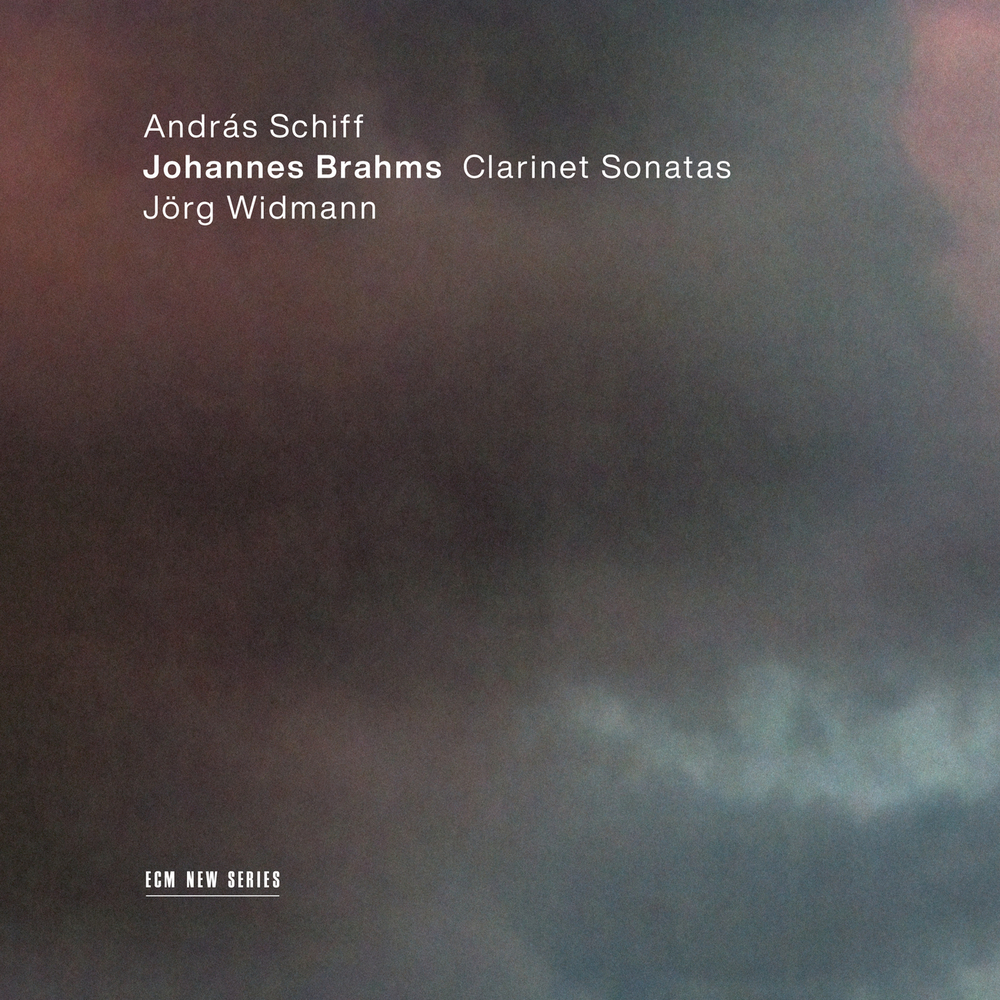
Schiff/Widmann: Brahms Clarinet Sonatas (ECM New Series 2621)

András Schiff
Jörg Widmann
Johannes Brahms: Clarinet Sonatas

András Schiff piano
Jörg Widmann clarinet
Recorded May 2018
Historischer Reistadel, Neumarkt
Engineer: Stephan Schellmann
Cover photo: Jan Jedlička
Produced by Manfred Eicher
Release date: October 2, 2020

In the opening gestures of the Sonata in E-flat major, op. 120/2 (1894), for clarinet and piano, it’s difficult not to feel the breath of life that moved its composer, Johannes Brahms (1833-1897), to such rapture in the latter years of his life. As the second of two such sonatas and his final chamber work, it is a testimony not only to Richard Mühlfeld, the master clarinetist of his day whom Brahms called “the nightingale of the orchestra,” but also to the self-effacement with which Brahms struggled throughout his creative life. And so, when considering the enduring interpretations here by pianist András Schiff and clarinetist Jörg Widmann, one must understand that without a love for every note, the bars between them would erode. Thus, Widmann gives colorations to the breath at every turn, while Schiff understands the role of the piano in Brahms’s chamber works as more than an accompaniment, giving it the fullness of expression it requires. The second movement, a rousing Allegro appassionato, is quintessential Brahms for its controlled drama and balance of fine motor skills, all tied together with a rustic charm. The final movement works patience into the virtue of exuberance.

The Sonata in f minor, op. 120/1 (1894), is even more dynamic. After a gradual first movement, the second unravels like paint from a brush, finding favor in the final trails of each stroke. The restrained Allegretto that follows sets up a rousing Vivace, the ebullience of which dazzles the senses. Given its symphonic textures, it’s no wonder the piece lent itself so gloriously to Luciano Berio’s orchestral transcription in 1986.

Between these giants of clarinet literature are Widmann’s five Intermezzi (2010) for piano. As tributes to both Schiff (to whom it is dedicated) and Brahms, they show a modern heart in love with the blood of tradition pumping through it. The central intermezzo, at 12 minutes, digs deepest into the spirit of this emotional transference. Throughout, we encounter waking moments in an otherwise dreamlike mise-en-scène. Nevertheless, clarity abounds.

Camerata Zürich: On an overgrown path (ECM New Series 2597)

Camerata Zürich
On an overgrown path

Camerata Zürich
Igor Karsko
 direction, lead violin
Maïa Brami speaker
Recorded September and November 2017
Radiostudio DRS, Zürich
Engineer: Andreas Werner
Cover photo: Nadia F. Romanini
An ECM Production
Release date: November 26, 2021

“When the heart speaks, the mind finds it indecent to object.”
–Milan Kundera, The Unbearable Lightness of Being

Czech composer Leoš Janáček (1854-1928) penned his two-volume On an overgrown path between 1901 and 1908. While its significance in the pianistic pantheon is often eclipsed by canonical predecessors, its inventiveness is marked by nonorthodox shifts in harmony, each a full statement without the need to justify what precedes or follows. Given the music’s history and place in time, few would be up to the task of arranging it for string orchestra with equal fervor, but this is precisely what Daniel Rumler did in 2016 to luminous effect, breathing not new but old life into the lungs thereof.

As Thomas Meyer notes in the CD booklet, the title of On an overgrown path references a Moravian wedding song, said path signifying the new bride’s severance from a home to which she can never return. The result is a collection of what the composer called “distant reminiscences” of folk songs and practices. In pieces like “A blown-away leaf,” the underlying connectivity of the notes rises to the surface as treasure from past sediment. Given its basis on the rhythms of the Czech language, we can rightly think of these as “texts” across which editorial marks of prosody and poetry abound, shifting with lyrical abandon from elegy to triumph at the gesture of a bow. Dances (e.g., “Come with us!” and “They chattered like swallows”) testify to the power of memory to reside where it cannot be erased. The spiritual glimpses of “The Madonna of Frydek,” which paints in broad strokes yet with detailed awareness, lean into Janáček’s love for his daughter, Olga, who died in 1903.

Much of this music, however, is divided against itself. For instance, what begins as a frolic in “Words fail!” morphs into uncertain recollections and emotional vulnerabilities. The latter work their way through “Good night!” and “Unutterable anguish” with the wormlike glow of burning steel wool. The strings are especially able to draw out that inner turmoil with maximum acuity. Even the closing Allegro grasps a bouquet of fragmented selves, each a palimpsest of circumstance.

Between the cycle’s two books is a 10-part text by Maïa Brami, dedicated to Thomas Demenga, who was the director of the Camerata Zürich when the orchestral arrangement was being put together (and who suggested the writing of these texts). Brami describes the scene as follows:

“In the evening of his life, Leoš Janáček returns to his native forest. He does know it, but it is the last time. The composer is looking for Otto, the son of his muse, Kamila Stösslova, whom he loves passionately. The boy has wandered off into the woods. After years of passionate correspondence, the young woman finally accepted the first-name as an admission of shared love and came to visit him in his family home. When he met her at a spa in 1917, the artist was at his lowest ebb: he had not recovered from the death of his daughter Olga and his career was not taking off. Kamila, his ‘rose,’ his ‘red flower,’ will resurrect him.”

This panoply of yearnings and recollections (“God how I would love to hold on to the summer,” he cries, “I who waited for it all my life!”) unfolds like a biography in miniature, brilliantly capturing moving images of the composer’s childhood (“Deep down in my suitcase, a pot of honey from my father’s hives, heavy as my grief”), mortal anxieties, and the loves connecting the spaces between. Thus, the composer is able to dip his fingers into the font his creative inspiration. And as the end encroaches on him, he resigns to the fleeting nature of things.

The program is bookended by two kindred pieces. The Meditation on the Old Czech Chorale St. Wenceslas, op. 35a (1914) of Josef Suk (1874-1935) welcomes natural sonorities. Like tall grasses in a windswept landscape, it gives purpose to the elements by making known their otherwise invisible movements. The Notturno in B major, op. 40 (1875) by Antonín Dvořák (1841-1904) closes with grace, folding us into a river’s current in search of an oceanic afterlife.

Matthieu Bordenave: La Traversée (ECM 2683)

Matthieu Bordenave
La traversée

Matthieu Bordenave tenor saxophone
Patrice Moret double bass
Florian Weber piano
Recorded October 2019, Studios La Buissonne, Pernes-les-Fontaines
Engineer: Gérard de Haro
Mastering: Nicolas Baillard
Cover photo: Thomas Wunsch
Produced by Manfred Eicher
Release date: September 25, 2020

La traversée offers the ECM leader debut of French tenor saxophonist Matthieu Bordenave, who first appeared thereon as part of Shinya Fukumori’s 2018 masterpiece, For 2 Akis. This time, he is joined by German pianist Florian Weber and Swiss bassist Patrice Moret. Clearly born for the label, onetime host to his hero Jimmy Giuffre’s band with Paul Bley and Steve Swallow, he allows those early influences to take residence in current practice, each a shade letting in different amounts of light through the windows of his musical soul. The present trio holds its own in the presence of such expectations, ever open to the possibilities of space and unstructured play. Other influences include classical chamber music, especially of the modern French persuasion (think Messiaen and Dutilleux). Classical training indeed comes to the fore in his technical control while his love of jazz spreads across eight originals in the fashion of a spilled glass of water—inching ever closer to the edge of the table but prevented from falling by delicate surface tension.

When the darkening of “River,” a duet between the bandleader and Weber, makes its gradations known, we find the saxophonist sitting alone in a place of seeming childhood significance. His breathy register is a ghost—not of the past but of the future. At the same time, his sound is antique in that one can taste the patina of his horn. When the character of the bass is introduced in the second scene, “Archipel,” an underlying cinematic implication is consummated. Thus, Bordenave recalls Giuffre but also Charles Lloyd’s muggy charm, cherishing the potential of a dying note as might a sitar virtuoso. All the while, Weber’s forthright pointillism meshes lovingly with Moret’s rounded spacing.

“Le temps divisé” assembles notes as an archaeologist does a skeleton, for great care is required amid the excitement of discovery to fashion a coherent simulacrum of the body it once inhabited. In the wake of that exacting labor, “Dans mon pays” speaks of home as the piano and saxophone nourish each other in the bass’s soil. “The Path” follows with the album’s deepest passage, rewarding the patient listener (like the set as a whole) with moments of sheer lucidity.

Although Bordenave is powerful and direct in his gentility, he understands the preciousness of space. “Ventoux” and “Incendie blanc” are special cases in point. Both are hopeful fascinations, treating yearning as an instructive force. Moret’s bass monologue in the former tune is superb, giving way to galactic light from Weber, whose delicate flames dance across the latter’s terrain. From the ashes of those reactions arises “Chaleur grise,” of which the meticulous fray wavers in reflection. Hence our return to “River,” now in trio form and willingly shed of its skin. A stepwise unison leads to the final note, free yet bound by just enough grit to make the dream feel actual.

La traversée is a diurnal experience, tracking heavenly bodies in a climate all its own. To listen to it is to watch your shadow marking the hours from dawn until dusk.