

Keith Jarrett
Carl Philipp Emanuel Bach
Keith Jarrett piano
Recorded May 1994 at Cavelight Studio, New Jersey
Engineer: Peter Laenger
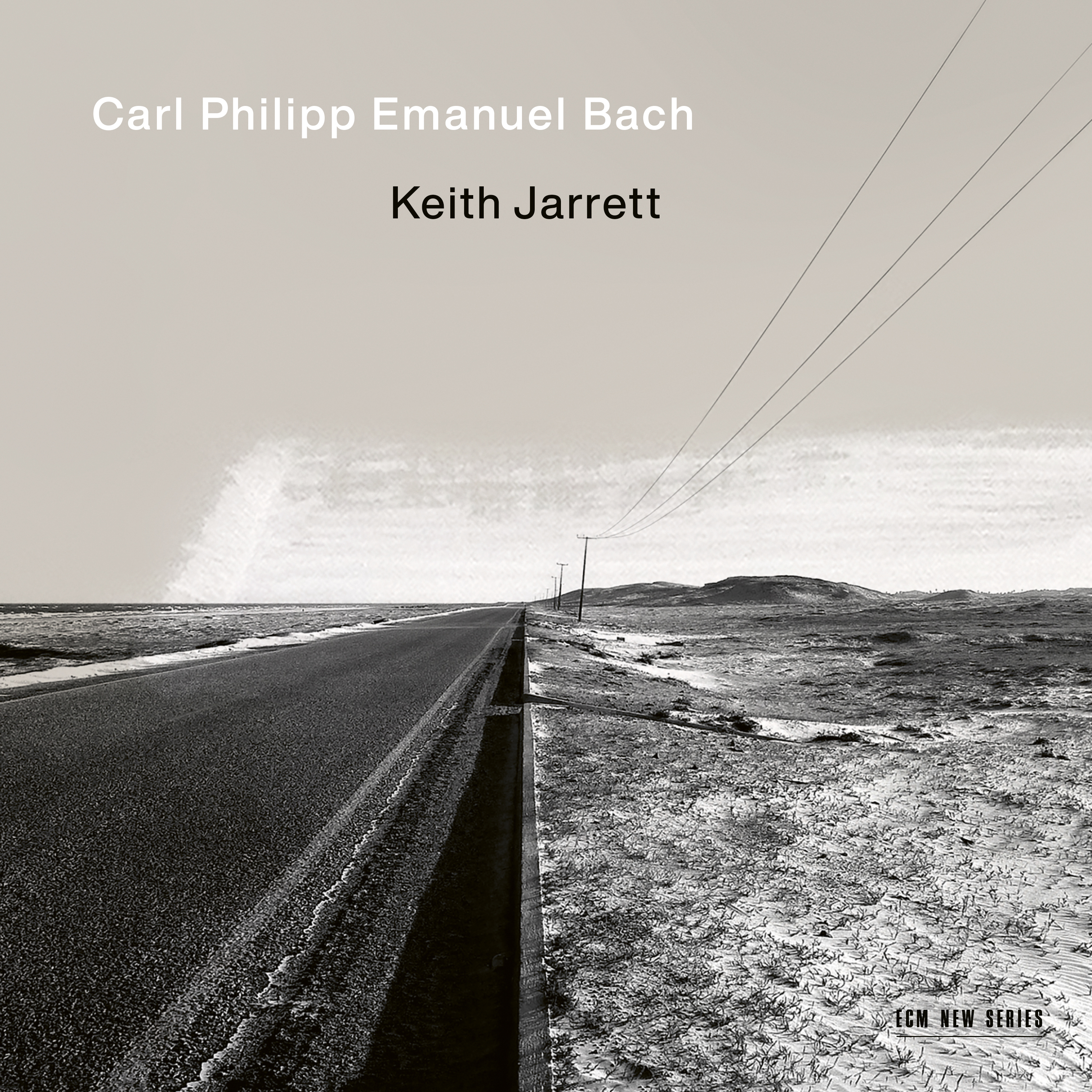
Cover photo: Mayo Bucher
Executive producer: Manfred Eicher
Release date: June 30, 2023
In his 2014 monograph, The Music of Carl Philipp Emanuel Bach, music historian David Schulenberg paints a compositionally focused portrait of Johann Sebastian’s second son. Despite living in his father’s shadow, his influence managed to shine a light through the veil of history by way of his seminal Essay on the True Manner of Playing Keyboard Instruments and the conduit he was purported to have furled between the Baroque and Viennese Classical schools. As a composer of nearly 1,000 works, his oeuvre is nothing to sneeze at, nor his style, as much an example of evolution in and of itself as of eras retrospectively defined.
As Paul Griffiths notes in the liner text for the present album, which documents Keith Jarrett’s traversal of CPE’s Württemberg Sonatas, the ocean between father and son may seem vast, even as it churns with currents of familiarity in concert with calls from more distant shores. Dedicated to Carl Eugen, Duke of Württemberg, this collection “makes the point about inheritance avoided, or qualificated, or contradicted, or accepted, whether with gratitude or resignation.” Although nominally composed in 1742/43 for the student who would soon ascend to his dukedom, Griffiths observes, “More likely it was for his own fingers he was writing, and for his own ears.” Jarrett, having only heard these pieces on harpsichord, felt compelled to make a piano version, resulting in this home studio recording from 1994, likewise also for his own fingers and his own ears. All the more honored we should feel to have it available three decades later.
Sonata I in a minor is glorious from the start. There are moments of intense poignancy, as in the Moderato, while the faster outer layers elicit feelings of joy that are always undercut by what Griffiths calls a “sad grace” throughout (I might also call it a glorious melancholy). The final movement, marked Allegro assai, carries astonishing depth in tow. What seems a lightly articulated dance has room for so much more than the listener can calculate. Jarrett brims with vitality and precision without ever letting go of the improvisational spirit for which he is known on the jazzier side of things.
The sheer clarity of Jarrett’s voicings, a profound match for the younger Bach’s own, is fully displayed in Sonata II in A-flat major, of which the concluding Allegro is especially vibrant for its multifaceted joys. Like a brick wall, each layer staggers, parallel to every other layer below and above it, adding strength to the overall design and function.
The opening of Sonata III in e minor is perhaps the most glorious of them all, revealing its heart from the first sweep of the second hand. The Adagio is nostalgia incarnate, while the Vivace—the briefest movement of the collection—peels itself away with unfiltered love. The pauses in Sonata IV in B-flat major make for passionate contrast, yielding an Andante of great beauty. Working in stepwise formation, it is a DNA helix surrendering to melodic sequencing.
The more these sonatas develop, the more they veer toward Father Bach, especially in the Adagio fugue of Sonata V in E-flat major. With sweeping intimacy, it pieces together its puzzle between gusts of wind and spirit. The final Sonata VI in b minor is another inwardly focused distillation that defends variegations of light and shadow. The clocklike Adagio is a gem, while the final Allegro glistens in the setting sun. Each is a different keyboard, two eddies in a bay coming together harmoniously, speaking the same truth but with different tongues.
 Between Sound and Space: ECM Records and Beyond