

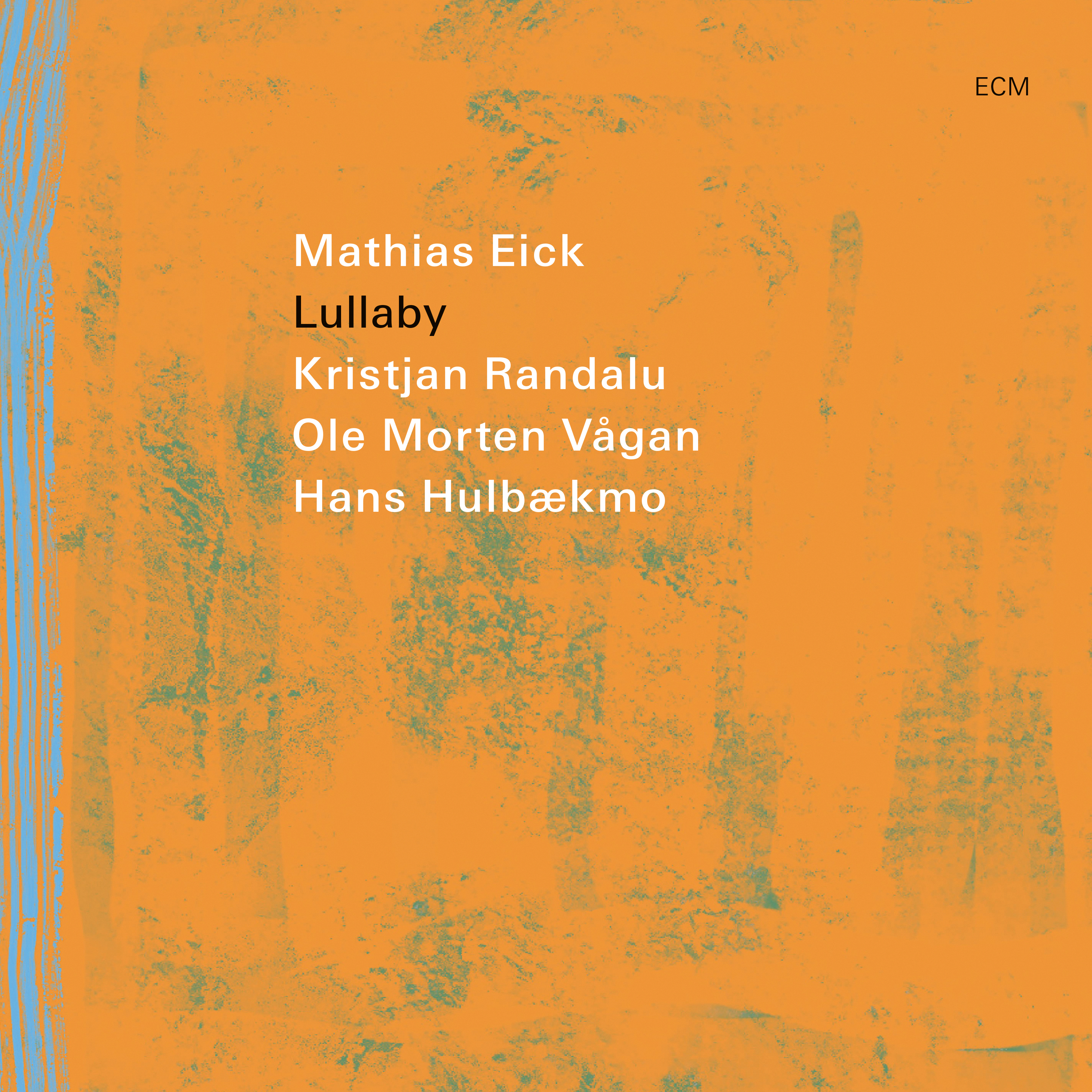
Mathias Eick
Lullaby
Mathias Eick trumpet, voice, keyboard
Kristjan Randalu piano
Ole Morten Vågan double bass
Hans Hulbækmo drums
Recorded January 2024 at Rainbow Studio, Oslo
Engineer: Martin Abrahamsen
Cover: Fidel Sclavo
Executive producer: Manfred Eicher
Release date: February 14, 2025
On Lullaby, Mathias Eick returns to ECM with a fresh quartet exploring eight originals. In addition to broadening his wingspan, the album marks a culmination of his creative evolution (if not also his evolutionary creativity). The trumpeter intensifies his aesthetic even as he opens it to new possibilities of freedom and expression. I can only analogize his relationship to his compositions to that of a father and his children, watching them grow and come into their own, even while knowing a part of him will always reside in their DNA.
Among his bandmates this time around, ECM listeners will be familiar with pianist Kristjan Randalu and bassist Ole Morten Vågan, while drummer Hans Hulbækmo is a newcomer to the label. It is, in fact, the latter whose presence is most deeply felt from the album’s first moments. His delicate establishment of “September” lays an open-bordered groove before Morten Vågan and Randalu make their introductions, pouring out grace from evocative pitchers of thought. Eick’s trumpet joins waveringly yet surely, never doubting its message and trusting in a higher power to give him a voice within and without his primary instrument.
The title track is the most inward-looking of the set. It serves as an especially suitable vehicle for Randalu, who builds on a tragic theme with selfless contemplation, giving Eick more than enough room to cushion the traumas of global politics (having been written in response to the violence in Israel and Gaza). Next is “Partisan,” a mid-tempo wonder grounded in Morten Vågan’s bassing, which shapes every turn of phrase as if it were the first. There is something vividly sunlit about the band’s sound, as emphasized by Eick’s falsetto vocals, which add such warmth of character (as they also do on “Free”). “My Love” is dedicated to the trumpeter’s wife, swelling from a pianistic intro into an overwhelmingly joyful ride. Randalu unpacks every vow as a memory in the making. Eick’s own soloing lends depth and breadth, examining the self and bowing in humility to having known such happiness in a world filled with suffering.
“May” offers one of the strongest melodies of the album, jumping into the swimming pool of the heart and doing a full breast stroke for nearly five minutes. Randalu’s harmonizations are affectionately articulated and give the tune just the uplift it needs to separate from its shadow. Meanwhile, the underlying pulse from Hulbækmo is bold yet never overbearing. “Hope” is another star turn for Randalu, who genuinely feels like he has always been a part of the Eick orbit despite being a new collaborator. A quiet tenderness gives the pianist a wide canvas on which to paint, while Hulbækmo adds light and shadow only where needed.
The gravelly beginning of “Vejle” opens into some darker strains, even as dawn beckons. A bright groove ensues, sending Randalu on a sojourner’s mission in which the sacred and the profane align. Eick’s soloing is at its freest here and shows just how unbound he has become in his playing.
While all the qualities that listeners have come to expect from the bandleader—the unabashed cinematic qualities and flowing atmospheres—are all present, it’s as if the camera has zoomed in a bit more on Lullaby. We get more close-ups than panning shots. At first blush, it almost sounds like a Manu Katché record, and likely gives itself nakedly to the blush of our interpretation. But as the distinctive qualities of its interplay become clear, we bear witness to a collective voice unlike any other. The result is a watershed moment for all concerned.
This, along with Dino Saluzzi’s El Viejo Caminante, is an easy contender for the top release of 2025.
 Between Sound and Space: ECM Records and Beyond