


But thou, when thou prayest, enter into thy closet, and when thou hast shut thy door, pray to thy Father which is in secret, and thy Father which seeth in secret shall reward thee openly.
–Matthew 6:6
Rodion Romanovich Raskalnikov is a murderer. To say as much is to betray everything and nothing about Crime and Punishment, the plot of which he is the central protagonist. But what has he—and will he—become? Such is the bigger question Fyodor Dostoevsky examines throughout his 1866 masterpiece.
In its opening act, we see enough of Raskalnikov’s contemplations to know that he is an unsettled individual, one who lives in the shadows because there is so little light to be had. Stepping out from his rented closet one hot July evening, “as if indecisively,” he is already waist-deep in melancholia. His modest lodgings do not constitute a place of rest or meditation. If anything, he has turned the Bible verse quoted above on its head. Rather than pray to the Father, he throws the doors of his heart wide open to the Devil, whose ever-encroaching impulses are given the freedom to sow themselves in his soil and absorb the tainted nutrients of his self-aggrandizement.
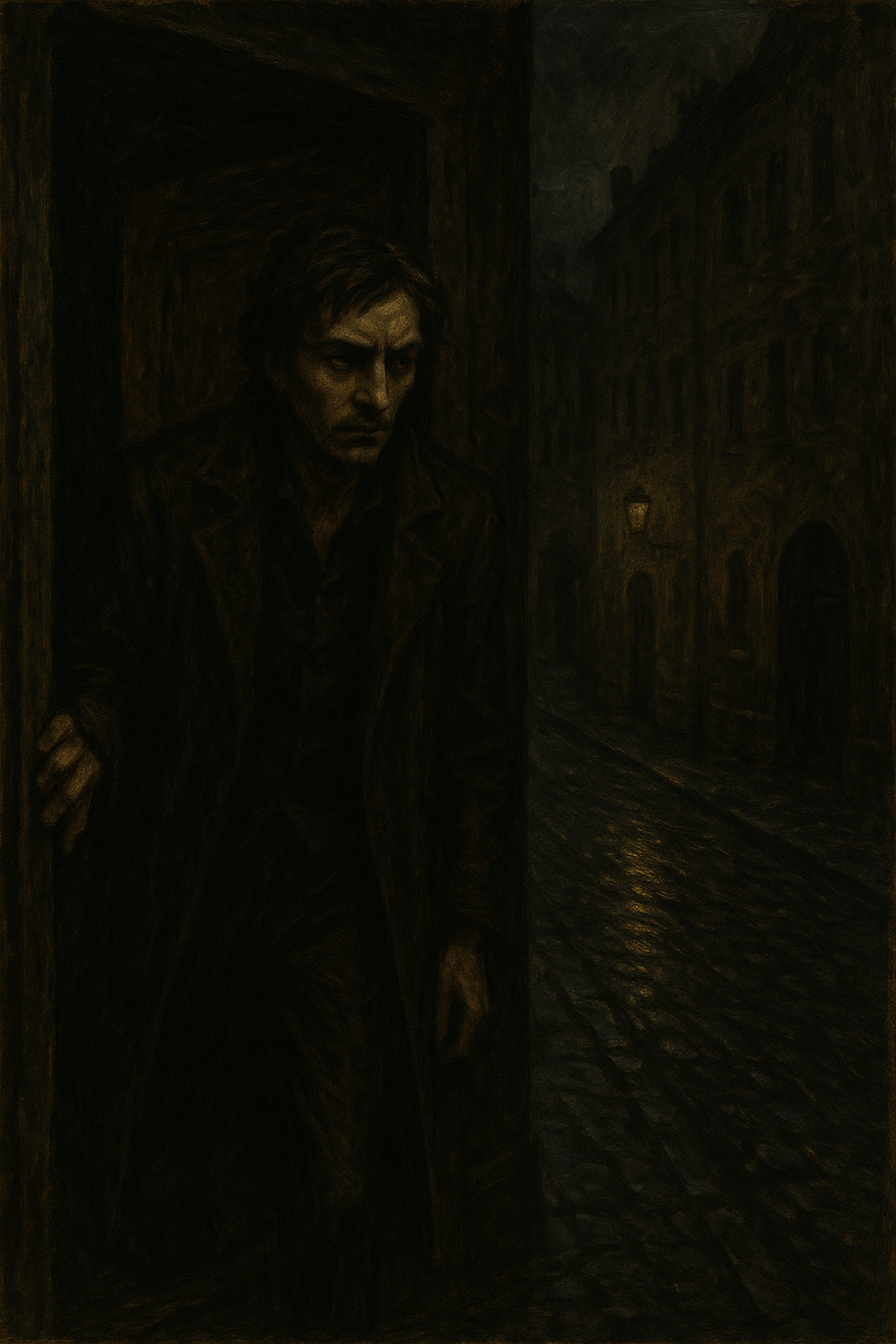
It is no surprise that the first words he utters are not to a friend, a person on the street, or to us. Rather, they are to himself. Internal dialogue is his magnetic north, and in following it, he leads us by proxy into a web of characters so electric and alive (even, if not especially, those hurtling toward death) that his fate can only be an object of our curiosity. Before we get to know him, he is already wondering: “Am I really capable of that?” thus alluding, of course, to the murder he has already contemplated and played out in his head and which, almost in the same breath, he dismisses as fantasy. And yet, fantasy is more than the realization of a desire. It is the very force by which he learns to desire. So strong is this drive that he begins to question whether it comes from within or from without. “If not reason, then the devil!” he spits forth, pitting the impulse to kill in a false dichotomy. So, too, does the Devil cloak himself in reason.
Or, more accurately, if not pure reason, then its tainted cousin of casuistry, the process by which the baseless effort to justify immorality becomes a self-fulfilling Ouroboros. This is why we so often find Raskalnikov talking to himself and why passersby take him to be a careless drunk. In his mind, the answers to all moral questions have been primed and ready but must be taken by force to ring true. Ironically, this may just be the most genuine thing about him.
Of the catalytic murder, the victim of which, Alyona Ivanovna, is universally hated for her shady pawnbrokering and abusive nature, we are given a relatively brief and merciless account, so that by the time the deed is done, we are invited to regard it with visceral dismissal. In the subsequent adrenaline rush, he becomes enchanted by its unfolding, as well as by the fact that an unsuspecting second victim had to be involved after walking in on the scene in progress. The translator’s introduction rightly puts it this way: “Crime and Punishment is a highly unusual mystery novel: the most mystified character in it is the murderer himself.”

That said, one would be mistaken in thinking that Raskalnikov’s torment is a result of his heinous crime. He has been in its clutches long before we first encounter him. It did not come pouring in from a tear in the fabric of time the moment he wielded that fatal axe. It is the result of the exhausting back and forth between his heart and soul that has besought him since childhood. Hence, the dream he has early on in the novel, in which he takes the form of a boy regarding a crowd of drunken rabble-rousers in the rural town where he grew up. Fearful of their coarseness, he clings to his father, a figure now absent in his life and perhaps already a model of indifference then. One of the men launches into a verbal tirade that culminates in him beating a horse to death in full view of the assembled onlookers. Young Raskalnikov cannot bear the sight, and neither can his adult self. After the dream, “the mere thought of it made me vomit in realityand plunged me into horror,” even while knowing that the manner in which the horse was dispatched reflects his desire to carry out the same. Furthermore, on the night of the murder, we are told, “never for a single moment during the whole time could he believe in the feasibility of his designs,” as if this were an excuse for their imminent manifestation.
It is significant, too, that the killer in his dream should be named Mikolka, a diminutive of Nikolas that means “victory of the people.” It conveys, in no uncertain terms, that if the destitute are to find a way out of their predicament, it must be done through violence. All of which points to a sociopolitical subtext that becomes more familiar as the narrative progresses. It is the very idealism that has buried its talons in Raskalnikov’s mind to the point of needing to overthrow the established mechanisms of power under which he knows order and, to risk belaboring the word, reason. He wants so much to rank among the “geniuses” who inhabit his waking thoughts, when he is still nothing more than the dreamed-of boy seeking refuge in his father in the face of senseless killing.
Various names, it turns out, are equally emblematic of inner tensions. Raskolnikov, for one, comes from the word raskolnik, meaning “schismatic,” referring to religious separatism while also implying a splitting of self. And then there is the friend from his university days, Dmitri Prokofich Razumikhin, whose surname means “to bring to reason.” Indeed, it is Razumikhin who cuts to the quick of our antihero with almost indulgent aplomb as he strives to “make a human being out of you, after all.” It is also he who helps us throw the parameters of his decrepit reunitee’s worldview into relief. According to said worldview, he observes, “crime is a protest against the abnormality of the social order—that alone and nothing more.” So it is that Raskalnikov’s justificational acrobatics trace a roadmap of interpretation for our benefit. As his enthusiastic acquaintance goes on to say, “Nature isn’t taken into account, nature is driven out, nature is not supposed to be.” Which is entirely accurate because Socialism, in its quest to vanquish hierarchy and oppression, fails to recognize that we are always at war with ourselves. In rejecting the notion of a living soul, it reduces the human condition to unalloyed materialism.
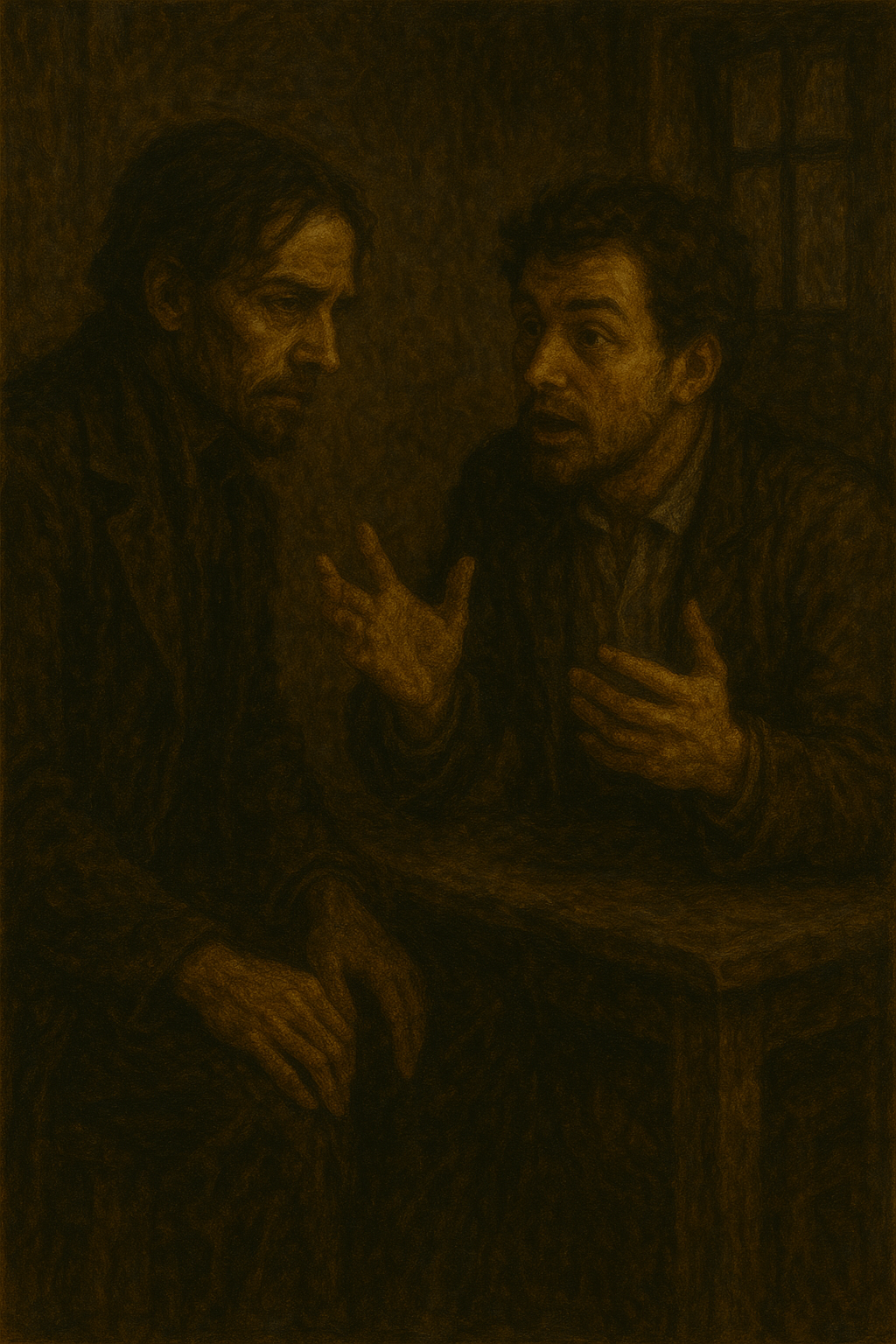
Others are quick to interject their own opinions on these nascent ideals. Among them is Porfiry Petrovich, lead investigator of Alyona’s murder, who is duly fascinated by an article that his main suspect once published titled “On Crime.” Porfiry summarizes its thesis as follows:
“The ordinary must live in obedience and have no right to transgress the law, because they are, after all, ordinary. While the extraordinary have the right to commit all sorts of crimes and in various ways to transgress the law, because in point of fact they are extraordinary.”
To which its author replies:
“I merely suggested that an ‘extraordinary’ man has the right…that is, not an official right, but his own right, to allow his conscience to…step over certain obstacles, and then only in the event that the fulfillment of his idea—sometimes perhaps salutary for the whole of mankind—calls for it.”
Here, we are given insight into his intellectual straw grasping. For even as Raskalnikov expresses this sentiment, he must already know that the philosophy of fulfillment is, at best, a phonetically borrowed loan word in the translation of his life. Still, he is insistent on one thing:
“I only believe in my main idea. It consists precisely in people being divided generally, according to the law of nature, into two categories: a lower one, ordinary people, who are, so to speak, material serving solely for the reproduction of their own kind; and people proper—that is, those who have the gift or talent of speaking a new word in their environment.”
Phrased differently, instead of simply reproducing through what is natural, the extraordinary creates something out of nothing through what is supernatural. Raskalnikov fancies himself, or at least would like to be, one of those “extraordinary” people who reject God yet wish to hold His power.
And so, his search for redemption ends up being a recapitulation of what makes him so flawed in the first place: namely, his humanity. Unable to take Nihilism to its most logical conclusion yet incapable of playing the role of the young radical, either, he is forced to choose between himself and…himself. With nowhere left to run but inward, he cracks his conscience open like an egg, scrambles the contents, and throws them into the gaping mouths of his listeners. Among those caught in his defenestrations is Sonya Semyonova Marmeladov, the daughter of a former official-turned-alcoholic.

During a climactic meeting with Sonya, Raskalnikov asks her to read to him the account of Jesus raising Lazarus from the dead, as recorded in chapter 11 of the Gospel of John. In listening to it, he is met by his greatest adversary: God himself. He may not believe in the Bible, but the weight of it is too much for his feeble shoulders. Even in a mind pierced by existential ennui, he has to admit that some things are best left untouched. Either way, the “second chance” offered in Lazarus’s resurrection is undeniably alluring to the bedraggled idealist, who leverages this intimate connection with Sonya as an opportunity to impatiently unlock too many doors in the advent calendar of his heart far ahead of Christmas, so to speak. When he tells her that “it wasn’t a human being I killed, it was a principle!” he is at once revealing his weakness and the fact that his remorse has nothing to do with the crime itself but with its aftermath. But no such act can occur in a vacuum, and this realization pains him to no end. In his attempts to blame the demonic for choices that were ultimately his own, he is no different than the “ordinary” people of his disdain.
At the same time, he is assaulted by an all-consuming apathy, which is, beyond the carnival laughter that is the novel’s leitmotif, the key signature of his life. As our narrator would have it: “Evil is the final ambiguity. Reason cannot accept it; rationalizing ideologies denies its existence.” In light of this, we can see that indifference is the greatest horror, as typified by the following narratorial observation: “His heart was empty and blank. He did not want to reflect. Even his anguish had gone; and not a trace remained of his former energy, when he had left the house determined to ‘end it all!’ Total apathy had taken its place.”
In reading this, I was reminded of what English preacher Charles Spurgeon, who was sermonizing at the same time Dostoevsky was penning his novel, and for whom indifference or lethargy was one of the most wicked influences on the convicted soul and something to be struggled against:
“I would far rather have a man an earnest, intense opposer of the gospel than have him careless and indifferent. You cannot do much with a man if he will not speak about religion, or will not come to hear what you have to say concerning the things of God. You might as well have him a downright infidel, like a very leviathan covered with scales of blasphemy, as have him a mere earth-worm wriggling away out of reach.”
We might easily lay this polemical transparency over Raskalnikov’s life, which marks time by the rhythms of a dank and battered city, itself a force of influence on almost every page.Appropriately enough, it takes the utterly deplorable Arkady Ivanovich Svidrigailov, former employer of Raskalnikov’s sister and an unrepentant sensualist, to give us an accurate characterization of the same when he soliloquizes: “One seldom finds a place where there are so many gloomy, sharp, and strange influences on the soul of man as in Petersburg.”

Not one to be proselytized to, Raskalnikov is quick to call out Svidrigailov for enigmatizing an environment that feeds so readily into his lecherous lifestyle. To this, Svidrigailov replies:
“In this debauchery there’s at least something permanent, even based on nature, and not subject to fantasy, something that abides in the blood like a perpetually burning coal, eternally inflaming, which for a long time, even with age, one may not be able to extinguish so easily. Wouldn’t you agree that it’s an occupation of sorts?”
From the perspective of one who has no real occupation (when asked at one point what he does for work, he responds, “I think”), Raskalnikov knows there is nothing to be had in this dialogue. Svidrigailov’s solution to their intellectual quagmire is to proclaim that “what every man of us needs is air, air, air, sir.” However, this is a false proposition, for where can one find air in a place that suffocates by default?
As the most obvious foil for Raskalnikov, Svidrigailov exaggerates some of his traits while subverting others in aggregate. He makes no excuses for himself and, if anything, seems to rather enjoy his position of authority insofar as he, too, is able to deprive others of breath without apparent consequence. At one point in their exchange, he also offers the clearest characterization of Raskalnikov himself:
“You walk out of the house with your head still high. After twenty steps you lower it and put your hands behind your back. You look but apparently no longer see anything either in front of you or to the sides. Finally you begin moving your lips and talking to yourself, sometimes freeing one hand and declaiming, and finally you stop in the middle of the street for a long time.”

In addition to painting him in stark likeness, and because he renders what was once a private detail into a barbed fact, he exposes the hypocrisy of Nihilism, which is supposed to be a net positive by treating everything (and everyone) as expendable, liberating the self from the shackles of accountability. And yet, Raskalnikov is constantly seeking judgment, inviting it from near and far, all the while shocked at his own insolence for letting certain incriminating details slip. The effect is such that he constantly attributes meetings to chance and miracle (“it was as if someone had come to his service”) when it’s clear he had a conscious hand in their denouement. Even when he tries to rationalize his violence through some sort of Robin Hood complex (“For one life, thousands of lives saved from decay and corruption”), he goes against the grain of his faith by upholding a moral good.
What distinguishes Nihilism from the Postmodernism of today is that, where the former avows that everything is equally meaningless, the latter claims that everything is equally meaningful. Common to both extremes, however, is the broken promise that either can be a viable escape from the suffering of living in a world bound by sin. What he fears the most is being thought of as innocent, which is why he is so perplexed by how he attracts sympathy and affection without even trying. “But why do they love me so, when I’m unworthy of it!” he cries toward the novel’s conclusion. “Oh, how I hate them all!” If anything, however, his hatred is not of people but of the mercy they carry like a cross, for it is the middle ground he cannot bear to inhabit. By the same token, mercy is the only possibility for redemption and shows that he was never cut out to be a dutiful anarchist. As Dostoevsky so eloquently phrases it: “He would have given anything in the world to be left alone, yet he felt himself that he could not have remained alone for a minute.”
As Raskalnikov gets closer to the possibility of a turnaround, he cannot entertain his lack of resolve as anything other than a failure of principle. Unlike the men of influence he admires from afar, whose exploits were never punished and who “endured their steps” with profound and domineering indifference, he grants himself no right to take that step, and this he regards as his greatest crime: not that he took a human life but that he failed to endure his own steps, deferring instead to confession.
If the only chance at escape is to hit rock bottom, if appreciating life is built on denying its inherent value, then he must be willing to undergo the ideological detox that primes him for love’s fresh coat of paint. Because no matter how much he may deny it, we were never designed to live alone.
*The images in this review were created using artificial intelligence (specifically, ChatGPT). The words they accompany were created using actual intelligence (specifically, my own).
 Between Sound and Space: ECM Records and Beyond