

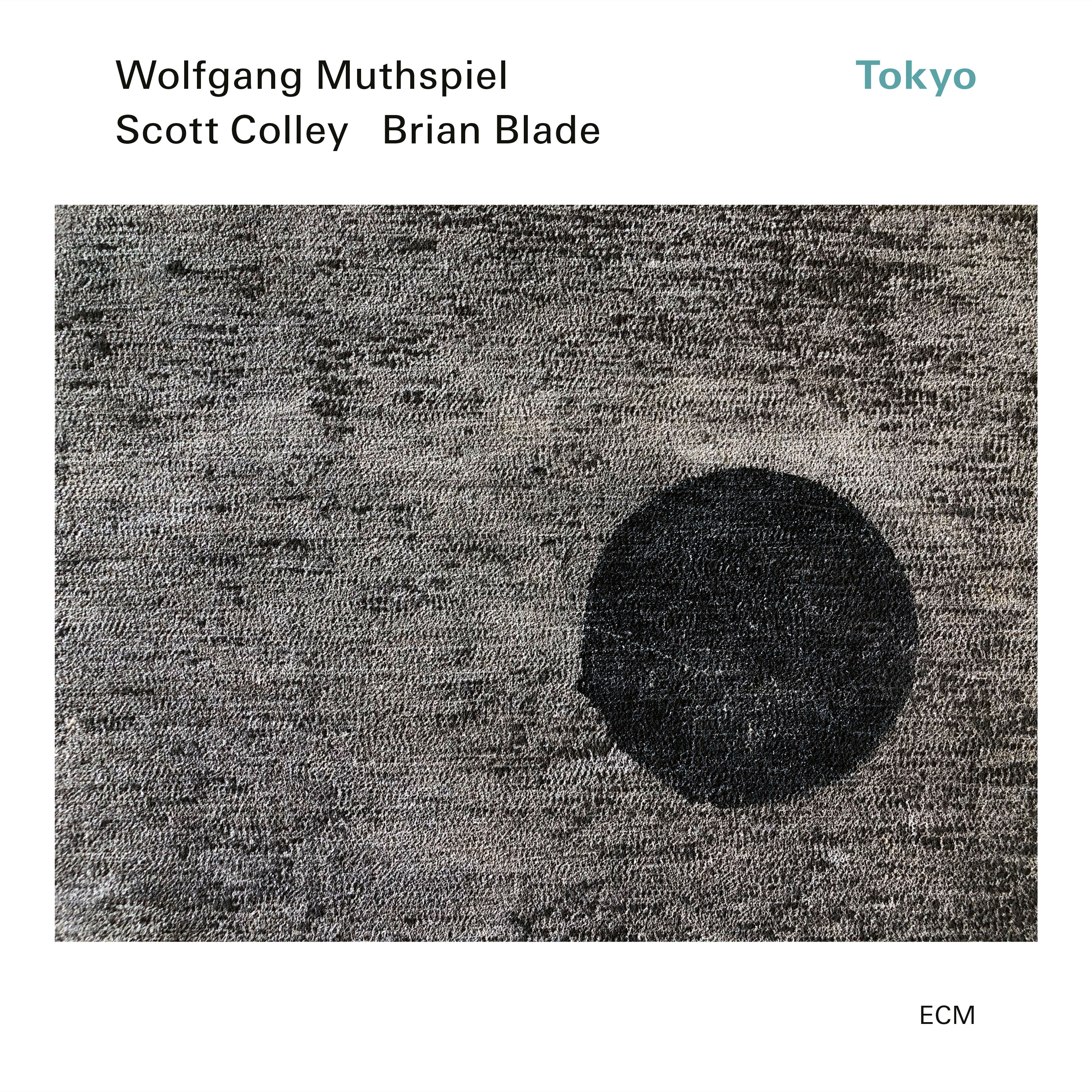
Wolfgang Muthspiel
Scott Colley
Brian Blade
Tokyo
Wolfgang Muthspiel guitars
Scott Colley double bass
Brian Blade drums
Recorded October 2024 at Studio Dede, Tokyo
Engineer: Akihito Yoshikawa
Assistant engineers: Ryuto Suzuki and Yo Inoue
Mixing: Michael Hinreiner (engineer), Manfred Eicher, and Wolfgang Muthspiel
Bavaria Musikstudios, Munich
Cover photo: Juan Hitters
Album produced by Manfred Eicher
Release date: September 26, 2025
For its third studio outing, the trio of guitarist Wolfgang Muthspiel, bassist Scott Colley, and drummer Brian Blade lays down its most complex and adventurous session yet, fittingly recorded amid the electric calm of its titular city. The band achieves simpatico liftoff from the start in its swinging take on Keith Jarrett’s “Lisbon Stomp.” With a forthright delicacy that is hard to come by these days, they make the music come alive with fluid precision, every note free yet placed right where it needs to be. The plane lands on a more unsettled note with Paul Motian’s “Abacus,” for which Muthspiel slips into echoing distortions for a crunchier sound. Blade taps directly into Motian’s painterly attention to detail, his wider palette eliciting a tactile commentary, while Colley’s solo unpacks every shadow he casts.
Between these two telephone poles, the filaments of Muthspiel’s originals stretch, each charged with varying intensities of voltage. The moods are as distinct as the writing is strong. From the lyrical balladry of “Pradela” to the tongue-in-cheek angularity of “Weill You Wait,” he evokes a spectrum’s worth of times, places, and moods. The latter piece, with its oddly captivating contours, shows just how deeply the guitarist is willing to dive to find his voice.
His wingspan feels broadest when the melody becomes a form of searching, reaching toward something far beyond what the eye can see. This is most evident in “Flight,” which turns the proverbial landscape below into a resonating instrument. Its aerodynamic theme rides one thermal to the next without so much as a wing flap. The blend of acoustic and electric signatures gives the track a rare three-dimensionality.
At just two and a half minutes, “Roll” is the album’s briefest cut but also among its liveliest. With a nod to Weather Report, it radiates that same exuberant sense of living in (and for) the moment. Like the album as a whole, it foregrounds Muthspiel’s talents without stepping on the toes of his bandmates. Colley and Blade are not accompanists but equal protagonists in a story that emerges chapter by chapter into a shared narrative.
“Christa’s Dream” lingers as the most haunting turn, full of transcendence and half-existence, visible yet intangible, like a ghost in the light of day. It gives way to “Diminished and Augmented,” wherein oblique acoustic stylings blossom with playful grace. There’s a hint of Ralph Towner in its balance of leaping precision and sliding ease.
“Traversia” ventures farthest into unconventional harmonies, taking cues from Messiaen’s bold colors while achieving near-Renaissance purity of tone through the use of a capo. Originally written on a children’s guitar, it retains an innocence even as it matures in real time, the arco bass weaving a thread of quiet majesty through it all.
The folk-inspired “Strumming” pays deference to Bob Dylan and Leonard Cohen, refracted through a seamless idiom. Muthspiel’s ember-infused guitar rides atop Blade’s locomotive brushes, creating a boundless sense of space where synthetic and human energies meet. It’s a song of rudimentary joy and quiet surrender, a reminder that sometimes the simplest gestures have the deepest resonance.
In the end, Tokyo feels less like a document and more like a meditation in motion of three travelers translating memories into sound. What Muthspiel, Colley, and Blade achieve here is an equilibrium between structure and spirit. It is jazz as weather: unpredictable, fleeting yet timeless.
 Between Sound and Space: ECM Records and Beyond