

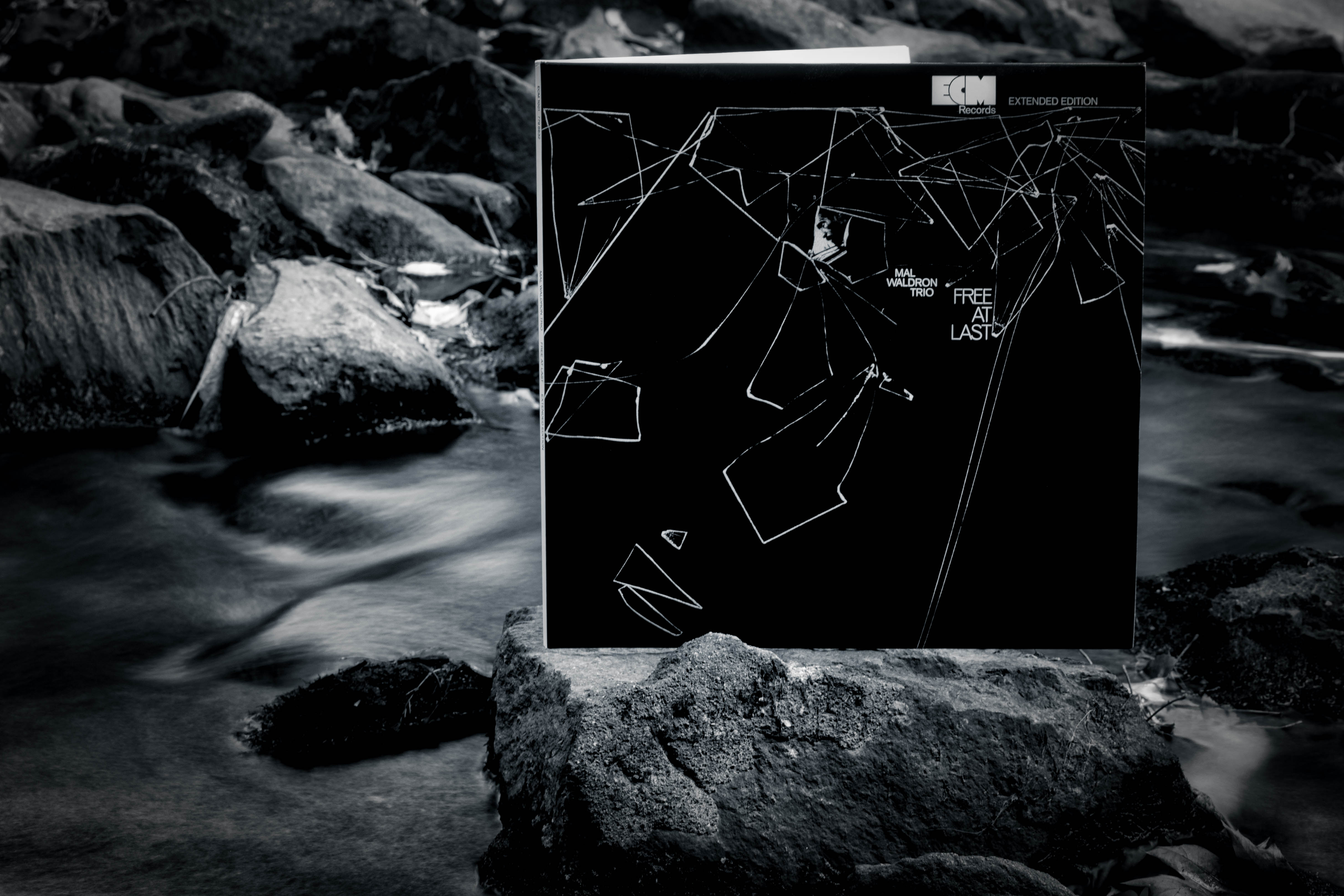
“I feel if you look back too much,
you trip when you take a step forward.”
–Mal Waldron
Although Mal Waldron began his career in jazz as an alto saxophonist, playing in the long, tapering shadow of Charlie Parker, fate would soon guide him back to the keyboard. The piano was, for him, not just an instrument but a resonant vessel sailing in the tempests and calms of his cross-hatched personality. His classical training gave him a compass; his improvisational instincts supplied the wind. A prolific writer of tunes—angular yet melodic, pensive yet full of forward motion—he became an indispensable sideman to the luminaries of his era, including John Coltrane, Art Farmer, Jackie McLean, and, above all, Billie Holiday, with whom he shared a natural rapport. Their collaborations seemed to hover between worlds—her voice the smoke, his chords the fire.
But every light casts its own darkness. Waldron’s journey was interrupted by a nervous breakdown that landed him in the hospital. And then, at his seeming lowest point, when he was invited to Paris to score a film. It was more than a job; it was a turning point, a new way of listening. Each city he touched thereafter—from Bologna to Cologne and, ultimately, Munich—became another note in the unfolding score of his reinvention. By 1967, he had settled in Munich. Along the way, he crossed paths with Swiss bassist Isla Eckinger and drummer Clarence Becton, another American expatriate whose trajectory brought him across the pond into a music scene unlike any other.
Free At Last, a title that feels both biographical and prophetic, ended up being one of three studio recordings Waldron made with ECM’s founder, Manfred Eicher, the others being The Call (JAPO) and the elusive Spanish Bitch (Victor Japan). In Waldron’s rhythmic restraint, in his careful placement of silence and tone, surely Eicher glimpsed a growing philosophy of sound, one defined not by density but by depth, not by volume but by presence. Waldron’s subsequent decades would see him traversing genres, yet always with the same chiseling intent: to refine expression until it gleamed with truth.
Now, in this two-LP reissue, gloriously packaged in a gatefold sleeve with all the original artwork, plus new liner notes by Steve Lake (from which I’ve distilled much of the information above), we are granted with both the familiar and the newly unearthed. The 1969 session unfolds again like a memory recalled in sharper resolution, joined by alternate studio takes on sides III and IV. The all-Waldron set list remains startlingly modern. From the very first shimmer of Becton’s cymbals on “Rats Now” to the closing sparkle of “Boo,” Eicher’s curation of space and clarity is already very much alive. Listening to it in 2025 feels less like revisiting an old field and more like standing again in its soil, still fragrant, still fertile, still yielding. To reap this harvest after more than half a century is to marvel at how sound, once released, can resist decay.
As noted in my first-impressions review, the trio’s momentum is undeniable in “1-3-234” and “Rock My Soul.” Both skip across a sunlit surface like stones whipped by practiced hands. Yet it is in the quieter pieces that Waldron reveals his most robust intentions. Whether mixing shadow and sparkle in “Balladina” or masterfully blending poetry and prose in “Willow Weep For Me,” he makes us acutely aware that emotions are points of departure, not destinations. Eckinger’s bass hums with empathy, Becton’s drumming reacts in real time like reflected light, and together they guide the listener on a journey worth savoring.
Among the newly released takes, the extended “Willow” is especially revealing. Each gesture seems to weigh more, to linger longer. One senses them circling not around a song but around a feeling, its perimeter undefined, its center perpetually receding. As in the photograph of the LP I took above, their coming together stands as a testament to the power of a vision that, even as the tide of history swirls and churns around it, remains true to itself to this day.
 Between Sound and Space: ECM Records and Beyond