


Brigitte Huck describes Lisl Ponger as “an artist for whom discourse is not just another fashionable word but a necessity,” and the claim feels almost modest. For Ponger, discourse is not a frame placed around the work. It is the current running beneath it, the carbon dioxide emerging from its lungs. Her practice understands politics not as subject matter but as a condition of vision itself. She examines the edges of perception, the fugitive traces that cling to bodies and landscapes, and the borders where identity dissolves and reassembles. These liminal spaces form the terrain on which her films ambulate.
Ponger began as a photographer, trained in art school and working in proximity to the Vienna Actionists. She documented the performances of Otto Mühl and Günter Brus when, as Huck observes, “women were the girlfriends, models, and in the worst cases, cool action material.” Yet even here, her camera questioned the dynamic unfolding before it. She was never a passive witness to male extremity but an early investigator of spectatorship, already alert to the power games embedded in the act of looking. Her lens asked: Who sees, and who is seen? Who has the authority to cut an image, and what kinds of harm can that maiming conceal?
That line of inquiry gained new momentum when she picked up a Super 8 camera on a 1974 trip through South America. The shift to film felt less like a change of medium and more like an opening into another temporal dimension. Travel became both a physical journey and a metaphor for crossing narrative thresholds. Movement turned into a form of knowledge. By the 1990s, she had begun to braid documentary practice with found footage, reworking her own archive and that of strangers until new patterns of politics and memory emerged. Through this process, a principle took root: these images resist the softness of nostalgia. They are not claimed as memory. They are constructed from real lives but never mistaken for personal recollection. They insist on remaining critical fictions.

This ethic shapes the drifting, tidal structure of Passagen, her 1996 film on the tourist gaze and the vast migrations of the 20th century. Rather than treating these subjects separately, Ponger reveals how tourism and emigration mirror one another, each defined by a transactional relationship to movement. The film follows journeys traced in circular arcs, almost like the lines of skin folded and refolded across generations. New York rises again and again on the horizon, imagined long before its skyline is ever seen. Those who crossed the ocean remember the hunger of arrival and the wages that barely justified the risk. Ponger avoids the lure of spectacle and instead allows calm narration to float over distant footage. The effect is meditative, yet within this quietude, something electric happens. Children return the gaze of the camera without hesitation. Their unguarded looking complicates the adults’ stories and suggests that migration is not simply a matter of the past. It passes forward, carried in the physiognomy of those who inherit it.
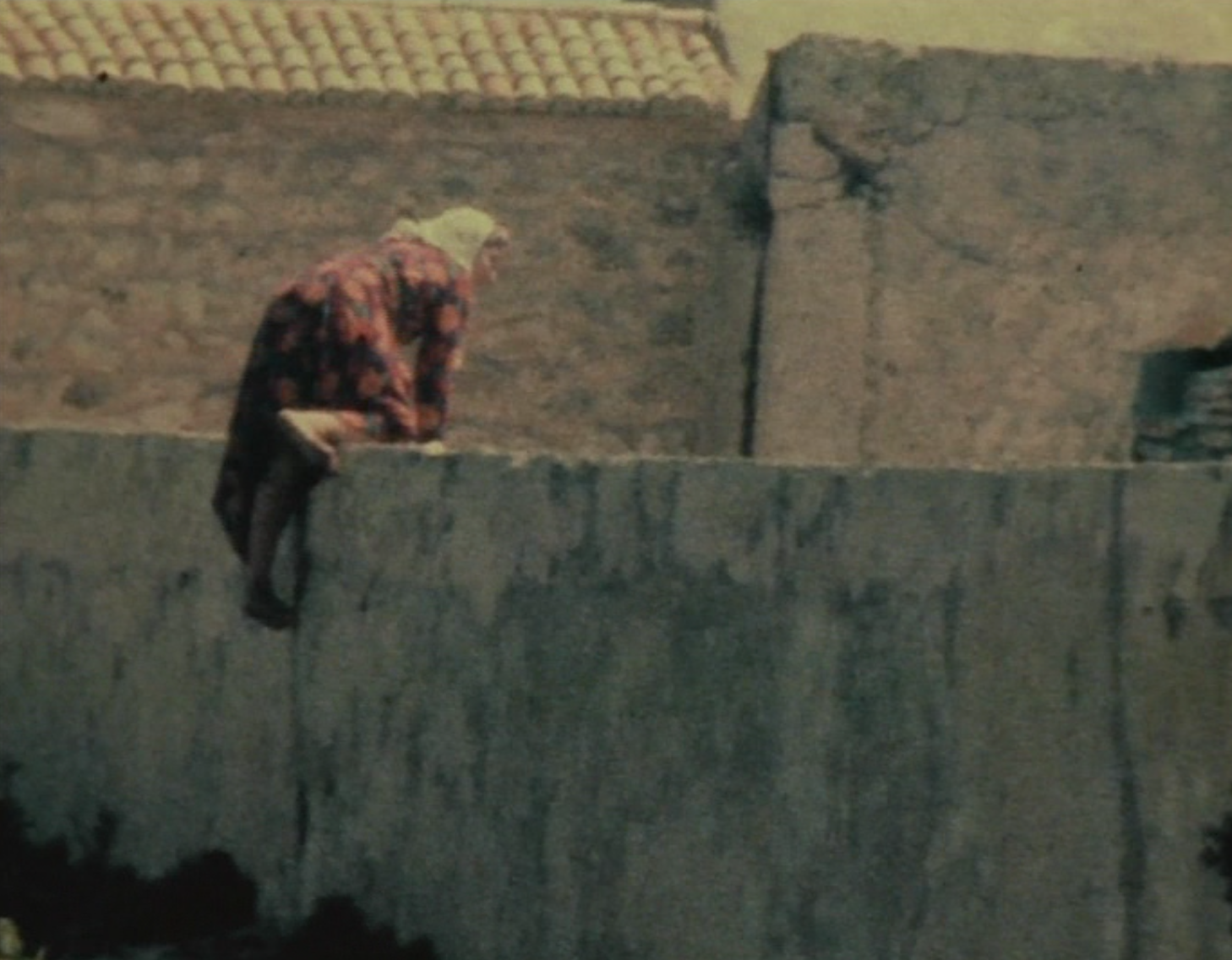
A similar tension shapes déjà vu, completed in 1999, where Ponger shifts toward the archaeological mode that would define so much of her later practice. She finds two abandoned canisters of home movies at a flea market, the filmed life of a married couple whose travels glow with the bright, unconscious arrogance of Western tourism. From these fragments, she builds a sharp and layered critique of exoticization. The film begins in darkness with the sound of a crowd and voices speaking in overlapping languages. Their recollections of travel circle around wonder, sentimentality, and the slippery paternalism that so often surfaces in encounters with cultural difference. These voices settle over images of rituals and landscapes that once thrilled the original filmmakers. Yet again, children appear, looking into the lens with a directness that cuts through the haze of jaded projection. Within this confrontation, Ponger locates the harline cracks of desire, authenticity, and the wish to touch a world without being changed by it.

The gaze shifts once more in Phantom Fremdes Wien, her 2004 ethnographic exploration of Vienna’s hidden pluralities. Filmed between 1991 and 1992, it records gatherings across the city: a Philippine church service, a Swedish festival of light, celebrations that arise wherever diasporic communities stitch a sense of home into unfamiliar streets. Ponger narrates with a measured, observational tone that carries the neutrality of an archive yet feels edged with the intimacy of a journal. Her approach lends the work a dual register. It is less an account of events and more a record of her encounter with them, an unfolding dialogue between seeing and understanding. Here, Vienna reveals itself not as a unified city but as an intricate constellation of worlds, each with its own history of labor, spirituality, and migration. Ponger quietly asks what renders someone “foreign” and who gets to decide.
Across these works, her images demonstrate that no picture is inert. Every frame is charged with the systems that shaped it: economies, colonial histories, gendered roles, the machinery of tourism, the patterns of migration that define our global present. Ponger does not merely portray these structures. She reconfigures them, attentive to the way vision itself is conditioned by power. Even her use of found footage carries an ethical undertow. She does not fold these images into her own life story. She keeps them open to critique, refusing to smooth them into sentiment or personal memory.
What her films reveal is a central paradox of modernity. We are always in motion, traveling across borders, screens, and narratives, yet we rarely understand the histories that make such movement possible. Ponger’s cinema encourages us to feel that complexity and to sense how each act of looking enters into a contract with the visible and the invisible. Looking can be acknowledgment one moment, erasure the next. To travel is to step into layered histories that cannot be consumed without consequence.
Her most radical gesture may be the quietest one. The children who return the gaze do not perform. They do not offer their images for use. They encounter the camera without the filters of ideology or expectation. In those brief exchanges, she suggests a way of seeing that refuses dominance, capable of unlearning what it has been taught and allowing the world to remain foreign without turning it into an object.
In such non-invasive hands, the camera acts as a vessel of ethical attention, moving through passages that have never been static. It listens to the stories carried in those movements and offers them not as trophies but as invitations to witness how the world is continually remade in the friction between looking and being seen.
 Between Sound and Space: ECM Records and Beyond