


Ivan Ladislav Galeta treats architecture as perception, rigorously constructed yet permeated by metaphysical play. A pioneer of Croatian media art, he works with meticulous control over frame, duration, and spatial relation, so his films feel less like recordings and more like experiments conducted on the fabric of time itself. Yet this precision never settles into rigidity. As Hrvoje Turković notes, Galeta’s work may be a “meaningful psychological experiment,” but it is also unmistakably free. His creativity speaks in diagrams, animated by curiosity and shaped by questions rather than assertions. What is an image, Galeta seems to ask, and what does it become when it is nudged, delayed, mirrored, doubled, or placed in conversation with itself?
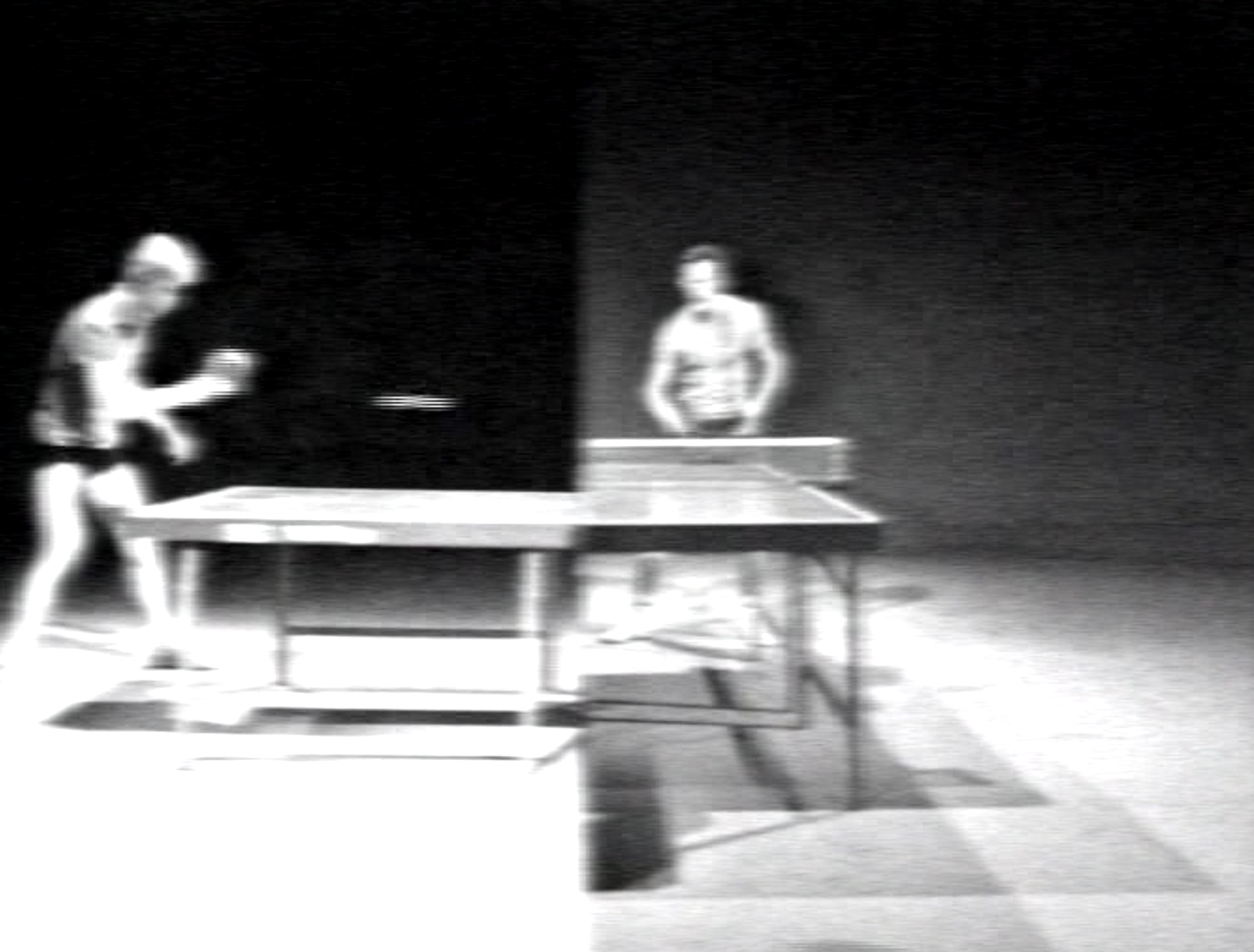
TV Ping Pong (1976-78) offers the clearest proposal. The film begins as a simple tableau of two men playing ping pong but gradually destabilizes the very space in which the game unfolds. A split-screen wipe initially feels like a technical convenience, yet as Galeta recombines the players spatially, placing them back to back on two televisions, superimposing them so that each faces his own double, aligning them side by side, and shifting angles with every hit, the logic of the game begins to fracture. The table, once a stable center, splinters into an L-shape, a cross, and an oblique angle that no longer corresponds to the geometry of lived space. Negative images pulse into view. The ordinary match becomes unmoored from its physical coordinates and reassembled in a realm both cerebral and playful. Galeta demonstrates how easily habitual perception masquerades as natural law and how invigorating it can be when that illusion loosens.
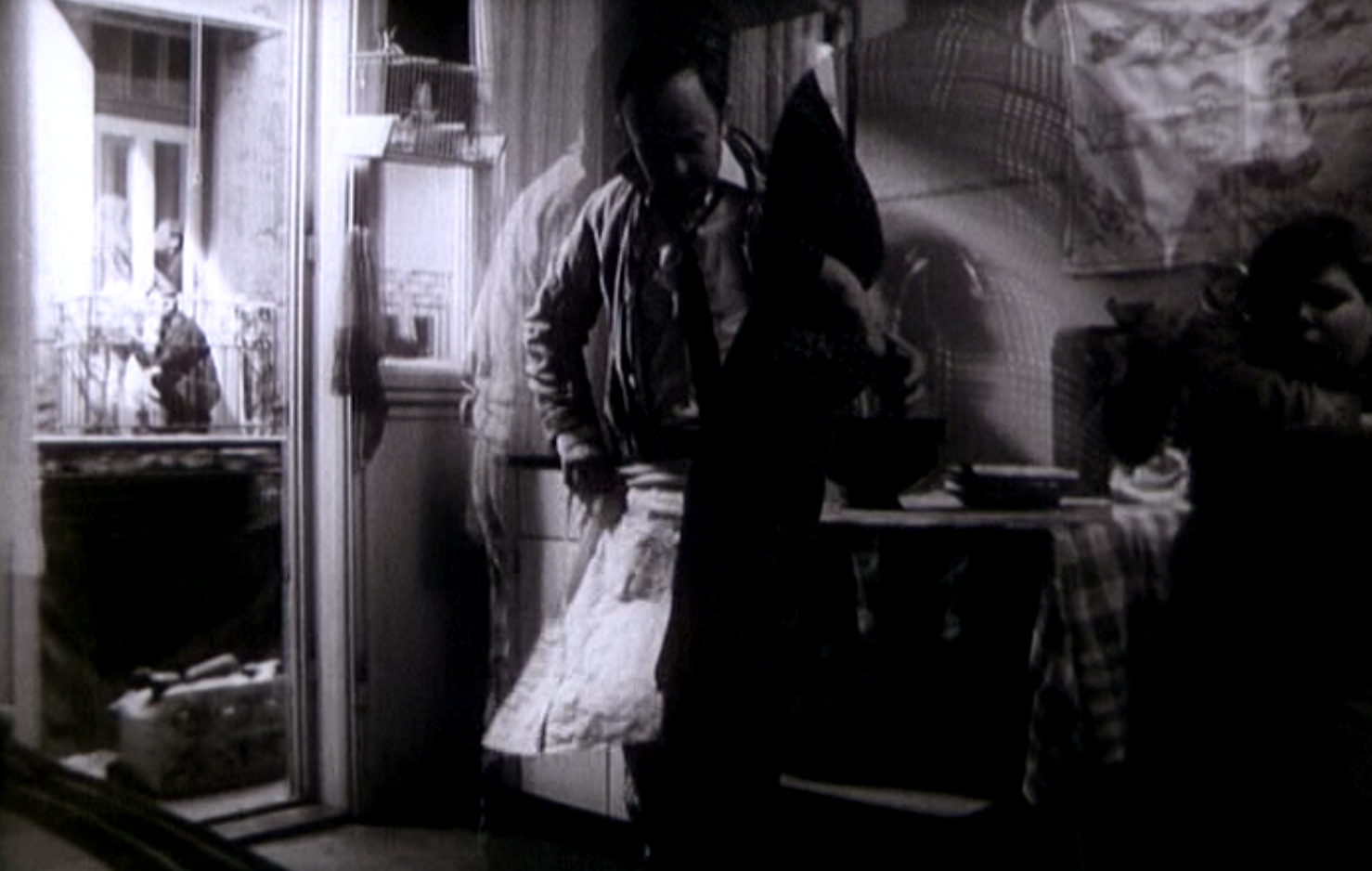
This principle deepens in Two Times in One Space (1976/84), perhaps his most haunting demonstration of expanded cinema. Using Nikola Stojanović’s 1968 film In the Kitchen as source material, Galeta introduces a precise delay of 216 frames between two simultaneous projections of the same footage. A family engages in domestic rituals such as eating, cleaning, and resting, doubled by an echo from the recent past. A hand reaches for a cup before it can grab it; a glance lands where it has already been; a small movement is performed twice, first by memory and then by presence. The delay creates a loop of perpetual arrival and departure, a household haunted by its own temporal afterimage. Nearby, a couple on a balcony professes their love, and their presence becomes strangely entangled with the time warp inside. The film’s emotion arises not from narrative but from the sensation of watching a memory overlapping itself before it has even had time to gel.

Galeta’s interest in temporal recursion becomes more explicitly cosmic in sfaĩra 1985-1895 (1984), subtitled “An Homage to Silent Movies.” He replaces Kubrick’s monolith with Ivan Kožarić’s sculpture EARTHBOUND SUN, an intervention both monumental and tactile. The sun or sphere becomes an object of interaction, tapped and caressed as if the universe were offering a lesson in its own grammar through physical contact. Dedicated to Pythagoras and Plato, the film conjures a vision of time as cyclical and harmonic. Its 72-frame delay produces a rhythm that feels almost biological, a slow, meditative breathing. Galeta writes that sound is silence in this film, and indeed, it brings forth our internal pulse, which anchors our relation to the image.

Water Pulu 1869 1896 (1987/88) shifts the structuring object, a ball in this case, into the center of a water polo match. With Debussy’s La Mer opening the film, a bright sphere floating on the surface becomes an axis around which the surrounding chaos of bodies revolves. Hands reach for it with the inevitability of gravitational pull; the ball rises through the frame as if it were a second sun. Anchored by its constancy, the film transforms the match into a study of centripetal desire, a choreography of approach and withdrawal that yields one of the great masterpieces of experimental cinema.

Galeta’s fascination with recursion and musical structure continues in WAL(L)ZEN (1989), a deconstruction of Chopin’s Waltz Op. 64, No. 2, as performed by Fred Došek. The music is played forward and backward, superimposed on itself until it becomes a fugue of temporal slippages. The melody remains recognizable but troubled, locked in a round where movement and stasis collide. The waltz, meant to turn endlessly, becomes trapped in a hall of mirrors, revealing the mechanism that underlies its pleasure.
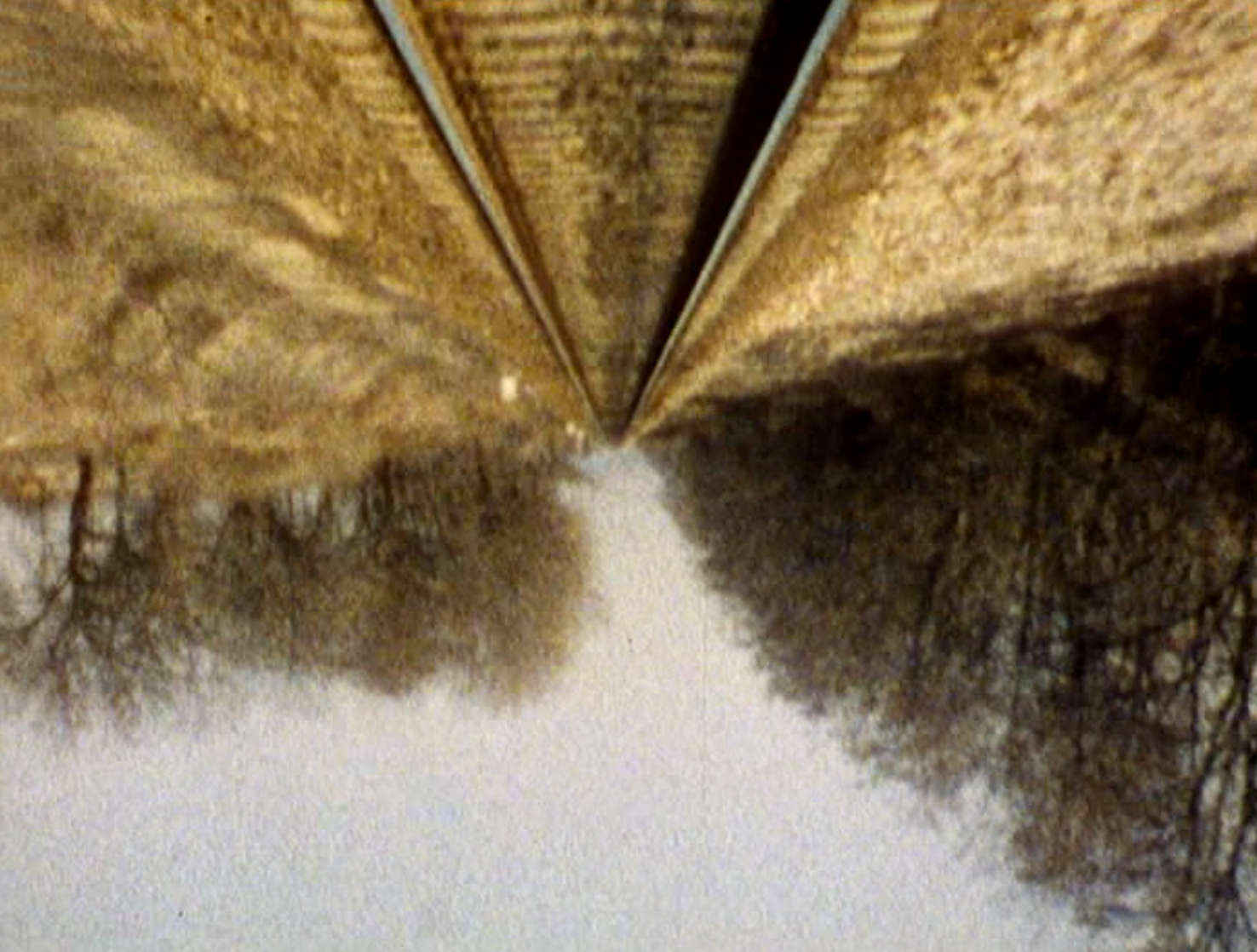
The play with geometry reaches a different register in PiRâMidas 1972-1984 (1984). Filming from the back of a train, Galeta transforms the vanishing point, the most fundamental element of perspectival space, into a rotating triangulation. The image turns, folds, and inverts; the horizon becomes a hinge. What should remain the most stable point of orientation becomes fluid, exposing the conceptual scaffolding that quietly organizes our visual world.
Even the bonus track, an introduction to PiRâMidas and the drawings for it and WAL(L)ZEN, reinforces that Galeta’s films are not spontaneous experiments but rigorously conceived visual theorems. The drawings reveal how structure and intuition coexist, how mathematical clarity can merge with a sense of wonder.
Across these works, Galeta emerges as a cartographer of perceptual instability, reorganizing reality through his camera until its assumptions become visible. Time is his greatest collaborator, and we are his faithful allies in chronological skepticism.
 Between Sound and Space: ECM Records and Beyond