

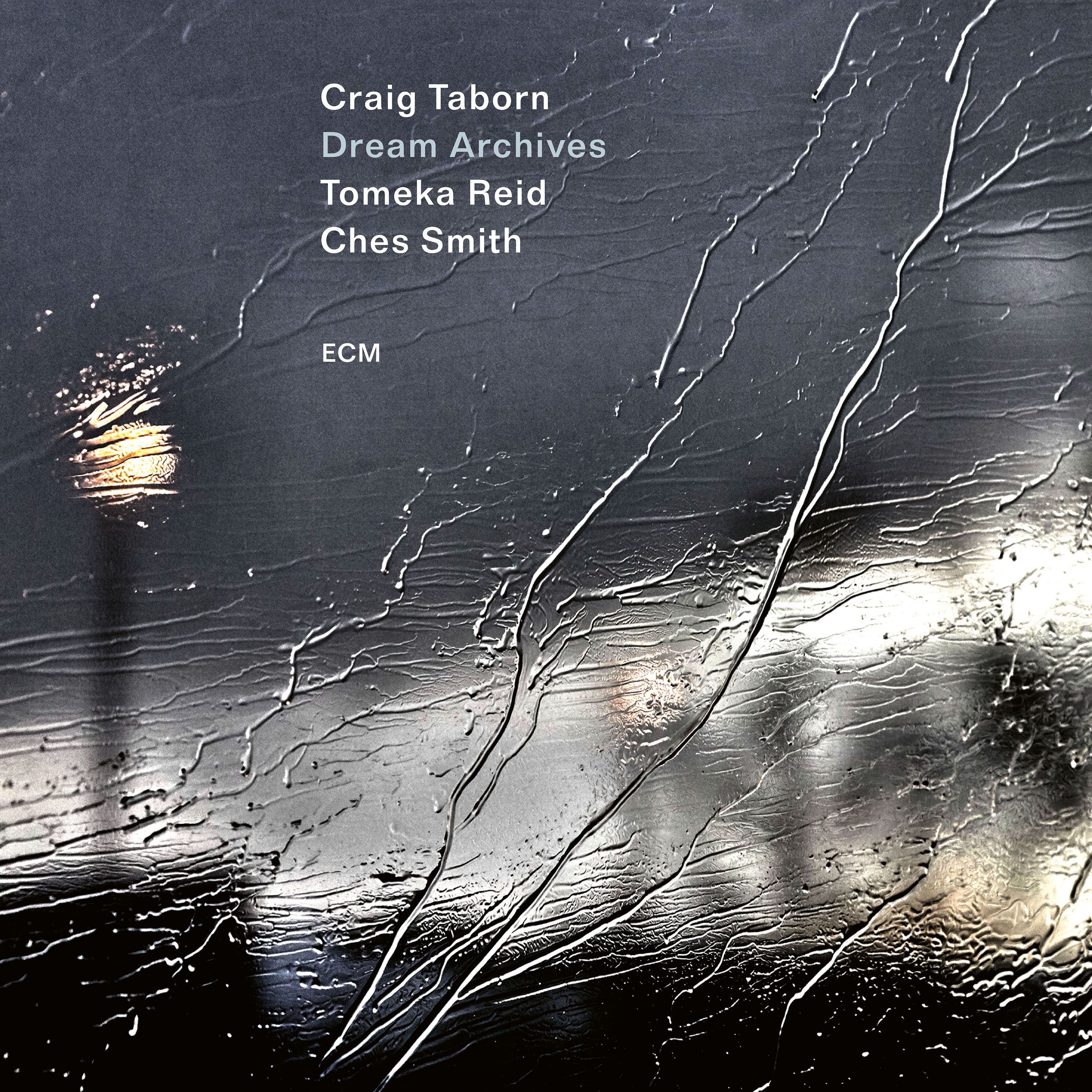
Craig Taborn
Tomeka Reid
Ches Smith
Dream Archives
Craig Taborn piano, keyboard, electronics
Tomeka Reid violoncello
Ches Smith drums, vibraphone, percussion, electronics
Recorded January 2024
Firehouse 12, New Haven
Engineer: Nick Lloyd
Mixed by Craig Taborn, Manfred Eicher, and Michael Hinreiner (engineer)
Bavaria Musikstudios, München, July 2025
Cover photo: Thomas Wunsch
Album produced by Manfred Eicher
Release date: January 16, 2026
After beguiling audiences during their 2025 German tour in anticipation of the album at hand, pianist Craig Taborn, cellist Tomeka Reid, and percussionist Ches Smith align their trio for ECM’s first release of 2026. The title, Dream Archives, frames the music in the most charming of contradictions. Does it propose a vault where dreams can be stored, catalogued, and retrieved at will, filed away under emotional subject headings? Or does it imply that dreams themselves function as archives, containing versions of ourselves we would never dare to perform while awake? The answer seems to flicker between both states, never settling, always indexing something just out of reach.
The opening lines of “Coordinates For The Absent” lean toward the former interpretation through their careful laying down of intent. Subtle electronic signals hang in the air, suspended as if awaiting authorization, and the piece offers itself as a puzzle box of possibility, one that opens only when the correct sequence of ambient gestures is entered. Each removal reveals another chamber until a nexus of musicianship appears that feels parthenogenetic. What unfolds is a system waking up, blinking itself into awareness.
From this tender pile of ashes rises “Feeding Maps To The Fire,” a phoenix song rendered with turn-on-a-dime precision and lightning-fast cognition. Reid circles the square, squaring the circle even, granting Taborn and Smith a territory they can claim equally with hands and feet. Her transitions from declaration to sublimation arrive with uncanny grace, functioning as a single conductive wire of intention that transmits thought across the studio in real time. Direction is fed directly into combustion here, and nothing burns without learning something new about its own heat.
“Dream Archive” opens with Smith on vibraphone doubling Taborn while Reid recalibrates the internal circuitry with a quiet furiosity that hums beneath the surface. Some of the session’s most intimate connections are forged in this space. An intelligent system comes online, discovering its cellular reality one line of musical code at a time. Still, the music never forgets the hand that writes the algorithm. There is a constant searching for connections that only breath, skin, and intention can provide. Motifs bend themselves into a twisted ballad before being pushed off a cliff, tumbling across jagged terrain, landing improbably intact, scuffed but smiling.
“Enchant” turns the night sky inside out and offers it as a writable surface, a palimpsest of the heart rendered in constellation and groove. Reid’s ostinato summons further digital traces, as though the hairs of her bow were the threads to which these signals cling, pulled magnetically toward a pulse that knows how to moonwalk away from expectation.
Set within this sea of Taborn originals are pieces by two of his guiding lights. Geri Allen’s “When Kabuya Dances” blossoms with the utmost delicacy, unfolding as a textile woven from shadow and intention. It searches for illumination in Taborn’s pianism and finds it as Reid and Smith combine their energies into ground, horizon, and sky. A stomping denouement introduces phenomenally geometric trio work, Reid on pizzicato assuming the role of bassist while Smith’s drumming speaks in joyful, articulated angles. The music smiles openly here, happiness not hinted at but announced, stamped, and joyfully notarized.
Paul Motian’s “Mumbo Jumbo” continues that spirit of play, revealing a compositional singularity in which Taborn clearly recognizes a kindred mind. Its angular melody opens the door to some of the trio’s most delicately adventurous exchanges. The tune carries a faint echo of Tchaikovsky’s “Dance of the Sugar Plum Fairy,” refracted through beat poetry, stripped of words, and filtered back into breath and wood and skin. Smith’s use of gong and timpani lends a ceremonial grandeur that never tips into pretension, offering Reid a tender surface upon which to draw her confident, decisive lines.
Ultimately, the dreamlike quality of Dream Archives does not arise from its unpredictability, nor from the way it renders the surreal inevitable. It emerges instead from the album’s theatrical intelligence. These performances understand that dreaming is an act, one that requires commitment, timing, and a willingness to forget oneself mid-gesture. The trio performs with the concentration of method actors who never break character because the character is the moment itself. In doing so, they blur the line between performer and listener, pulling us into their private syntax of meaning.
By the album’s close, the archive no longer feels like a place of storage but a living institution, one that rewrites itself each time it is entered. The dreams here are not preserved so much as rehearsed, practiced until they become fluent. When the final notes fade, it feels less as though the music has ended than as though we have woken up holding fragments we cannot fully explain. These are the kinds of dreams that follow you into daylight, that annotate your memory without permission, that insist on being remembered even as they refuse full recall. In that sense, we are reminded of how to keep dreaming with our eyes open, filing experience under wonder, and leaving the cabinet unlocked.
 Between Sound and Space: ECM Records and Beyond