

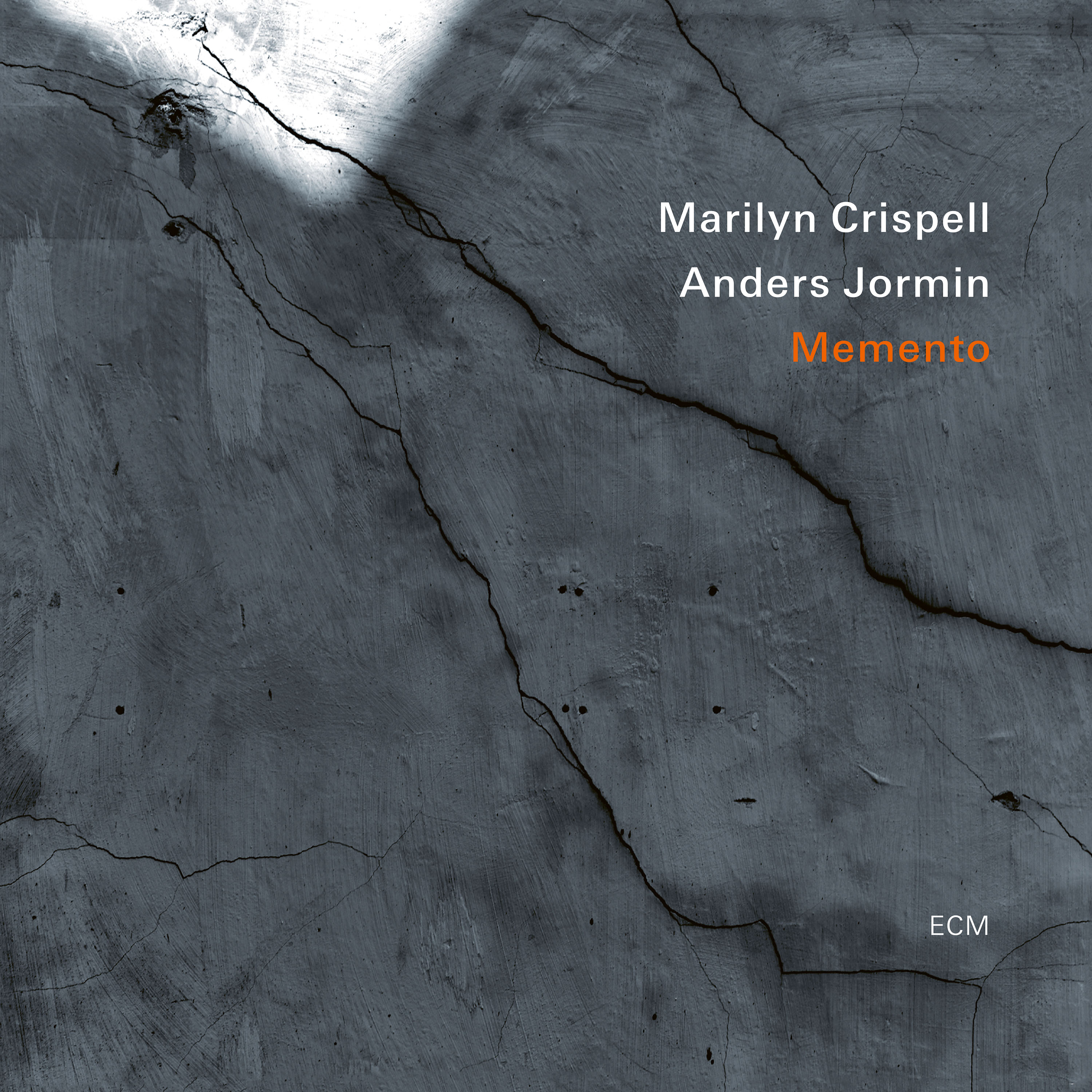
Marilyn Crispell
Anders Jormin
Memento
Marilyn Crispell piano
Anders Jormin double bass
Recorded July 2025
Auditorio Stelio Molo RSI, Lugano
Engineer: Stefano Amerio
Cover photo: Thomas Wunsch
Produced by Manfred Eicher
Release date: March 20, 2026
Memento arrives with quiet poetry, the kind that settles into the human heart of its own volition. In this first duo encounter between Marilyn Crispell and Anders Jormin, collaboration feels secondary to recognition, as if two long-circling orbits have finally aligned. Both artists carry histories that run through the ECM tapestry, yet what unfolds here feels more essential than lineage or style.
The opening sequence of improvisations awakens the album with a fragile sense of recall. Each gesture conveys the hesitancy of memory surfacing, not fully formed, yet insistent. A tender gravity settles over these exchanges, one that avoids declaration and favors suggestion. Crispell’s piano hovers at the edge of articulation, tracing lines that seem both discovered and surrendered, while Jormin’s bass responds with near-instinctive sensitivity. Their interplay unfolds like a language stripped to its essence, where every note feels earned, released only when it can no longer remain unspoken. Even moments of lightness retain a delicate restraint, a shared understanding that silence is an equal partner in the unfolding.
As the album deepens, this sensitivity becomes its guiding principle, especially in its treatment of memory. The pieces shift and refract, less like fixed compositions than terrains revisited under changing skies. Jormin’s “Three Shades of a House” embodies this quiet transformation. Its dual incarnations feel like glimpses through different windows of the same interior. The “Morning” version carries a tentative warmth, while the “Evening” rendering withdraws into solitude, its contours softened by introspection. Time alters not only the surface of the music but its inner weight, revealing how experience reshapes even the most familiar forms.
The album also gestures outward, though always through an inward gaze. “The Beach at Newquay” evokes place through atmosphere rather than description, a coastline suggested in fragments of tone and texture. Jormin’s bass releases distant calls that dissolve before they can settle, while Crispell’s piano glides like shifting light across water. The scene feels steeped in night yet illuminated from within.
What binds Memento together is its understanding of relationships as living presences, shaped as much by absence as by proximity. Crispell’s compositions, especially “Song” and the title piece, carry a clarity that resists sentimentality while remaining deeply felt. Affection moves through these works with a measured grace, tempered by the knowledge that connection always harbors the answer to its own vanishing. Jormin responds with a tone that approaches the human voice. Together, they form a grammar of care that finds strength in vulnerability, itself a source of resonance.
By the time “Dragonfly” emerges, the album has settled into something less like a sequence and more like a state of being. Crispell’s elegy for Gary Peacock allows the past to move freely within the present. The closing moments feel like a gentle release, a soft shift in the air. What remains is something akin to a shadow that no longer belongs to an object. It suggests a world where presence is always in the process of becoming something else, where even disappearance holds authorship.
 Between Sound and Space: ECM Records and Beyond