

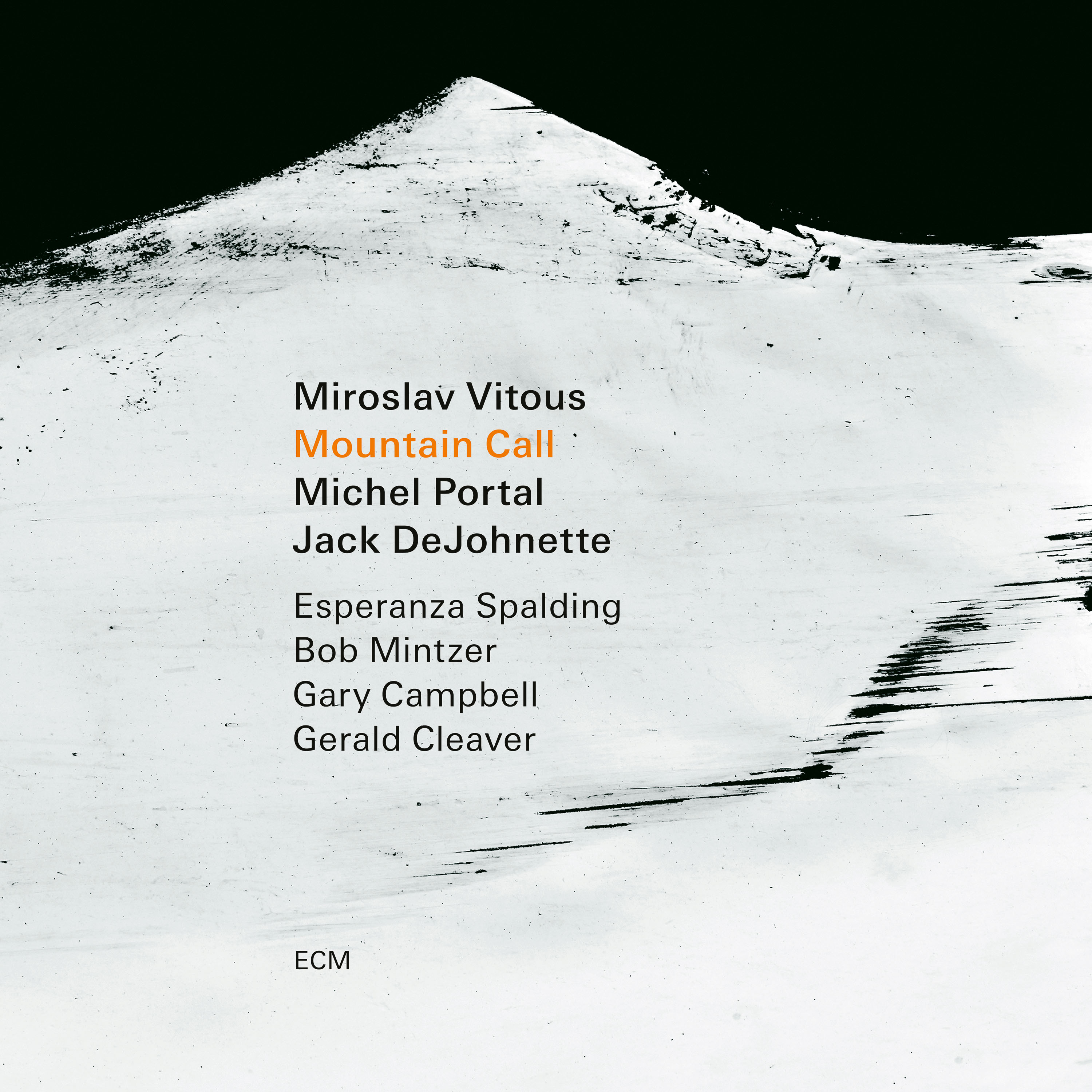
Miroslav Vitous
Mountain Call
Michel Portal clarinet, bass clarinet
Miroslav Vitous double bass
Jack DeJohnette drums
Esperanza Spalding voice
Bob Mintzer bass clarinet
Gary Campbell soprano and tenor saxophones
Gerald Cleaver drums
Members of Czech National Symphony Orchestra
Recorded 2003-2010 at Universal Syncopation Studios, Prague
by Miroslav Vitous
Cover photo: Thomas Wunsch
Produced by Miroslav Vitous and Manfred Eicher
Release date: March 27, 2026
Mountain Call marks the end of a decade-long wait since the last ECM leader date from Miroslav Vitous, who presents us with a program of duets and small ensembles. Recorded between 2003 and 2010, the result is a broad portrait in detailed brushstrokes, showcasing his talents as composer, improviser, and arranger.
The opening tracks with reed virtuoso Michel Portal, who was last heard alongside the Czech bassist on 2009’s Remembering Weather Report, unfold somewhere between what is remembered and what has yet to be. “New Energy” emerges already in motion, clarinet and bass entwining in lines that bend across uneven terrain. It carries a strange familiarity, the sensation of hearing something long forgotten yet intimately known.
“Second Touch” introduces movement of a different kind, a dance grounded in continuation. Modal currents ripple beneath the surface, tinged with distant geographies, suggesting lands both real and imagined. The two instruments circle each other with a quiet understanding, travelers who have never met yet share the same destination etched somewhere on their hearts. Lines coil and uncoil, never colliding, always converging.
By the time “Unexpected Solutions” arrives, rhythm begins to pulse more insistently, Vitous drawing percussive language from the body of his instrument while Portal deepens his tone into something almost primal. The feeling is grounded and tactile. Confidence emerges here through direction, a sense that the journey requires no explanation.
That latent need for propulsion finds its answer in “Tribal Dance,” a brief yet luminous duet with Jack DeJohnette. Knowing this performance lands among DeJohnette’s final released statements lends the piece an unspoken gravity. Each cymbal touch lingers as a fading footprint, implying both immediacy and permanence. The brevity sharpens its impact, a final glance exchanged between companions before diverging paths.
The subsequent duets with Portal on bass clarinet drift inward, their abstraction guiding a descent. These pieces fill quiet spaces between landmarks, where reflection takes precedence over motion. From this interiority emerges “Epilog,” a work that expands outward while retaining its core. The orchestral sampling transforms Vitous’s voice into a chorus of selves layered across time.
With “Evolution,” the landscape widens dramatically. Joined by Bob Mintzer and the Czech National Symphony Orchestra, Vitous constructs a triptych of transformations. Strings tremble with distant force, while timpani resonate with deep structural weight beneath the surface. The music unfolds with cinematic inevitability, guided by forces that seem larger than the individuals involved. Within this expanse, the dialogue between Vitous and DeJohnette remains the axis around which everything turns (so much so that everything else feels peripheral).
“Rhapsody” introduces the voice of Esperanza Spalding, whose presence alters the album’s emotional temperature. Her singing carries intimacy and radiance, inhabiting the music from within. Vitous’s compositional touch becomes painterly here, each gesture placed with care yet open to reinterpretation. “Africa” pulses with a soulful urgency, a call that feels both personal and collective, while the closing “Lullaby” compresses an entire day’s passage into a fleeting moment, light folding into shadow with quiet inevitability.
These two larger-scale pieces are framed by duets with Portal on bass clarinet. “Delusion” pushes the mechanics of improvisation. Here, melody becomes a question, one that both musicians address in fleeting alignments that dissolve as quickly as they form. The title track concludes the journey with a return to the elemental. Vitous’s bow draws out tones that are forthright and resonant, the instrument revealing its own hidden history. There is no ornament here, no excess, only the raw exchange of sound and intent. Each phrase feels necessary, each silence earned.
These are musicians who understand that sound is produced and received in equal measure, shaped by what lies between intention and perception. Thus, the true subject of Mountain Call concerns the strange continuity that binds time together. Old paths travel with us, reconfigured with each step. Beginnings carry traces of what came before, endings open toward what cannot yet be named. Somewhere between stasis and motion, identity loosens its grip, and in that loosening, something wider than self begins to listen back.
 Between Sound and Space: ECM Records and Beyond