
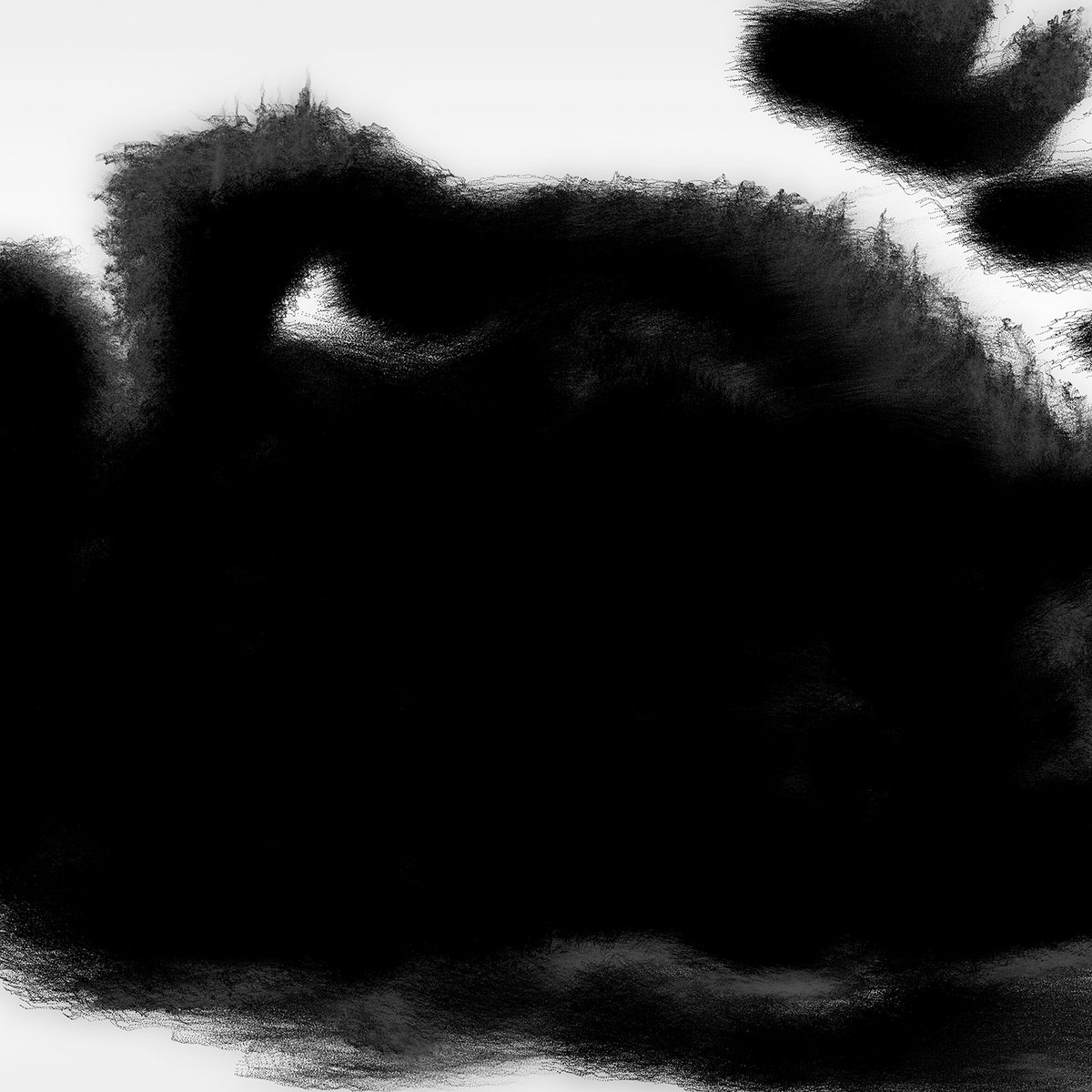
The distance between two points is ordinarily a problem for geometry. On Points of Inaccessibility, it becomes a pathology of attention. A chance encounter at MUTEK in Mexico City in 2024 brought Ibero-American composer Rafael Anton Irisarri into conversation with Dutch media artist Jaco Schilp, whose invitation to the Uncloud residency in Utrecht the following spring led their inquiry into the abandoned carcass of the Pieter Baan Centre. Once a forensic psychiatric prison, the building had specialized in extracting intelligibility from captivity; now its emptied rooms hosted a different form of interrogation. Irisarri stretched bowed-guitar notes through looping circuitry until each gesture acquired the dimensions of a corridor without an exit, while Schilp’s custom point-cloud software translated the live sound into visual constellations perpetually failing to hold their shape. Here, the apparatus designed to render experience legible produced its own exquisite illegibility, a digital Rorschach in which perception caught itself manufacturing evidence. The building’s carceral history seeped into the circuitry, lending each disintegrating image the afterlife of something forcibly remembered.
Returning to New York, Irisarri approached those improvisations as ruins still inhabited by their makers. He mapped fragments into MIDI, insinuated Prophet 5 harmonies and Moog undertows beneath the bowed strings, then enlisted Abul Mogard’s editorial ear to preserve the encounter’s original volatility. The album’s title borrows from remote coordinates whose identities are determined by distance, but turns the cartographic conceit against our supposed culture of perpetual contact. Every algorithm promises a shortcut to intimacy while manufacturing fresh interiors of estrangement; every simulated acknowledgment arrives carrying the faint bureaucratic odor of an absence already processed and filed. Irisarri calls these compensatory rites “digital shamanism,” although their sorcery belongs to capitalist realism, which has taught alienation to impersonate its own cure. Across four movements, Points of Inaccessibility listens for the human pulse inside that recursive deception, excavating a hauntology of suspended futures from the detritus of technological communion. Memory persists as interference in a system increasingly incapable of remembering what its connections were meant to connect. Presence becomes the vanishing point of its own transmission, leaving consciousness to wander the immaculate circumference of an intimacy whose center has been quietly outsourced.
“Faded Ghosts of Clouds” is the voice of an unborn generation emanating from a realm that, despite being right beneath our feet, is all too easily ignored in the hustle and bustle of our everyday lives. The painful irony is that, while technology blinds us to the details of existence that make it so beautiful, it remains the apparatus by which such music becomes possible, gathering otherwise estranged elements into an orbit so internal that we have forgotten how to make physical contact with it. Drones of electronics and string-borne songs creep toward the edges of our collective waking dream. Across their slow ebb and flow, we are implicated as mere driftwood in the cosmic tide, reaching our arms out in slow motion toward the shore but coming up with only sand slipping through our trembling fingers. And while the textures mount and the notes appear to go skyward, our bodies sink in proportion, never knowing what light might await above the surface. There is something embryological about this inversion of gravity, as though the music were gestating an entire civilization within the amniotic darkness of its own forgotten origins. Each swelling frequency brings us closer to an inheritance we cannot claim without first acknowledging how much of ourselves we have surrendered to the machinery of recognition.
“Breaking the Unison” emerges as a child thereof, possessed of its own rebellious streak and a grittier electric guitar sound that magnifies its voice beyond fleshly containment. The more it cries out to be heard, the less defined it becomes, drowning in a sea of its own making as the world swarms inward over and over, until the face ceases to function as an individual marker and identity becomes one final exhale of illusory fixity. Yet there is a strange tenderness in this erosion, a willingness to inhabit the wound of differentiation before language cauterizes it with a name. Irisarri allows distortion to assume the dimensions of an unfinished autobiography, its pages written in the granular debris of sensations that never achieved the dignity of recollection. What remains is a kind of prenatal dissent, the terrible freedom of a consciousness discovering that the boundaries protecting its singularity might also be responsible for its loneliness.
With parent and child brought under the same galactic umbrella, their home is constituted by “Signals from a Distant Afterglow.” The title is prophetic, speaking in a language of arcs and pulses that, ordinarily too minute to be held and regarded, suddenly become knowable in human terms. The music extends its feelers into the interstices of perception, where every vibration seems to contain a small archaeology of the future. Then something miraculous happens, as vocal loops provided by Karen Vogt permit the possibility that something familiar may yet be found in the great unknown. Although wordless, her presence speaks volumes about the soul and its tender cage, suggesting that even the most intimate utterance must pass through a labyrinth of estrangement before reaching another consciousness. Her voice acquires the fragility of an artifact excavated from a future extinction, bearing the fingerprints of someone whose existence has yet to occur. The resulting intimacy is almost unbearable because its object remains suspended just beyond our capacity to identify it. We recognize the yearning before we can remember whom we have been yearning for.
The bars of that tender cage are comprised of “Memory Strands,” whose enveloping textures seem to originate in a place that has already held us in its hands from conception. As tender as it is clear in its delineation of heart from mind, the piece provides just enough order to arrest our fear of falling over the cliff of uncertainty. A portal within a portal, it opens a pathway into itself, ad infinitum, serenading us through its recursive slipstream. There are echoes here of Stephen Scott’s bowed piano works enmeshed with William Basinski’s loops and filtered through Tim Hecker’s incandescent abrasions, although such coordinates offer only provisional access to an interior that continually redraws its own perimeter. So much depth resides in these pieces, so many corners in which we might cower in awe at the immensity of this reality in which we find ourselves. Their beauty emerges from the possibility that memory, in preserving our intimacy with what has vanished, also perpetuates the original violence of its disappearance.
Perhaps this is where Points of Inaccessibility makes its most unsettling proposition. The Pieter Baan Centre was once dedicated to determining the contents of human interiority, converting the bewildering opacity of another person into something admissible as knowledge. Its former inhabitants were subjected to an institutional faith in the legibility of the soul. Irisarri returns us to that predicament through the spectral machinery of a world increasingly devoted to making every consciousness available for inspection. Yet the music carries within its fractures a quietly radical possibility: that our deepest obligation to one another might involve protecting what cannot be accessed. What if the ultimate intimacy were the recognition of another’s right to remain unknowable, even to those who love them? The geography of isolation would then disclose an unsuspected ethics of hospitality, one in which distance becomes a form of tenderness and the uncharted core acquires the sanctity of a home. At the remotest coordinate of this extraordinary album, we discover that the first act of love is to leave something in another person forever undiscovered, so that even the universe, with all its instruments of detection, must learn the humility of approaching a closed door without turning the handle.

