
“One tries to cure the signs of growth, to exorcise them, as if they were devils, when really they might be angels of annunciation.”
–Anne Morrow Lindbergh, Gift from the Sea
To receive the world is to allow it to leave a mark. In Amizdel, Charlie Rauh approaches that vulnerability as a practice of attention, gathering a year’s worth of memories and encounters into a record of learning to remain open. His introduction locates a quiet source of strength in the willingness to accept what others offer and to live with the knowledge that hardship may arrive as unexpectedly as beauty. The question guiding this undertaking is how such openness might sustain us through both. Beneath it stirs another, more elusive inquiry into what becomes of the self when its conditions waver at the edge of uncertainty.
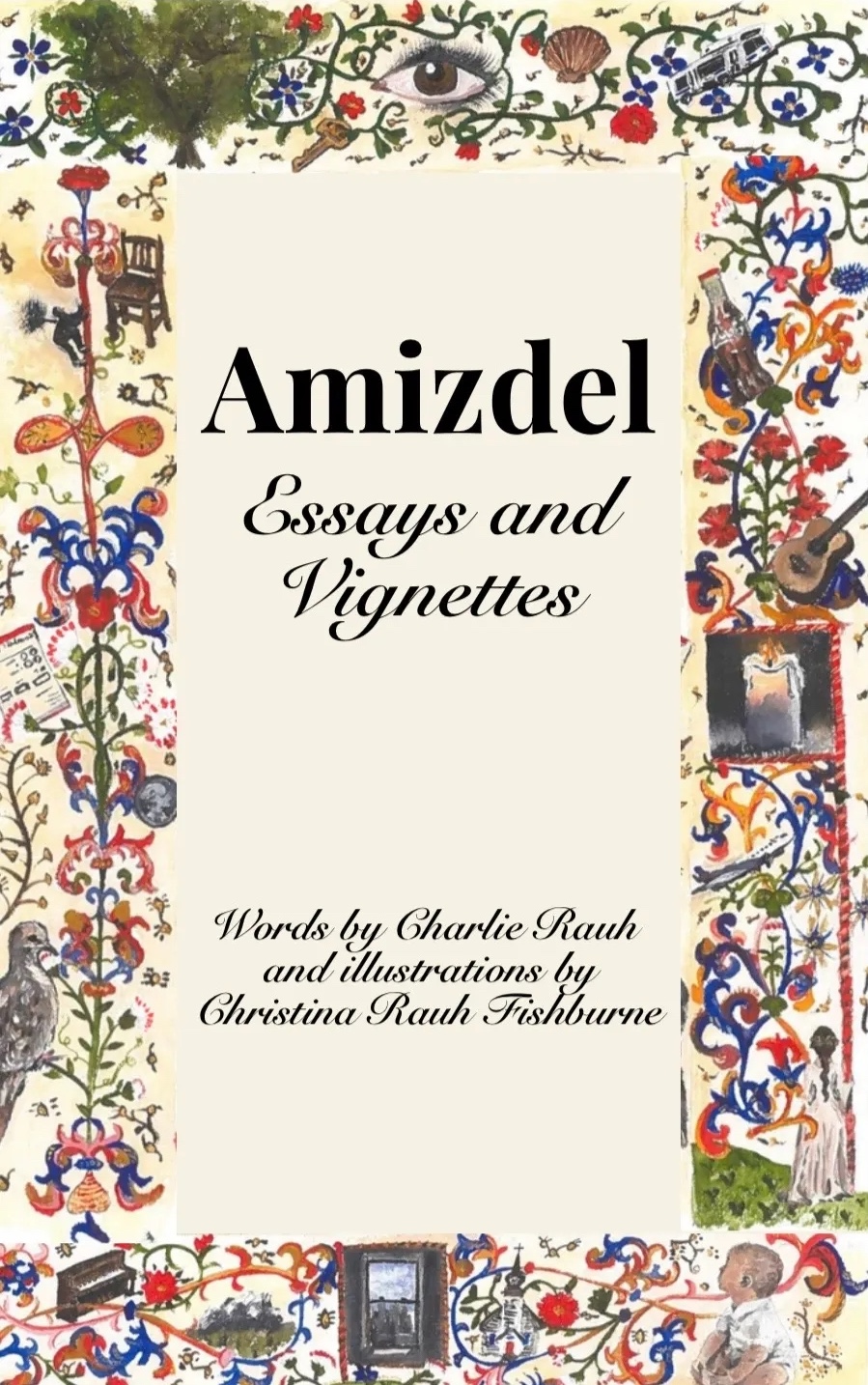
The book takes its title from Hildegard von Bingen’s word for “armor,” preserved in her enigmatic lingua ignota, or “unknown language.” The indeterminate purpose of that language gives Rauh’s reflections a suggestive point of departure, allowing protection itself to remain a question. Awareness and connection become ways of inhabiting an exposure whose terms we cannot dictate. Such armor acquires the delicacy of a membrane, carrying the world’s pressure into the being it encloses. Beautifully illustrated by his sister, Christina Rauh Fishburne, Amizdel also brings a familial dimension to this exploration. The collaboration places an actual relationship within the book’s meditation on receptivity, giving its concern for others a material presence before any philosophy can float free of the hands that made it.
The only way to find what is lost is to become lost oneself. This profound lesson, learned early in a childhood anecdote shared as the book’s opening, sets the tone for everything that follows. A mother drops a coin into the grass to locate a missing necklace, entering the object’s predicament through an imaginative adjustment of scale. The mind kneels until the blades become corridors. Drawn from that formless yet inexhaustible wellspring we call consciousness, Rauh’s subsequent contemplations repeatedly loosen the coordinates and the proverbial map on which they are plotted. Their mystical irony resides in the compass that continues to guide him, equally immaterial yet central to his existence. Direction emerges from intimacy with what has eluded him. Later, his missing keys reappear during the clearing of an apartment destroyed by fire. Their recovery leaves the destruction intact, placing a difficult limit on the consolations of seeing. A revelation can illuminate the ashes without returning them to wood.
“We are born explorers,” he writes, locating our questioning nature in the accumulations of thought and experience through which answers become possible. In that sense, reminders and remainders approach synonymy, bringing something important to the beds of our internal gardens. Seeds and fully grown plants occupy different moments in a continuum whose circumference we cannot see; even the smallest remnant carries a subterranean proposition about what may grow. Yet exploration also depends on the stillness to enjoy having no destination. Rauh’s practice of sitting at successive bus stops, leaving each when the bus arrives, quietly detaches waiting from the obligation to board. The interval acquires a life independent of whatever might end it. This “joyful waiting” is where we so often forget to dwell, having surrendered the present to the appointment it is supposed to keep.
Such a practice helps explain the book’s form. Its longer essays give way to fragments that allow impressions and aphorisms to become entities unto themselves, endowed with a cognition and will of their own. Not every story needs a biographical fingerprint. Whether meditating on flight or mortality, Rauh becomes less securely positioned at the center of his observations as they compound. A window can have a perspective; a room can shelter a silence that survives its occupant. The recurrent second person further unsettles the distinction between observer and observed, admitting the reader into an address whose original recipient may remain unknowable. Intimacy gathers around this uncertainty. To enter the conversation is to accept that some part of it will always belong elsewhere, beyond the reader’s appetite for disclosure.
The shoreline offers a particularly charged version of that encounter. In Ocean, Rauh recalls his residency on Captiva Island and the music that emerged from his proximity to the sea. These liminal zones of contact are nature’s affordances, places where the immense permits our touch without becoming manageable. Memory washes into composition, and the body discovers how readily an invitation can contain danger. His nighttime floating eventually enters into conversation with Hans Scholl’s writing and resistance to Nazism. The distance between voluntarily confronting uncertainty and suffering political persecution resists lyrical compression, giving the meditation its moral charge. Beauty can demand an answer from someone who has every reason to feel abandoned by it. “Courage is not the absence of fear,” Rauh notes, “but the disarming of its paralysis through love.” Against our habit of turning prayers into contracts, the sentence leaves courage vulnerable to an outcome it cannot purchase.
Grief makes that vulnerability more intimate. Certain emotional registers cast permanent shadows on our lives that never quite capitulate to the sun’s willful shine. Rauh’s recollection of Connie, who taught him to take pleasure in breathing, gives this permanence a corporeal articulation. Her lesson survives within the action of a chest rising and falling, allowing the absent teacher to participate in another breath. For a musician, the implications extend beyond technique: sound begins in a body’s willingness to make room. Remembrance, however, is a conscious act that must be brought forth through intention. Habit can carry what the mind has ceased to name, and attention grants that inheritance a moment of audibility. Somewhere beneath the ribs, an unfinished instruction continues opening its small door.
In thinking about and through time, Rauh attends to rhythms we cannot control. Morning arrives with a relentlessness that complicates our declarations of allegiance to the night, while the same hour holds utterly different lives within it. His personal ceremonies, whether lighting a candle or watching people pass by, are hugged by the rising sun without acquiring a claim on everyone else’s experience. This distinction becomes especially consequential when Morning turns to the poetry of Phillis Wheatley Peters. The recurring dawn meets a voice formed under enslavement, and the act of beginning another day takes on an ethical demand that exceeds the pleasures of illumination. Rauh hears a summons to creative responsibility. What will we make with the life that has reached us? The question gathers force from the particular person asking it, whose circumstances enter the light and change its meaning.
The most important things in these pages can only be fully understood in the moment of their unfolding because they belong to those who experience them. In that way, they have a voice. Old rooms retain a character that cannot be replicated elsewhere, just as these curious assemblages of mind and body that house what we call “souls” acquire a withered architecture all their own. Rauh’s imagined visits to sparsely furnished interiors preserve the darkness in their corners, granting even an unoccupied space a measure of privacy. Fishburne’s portraits offer another form of this restraint. Faces held within quiet borders, some edged in gold, remain distinctly themselves amid the prose’s more fluid intimacies. Their presence gives the book’s spiritual inheritance a human countenance. The voice of creation may be deliberate, but it doesn’t shout into our ears; sometimes it waits until we have ceased furnishing every silence with ourselves.
Even in the absence of a promise of glory, something keeps us striving, with beginnings that carry endings in their hearts. The brief pieces gathered under Cloud-Moving Wind-Filled place that impulse, each an overture to an opera that never sings, whose unperformed passages accumulate within the reader. “I know what you are after,” Rauh observes, “and it isn’t glory or money. You are after a mortar.” The word holds the binding agent beside the weapon, bringing the longing for cohesion into dangerous proximity with the wish to destroy whatever threatens it. Wholeness, too, can harbor aggression. In the adjacent Curious Architect, building begins with the willingness to ask how things hold together. One senses a “mysterious architect” working through these pages, although the structure remains exposed to the desires of whoever inhabits it. The book’s armor must contend with the violence concealed inside our own hopes for protection.
That complication becomes harder to evade in Recollections, where Rauh’s tenderness passes through morally unsettled terrain. In Shoulders, an apparent rescue develops the momentum of a getaway, only to leave the narrator questioning what he has done. Good intentions survive here with their authority diminished. Elsewhere, an emptied dwelling fills with ghosts the speaker acknowledges having created, and departure requires him to sit among them until their work is finished. The uncanny gives memory a laboring body, capable of resisting the meanings we would assign it. These passages leave pieces of unfinished futures and unfinished pasts needing time to sit and ruminate. Their darkness deepens the earlier invitation to receive, as another person’s suffering may enter our lives without becoming available to our preferred story of ourselves.
Near the close of I Don’t Live Near the Fairgrounds Anymore, a misspelled name bears the weight of an attachment language could never quite preserve. The spaces between its letters become places where love and loss unravel, carrying the ache of everything a name can summon and everything it cannot contain. Here the opening search for a necklace acquires a more difficult afterlife. Some absences will remain beyond the reach of the most attentive hand. History is where secrets are buried, and eventually we contribute our own to the soil. We feel heard in the unwritten blankness around them, where our own unfinished lives can settle for a moment. The compass continues its inaudible turning. In the garden beneath the page, a seed holds open the dark.

