
There is something quietly revelatory about music that inhabits silence, discovering entire worlds of meaning in the lingering resonance of a struck key or the breath preceding a sung phrase. On Natures, Silent Fires approaches spirituality as a condition of being, forever unfolding in the fragile relationship between sound and its absence. “Aqtāb” opens in prayer, giving itself voice and shape through Karoline Wallace, whose singing floats while somehow touching the ground with the soles of its feet. Håkon Aase’s violin follows as an agent of protection, its smallest movements keeping danger beyond the circle of hearing, while Alessandro Sgobbio’s piano remains a tender guide. Whatever the inward journey promises, its first revelation concerns the companionship necessary to undertake it, each musician carrying a portion of the others’ vulnerability.
Formed in 2016 at the Norwegian Academy of Music in Oslo, the quartet gathers 12 contemporary sound meditations under a title that leaves the many shades of existence open to discovery. Released through Tǔk Voice, the vocal imprint of Paolo Fresu’s Tǔk Music, the album develops through shared imagination within Sgobbio’s arrangements. In “Sabdah,” Hilde Marie Holsen’s trumpet becomes a flowering presence, its petals opening onto times and places surrounding the present without quite intersecting it. This miniature and the title track are brief yet dense with narrative histories of their own, their harmonies between violin and voice achingly heart-seeking. Acoustic instruments and electronics inhabit the same anatomy, through which English, Italian, Norwegian, Arabic, and German trace a geography whose borders are continually being recalibrated. Drawing upon traditions across different historical periods, Wallace treats language as a material to be shaped, its meanings conveyed as much by vibration as by syntax.
“The Cloude” expands these poems to a short story’s breadth, allowing the relationship between voice and bow to disclose its profoundly delicate mechanics. Aase’s avian gestures congregate in gentlest hints of dreams, while Wallace stretches clouds of subtle brightness, pulling us forward and backward simultaneously. Trumpet and piano serve as metaphysical go-betweens, their interventions making a habitable space within that temporal contradiction. Aase’s presence on Mathias Eick’s ECM recording Ravensburg provides a tangible point of contact with another ensemble attentive to the expressive possibilities between violin and trumpet. Here, his responsiveness extends into the grain of Wallace’s singing, where the distinction between breath and horsehair becomes wonderfully difficult to locate.
“From Everlasting” opens with an echoing trumpet that signals the unfolding of its own destiny in real time, drawing us into its subtle persuasions. Wallace tenderly pulls one petal at a time from the stem of self-awareness, seeking a dwelling place from which to touch the sky without instruments of war or conquest. In that desire, she uncovers an ethics of nature that Holsen expands over Sgobbio’s shaping waves, the sacred acquiring substance through the care taken with another’s utterance. Stefano Amerio, who recorded and mastered Natures, also engineered Giovanna Pessi and Susanna Wallumrød’s ECM album If Grief Could Wait, a kinship that feels especially apt in the intimacy of voice and strings. That shared credit invites us to hear the recording space as another participant, sensitive to the small negotiations through which a solitary tone acquires company.
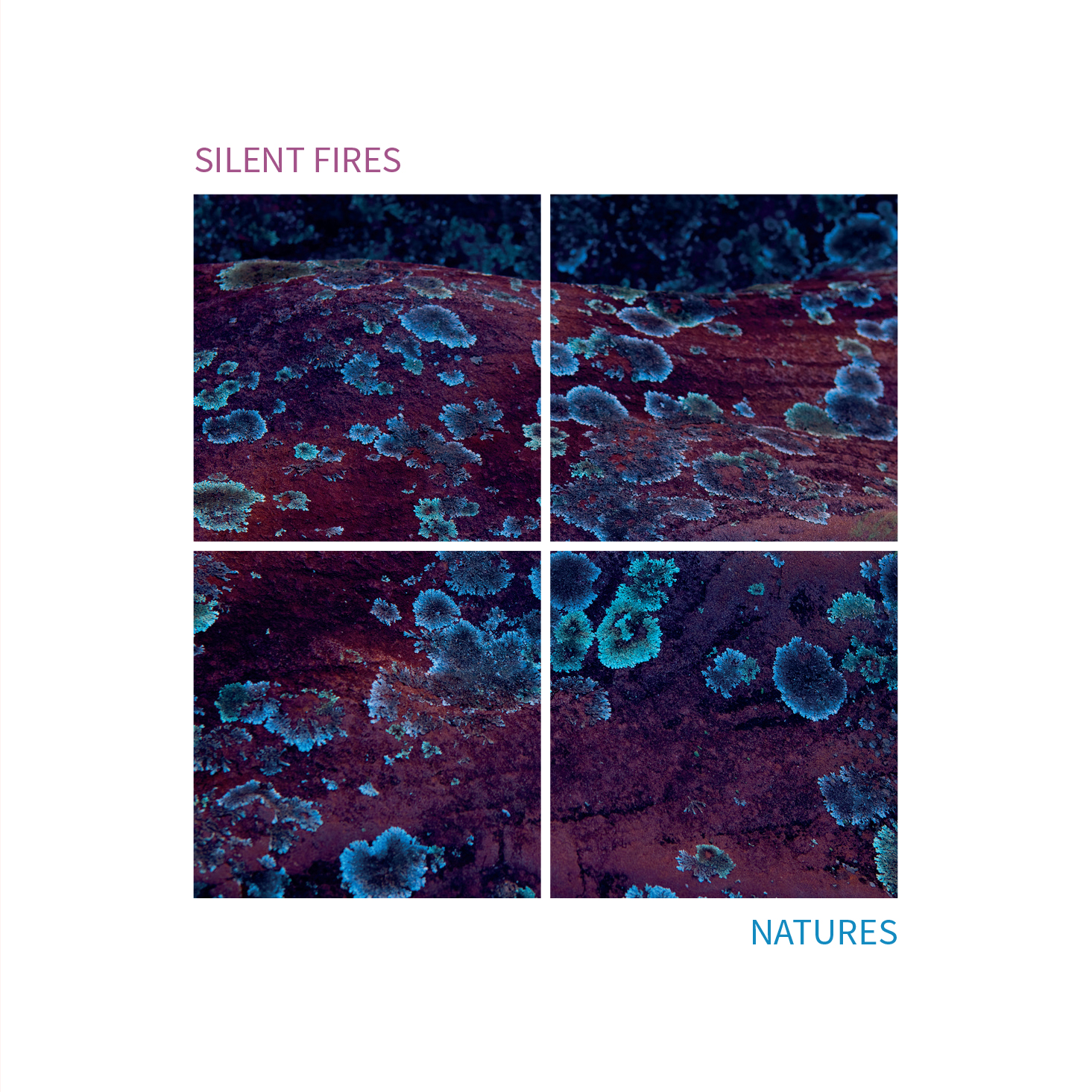
Pizzicato footsteps of moonlight move through “Il Bagno della Luna,” animating a delicate organism that opens into gorgeous arpeggios and superbly articulated harmonies between voice and trumpet. Its emotional purity comes from the musicians’ willingness to expose the joins, allowing us to hear how an individual gesture becomes communal feeling. Juan Hitters’s quadripartite cover offers a visual counterpart in its dark, organic textures, four apertures through which matter seems to contemplate its own incompleteness. A germinal energy stirs beneath their surfaces, suggesting that creation draws nourishment from the very obscurity we are so often tempted to correct. The panels invite a gaze willing to surrender the urgency of recognition, just as this music makes perception itself an act of participation.
That participation acquires cinematic depth in “En Fremtid Blå,” whose harmonies welcome us into the inner sanctum of the heart without requiring us to account for everything we bring there. “Skjønnhet” gathers such openness into a fragile lullaby, its gentleness giving the body permission to occupy the same spiritual geography as the wandering voice. Now given a studio incarnation after a life in performance, its apparent stillness sheltering the gestures that have passed through it. Dancer Synne Garvik, a presence in the group’s performances since 2018, extends this relationship into transformation. Her involvement makes explicit something already stirring within the quartet’s exchanges, the sense that a note possesses joints and can bend toward another living thing.
Along the violin arpeggios of “Lagrimæ,” a web of sadness offers Wallace’s voice a place to rest from its weariness, each strand retaining the tremor of what it holds. Sorrow becomes a structure capable of supporting someone, and the ensemble’s restraint allows that transformation to occur without sentimental instruction. “Beisan,” a soft yet rich piano piece, finds glory in the shadows, its unobtrusive seeking a modus operandi for the sequence as a whole. Sgobbio’s submission to something divine has an almost tactile humility, a willingness to leave certain doors unopened so that whatever lives behind them may continue breathing.
The healing segue of “Live, Love, Lose” brings us into the final embrace of “Glühwürmchen,” which offers its glow as a kiss goodnight, though its intimacy carries a disquieting reversal of scale. We entered these meditations seeking a dwelling place within the world, only to discover how much of the world depends upon finding one within us. In that reversal, even the smallest act of attention becomes a question of hospitality, and what we call a soul begins to resemble the earth’s request for asylum inside its own creations.

