

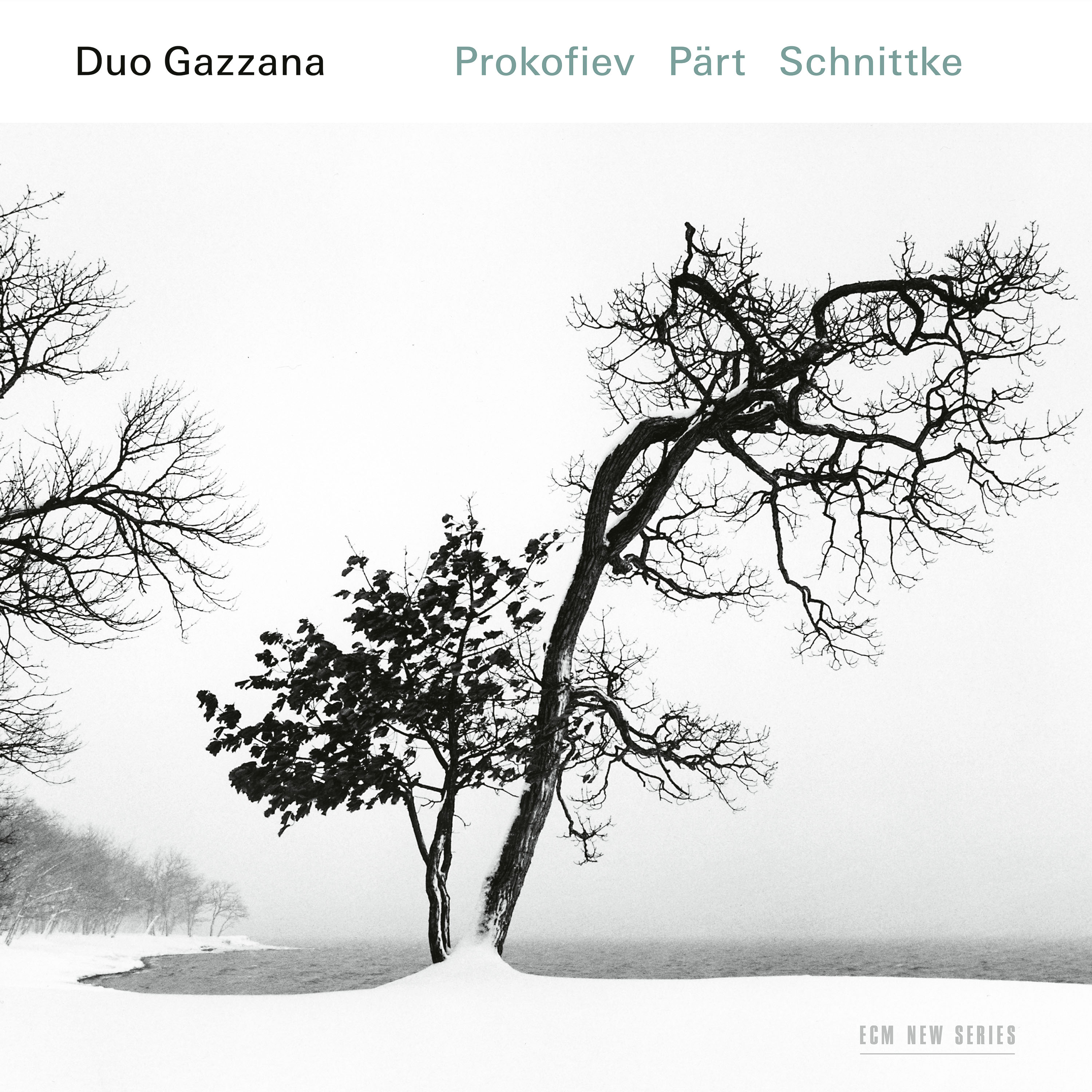
Duo Gazzana
Prokofiev/Pärt/Schnittke
Natascia Gazzana violin
Raffaella Gazzana piano
Recorded February 2025, Reitstadel Neumarkt
Engineer: Markus Heiland
Mixed September 2025
by Manfred Eicher and Michael Hinreiner (engineer)
Cover photo: Michael Kenna
Produced by Manfred Eicher
Release date: April 17, 2026
Since 2011, Duo Gazzana have occupied a rarefied space within the ECM New Series realm, where sound is uncovered as a relic from beneath layers of listening. Across their previous recordings, the sisters Natascia and Raffaella have cultivated a language of intimacy that resists spectacle, drawing the ear inward, toward a threshold where precision meets vulnerability. Their artistry thrives not on assertion but on trust, a quiet confidence that what is essential will endure without artifice.
This latest album extends that ethos while threading it through a program shaped by endurance, fracture, and the fragile grace of survival. The chosen composers speak across time not through stylistic unity but through shared confrontation with hardship. As Stefano Carucci observes in his booklet essay, these figures, despite their divergent origins and trajectories, all encountered forms of sociopolitical suffering that threatened to silence them, and yet found in music a passageway beyond constraint. What emerges, then, is not merely a collection of works but a meditation on resilience. Each piece becomes a chamber where pressure resonates.
Sergei Prokofiev (1891–1953)
Sonata for Violin and Piano No. 1 in f minor, op. 80
Written under the oppressive weight of the Stalinist regime, interrupted by war, and completed in 1946, this sonata bears the imprint of a mind navigating both external censorship and internal unrest. The opening Andante assai does not so much begin as seep into being. The piano murmurs from its lower depths, a shadowed resonance that seems to remember something it cannot name. The violin responds with a tremor, not quite a voice yet no longer silenced. Their exchange unfolds like a fragile correspondence between distant selves, each phrase arriving slightly worn by travel.
Textures accumulate slowly, their friction almost tactile. One senses thought grinding against itself. Then, unexpectedly, a glint of irony surfaces, a crooked smile glimpsed through fog. The piano drifts into an impressionistic shimmer, while the violin traces an erratic line above, a figure balancing along a fence that refuses stability. A final whisper of pizzicato settles the air before the Allegro brusco asserts its presence, not with brute force but with a taut clarity that holds its ground. The Gazzanas render this movement with astonishing poise, maintaining a paradoxical separation. It feels as though violin and piano inhabit parallel rooms, their dialogue conducted through walls that neither obstruct nor reveal entirely.
The subsequent Andante opens a window. A stream appears, modest and unassuming, its flow uninterrupted by spectacle. Yet even here, unease lingers beneath the surface. The music twists subtly, its beauty edged with something watchful. By the time the Allegrissimo erupts, the earlier calm reveals itself as prelude rather than respite. Motion accelerates into a language of leaps and surges, returning to earlier motifs not as closure but as transformation. The ending resists finality. It suggests continuation beyond hearing, as though the sonata persists in some unseen dimension, spiraling outward long after the last vibration fades.
After such intensity, the arrival of Arvo Pärt’s Spiegel im Spiegel feels like stepping into a space where time loosens its grip. This work, among the first articulations of Pärt’s tintinnabuli style, invites a relinquishing of self. The performers become vessels rather than agents, their gestures stripped of excess until only essence remains. The piano’s arpeggios unfold with crystalline patience, while the violin sustains a line that seems to hover between presence and absence.
In this interpretation, the Gazzanas uncover a depth that resists articulation. The music breathes within a threshold where the physical dissolves into the ineffable. It carries the faint suggestion of something sacred, not declared but intimated. Each note appears as if reflected in another, a mirror that does not duplicate but reveals hidden dimensions. The simplicity is deceptive. Beneath it lies an infinite regress, each tone containing the seed of another, extending endlessly into silence.
Prokofiev
Five Melodies, op. 35a
Originally conceived as vocalises for soprano and piano in 1920 and later transcribed for violin, these miniatures form a bridge between tradition and innovation. They are concise yet expansive, each piece a self-contained world that flickers into being and vanishes before it can be fully grasped. The Gazzanas approach them with a sensitivity that honors their dual nature.
The second melody stands out in particular. Its opening pizzicato gestures evoke a tactile immediacy, as though the music were being plucked directly from the air. The flowing ostinato that follows transforms this grounded beginning into something buoyant, almost dance-like. Yet the energy never settles into predictability. It shifts, folds inward, then reemerges with altered contours. The final Andante non troppo balances restraint and exuberance, its voice alternating between whisper and exclamation. The conclusion does not resolve so much as dissolve into a state of luminous equilibrium.
Alfred Schnittke (1934–1998)
Gratulationsrondo
Schnittke’s polystylistic language introduces a different kind of tension. Here, contrasts are not reconciled but allowed to coexist in uneasy proximity. Familiar gestures are tinged with unease, while dissonance acquires an unexpected radiance. The Gazzanas navigate this terrain with a delicacy that reveals the work’s inner vulnerability. Beneath its shifting surfaces lies a candid exposure, as though the music has shed its defenses and stands unguarded before the listener.
What ultimately defines Duo Gazzana’s performance throughout this album is a quality that might be called bareness, though the term hardly captures its fullness. Their playing does not impose meaning. It creates space for meaning to emerge. Each phrase feels unencumbered by expectation, as if the music were discovering itself in real time. Their sisterly connection is evident, yet it is not the focal point. Rather, it is the organic foundation upon which a more profound dialogue unfolds.
And perhaps this is where the album leaves us. Not with answers, nor even with questions, but with a shift in how we attend to sound itself. These works, shaped by hardship and carried forward through fragile persistence, remind us that music is not merely an object of listening. It is a mode of being, a way in which experience transforms into something that can be shared without being diminished. In the end, what lingers is not the echo of suffering but the realization that even in silence, something continues to resonate. Whether we call it memory, spirit, or simply presence, it carries us forward with hope.

