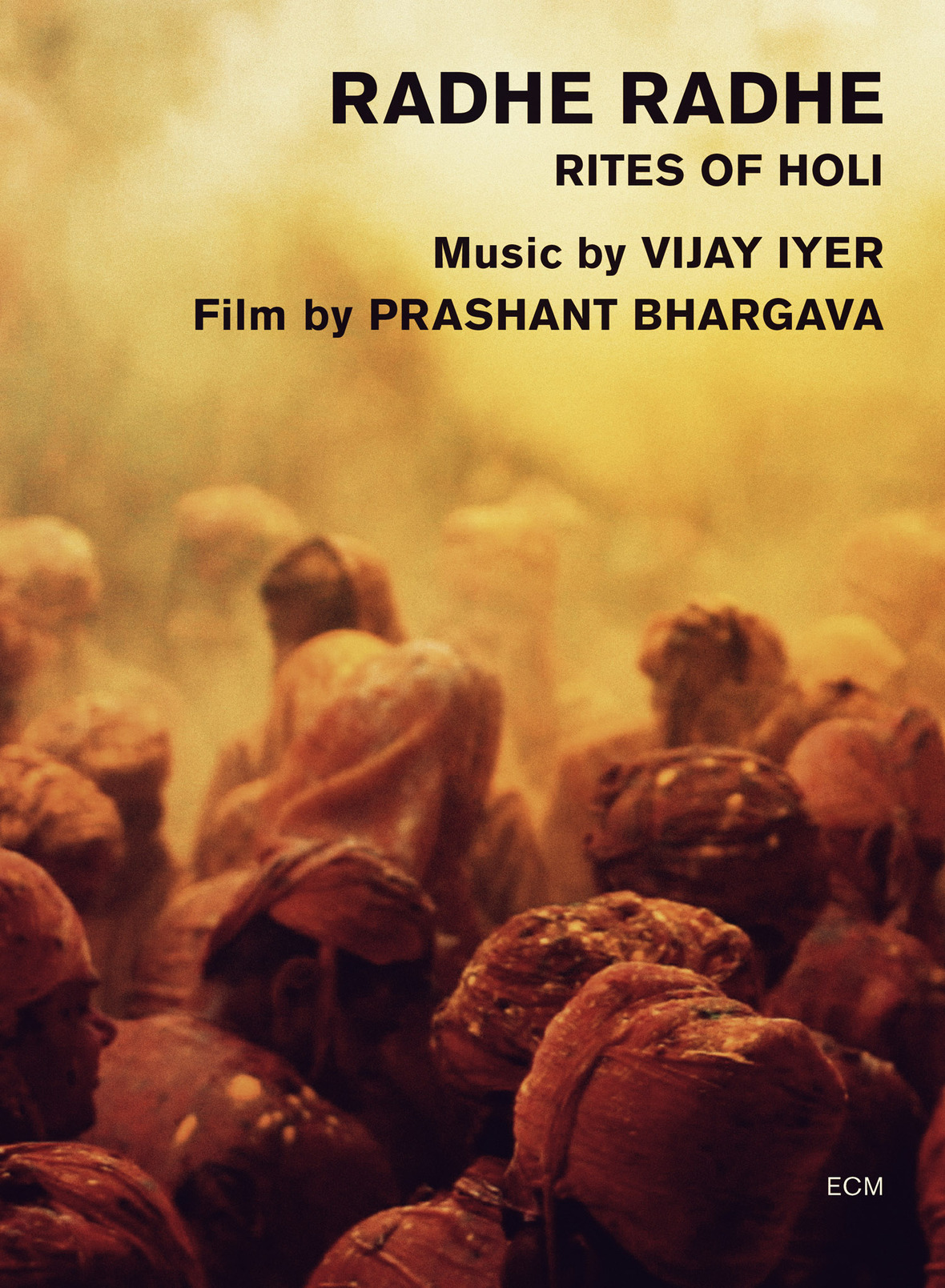
Prashant Bhargava & Vijay Iyer: Radhe Radhe – Rites of Holi (ECM 5507)

Radhe Radhe

Radhe Radhe: Rites of Holi

Vijay Iyer composer
Prashant Bhargava film director, editor
Anna George actor
Craig Marsden director of photography
International Contemporary Ensemble
Eric LambLaura Jordan Cocks: flute, alto flute, piccolo
Joshua Rubin: clarinet, bass clarinet
Rebekah Heller: basoon, contrabasoon
Gareth FlowersAmir Elsaffar: trumpet
Jennifer Curtis: violin
Kyle Armbrust: viola
Kivie Cahn-Lipman: cello
Cory Smythe: piano
Ross Karre: percussion
Tyshawn Sorey: percussion, drum set
Adam Sliwinski: conductor
Vijay Iyer: piano, electronics
Soundtrack produced by Vijay Iyer and Manfred Eicher.
Recorded live at Memorial Hall, UNC Chapel Hill, March 26, 2013
Engineer: Frank Martin/Media Production Associates
Live concert sound engineer: Levy Lorenzo
Additional recording at The Bunker Studio, April 20, 2014
Engineer: John Davis
Mixed at Avatar Studios, NYC by James Farber, Vijay Iyer, and Manfred Eicher
Assistant: Aki Nishimura
Additional engineering, editing, and consultation: Liberty Ellman
Bird

Ron Fricke’s 1992 classic Baraka endures as one of the most consummate examples of non-narrative cinema. Its montage of images from around the world was even more eclectic than the soundtrack that went along with it. But despite the many ceremonies, creative arts, and labors that Fricke documented—including death pyres and ritual baths in the river Ganges—he never captured the Hindu religious festival known as Holi. Had he done so, it might have looked something like Radhe Radhe.

Opening Shot

Filmmaker Prashant Bhargava’s ode to this so-called “festival of colors” traces the eight-day celebration back to Mathura, mythic birthplace of the supreme deity Krishna and his lover (in the strongest sense) Radha. Hence the film’s title, a term of praise and greeting often exchanged in the streets of Mathura, where she is believed to be a gateway to true understanding of Krishna. Her power is a central theme, an explosion of devotion far more vivid than the human-made pigment sold on the streets in the weeks leading up to this cathartic event.

Given the film’s subtitle, “Rites of Holi,” and the fact that Holi is practiced in the spring may put one in mind of Igor Stravinsky. This is no coincidence. Although not a direct homage to Stravinsky, Radhe Radhe was the result of a commission for the 100th anniversary of the Russian composer’s Rite of Spring, and one of a dozen projects freshly created in its honor. It is still a ballet of sorts, not least of all for the dialogic contributions of Indian-American pianist Vijay Iyer. In a manner of speaking, he and Bhargava met halfway—the director boiling down over 30 hours of footage into a 35-minute film and the composer expanding molecular impressions into a fully integrated score—so that the finished product was a narrative duly rendered. Iyer’s task was to match Bhargava’s rhythms, taking the listener through what he calls a “series of energies.”

Crowd 3

Bhargava first gained international attention with his debut feature Patang (The Kite) in 2011. That his roots grabbed their soil in hip-hop and graffiti art should come as no surprise, for his gifts of rhythm, poetry, and color were likeminded in their urban respect. But with Radhe Radhe he went further underground, mining deeper traditions of those same creative registers. The film is, then, as much a musical as it is a visual tour de force, building like a raga to near-ecstatic heights. Indeed, before a single image graces our retinas, Iyer’s pianism sets the stage over a dark title screen. Slight dissonances therein betray something of the chaos about to unfold, but obscure enough of it so that we might experience it anew, even in multiple viewings. Along with the young musicians of the International Contemporary Ensemble, Iyer creates a mood that is beautifully unsettling, and all the more organic for it.
Face 1

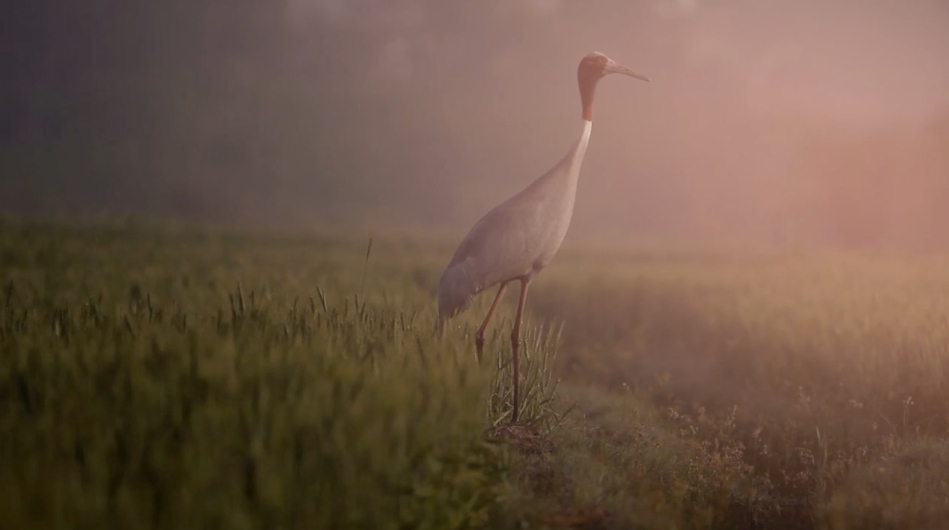
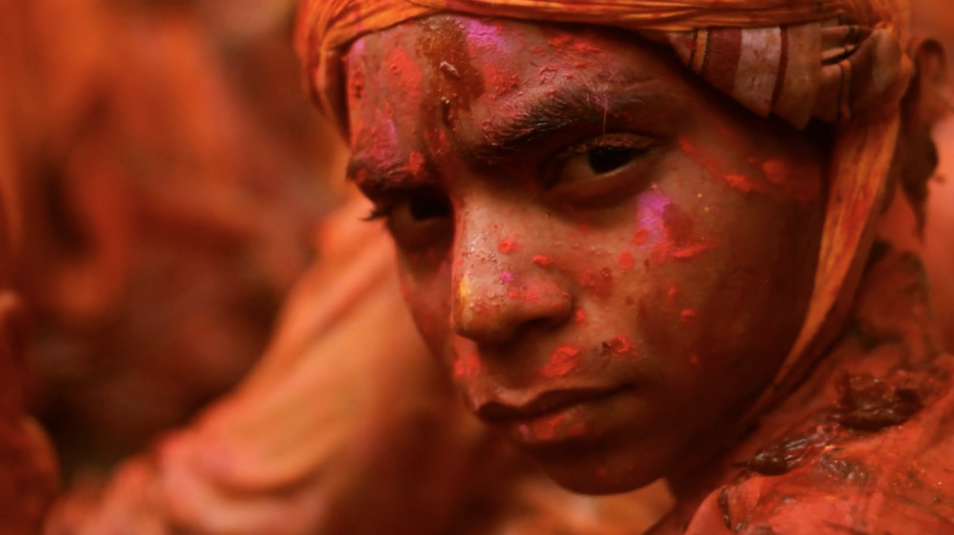
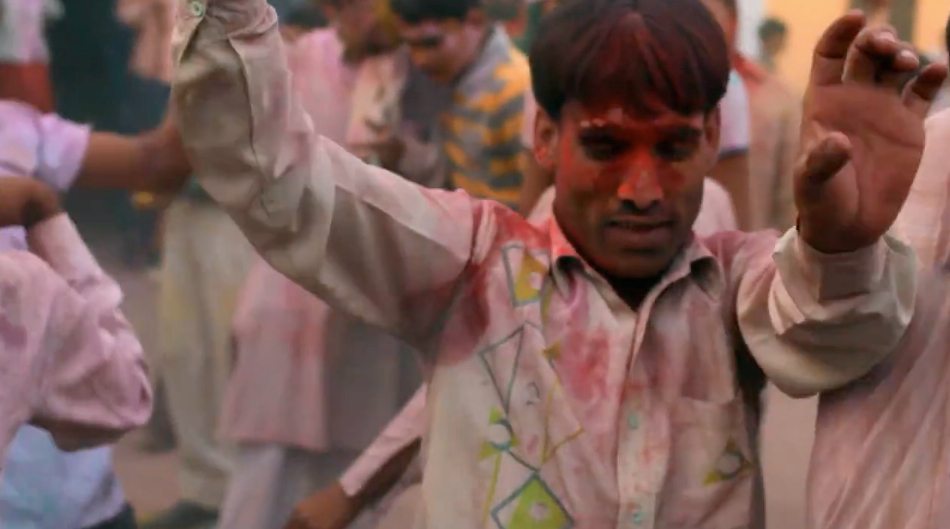
The film’s first part, “Adoration,” builds its intimacies one stratum at a time. The stage is set in a misty landscape. We see only details: boatmen preparing for the days’ revelry, a bare back, a glimpse of braided hair. The streets then come to life as food vendors ready their meals and women wash their garments in the river. The soundtrack is restless, anticipatory. A cargo train passes by, as if to underscore the film’s narrative drive. More fragments: a face half-reflected in a mirror, candles burning on an altar, a gossamer veil. As crowds thicken and the dance begins, Iyer’s pianism brightens. Even the birds in the field seem to join in. Flute and brass contrast one another with purpose. Their notes flower and wither, changing focus like the lens that guides them. Strings and percussion add color streamers of their own as the iconic powder hits the air.

Crowd 2

Part 2, “Transcendence,” puts further emphasis on Bhargava’s footage of an imaginary Radha played by actress Anna George. He spins from these scenes, shot in the US and woven throughout the film, a primal and sexual interplay that signals the true emergence of spring. It’s a bold move, as the director himself is first to admit in the DVD’s “Making Of” segment, but he wanted to bring that “everyday magic, that intimacy that we share as people to the narratives of the gods.” He believes that the push and pull of Radha and Krishna exists in all of us, as it does also in the increasingly inseparable relationship between sounds and scenarios. A trumpet, for example, works its melodic overlay during a long shot of Radha’s face, implying an environment far vaster than the immediate contrivance of the studio.

Radha 2

As the cinematography becomes more contemplative, the music subdues itself in solidarity. In the same way that Bhargava seems to have eyes in many places at once and flits between them by changing cognitive channels, so too does Iyer’s complementary switching take every movement into account. A sensual flowering of street noise enters the mix, as if bleeding of its own volition, leaving us wanting to shed our inhibitions and dive into that sea of color.
Dancing 2

In May of 2015, Bhargava died at the age of 42 from cardiac arrest after a history of heart disease. But the tragedy of this death is so graciously balanced by the exuberance of his small yet vivid oeuvre that one can focus on the latter in a state of pure invigoration. In this respect, we do well to read Radhe Radhe in the spirit for which it was made. In a world where the rites of Holi have spread to unlikely corners (I witness its rainbowed aftereffects on my American university campus every year), it’s nice to know that one artist’s vision can bring us anytime to the source with just the press of a PLAY button.

Field

(See this article as it originally appeared in RootsWorld online magazine here.)

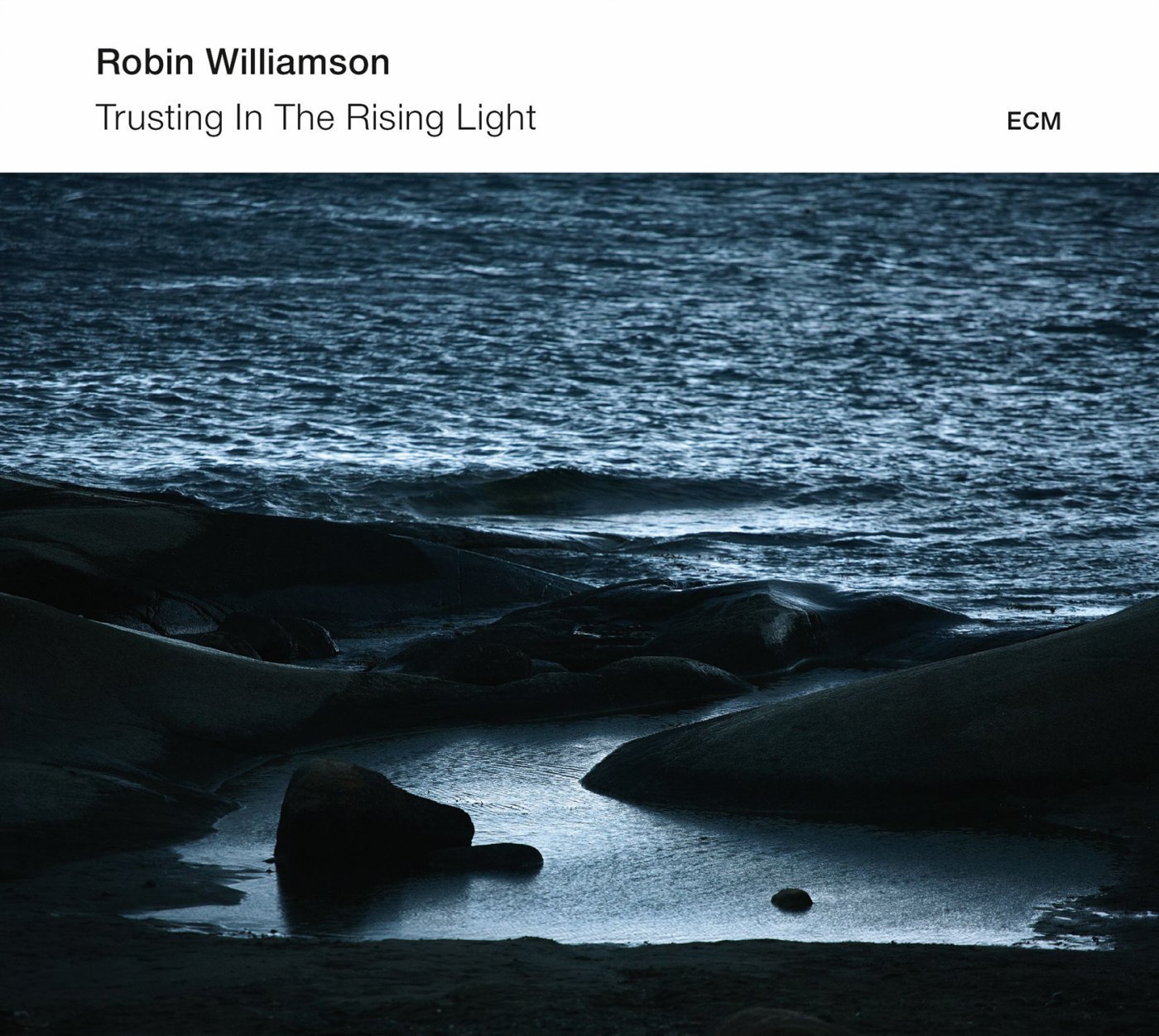
Robin Williamson: Trusting In The Rising Light (ECM 2393)

Trusting In The Rising Light

Robin Williamson
Trusting In The Rising Light

Robin Williamson vocals, Celtic harp, guitar, hardanger fiddle, whistles
Mat Maneri viola
Ches Smith vibraphone, drums, gongs, percussion
Recorded January 2014, Rockfield Studios, Monmouth
Engineer: Steve Lowe
Assistant engineer: Tim Lewis
Mastering: Christoph Stickel and Steve Lake
Produced by Steve Lake

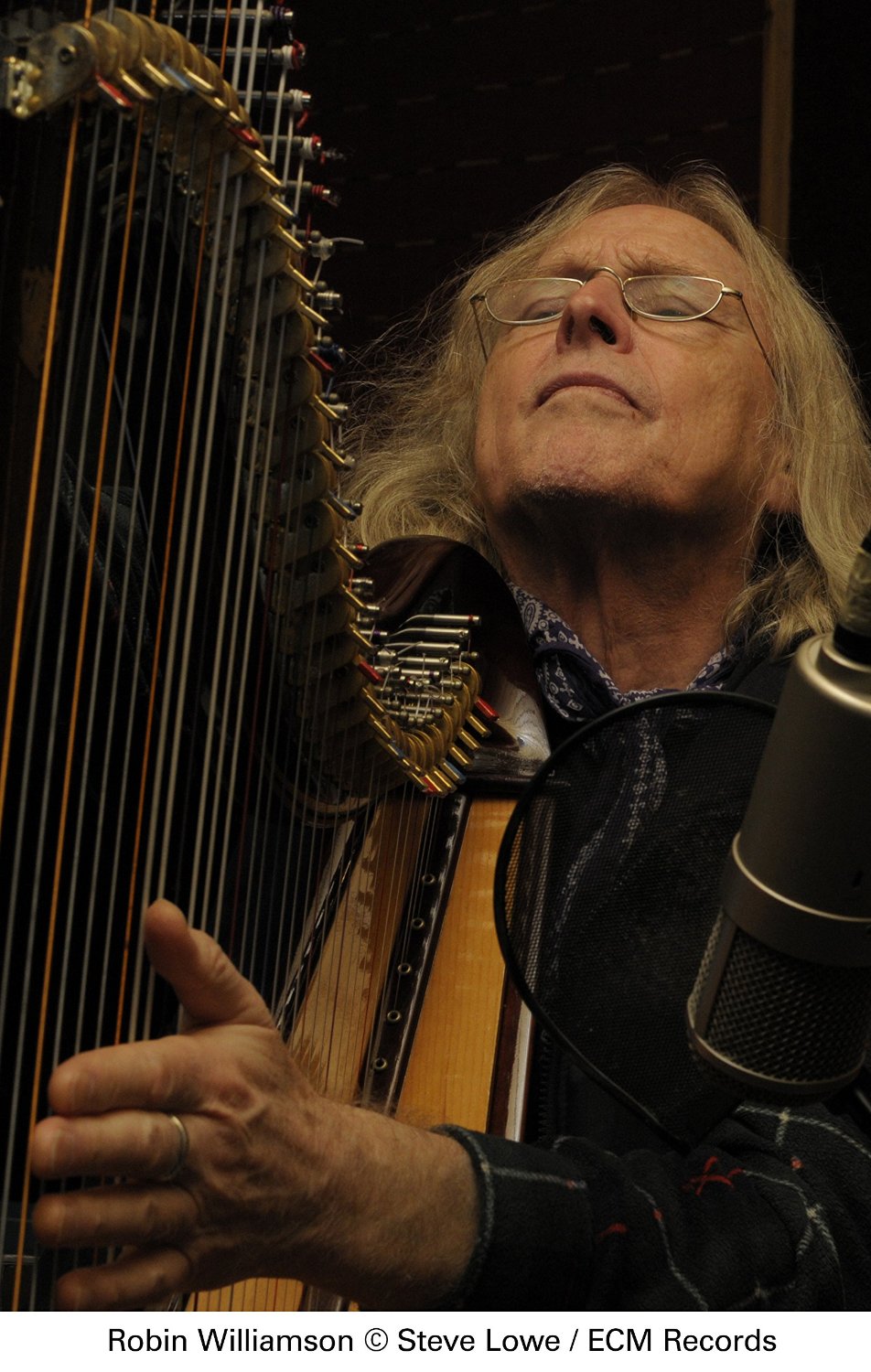
Robin Williamson, perhaps the last true bard on earth, returns with Trusting In The Rising Light. Following a string of intimate programs setting the words of famous poets to music (among them Dylan Thomas, Walt Whitman, and William Blake), he now dips a quill into his own inkwell and scrawls a masterful new ream of originals. Ten years separate this recording from its predecessor on ECM, The Iron Stone, but the wait has been well worth it, not least of all for the contributions of his fellow session musicians. From that last album he retains violist Mat Maneri and to this nexus adds drummer-percussionist Ches Smith. The result is an attuned, free jazz-folk session that feels at once long overdue and just right for its time.

RW

I caught up via e-mail with the album’s producer, Steve Lake, who described how the project came together:

“I’d been in touch with Robin over the years, and hadn’t realized that so much time had elapsed since The Iron Stone—the clichés about time moving faster as we age are true. In autumn 2013 he said he was in a period of writing lots of songs and read me the lyrics to ‘Trusting In The Rising Light’ and ‘Swan’ over the phone. It seemed like the moment for a new album. Robin said he wanted to work with Mat Maneri again, which of course was fine with me. I talked with [ECM head] Manfred Eicher about a possible vibraphone player for the session and Ches Smith’s name came up. It struck me as a good idea since I knew that Ches had formed a new trio with Mat and Craig Taborn. So inside the Williamson line-up there were two proven associations, Robin/Mat and Ches/Mat. With this as a basis we could confidently get to work.”

Where some voices crack and smolder with age, Williamson’s is like a fine sword: it only gets stronger the more it’s folded in its malleable state. And while he has always engaged larger questions of conviction, politics, love, and sense of place, on Trusting he seems far more content to dwell on the little things: spending time with a loved one, the fundamental pleasures of observation, and, as the album’s title implies, faith in life’s givens and regularities. As a romantic, he is lyrical yet realistic. He seems well aware that the limits of his control extend not much farther beyond his own body and the words and music it produces.

Nowhere is this clearer than in the title song, which turns on a movie with no opening credits. Here is one who stands at harbor, watching the rise and fall of the waves and knowing that some things are better left to their own rhythm:

In every man-hewn stone
The anchored voices murmur
Long long
What they have always to say
As to what of our life
When whence and whither
We born of woman
Born of the Great Mystery

Being a relatively new yet enthusiastic fan, I asked Lake to place the album in the larger context of Williamson’s decades-long career. “It’s a high point,” he answered, “but if I look at Robin’s discography there are a lot of high points, including albums on his own Pig’s Whisker label which too few people have heard (if you can find them I recommend Ring Dance, At The Pure Fountain, and Dream Journals). Robin’s been a working musician for almost sixty years but has never been exactly career-minded. His musical and literary interests carry him forward and as a result he has had, I would guess, a richer and more interesting life than many who have made the career a priority. Trusting in the way of the waves, as he says in the title track…”

Accompanying these sentiments—in truth, embodying them—is Williamson’s trusty harp. Despite being prone to putting on magical airs, at his fingertips it is not an instrument of spells and incantations. Over the years it has become burnished like a well-worn table at which countless meals have taken place. And there, among the dishes and scratched spoons are those same rhythms of life, having left their hieroglyphics behind for deciphering. As he blossoms in a wave of strings, crashing on the shores of a dawn not so far away, he provides confirmation that in the good work one can be grateful for the opportunity to engage with land and sea, to know that it will all be waiting on the other side of slumber.

Whether through the droning raga of “Our Evening Walk,” in which love begets love, or the heartfelt wonder of “Alive Today,” in which Williamson takes comfort in something as insignificant as the flap of a bird’s wings, such assurances thread every song that follows with the knowledge that all those things we rely on will be there for us, in light or darkness. Sometimes, as in “Falling Snow,” his romance is with the universe at large, pulling together time and space like a massive proof of emotional and spiritual relativity. At others, it is undeniably close to home, calling his wife Bina by name as he does in the sensuously realized “Your Kisses.” For the most part, however, Williamson looks either down at “These Hands Of Mine” or back along the “Roads” that led him to where he stands. The former tune features a jaunty guitar while the latter’s commentating viola weaves in and out of the loom. In both, the feeling of departure is constant, arrival questionable. And in “The Cards,” a song loosely based on a traditional Irish air “The Coolin” but otherwise ad-libbed in the studio, he offers a cautionary tale against prediction, trusting in reality instead of relying on dreams or elusive signs. Accompanied only by guitar, elastic and supportive of any and all possibilities, he contemplates this dance in what he calls the “soul of souls.” It’s as if he were at a bar alone, the last dart thrown along with last call, but it’s the kind of draft of which every sip tastes as good as the first.

Sitting with this album is like traveling somewhere for a while, much as the musicians did just to bring it all together. Lake sets up the scene:

“Rockfield is a residential studio deep in the Welsh countryside with a long history of recording especially rock music. When we arrived, Mott The Hoople were just finishing a mixing session. We spoke briefly with them. It was slightly odd, almost time-warp inducing, to be in the same room with Mott and Mat Maneri, but strange juxtapositions belong to the journey. I liked living at the studio and had some interesting talks with its owner Kingsley Ward about his early life as a session musician working for Joe Meek in London. There’s a lot of idiosyncratic recording knowledge concentrated at Rockfield. For the session with Robin the mood was positive, friendly and committed. Robin had some songs mapped out on which Mat and Ches were given directives and specific things to play, mostly with some improvisational freedom. And there were some pieces that were wide open to improvising, particularly ‘Just West Of Monmouth,’ ‘Night Comes Quick In LA,’ ‘Swan’ and ‘Islands Of The Inner Firth.’”

The latter songs rest somewhere between speech and singing and flower in freely improvised settings. “Youth burns brighter than neon,” he sings in “Night Comes Quick In LA,” a cynical, bird’s-eye view of superficiality gone rotten in the valley. The beat poetry aesthetic only adds to the acuteness of his poet’s eye. In “Just West Of Monmouth,” Williamson nestles himself in a gravelly accompaniment of percussion, whistles, and bows, unspooling his tale of creation in the rustle of underbrush and thirsty plains. Next is a sojourn into “The Islands Of The Inner Firth,” where awaits the mirror into which we must all someday look:

Now in the October of my life
I trace
Beloved and well remembered shore
Your stony verge
You cold and turbulent Scots water
In memory I trace
My kindly haunted past

So begins a summation of a creation and a new beginning of memory strung like a bead on a necklace that is forever growing to fit the thickening neck of experience. And before him is the pond where swims the eternal “Swan,” who joins her “world self / Where air and water meet.” Let us hope that Williamson’s swan has a long time yet before it sings.

(See this article as it originally appeared in RootsWorld online magazine, where you can also hear sample clips. To hear more of Trusting In The Rising Light, click here.)

Live Report: Avi Rothbard Trio at Smalls Jazz Club

Avi Rothbard Trio
with Jay Leonhart (bass/vocals) and Tomoko Ohno Farnham (piano)
Smalls Jazz Club
22 June 2015
7:30pm

Israeli-born guitarist and composer Avi Rothbard has earned his stripes in the relentless music scene of New York, where he has lived since 1999 and where his talents have found their way into a range of projects. With such a full palette already on his own, only those musicians with the right sensibility will do for bandmates, and a trio performance with bassist Jay Leonhart and pianist Tomoko Ohno Farnham at Smalls in June of 2015 was just what the doctor ordered in this regard.

Over the course of two richly varied sets, Rothbard and friends managed to balance their idiosyncratic strong points within a smooth group unity. Each musician brought a distinct signature to the stage without ever clashing for dominance. Farnham’s compacted, cellular approach to soloing, for instance, tapped the flavors of old-timey jazz to everything she touched. Whether comping beneath Rothbard’s leading tone in Randy Weston’s “High Fly” or bringing nostalgia and joy to the music of Wes Montgomery and Kenny Baron, she maintained a free, conversational tone. She further showed her inventiveness in Herbie Hancock’s “Dolphy Dance,” for which, in tandem with Rothbard’s sensitive touch, she spun fresh colors from the older threads.

Rothbard, for his part, stretched each tune until it fit like a favorite shirt. As composer, he spearheaded some of the most impressive turns of the night. Three originals—“Eye Talk,” “Twin Song,” and “Minor Impact”—acted as vibrant springboards for the band’s communicative potential, each more appealing than the next. With moods ranging from lyrical to blinding, they had an overall ductile quality that adapted itself to the themes at hand. As technician, Rothbard bared his chops on the theme from I Love Lucy, an unexpected highlight made all the more brilliant for its arrangement and virtuosic energies.

Overall, the drum-less roster allowed the band members to revel in open improvisational spaces. Leonhart was particularly on point in this regard, his playing so percussive that the sticks and skins were hardly missed. A fixture in the New York jazz club scene, Leonhart sang not only through his instrument but also along with it, offering two originals of his own—a self-deprecating blues called “Joy” (another fine vehicle for Farnham) and a humorous ditty about sitting next to Leonard Bernstein on a plane—and a lighthearted take on “Cool,” from Bernstein’s West Side Story.

With so much to appreciate in terms of execution and variety, the Avi Rothbard Trio delivered exactly as advertised, plus a few surprises thrown in for good measure, for a thoroughly enjoyable summertime gig that was the very essence of cool.

Klaus Gesing review for All About Jazz

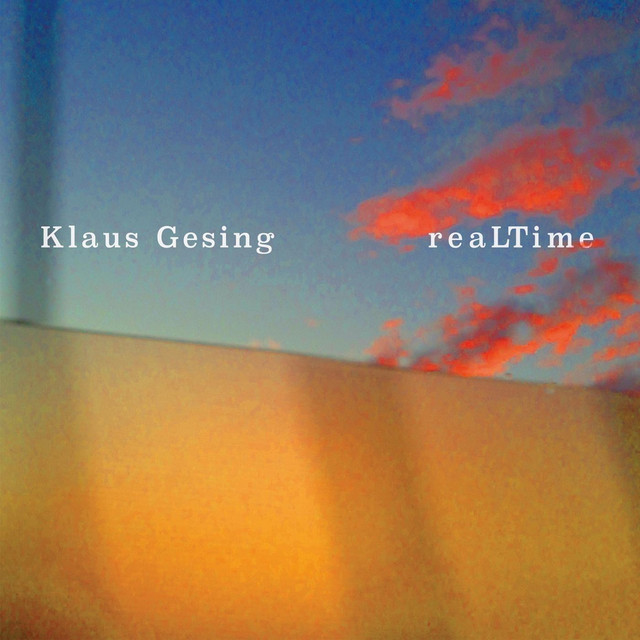
My latest review for All About Jazz is of multi-reedist and composer Klaus Gesing’s solo album reaLTime. Gesing will be known to ECM listeners for his collaborations with Norma Winstone and Anouar Brahem, but his solo work should have strongest appeal to fans of John Surman. Click the cover to discover!

reaLTime

On the Art of Transcending Death: The Music of Bernard Oglesby

Remember thy creator before the silver cord be loosed, or the golden bowl be broken or the pitcher shattered at the fountain or the wheel broken at the well. Then shall the dust return to the earth as it was and the spirit shall return unto God who gave it.
–Kirill, Andrei Rublev

Bernard Oglesby is a quiet crafter. He works his trade like a night boatman, oaring creative waters with a carriage of intuition that can only come with repetition. More than the realization of experience, such action translates into the experience of realization. It can be no surprise, then, that Oglesby should cite “The Ontology of the Photographic Image” as a cornerstone of his personal expression. To one who works across media, André Bazin’s seminal 1960 essay addresses a core truth of representation that resonates through his principled output. “It is perhaps the interrelationship of past, present, and future,” explains Oglesby, “that best characterizes my underlying philosophy and it is in Bazin that I find the clearest indicator for my whole practice: that of the ‘mummy complex,’ where time is slowed and preserved through a process of embalming—or, in my case, recording—in order to transcend death.” His relationship, as of any artist, to acts of transcendence is not one of seeking and achievement, but rather of bloodletting and enmeshment. For to see the self as fallible is to necessitate unfolding into light itself.

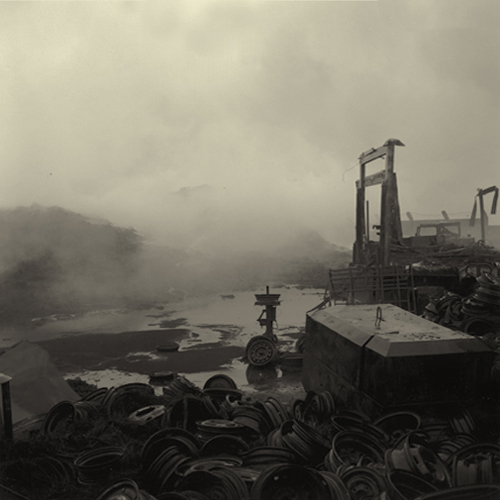
Alongside his establishment in the fields of photography and painting, Oglesby has submerged his hands in currents of filmmaking and music. In some ways, his films are more musical than they are visual, while his music is decidedly filmic. His 2011 Mandrel, for instance, is on the surface a detail-oriented montage of foundry workers’ tasks shot in crisp black and white. But it is the incidental rhythms of said tasks that make its composition such a fine one for the senses.

The relationship between his imagistic and sonic practices is, I daresay, indivisible. “I am convinced that music is the most visual of all art forms,” Oglesby agrees, “and by its nature, nonhierarchical in its direct ability to connect with people on many personal and social levels. It was with Andrei Tarkovsky’s Andrei Rublev and the score by Vyacheslav Ovchinnikov that I began to experience and understand just how life-changing the relationship between visual art and music could be.” Yet where Tarkovsky sought to show through that classic film the artist as a hub of worldly creation, Oglesby in his own compositions is concerned with the spokes emanating from it. Like rays to a sun, each can be traced to a generative source.

Without End
Without End (Levenshulme, 2003) Silver Gelatin Print

Mapping his musical evolution is a likeminded task and finds the young Oglesby seeking priesthood at a Franciscan monastery, where a different path was revealed to him on the cusp of retreat: “I left to become a church window designer,” he recalls, “before attending art school, where I failed my degree. It’s clear now that music formed a very important subconscious role and experience for me, as I come from a musical background with many of my forefathers and current family involved as musicians, singers, and producers.” Despite the constant evidence of music at home, and skipping over the obvious recovery from his nominal “failure,” Oglesby showed no direct interest in music early on. Film soundtracks, however, had what he terms a “deep and permanent register” in his growth as a listener, the scores of James Bernard and Bernard Herrmann being held in his highest esteem. Since then, his ears have subsisted on a contemplative diet of Frédéric Chopin, Valentin Silvestrov, and G. I. Gurdjieff. It is to the latter we might draw the darkest vein of kinship, wherein pulses a notecraft as vivid as his painted photographs.

Aubergine
Aubergine (Manchester 2010) Archival Pigment Print

I asked Oglesby how he came to the staves:

“Writing music does not come easily or naturally to me. My hand was forced as a composer, as I found the process of working with other composers extremely difficult and unproductive. A film project I was working on about the sinking of the ship Mefkure required a score to be written and produced. Unfortunately the composer for the project had very different ideas regarding the score and we constantly banged heads. At the time the production team dared me to write the score, so I did. It took 18 months locked in my studio. I approached the task as a novice and initially began learning to use a keyboard as an immediate point of entry into writing and composition. Quickly apparent was a disconnect between my practice as a visual artist and a composer, and the only way for me to reconcile this dislocation was to embrace music solely as a visual language. At this revelatory point my approach to music composition changed, as I no longer looked to the traditional structures of score writing and began to create a visual code to which I could assign sound, expression, pitch, and percussion. Since my early experiments with the Mefkure score, I have established a working method that involves extensive research centered around each project. This research includes making sound recordings, collecting stories, making short films, taking photographs, then using this material and mute boards to map out the form and context of each composition.”

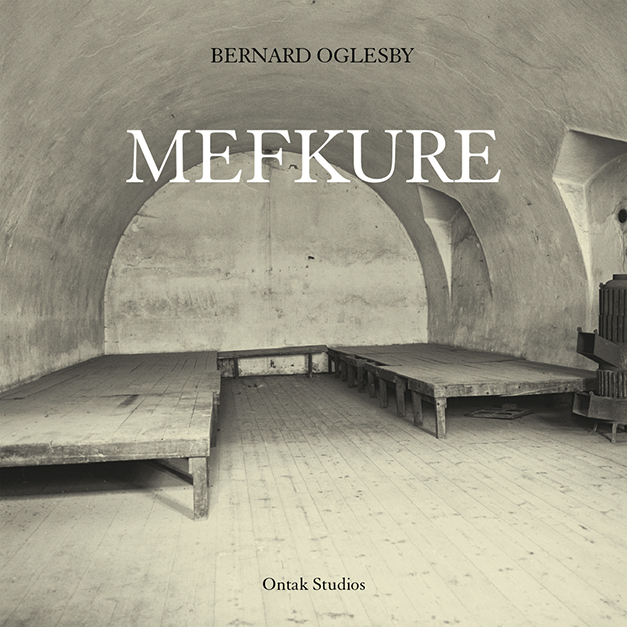
Mefkure

Mefkure (2012) was actually the second in a trilogy built around the words of Ovidiu Nimigean (b. 1962), to whose poetry Oglesby was introduced while making a short film about Romanian immigrants digging for scrap metal just to get by: “Principally, it is his ability to invest descriptive fact with deep emotional content about the strain of death and dislocation,” says Oglesby of the Romanian writer. The minimal nature of the music is like the pitch to every gaseous ball of sentiment and finds its genesis in the forested pathos of Departe (2012).

Departe

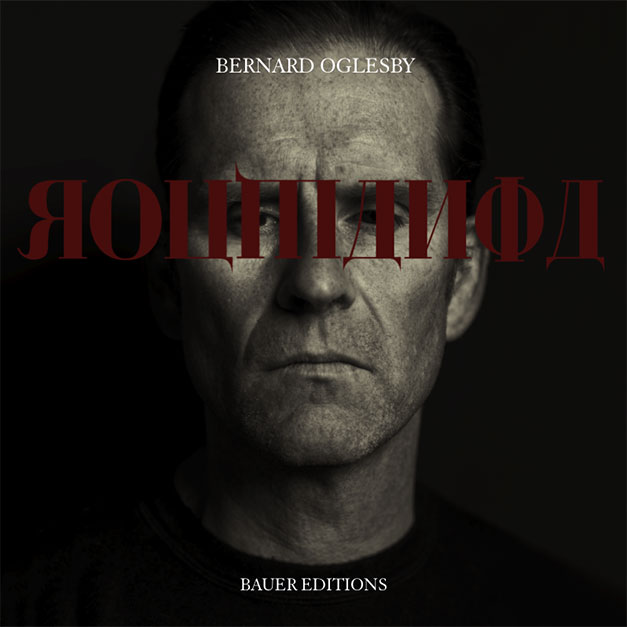
Side projects such as Torah (2013), a collection of solo piano works paralleling Erik Satie’s The Gymnopédies, and Jannah (2013), a suite for string quartet and keyboard written around the concept of original sin, followed, each appearing like an inexplicable line in a fingernail and representing a major leap inward toward the realization of compositional identity. Over the progress of that identity, Oglesby is still unresolved: “What I am clear about, however, is that those early unconscious moments, as a child, were seminal in priming me for my current creative output.” To be sure, the formative albums feel like a hermit’s sketches, their primary audience a congregation of shadows along cave walls. But with the 2015 release Roumania he has yielded a finished painting. For the composer, it “represents a moment of pure clarity, when all the elements of gestation, encompassing 15 years, come together and speak with elegance, economy, and stillness about slow time and its moral implication. The earlier, fledgling works had more of a narrative structure and graphic framework as I began to explore and test my theories about the relationship between image and sound.” The present recording furthermore completes the Nimigean trilogy.

Roumania

Roumania is as much a musical construction as conversation, in this instance of and with the beloved “Ballad” for violin and piano by Romanian composer Ciprian Porumbescu (1853-1883). The original work engages the doina, a traditional improvisational form with Arabic roots. The mood of the doina is contextually dependent, and takes on devotional textures in Oglesby’s reimagining. The album’s heart pumps in a fair share of its nourishment from pieces for solo piano and prepared twin pianos scattered throughout. The musicians in question, Anton Heart and Marracha Ward, approach the playing with as much solemnity as went into the writing. At once long-tailed and close enough to hear it breathe, the music drags chains of heavy memory as it washes its own skin and hangs it to dry in a wind of reflection. There is a mental substance to its labor, which finds grayest acumen in “The 4th Way,” the title of which makes reference to Gurdjieff’s anti-institutional path to spiritual awakening. Its pigments are notes incarnate, as are those of “In Deep Silence,” which like Arvo Pärt’s Spiegel im Spiegel speaks to the untethered mind.

Roumania also makes use of field recordings. Originally taken as research for the aforementioned Mefkure but shelved for a film that never materialized, they were gathered by the composer and Janez Hovec in the lower Carpathians and Black Sea. Their addition triangulates the axes of sound and image with that of space. Lapping waves (“Night Roumania”) disguise the piano as rocky shoreline, while cries of birds (“The Black Gulls”) dislocate us from the light of dawn. Like a Theo Angelopoulos film or Eleni Karaindrou soundtrack thereof, these environments sing for time, out of time, and with a strength that cares little for numbers. In “He who loves and leaves,” vocalist Mija Aleksiss and cellist Ontak Ayer join Ward at the keyboard to mark the waters of trauma with multiple voices, each a buoy signal of vivid light.

Two pieces—“Laegan” and “From Abroad”—feature the otherworld of spoken word. In the first, Romanian poet Ana Blandiana, who is responsible for introducing Oglesby to Nimigean, reads concavely, as if her language were a cinematic fade. The piano blends into view, while holding on to the rhythms and patterns of that speech. It strikes up a chord, a dance past midnight, a melancholy that lingers whenever one can’t sleep for the dead. The second is Nimigean himself, whose lo-fi aesthetics breed hi-fi effects. He steps through a door, taking the listener outside of all clothing and shelter, until the only language left is that of breath without song.

A request to all of my readers

I’m currently embarking on a little project, for which I am compiling my “Top 100” ECM reviews to date. Whether you’ve been following my blog for five years or five days, I trust that you will have some favorite reviews of mine. It would be of great help to me if you could list those reviews that you feel are most effective at capturing the spirit of the music, as well as those that led you to new and meaningful discoveries, by leaving a comment to this post. Thank you!