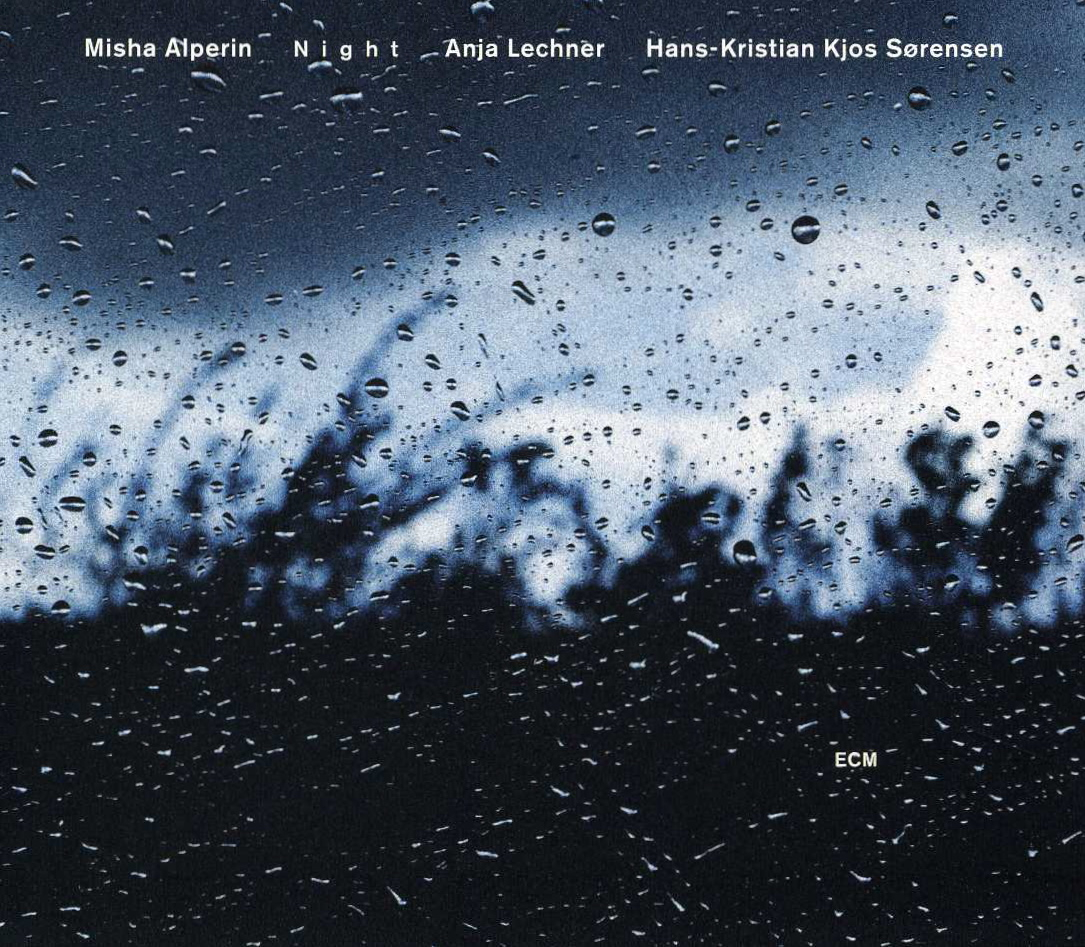
Misha Alperin: Night (ECM 1769)

Night

Misha Alperin
Night

Anja Lechner cello
Hans-Kristian Kjos Sørensen percussion, marimba, voice
Misha Alperin piano, claviola
Recorded April 4, 1998 at Vossa Jazz Festival, Norway
Engineer: Jan Erik Kongshaug
Produced by Manfred Eicher

Atmospherically speaking, Misha Alperin has created some of ECM’s most haunting discs. In the wake of one such disc, At Home, the Ukrainian pianist-composer surprises with yet another unexpected turn of events. The event in question is the commissioned performance at the 1998 VossaJazz Festival in Norway documented here. The end result is a new beginning, a flowering of innovation and sensory breadth.

With German cellist Anja Lechner and Norwegian percussionist Hans-Kristian Kjos Sørensen in tow, Alperin’s keys open the curtain with “Tuesday,” and in that Everest shape reveal the touch of two bows: one at Lechner’s strings, the other humming along the edge of Sørensen’s cymbals. As the trio settles into a spiral of sleep, regularities begin to emerge. Thus welcomed into the performance, one can note the figural language that is Alperin’s forte. His body arches, conforms to what is being played. His physicality comes out especially in “Tango,” which fronts his sweet descriptions before delicate snare rolls and legato support from Lechner, the latter switching to pizzicato to buoy every footnote. After a duet between Lechner and Alperin (the tender “Adagio,” which absorbs breath in lieu of exhale), the dotted marimba of “Second Game” counters with some delightful surprises. From the persuasive beauty of its Steve Reichean introduction to jocular turns and thematic quick-changes that recall The Carnival of the Animals of Saint-Saëns, it encompasses a thousand positive memories. These render the quiet spirit of “Dark Drops” all the subtler. The title track is evocation par excellence, weaving cricketing percussion through a loom of moonlight. Timpani and strained vocals make for some unusual effects in “Heavy Hour,” a ritual thesis of howling abandon. The suite concludes with “Far, Far…,” which carries us beyond the implied “away” to a place where lullabies alter the sky as would a luthier achieve a perfect curve of tiger maple.

Night is a topographical palate. From hills to caves, cliffs and open fields, it is a regression to the womb, a reverie of cloud-shift and prenatal lightning. Like etcher’s acid, it renders its images in reverse, righted when printed on the mind.

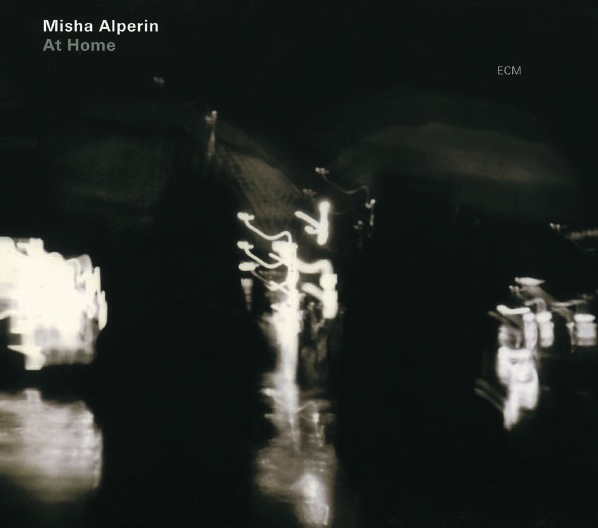
Misha Alperin: At Home (ECM 1768)

At Home

Misha Alperin
At Home

Misha Alperin piano
Recorded at home by Misha Alperin, February 1998
Edited and mastered at Rainbow Studio, Oslo
Album produced by Manfred Eicher

Misha Alperin has been something of a shadowy presence in the annals of ECM. His previous albums—namely, Wave Of Sorrow, North Story, and First Impression—marked him as an enigmatic musician of sparse yet effective language, at times of humor and gaiety. But if you want to know how the Ukrainian-born pianist’s heart beats, the forms his dreams take, let At Home be your looking glass. The aching lyricism of the title track, which opens this collection of improvised pieces, is all you need to know what’s going on: a private, reflective session surrounded by Alperin’s most familiar things. Recorded at his home in Norway, where he has lived for the past two decades, the program unfolds in a mosaic portrait of the artist in various stages of emotional awareness.

Remarkable about this album (and true also of Keith Jarrett’s Facing You) are the levels of evocation sustained throughout. It’s as if Alperin were letting himself fall and trusting in the piano strings to catch him in their net. It is inspiring to experience such breaking down of hesitations—to feel, for example, the subterranean forces of “Nightfall” digging so deep it almost hurts to imagine their visceral impact. In “Shadows” Alperin makes use of space as a brush artist would of ink, expressing much with little. Intermittent clusters and arpeggiated phrases share the piano’s natural resonance, stretching phonemes into the speech of “10th of February.” It is the album’s most figural piece, contrasting a circular left hand with a circling right: a night flight of unfathomable scope in under five minutes. Behind the winged structures of “The Wind” thrive unlived pasts, histories beyond the ken of the hermetic performer at the keyboard, lives whose implications are decades yet in knowing.

The album is not without its whimsy. A Norwegian folk dance provides the inspiration for “Halling,” which might have felt out of place in the program were it not for the integrity of its spirit. “Light” and “Game” bring further playfulness to the fore, in the former offsetting potentially ominous chords and in the latter rummaging through a toy chest of childhood relics. With these Alperin creates sparkling vignettes, one after another, until the outtake of “Njet” chambers the parent calling to the child, the husband to the partner, flowing down the hallways into light.

Susanne Abbuehl: April (ECM 1766)

April

Susanne Abbuehl
April

Susanne Abbuehl voice
Wolfert Brederode piano, harmonium, melodica
Christof May clarinet, bass clarinet
Samuel Rohrer drums, percussion
Recorded November 2000 at Rainbow Studio, Oslo
Engineer: Jan Erik Kongshaug
Produced by Manfred Eicher

All night the sound had
come back again,
and again falls
This quiet, persistent rain.
–Robert Creeley (1926-2005)

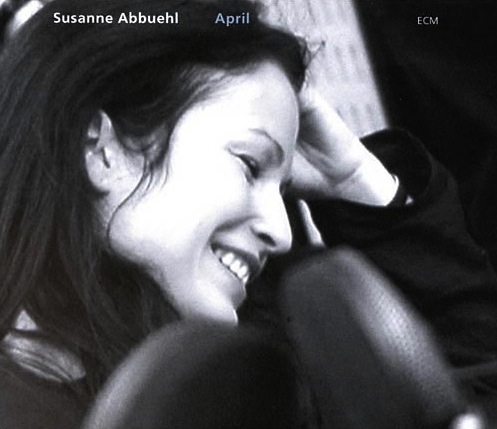
The ECM debut of Susanne Abbuehl is a verdant introductory résumé for which the Swiss singer-composer presents settings of poems by e. e. cummings and sets her own to the music of Carla Bley. Abbuehl comes from a long line of idiosyncratic chanteuses to have passed through ECM’s hallowed halls—including Sidsel Endresen, Norma Winstone, and Annette Peacock—and has left behind a veritable wing of artwork to admire at length. April carves out perhaps the most distinct of these exhibitions, and with “yes is a pleasant country” introduces us not only to her nesting textu(r)al approach, but also to the poetry of her synergistic band. Pianist Wolfert Brederode (who has since gone on to record leader dates for ECM), drummer Samuel Rohrer (also of Brederode’s quartet), and clarinetist Christof May together grow, needle by needle, the Christmas tree from which Abbuehl hangs her vocal ornaments. The simpatico between singer and sung is further palpable in her braiding with melodica and clarinet in “all i need,” for which its love guides her indigo words far into the heavens. “skies may be blue” and “yes” form a bonded pair. One is a meditation on spring, the other a field of rolling hills painted in wordcraft. Brederode’s composing and playing are exquisite in “maggie and milly and molly and may,” a litany of fleeting memories in which his pianism overshadows with a vocal quality all its own. The final cummings tribute comes in “since feeling is first.” This Abbuehl sings solo, a tribute to the poet’s later disavowals of punctuation.

Bley’s classic “Ida Lupino” gets a lyrical makeover, bringing out just one of countless stories hidden in its pathways: astute, a touch dark, and emotionally forthcoming. Brederode is something of a sage here, navigating the whimsical images therein: a tiger in the snow, a waning eye, a folding of the self into another’s embrace. “Closer” and “A.I.R. (All India Radio)” pitch more cargo onto the S.S. Bley, set adrift on moonlit waters. Beyond Abbuehl’s “together-colored moment,” precious jewels shine in anticipation. The air is as wistful as one’s naming of it, yet promises eternity in the bass clarinet’s deep pocket. The latter tune processes by virtue of Rohrer’s understated timekeeping. Among the more seamless weddings of voice and music the album has to offer, one can easily get lost in its wordless circumscriptions. (It also foreshadows the album’s closer.) Bley gets one last nod in “Seven,” for which Abbuehl places spoken verse—in her words: petal by petal, yet deeper than all roses—upon the heart’s altar.

Yet there is perhaps nothing so beguiling here than her re-imagining of “’Round Midnight.” Accompanied only by Brederode on harmonium, the tune creeps out from the darkness and shivers the very marrow. “Mane na” concludes the session by paying homage to Abbuehl’s Hindustani vocal training with a raga compressed to the scope of a teardrop.

Although barely acknowledged above, Rohrer’s delicate infusions haunt the landscape throughout, reaching, as Abbuehl recites, “somewhere I have never travelled, gladly beyond…” In those rhythms is a heart made of pages, thirsty for the next scratch of pen.

An auspicious label debut.

Alternate April
Alternate cover

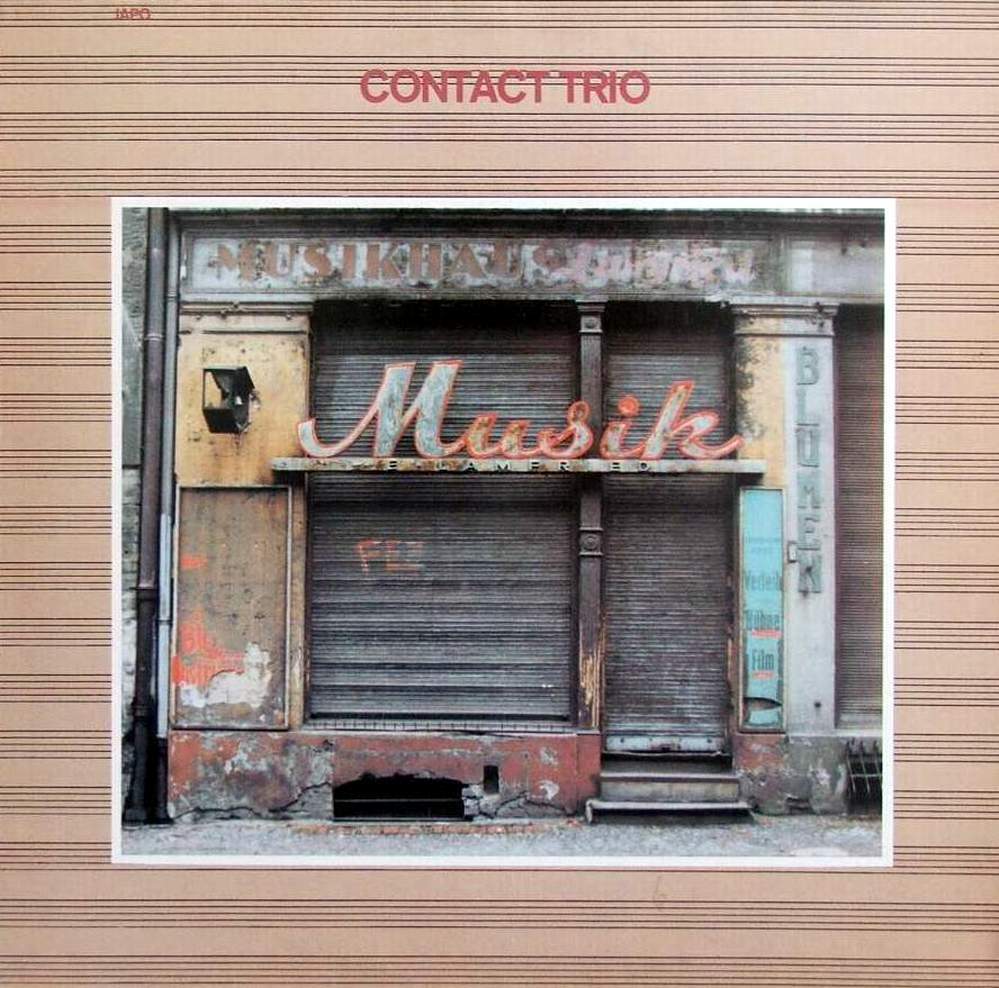
Contact Trio: Musik (JAPO 60036)

Musik

Contact Trio
Musik

Evert Brettschneider electric and acoustic guitars
Aloys Kott electric and acoustic basses
Peter Eisold drums, percussion
Recorded October 1980 at Tonstudio Bauer, Ludwigsburg
Engineer: Martin Wieland
Produced by Thomas Stöwsand

Musik was the second effort by the Contact Trio for ECM’s sister JAPO label. Inspired by the atmospheric developments of Wolfgang Dauner (see, for example, Output) and heavily invested in the softening distinctions between rock and jazz, the trio had by now perfected its rhizomatic sound in what was to be its final record. Here Peter Eisold takes the place of drummer Michael Jüllich, and the result is a truly aerobic experience.

The warm-up
The echoing guitar of “Air Lines” opens the session by straddling extremes of register and sharpness, and starts a snowball rolling down the bass’s equally resonant hill. Strangely, the ball doesn’t pick up speed for some time, but paces itself in a journey of textured reflection, tracing from each icy particle a possible trajectory of flight. Eisold’s unique percussive language is thus apparent. And then: traction as the rhythm section hurls the guitar to tell its story in anticipation of an untimely end.

The stretch
Muscles and tendons glow with flexion in “String Games.” Acoustic in hand, Brettschneider reflects on a past in which the only truth was a broken mirror. There is a feeling of dedication here, a deference to time at large for providing this opportunity to luxuriate in the creation of music. Like the first, this track hooks on to something more propulsive in the final minutes, only now running through the backstreets of a small Spanish town, chasing after a melody.

Lower body
“Daddy Longleg” is an invigorating turn featuring two overdubbed electric guitars and electric basses, each relaying torch light in palpitating dialogue with the other. Eisold again shines with colorful cymbal work that evokes nocturnal footfalls in the walls.

Core
From its title alone, “Simple Symphony” would seem to be an allusion to Britten’s work of the same name. The music provides an entirely different experience. From Brettschneider’s throbbing beats and elastic chording to the groovy trio unity achieved thereafter, it climbs every tree in its way like a squirrel on a mission. The rhythm section positively shines in gorgeous geometries, sliding from one signature to the next with the ease and comfort of a fountain pen.

Back
The spine gets is due attention in “Silence,” which curves in a protracted arch. Stained guitar and arco bass lead into a plunking dream of youthful flexibility, edging a ghost town with its metal detector until it finds two rusted guns from a shootout, long forgotten…

Chest and arms
“Elbow Dance” completes this full-body workout with a slog through cement that finds resolution and strange comfort in the hardening.

At the risk of belaboring all of this analogizing, Musik is an intensely physical record. Not only in the sense that it feels weighted and animate, but also for its permeable compositions. Each is a thoughtful assemblage of lines that no longer has need for points of origin. Together, these lines leave the listener with a lasting meta-statement of harmless transgression.

A gem in ECM’s apocryphal bin.

Laurie Anderson: An Instrument Unto Herself

Laurie

Laurie Anderson
State Theatre (Ithaca, New York)
September 21, 2013
8:00 pm

Laurie Anderson has been called many things: raconteur of the mundane, pop culture critic, electronics wizard, musician and composer. Yet, do not be mistaken: She is not a performance artist, but an artist of performance. Having placed some of the most harrowing social turns of the past four decades under her microscope, Anderson proves that individuals are not the constants of historical change. Rather, history attains a cyclical consistency, the agents and subjects of which are anomalies. The twenty-first century stands before us like a divining pool into which she cannot help but cast her soothing critiques to see how our reflections change. Her crafting of words thus reveals a cinematic imagination in the truest sense. As she once confessed in an interview: “I try to make records that are cinematic, movies that are musical.” The seen and the heard come from the same place.

Anderson is no stranger to central/upstate New York. Her stage debut, following a string of formative gallery exhibitions and writings on art, took place a stone’s throw away in Rochester where, in 1972, she premiered her outdoor symphony for car horns in The Afternoon of Automotive Transmission. Since then, her interest in the relationships between matter and space — specifically violin and voice, self and projection, microphone and venue — has come to define her role as a darling of the underground. Press surrounding Anderson has been rife with such characterizations, all the while ignoring the fact that she has been working above ground from the start. Firmly embedded in the goings on of society at large, her instincts have borne idiosyncratic approaches to language, multimedia  and sampling. Despite these innovations, she boasts no avant-garde badge — she is content to wander nomadically, solitarily, dropping crumbs for the weary.

As the title of her seminal 1982 record Big Science suggests, Anderson is no stranger to her right brain, a point invoked before Saturday night’s performance of her recent multimedia work, Dirtday! at The State Theatre. In his introduction, Museum of the Earth director Warren D. Allmon stressed the interconnectedness of art and science and championed Anderson for skirting the boundary between the two and softening that boundary along the way. That said, as the opening washes of her electric violin filled the hall, clearly something bigger than science was happening — an overt awareness of, and engagement with, the broader contexts in which her data streams multiply. Concertgoers presumably saw bits of themselves in those streams, swimming against the current in an effort to stand out. In this way, Anderson’s work lacks a clear center and allows listeners to anchor its assembly differently every time, and to be involved in its eternal unfolding.

Fascinating though Anderson’s musical details may be, more so are the here and now of the messages in which she is enmeshed, and the futures bought and sold along her avenues of thought. For the latter image we can thank Fenway Bergamot, the male alter ego Anderson has long cultivated on stage and in the studio. To achieve the transformation to Bergamot, she bends the pitch of her voice by electronic means to that of a masculine register in a process she calls “audio drag.” It is not an adoption of a character for her, but a coming into being (the inflections and pauses of that voice are distinctly her own). Over the years, Mr. Bergamot has grown into a less confident observer, one who questions the self by questioning others. The chisel of time has chipped away at his resolve, leaving him world-weary and mistrustful. His memories are fuzzier, his dreams murkier than ever before. As an integral narrator of the evening, he was also a harbinger of memory, his voice creaking like the floorboards in a house of regret.

Fenway
Fenway Bergamot, as depicted on the cover of Homeland

Topics covered in Saturday night’s show were even more diverse than the vocal registers Anderson utilized to articulate them. Everything from SIDS to New Jersey tent cities, from governmental scare tactics to reflections on Darwinian anxiety — even a video appearance by her artistically inclined Rat Terrier, Lolabelle, was fair game. Couched in a lush sound mix of distant thunders, beats and loops, the “everydayness” of her philosophies breathed earthiness into the most cosmic moments. Impossible childhood dreams shared the air with an array of electronic gadgetry, each unit a means to a beginning. Passages of analogue warmth butted up against sharper denouements, broken intermittently by her bow. The violin was at once her empty cup and an overflowing vessel, an omniscient presence that hovered at the edge of total integration with its performer’s body — a fantasy made reality when toward the end of the show Anderson placed a pillow speaker into her mouth and turned herself into a live instrument.

In her magnum opus United States, Anderson de-scribes a night drive, concluding, “Eventually it starts to get light and you look out and you realize you have absolutely no idea where you are.” It’s a haunting image, a quintessential moment of confusion in her archive. And yet, sitting there in Ithaca’s historic State Theatre in a sea of flesh, gray matter and mutual regard, it was difficult to imagine ever becoming lost in a world where true solitude has become a chimera. Bathed in soundscapes as affecting as they were constructed, we knew exactly where we were.

(See this article as it originally appeared in the Cornell Daily Sun.)

Jiří Stivín/Rudolf Dašek: System Tandem (JAPO 60008)

System Tandem

System Tandem

Jiří Stivín alto sax, soprano sax, flute, alto flute, recorder
Rudolf Dašek guitar
Recorded May 1974

Jiří Stivín is a true renaissance man. Widely involved as a classical musician in especially early and Baroque music circles, the flutist and composer is also one of the most highly regarded jazzmen of the Czech Republic. The son of an actress and an inventor, he has absorbed both of his parents’ talents, combining their passion for expression and utility in an immediately recognizable style. On System Tandem, he joins guitarist Rudolf Dašek, a partner in crime since 1971. This out-of-print session owes its verve to time spent at London’s Royal Academy of Music, which put Stivín in touch with the exciting jazz-rock fusions proliferating in the late sixties, and found him in the midst of Cornelius Cardew’s legendary Scratch Orchestra. His project with Dašek—probably the most successful jazz outfit to emerge from his homeland—enjoyed great festival circuit success on the continent and abroad. System Tandem came on the heels of a collaboration with bassist Barre Phillips, and the latter’s balance of form and spontaneity is certainly in the air. Dašek, who passed away in 2013 at the age of 79, was another stalwart of the Czech jazz scene known for crossing the genre divide. From his trio with George Mraz and Laco Tropp (among other drummers) to work as soloist before the Prague RSO, his dedication to new music was unflagging. Together, he and Stivín stayed true to that exploratory spirit, working alongside Pierre Favre and Tony Scott, big bands, and countless other configurations.

For its second album (following a debut on RCA Victor in Finland), System Tandem focuses the integrity of the music. Stivín pens the first cut and arranges the second. “Puddle On The Muddle” shows off the duo’s sense of light and shadow in a steely combination of registers. The lively interplay and ping-ponging of ideas allows Stivín to veer down wilder paths of squealing abandon in a robust opening gambit. The Moravian folk song that follows, “Forman Going Down The Valley” is the first of a few pairings of flute and guitar. The theme here is mountainous, painterly, and segues into the album’s remainder, all of which bears Dašek’s stamp. “Hey, Man (Let’s Play Something About Spain)” is the first standout and deepens the fluted streams of its predecessor. Buoyed by echoes of “Hasta Siempre” and quasi-flamenco touches, Stivín jumps into the deep end in another inspired solo turn. He speaks in tongues, becoming more vocal by the moment, for stretches abandoning the flute altogether. “What’s Your Story” mark’s the flute’s last appearance in a forlorn piece of restrained melodic shape. As it progresses, the virtuosity adjusts its sights a few clicks to the left. Stivín breaks out the soprano for “Shepherd Song,” evoking a dance party of undomesticated wildlife. This leaves us with the album’s pièce de résistance, “Puzzle Game.” For this marvelous foray into Baroque territory, Stivín plays a dizzying recorder against an invigorating Django Reinhardt rhythm. Dašek’s finger picking works wonders in the final stretch.

This rare gem is due for reissue not only for its content, but also because the lackluster engineering could do with an overhaul. At many points throughout, the guitar’s audibility is torn to shreds by Stivín’s sharp edges. This is especially true in “Hey, Man” and “What’s Your Story.” It’s as if Dašek were playing with his back to the listener, which makes him feel not so present and obscures his contributions. Thankfully, the recording levels are more graciously tweaked in the final track. Engineering caveats aside, the perks of System Tandem are in its well-muscled compositions. Building enough emotional resonance to undermine the need for a rhythm section is no easy trick for any unconventional duo, but Stivín and Dašek have no problems pulling the rabbit out of the hat.

To all you vinyl collectors, I say: Seek this one out.

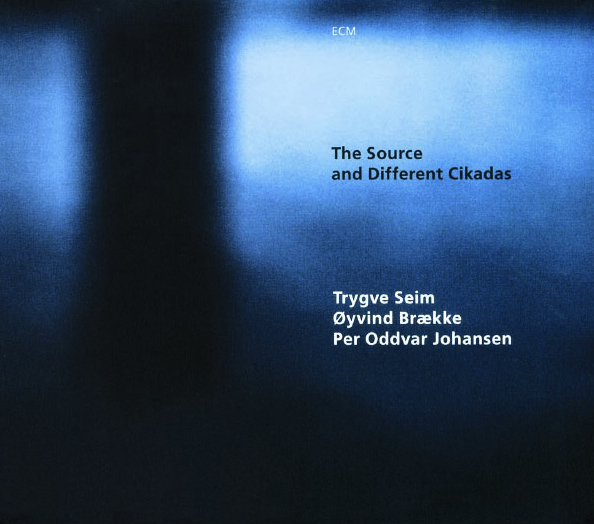
Seim/Brække/Johansen: The Source and Different Cikadas (ECM 1764)

The Source and DIfferent Cikadas

Trygve Seim
Øyvind Brække
Per Oddvar Johansen
The Source and Different Cikadas

Øyvind Brække trombone
Trygve Seim tenor and soprano saxophones, clarophone
Per Oddvar Johansen drums
Henrik Hannisdal violin
Odd Hannisdal violin
Marek Konstantynowicz viola
Morten Hannisdal cello
Frode Haltli accordion
Arve Henriksen trumpet
Christian Wallumrød piano
Finn Guttormsen bass
Recorded November 2000 at Rainbow Studio, Oslo
Engineer: Jan Erik Kongshaug
Produced by Manfred Eicher

Norwegian saxophonist Trygve Seim presents another facet of his musical diamond with the Source, a band he leads with trombonist Oyvind Brække and drummer Per Oddvar Johansen. Notable for bringing together the Cikada Quartet, of which cellist Morten Hannisdal had already played with Seim on Different Rivers and Sangam, and pianist Christian Wallumrød, along with mainstays Arve Henriksen on trumpet and Frode Haltli on accordion, the present session draws out music of a spongier texture, something more prone to dances than to rituals.

The compositional credits are fairly well distributed, with four coming from Seim’s pen. Generally, his are viscous, pathos-rich becomings. “Organismus Vitalis” puts the world under a microscope and revels in all that wriggles in its enlightening circle. In this regard, and by virtue of its floating sensibilities, one might easily connect the dots to Terje Rypdal’s chamber pieces or even to the diffuse scenography of David Darling’s solo ventures—such are its darkly inflected beauties. The Cikadas ebb and keep on ebbing, inching ever closer to shoreline structures as Johansen’s nuanced descriptions ever so barely edge the frame. An auspicious, postludinal beginning to an album of rich variety.

Seim’s thematic voice achieves deeper traction in such tunes as “Bhavana” and “Obecni Dum.” In both, the strings play a vital role in shaping the contexts in which, respectively, saxophone and accordion find purchase. Whether the slide of Seim’s earthy song or the moth-like pursuit of Haltli’s accordioning, there is in all of it something sacred. Even the restless “Fort-Jazz” brings with it a consistency of atmosphere, a fox hibernating in want of rampant spring.

Johansen brings that thaw with three pieces of starkly agitated character. In both “Mmball” and “Deluxe,” his drums are front and center. The latter especially recalls Hal Russell’s exuberant storytelling, all the while heightening the strings’ integration. Bisecting them is “Funebre,” an excerpt from Witold Lutosławski’s 1964 String Quartet that breathes with much the same looseness of structural integrity. This leaves “Uten Forbindelse,” a jazz spring ever on the verge of uncoiling toward infinity. Brække is the clear winner here, spawning as he does an outpouring of spirited exchanges and merging with Seim until the final trill sets them free.

The trombonist, in fact, edges past his co-leaders with five pieces to his name. Brække’s work lies somewhere between that of Seim and Johnansen, balancing the former’s weathered sound with the latter’s spontaneity to varying degrees. Notables include the whimsical “Flipper,” which takes full advantage of the group’s sound colors, and “Plukk,” which charts a subtle interplay of light drumming, pianism, and pizzicato filigree. “Sen Kjellertango” is another eye-opener, a slinky groove anchored by cello and punctuated by soprano saxophone, trumpet, accordion, and drums to dazzling effect.

Two free improvisations round out the set list. Wallumrød and Johansen touch off “Number Eleven” with their patience, overturning stone after stone, until the promise of subterranean force pushes through like a bud. The surrender is tender and blends into surrounding forest like a hunter. “Tutti Free” brings us back to a winter wilderness, dotted by fresh footprints of escape.

Those who enjoyed Bent Sørensen’s Birds and Bells may want to give this one a test spin. The scenography Seim has constructed here is of the highest integrity and practically assures the bending of a curious ear.

Alexander Knaifel: Svete Tikhiy (ECM New Series 1763)

Svete Tikhiy

Alexander Knaifel
Svete Tikhiy

Keller Quartett
András Keller
 violin
János Pilz violin
Zoltán Gál viola
Judit Szabó cello
Oleg Malov piano
Tatiana Melentieva soprano
Andrei Siegle sampler
In Air Clear and Unseen recorded October 2000 at Radio Studio DRS, Zürich
Engineer: Peter Laenger
Svete Tikhiy recorded1994/95 at Film Studio Lenfilm and 1997 at St. Petersburg Recording Studio
Engineers: Mikhail Shemarov, Victor Dinov, and Andrei Siegle
Produced by Manfred Eicher

Nature is not as you imagine her:
She’s not a mold, nor yet a soulless mask—
She is made up of soul and freedom
She is made up of love and speech…
–Fyodor Ivanovich Tyutchev (1803-1873)

For its first conspectus of St. Petersburg-based composer Alexander Knaifel, ECM presents  Svete Tikhiy (O Gladsome Light). Side by the side, the program’s two works—each a triptych—seem vastly different in scope. And perhaps they are on the surface. But they are also part of an ongoing braid of interest on the part of the composer in what is lifted from the score and held in the spirit of the performers to whom he entrusts interpretation: in essence, the reading of the word. For this recording, the word comes to us both lower- and uppercased.

The former flexes its waking hour throughout In Air Clear and Unseen (1994) for piano and string quartet, peeking from behind the Orthodox veil through which Knaifel’s music is often so diffused. Steeped in the poetry of Fyodor Tyutchev, each tableau reads through gestures of slowly measured time. “In Some Exhausted Reverie” begins in Silvestrov-like fashion: with a piano postlude. It touches the ether with a delicacy so organic it almost falls away by merely being gazed upon. Its stillness may be illusory, but the potential emotional connection it makes with the listener flows into the ribcage and finds room to conform.

If encouraged to compare, one could cite Pärt’s Alina as an analogous atmosphere, if only for its breathing room. Distinct here is the feeling of something titanic, as if an entire history were being grappled with in a single note. All of which makes the opposite point: that there is never just one note, for each is a combination of many more, and those of still others. The air is unseen, yes, but it can be felt. It is a field of touch. Hence the tactility of Knaifel’s performers, whose own lives are filtered through their contact with the music. Instructed as they are to intone that which is ultimately “unvoiced,” the instrumentalists embrace each living moment with their entire being, itself a resounding instrument of warmth and illumination.

The central section, “An Autumn Evening” (for string quartet), finds a more distant analogue to the music of Tavener, whose The Last Sleep of the Virgin is also of Byzantine cast (and, coincidentally enough, composed the same year as the accompanying work on this disc). The lucidities of both shimmer in slow motion. Unique to Knaifel’s aesthetic is the unity of the assembly: the quartet is one flesh, a portrait of humanity drawn through what he calls “chain breathing.” The combination becomes something of a filter through which death renews life. It is the dreamed-of ribbon still in hand upon waking. The final section marries these two impulses, pulling childhood memories like a hood against blasphemy and lighting many candles from a single, originary flame.
The title composition, Song of the Most Holy Theotokos, is composed for soprano Tatiana Melentieva and sequencer. The eponymous hymn, which appears only at the end of the piece, is among the oldest Christian hymns, a folding of light into Christ and both into the world. It is force of life, but also agency of solace. Here the self-reflexivity of the replenished soul is expressed in the electronic manipulations and multi-tracking of Melentieva’s voice. The result is a ponderous, overtly crafted chorus of the self, giving way to echoing caverns of implosion. These, in turn, impart life to the openness of God. From mantra-like quivers and resonant tongues to the rounded grace of the central unaffected voice, it turns lullabies into dust and dust into starlight. And as the final fragments blur skyward, worship becomes a shroud for the ears.

On the whole, Svete Tikhiy is also a master class in engineering. Were the content not afforded the spaciousness it deserves, its inner voices might never reach us. This is not to say that technology adds something not already there, only that it brings out inherent tendencies toward infinite expression. The echo becomes a primary signifier of its referent, but also something more: a reference in and of itself to yet another echo, ad infinitum.