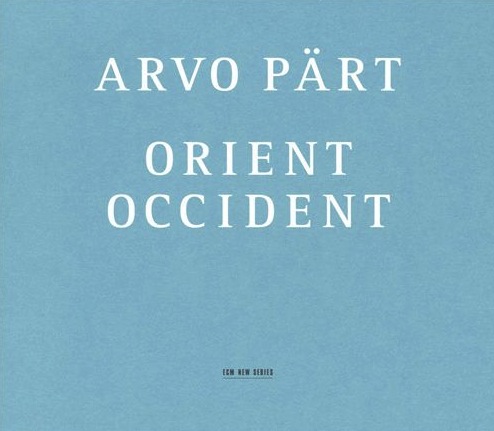
Arvo Pärt: Orient & Occident (ECM New Series 1795)

Arvo Pärt
Orient & Occident

Swedish Radio Symphony Orchestra
Swedish Radio Choir
Helena Olsson soprano
Tõnu Kaljuste conductor
Recorded May 28 – June 1 2001, Berwaldhallen, Swedish Radio, Stockholm
Engineers: Jan B. Larsson, Anders Hägglöf, and Rune Sundvall
Produced by Manfred Eicher

The name of Arvo Pärt has become something of an institution in the consumer culture of classical music. The “New Spiritualism” heralded by such seminal recordings as his Tabula rasa and Te Deum crystallized a sentiment that listeners were craving in the ruins of a postmodern malaise. Yet with this music came a host of expectations: it was supposed to heal us, guide us to an inner light, and provide an inexpensive and convenient means of achieving (temporary) peace. It was something to rely upon, a sonic friend that would never leave us. In believing this, however, we began to lose sight of our own powers and the tremendous dependence we were placing upon recorded media to wrestle with moral dilemmas in our stead. Beautiful and, yes, spiritual though these media are, they can never be a substitute for the enlightenment we read into them.

The frame of Orient & Occident captures the dark side of Pärt’s compositional moon. Stand too close to it, and its darkness overwhelms; too far and it becomes a mere block of shadow. Wallfahrtslied (Pilgrim’s Song), a German setting of Psalm 121, positions us at a median distance and allows us to appreciate the best of both worlds. Composed in 1984 in memory of the composer’s close friend, Estonian director Grigori Kromanov, and since revised for men’s choir and strings, it is a harrowing slice of emotion. The music seems to grit its teeth in a slow, seething discontinuation as voices lay themselves at the orchestral altar. Strings try to remain passive, yet cannot help but break free from their subordinate position with cries of supplication. Before long, they stretch themselves into the thinnest of layers, through which one may see the translucence of the “self” and the “other” and acknowledge that the same light passes through and gives both substance.

The seven-minute title composition, penned in 2000, is for strings only and continues the path that Pärt first began laying with Psalom and Trisagion. It is a grand statement, to be sure, but works its effect through tiny sonic miracles and primes us for the sojourn that awaits us in Como cierva sedienta (1998), a Spanish setting of Psalms 42-43 for women’s choir and orchestra. Exquisite winds recall 1989’s Miserere and rock like a cradle for soprano soloist Helena Olsson’s spiraling invocations. This is music firmly entrenched in its surroundings, while also content to break free from its compulsory resolutions. Strictly choral passages add pastoral unrest. Words tumble out of their own volition, filled with outbursts and infectious proclamations. Like the soul in this final Psalm, downcast even in the light of salvation, I realize that I fall into traps only of my own making. Every time I pull myself out of one, I am reminded that sounds like these are more than incidental to that struggle. Rather, they embody it to the fullest, a collective reminder of the physicality of living experience and the lessons it provides.

The title of Pärt’s eighth ECM album makes me think of colonialism and its feeble justifications for subversion. That being said, I don’t think this is what the music is about. It deals instead with the gap that links these two words and the sacrifices that fill it with song. It is the blood flowing through that emptiness, and we the plunger pulling back to suction out the contagion of enslavement that prevents us all from staring into the face of love.

<< Frode Haltli: Looking on Darkness (ECM 1794 NS)
>> John Surman/Jack DeJohnette: Invisible Nature (
ECM 1796)

Kenny Wheeler: Deer Wan (ECM 1102)

ECM 1102

Kenny Wheeler
Deer Wan

Kenny Wheeler trumpet, fluegelhorn
Jan Garbarek saxophones
John Abercrombie electric guitar, electric mandolin
Dave Holland bass
Jack DeJohnette drums
Ralph Towner 12-string guitar
Recorded July 1977 at Talent Studio, Oslo
Engineer: Jan Erik Kongshaug
Produced by Manfred Eicher

Among Kenny Wheeler’s cleverly punned titles, Deer Wan takes the cake. For his second ECM album as headliner, the prodigious trumpeter/fluegelhornist serves up a set of four originals—three long and one short—sure to enliven any morning routine or Sunday afternoon alike. The top-shelf cast reads like a who’s who of ECM’s best and brightest: Jan Garbarek on saxophones, John Abercrombie on electrics, Dave Holland on bass, Ralph Towner on his ever-present 12-string, and Jack DeJohnette at the drums. Wrap this in the splendid engineering of Jan Erik Kongshaug and you get unquestionable sonic bliss.

The 16.5-minute “Peace For Five” is an album in itself and provides an ideal launching pad for Wheeler’s astonishing lyricism. A somber aside from Holland and not-so-somber acrobatics from Abercrombie and Garbarek all contribute to a richly flowing tapestry in this epic opener. Wheeler and company tear a page from the book of Enrico Rava with “3/4 In The Afternoon.” Like a stroll through lush gardens, one finds in it a veritable ecosystem of visual and melodic ideas, compressed into a single brass-gilded flower. Towner’s reverberant plush underscores the warmth within. As we swing over into night with “Sumother Song,” Garbarek’s liquid tenor evaporates into its own swan song with only a tinkling of cymbals to mark where it once stood. But this, we soon discover, is only a pause before DeJohnette’s beautifully corrugated rhythms unfold beneath a soaring fluegelhorn. After a windy introduction, the title track quickly weaves itself into an upbeat welcome mat on which we wipe our feet as if after a long journey. Buffeted soloing all around brings us full circle to a state of renewed appreciation for that which we’ve always known.

Deer Wan is an unsung masterpiece of smooth jazz with just enough sharp edges to leave an unforgettable scar or two. A most endearing album for those who like a shot of whiskey in their musical coffee.

<< Gary Peacock: Tales Of Another (ECM 1101)
>> Jack DeJohnette’s Directions: New Rags (ECM 1103)

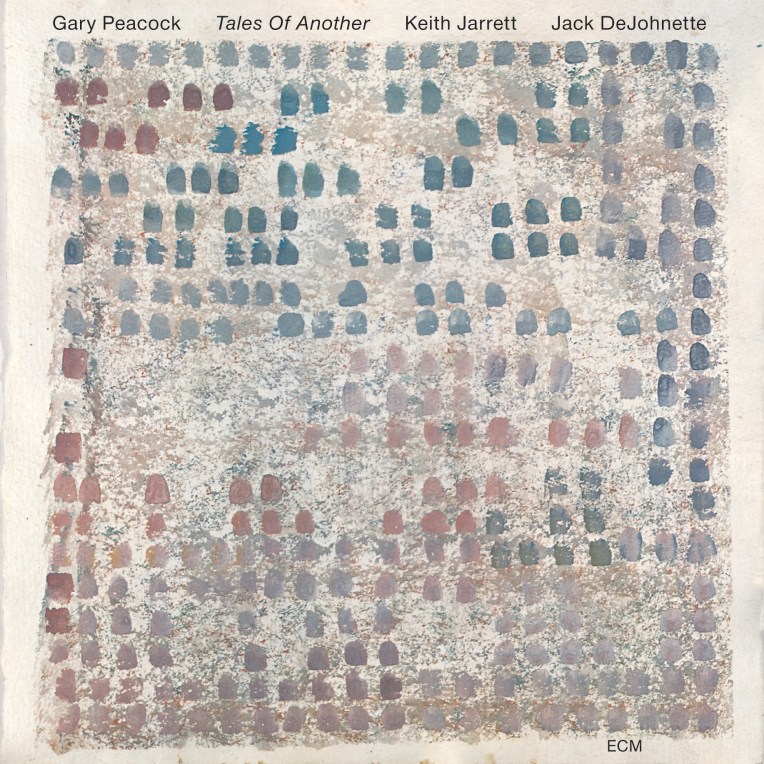
Gary Peacock: Tales Of Another (ECM 1101)

ECM 1101

Gary Peacock
Tales Of Another

Gary Peacock bass
Keith Jarrett piano
Jack DeJohnette drums
Recorded February 1977, Generation Sound Studios, New York
Engineer: Tony May
Produced by Manfred Eicher

The grouping on this album represents a milestone in ECM outfits, persevering to the present day as it has in the form of Keith Jarrett’s mighty standards trio. Though a far cry from the ecstatic overloads honed over years of synergy and touring, there is an almost naïve charm to this effort and the evenhanded musicianship that sustains it. Each of these six “tales” begins in loveliness. Piano and bass bring the most urgency to bear, as in the gorgeous “Vignette,” in which Peacock gets his first lilting solo, and its follow-up, “Tone Field.” Both start off slow and sure, with DeJohnette giving the barest hint of traction and Jarrett biting deeply into fractured themes. “Major Major” gives us the steady beat we crave beneath majestic chording from the piano man, who offers up a prime slab of linear sirloin. Yet the album’s juiciest sediments can be found in the massive “Trilogy” that makes up its second half. DeJohnette skirts the rims with requisite flair while Peacock slathers on a bright veneer. Jarrett grunts ecstatically with every new development, shooting fire from his fingers. Such is the energy one has come to expect from this nonpareil threesome. Jarrett cuts off our air supply before the final stretch, the hair-trigger precision and on-your-toes syncopations of which make this pensive journey more than worth taking.

Peacock’s moody compositions make for a strikingly different experience. His fingers pull with accomplished ease at the strings of his bass. DeJohnette sticks to the margins, but fills them like no one else can. Jarrett, it might be noted, is more vocal here than I’ve ever heard him. For many, this seems to be the album’s only downfall. As far as this listener is concerned, his woops, grunts, and squeals merely underscore a musician who is unafraid to let his heart sing.

<< Keith Jarrett: Sun Bear Concerts (ECM 1100)
>> Kenny Wheeler: Deer Wan (ECM 1102)

Tom van der Geld: Path (ECM 1134)

ECM 1134

Tom van der Geld
Path

Tom van der Geld vibraharp
Bill Connors guitars
Roger Jannotta flute, soprano saxophone, oboe
Recorded February 1979 at Tonstudio Bauer, Ludwigsburg
Engineer: Martin Wieland
Produced by Manfred Eicher

Path brings together guitarist Bill Connors (fresh off a stint with the Jan Garbarek Group on Photo With…), Carla Bley Big Band regular Roger Jannotta on winds, and vibraphonist Tom van der Geld for a network of pellucid improvisations entwining the barest of compositional skeletons. Connors’s twangy steel drops us immediately into an ethereal sound-world with “One,” mediating a pleasant conversation between flute and vibraphone. Thus begins a kaleidoscope of duets, trios, and quartets (the latter courtesy of some non-intrusive overdubbing). Mallets provide a resonant trunk in “Eevee,” from which branches Connors’s crisp foliage, all of it animated by the breath of a majestic flute. This blends smoothly into the pastels of “Joujou,” where familial nostalgia abounds. The title of “Michi” is Japanese for “path,” which makes it the title track by way of translation. Jannotta switches to soprano sax in this new enigmatic territory, landmarked by gossamer flags and empty way stations, before fluting a veil of Aeolian sounds over our ears. “Joys And Sorrows” works stretches our heartstrings and plucks each with the gentility of a raindrop on a spider’s web. Two ghostly guitars shine inside its nocturnal halo of vibes, bisected by soprano with a comet’s grace.

Like a meteor shower, one spends a long time waiting for excitement in Path, only to realize that the pregnant darkness to which one has held such rapt attention harbors far greater wonderment. As one of ECM’s most transparent statements, this positively exquisite album is an easy candidate for president of the label’s Bizarrely Out of Print Club. Find it any way you can and be moved, as you will.

<< John Abercrombie Quartet: Arcade (ECM 1133)
>> Jan Garbarek Group: Photo With… (ECM 1135)

John Abercrombie: Characters (ECM 1117)

ECM 1117

John Abercrombie
Characters

John Abercrombie guitars, electric mandolin
Recorded November 1977 at Talent Studio, Oslo
Engineer: Jan Erik Kongshaug
Produced by Manfred Eicher

Just four months after the historic Gateway 2 session, John Abercrombie stepped into Oslo’s Talent Studio to record Characters, his first and only solo album for ECM. While the guitarist’s trademark electric lurks here and there, a modified mandolin takes the strongest lead. The album also features about as much acoustic as one is likely to hear from Abercrombie in one sitting. All of this makes for sonic perfection.

At nearly 11 minutes, “Parable” is the longest cut on the album. A plaintive mandolin seems to stretch its strings as Abercrombie adds almost sitar-like cadences until, about halfway through, we realize this is but the stem of an overarching flower, which reveals its full bloom in an acoustic umbrella. With peerless thematic acuity, Abercrombie reconfigures his melodic matrix in “Memoir,” a nostalgic acoustic duet, each channel part of a spontaneous conversation. It is the most fleeting track on the album, but also the most intuitive. Next, Abercrombie transmits a “Telegram” straight into our souls. Like the message of its title, it is formless during transmission, but arrives in tangible form through the advent of technology, of which performance is Abercrombie’s medium of choice. His involuntary humming harmonizes with itself in a subconscious overdubbed chamber choir. “Backward Glance” recalls the title of Steve Kuhn’s classic tune. Dense acoustic chording spins powerful thermals upon which Abercrombie spreads his electric wings, drawing a feathered curtain over our eyes in the final strum. The spindly diversions of “Ghost Dance” percolate like anesthesia through the bloodstream before “Paramour” makes its debut as another acoustic duet (Abercrombie would soon resurrect it at the heart of his first quartet album, Arcade). More of the same awaits us in “After Thoughts,” where every pause feels like a deep breath that is at last exhaled in a luxurious chord. Lastly, through the liquid sheen of “Evensong” we catch visions of ourselves at different ages. After a silence, an acoustic hand opens its fingers wide as one electric swells in accompaniment and the other glides like a stingray for a sublime finish.

The album’s title is a prescient one. In addition to glyphs on a writing surface, “characters” are people, animals, or any other living creature whose desires animate a story. They might also be the traits of those creatures, or even the morals that define their personalities. Here, we encounter all of these and more, threaded ever so genuinely by one musician’s unique sense of space-time. For anyone wishing to peer into the soul behind the sound, let this be your window.

<< Egberto Gismonti: Sol Do Meio Dia (ECM 1116)
>> Jan Garbarek: Places (ECM 1118)

Juliane Banse/András Schiff: Songs of Debussy and Mozart (ECM New Series 1772)

Juliane Banse
András Schiff
Songs of Debussy and Mozart

Juliane Banse soprano
András Schiff piano
Recorded January 2001, Reitstadel, Neumarket
Engineer: Stephan Schellmann
Produced by Manfred Eicher

Sometimes one can set aside the reputations of composers and simply enjoy their music. This recital of songs by Mozart and Debussy, performed by an equally unlikely pair in pianist András Schiff and soprano Juliane Banse, however, simply overflows with its creators’ indelible marks. With a hefty dose of poetry, from French symbolists to Goethe, at hand, we’re the lucky ones who get to connect the dots in a constellation of unusual proportions.

Schiff’s well-spaced articulations and Banse’s meticulous control of tone make for a most fitting vehicle for the evocative Beau soir (Beautiful evening) of Debussy that introduces the program. Clair de lune (Moonlight) very much recalls the songcraft of Poulenc and enchants with its opening line from Verlaine: “Your soul is a chosen landscape…” Such cerebral storytelling continues through Pierrot to the equivocal Apparition. Dissonances in En sourdine (Muted) and the almost Carmen-like pastiche of Fantoches (Marionettes) add bolder hues. Verlaine’s careful words reappear in C’est l’extase langoureuse (It is languorous ecstasy), in which Banse pines:

This soul which mourns
In the subdued lamentation,
It is ours, is it not?
Mine, say, and yours,
Breathing a humble anthem
In the warm evening, very softly?*

These songs are not without their programmatic gildings, as in the cascading pianism of Il pleure dans mon cœur (Tears fall in my heart) and the thrilling chording of Chevaux de bois (Merry-go-round). Many adjectives come to mind when trying to describe these miniatures, but the one that resounds most for me throughout this recording is: clear. Like fresh light poured upon the morning fields, they nourish like no other stimulant.

Where Debussy works in more horizontal, sinuous gestures, Mozart brings potent verticality. Though a few of his Lieder, such as Warnung (Warning), bristle with the stately charm we popularly associate with the Salzburgian wunderkind, we cannot help but be delighted by the playful strains of Der Zauberer (The sorcerer), which likens the flames of passion to the dark magic of an eager pursuer. The little fable of Das Veilchen (The violet) gives voice to the desires of its titular flower, who spots a frolicking shepherdess. The violet dreams of being plucked and pressed to her bosom, only to be trodden as she skips ignorantly past. Its last sentiments:

“If I must die, at least I die
Through her, through her,
Here, at her feet!”

The recital closes with Abendempfindung (Thoughts at eventide), in which Joachim Heinrich Campe bids his loved ones not to fall too deeply into grief upon his death, promising to be there with open hands to carry them into heaven:

Bestow a tear on me and be
Not ashamed to weep for me,
For this tear shall be the finest
Pearl within my diadem.**

These songs are simply fascinating, and all the more so for being programmed together. Within them are many discoveries to be had. Banse and Schiff are so exacting that one almost imagines the music as having been written for them. An altogether captivating album that is as capricious as it is austere.

* Translation by Winifred Radford.
** Translation by Lindsay Craig.

<< Alexei Lubimov: Der Bote – Elegies for Piano (ECM 1771 NS)
>> Giya Kancheli: Diplipito (ECM 1773 NS)

Zehetmair Quartett: Schumann (ECM New Series 1793)

Zehetmair Quartett
Robert Schumann

Zehetmair Quartett
Thomas Zehetmair violin
Matthias Metzger violin
Ruth Killius viola
Françoise Groben cello
Recorded August 2001, Radio Studio DRS, Zürich
Engineer: Stephan Schellmann
Producer: Manfred Eicher

Composed during the summer of 1842, Robert Schumann’s three string quartets bear dedication to Felix Mendelssohn and are his only chamber works without piano. A few years before their appearance, while sitting in on a series of quartet rehearsals led by Mendelssohn’s friend and concertmaster, Ferdinand David, Schumann was first struck by the greatness that Ludwig van Beethoven had brought to the form. Determined to match that greatness, he found himself obsessed by “quartettish thoughts” and ready to tackle the form at which he had long desired to try his hand. He set out on the daunting task of writing his first quartet. Sadly, this piece did not survive, but we do have the subsequent threesome that is his Opus 41, of which two have been recorded for this instant reference recording.

Schumann struggled with inner demons all his life in a constant balancing act between his burgeoning romanticism and intellectual acumen. It was only in Beethoven’s titanic and immovable reputation, says Martin Meyer in his liners, that Schumann turned to both internal and external sources for inspiration. Where Beethoven’s “absolute” approach seems to cast the greater shadow, this is as much due to the inordinate amount of light shed upon it as to any inherent superiority. Schumann’s programmatic idiosyncrasies provide as much fascination, and these the Zehetmair Quartet brings out at every turn.

The fluidity of the String Quartet No. 1 in A minor is surpassed only by that of the performance itself. The Mendelssohn-influenced Scherzo brings the gelatinous bones of the Introduction to vibrant life with palpable connective tissue. The results are playful yet graceful, honed in rustic elegance in spite of their aristocratic borrowings. After a speculative Adagio, we arrive at the scraping violin and resplendent tutti passages of the Presto. Such alluring energy leaves us in need of the Andante that opens the String Quartet No. 3 in A major. A beautiful legato theme, eerily similar to the central oboe/flute passage in Tchaikovsky’s “Waltz of the Flowers,” emerges in the violins. Zehetmair moves like a breeze across water, while the others capture every wave of sound with unbending accuracy. Muted strings in the second movement build to a rousing density that is easily the disc’s highlight. Pizzicato strings enchant in the third, while the masterful Finale inspires with its urgency.

With the string quartets Schumann tightened his grasp of modality in a careful exchange of sentiment. There is what Meyer calls a “clouded lyricism” throughout these ternary works that is enhanced all the more by the enlivening performances on this recording. And while the fact that it won the Gramophone Award for Album of the Year is no small consolation prize, it seems but an afterthought when reeling from the music that earned it.

<< Anouar Brahem: Le pas du chat noir (ECM 1792)
>> Frode Haltli: Looking on Darkness (
ECM 1794 NS)

Gideon Lewensohn: Odradek (ECM New Series 1781)

Gideon Lewensohn
Odradek

Auryn Quartet
Matthias Lingenfelder violin
Jens Oppermann violin
Stewart Eaton viola
Andreas Arndt cello
Alexander Lonquich piano
Gideon Lewensohn piano
Recorded February 2001 at Radio DRS, Zürich
Engineer: Stephan Schellmann
Produced by Manfred Eicher

Israeli composer Gideon Lewensohn splashes onto ECM New Series with Odradek, a program of intriguing, sometimes perplexing, but always gripping music. The Piano Quintet is exemplary of Lewensohn’s odic approach, paying homage to his own brother Micah, as well as to György Kurtág, the Hilliard Ensemble, George Rochberg, and Dmitri Shostakovich. And while more than a smidgeon of each movement’s namesake is palpable, even more so is the freshness of a unique voice in contemporary music. These are not the seemingly perfect circles of ripples in a pond, but rather the jagged and frothy edges of an immeasurable shoreline. The first movement is a cycle in reverse. Violins pull like hands from a gooey mass clutching the prize they so desperately sought, only to realize that its virtues have all but been destroyed in the process of discovery. The second movement skitters like glass, shifting through high harmonics and mysterious refractions. In the third movement the cello at last groans from the underworld. With the circling birds of high violins now gone, it is free to peek its head above the surface and divine its own shadow. The fifth movement is the most violent, its controlled chaos spiraling ever downward into magma. These honorary fragments continue in the title quartet with further nods to Giya Kancheli, Witold Lutosławski, and Gustav Mahler, among others. Other descriptors are more subjective, charting moments of paranoia, drunkenness, and distortions of time. Still others bear whimsical subtitles like “Sarabandoned” and “Epiloque.” Each is a drip through a semantic IV in which the sublime and the violent are equal medicine. Bookending the Quartet are two iterations of the Postlude for piano. With every protracted fall into joy, moments of dynamic increase seem more like extensions of a default quietude rather than ruptures of it.

To be sure, Odradek is an uneasy place to be, but one that offers up its own fascinations with contemplation. The music responds just as well to abandonment as it does to undivided attention and maps its footsteps on the bodies of each high-caliber performer. Instruments are re-clothed and compressed into seeds before being scattered across a barren field that only now flourishes to make up for lost time. We are the reapers here, our scythes raking together every husk of this brilliant crop.

<< Keith Jarrett Trio: Inside Out (ECM 1780)
>> Thomas Demenga: Hosokawa/Bach/Yun (
ECM 1782/83 NS)