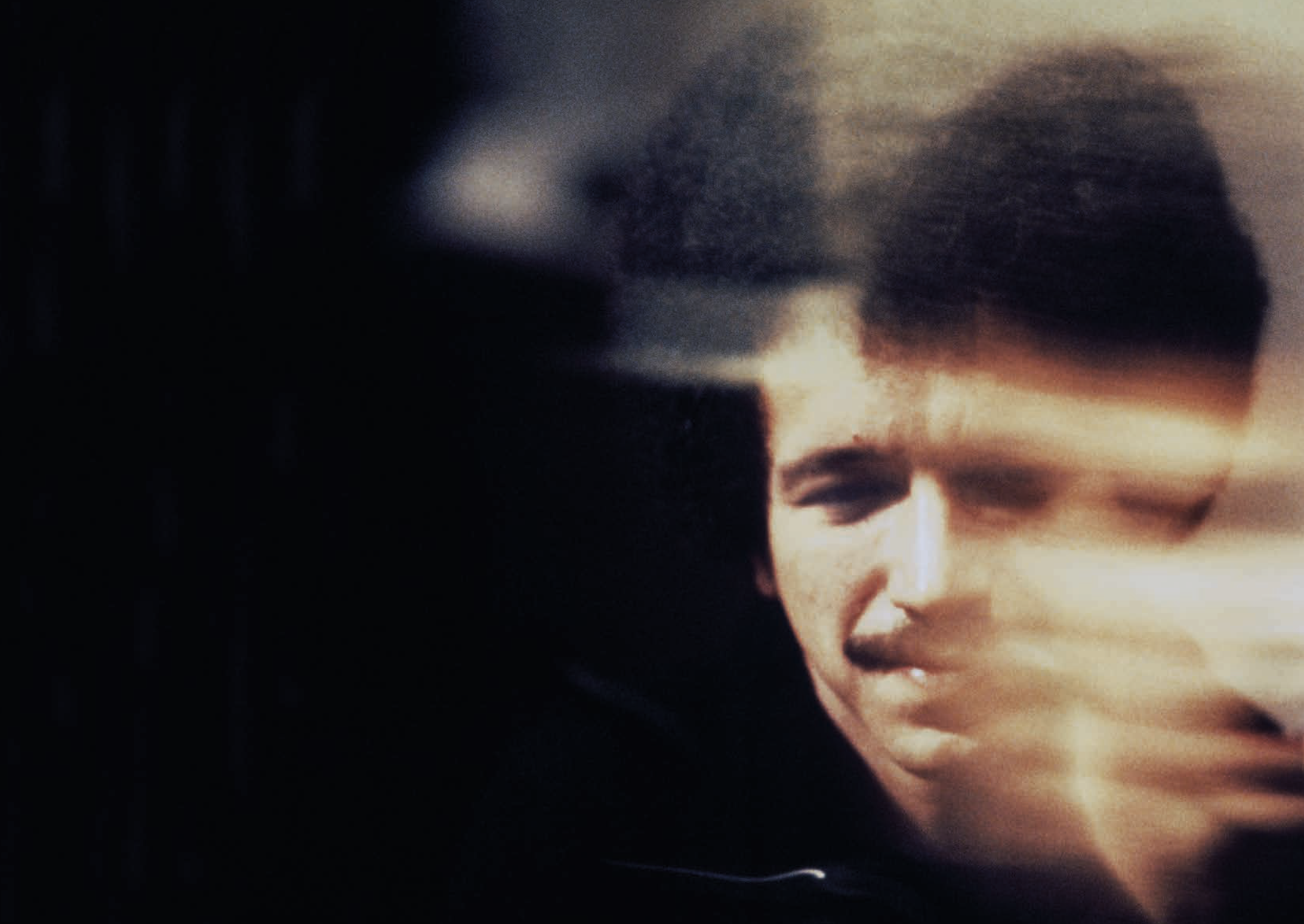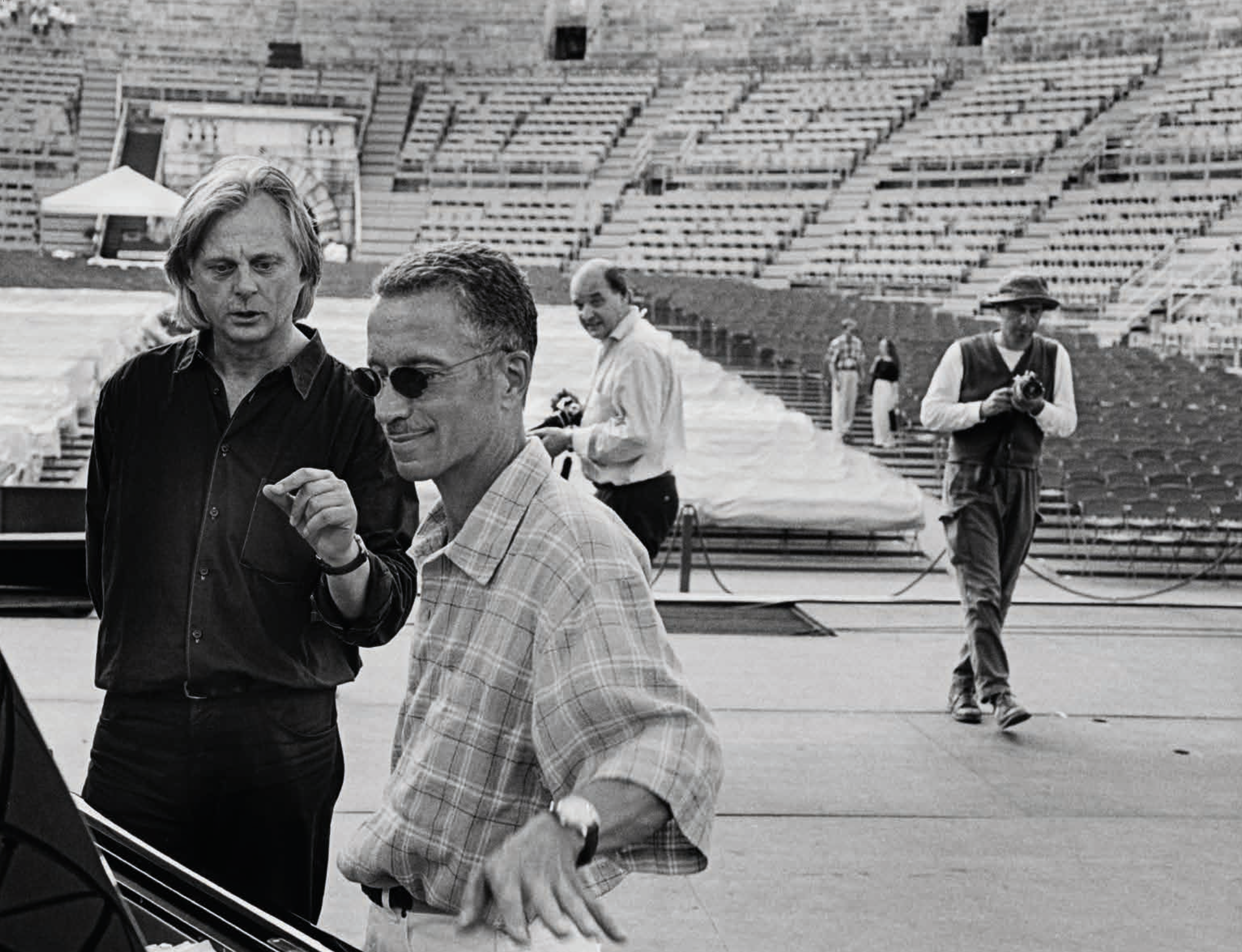
Michael Pilz: Facts for Fiction / Parco delle Rimembranze (INDEX 027)

“On the one hand life, on the other hand descriptions.”
–Friedrich Nietzsche

In front of Michael Pilz’s lens, the world is both witness and companion. The camera does not stand apart; it attunes itself to movements of light across a street when no one cares to notice. Christa Blüminger is right to position Pilz outside the usual pantheon when she writes: “In Pilz two radical cinematographic tendencies merge: the belief in the realistic quality of the filmic image (film as a trace of reality) and that of knowing about the artificiality of the material (film as a way of creating reality.” His works reject monumentality and mastery, cultivating instead a fragile attentiveness that feels almost pre-modern in its patience. He gathers encounters the way some collect rocks, each one carrying a trace of the larger landscape. Nietzsche’s epigraph becomes a quiet challenge as Pilz traces the seam where life and description merge.

Was übersetzt ist noch nicht angekommen (Facts for Fiction, 1996) begins with the kind of mishap only the unscripted can supply. Jeff Perkins, the New York taxi driver Pilz intends to follow through a night, locks his keys inside the cab before they can even begin. This simple inconvenience becomes the gateway to the rhythm of life. Perkins must borrow another taxi to collect a spare key, and already the night fills with negotiations: the cost of the ride, the weight of the workday, the precarious intimacy of two men in the backseat sharing space before they share a story. They grumble about passengers who can afford generosity but withhold it, and they reflect on the strange proximity that arises when strangers climb into one’s moving workplace and either speak freely or retreat into silence.

Once Perkins is back in his own cab, the film finds its heartbeat. Encounters pockmark the night, each one ordinary yet illuminated from within. Perkins has the temperament of a storyteller, although he never performs for the camera. He tells passengers he is curating a Cassavetes festival at the theater where he works part-time, offering such details as if they were incidental. He points out a corner where Billy the Kid once lived, calling him a “tough New Yorker,” dissolving the line between legend and geography. He remembers driving on New Year’s Eve with his ex-wife, both of them already fading from one another, when she asked how he could stand the endless procession of strangers. Perkins answers through memory rather than explanation. “When I first started driving,” he recalls, “I was sure that I’d remember every single person. It was so extraordinary to me.”

He muses about assembling a book of conversations, about the conceptual videos he once made, about Warhol’s house tucked quietly on a nearby block. He prefers things calm and uneventful, the steady cadence of an ordinary life. Driving becomes a way of being in the world. He has lived, traveled, fallen in love, drifted apart, and somehow the cab has been a conduit through which each phase passes. Pilz listens. He gathers the auras of storefronts sliding by, the brief lives of passengers entering and leaving, the throb of the city under cover of night. And before long, we can count ourselves among them.

Parco delle Rimembranze (Part of Remembrance, 1987) distills Pilz’s sensibility into something close to essence. Shot on a fall evening in San Elena, Venice, it meditates on dusk, on the moment when daylight withdraws and the air thickens with the residue of finished labor. A telephone booth glows faintly, footsteps and distant voices unfastened from their sources. The camera lingers without insisting, and the world begins to reveal its own quiet meanings. Pilz films a bench, a path, the last shimmer of light on water, and these modest images assume a gentle tenor in which things feel slightly more themselves. There is humility in this unbroken chain. Nothing demands interpretation, yet everything invites contemplation. Pilz offers no argument, no thesis, only the shiver between presence and memory, between the external scene and the inner life it stirs.

Together, these two films articulate a distinct philosophy: that reality is too much to embrace yet too little to abandon. Pilz does not pin the world to meaning. Rather, he allows meaning to traverse the surface of things, the way the glow of a taxi meter slices through Manhattan streets.

Pürrer/Scheirl: Super-8-Girl Games (INDEX 026)

Super-8-Girl Games is less an anthology than a shared mythos written by two bodies in constant negotiation. Ursula Pürrer and Hans Scheirl approach the technology not as a format but as an ethic, a domestic instrument capable of registering the tremors of queer, feminist, and trans becoming before those words had cultural shelter. Their films, recorded in bedrooms and kitchens, on rooftops and subways, function as improvised laboratories where the body splits, recombines, mutates, laughs, makes contact, and sidesteps the very categories that would try to contain it. If Vienna Actionism sought transcendence through destruction, Pürrer and Scheirl reclaimed similar spaces for pleasure, comedy, filth, affection, and the joyous collapse of any fixed subject.

The 1985 title film establishes this spirit immediately. Pürrer and Scheirl draw directly onto the emulsion so that halos erupt from bodies, arrows bounce off bare chests, and eyes surge with hand-drawn lightning. Water pours from an armpit, hairs radiate energy, and snakes unfurl from mouths. Each transformation mixes the grotesque with the jubilant. Their bodies exchange not only fluids but lines, gestures, and invented anatomies. The self-recorded soundtrack mutters, bleeps, and pulses, a playful séance conducted by two artists who grasp desire with a candor adults rarely allow themselves.

Das schwarze Herz tropft – Bastelanleitung zu -rinnen (The Black Heart is Leaking – Amateur Constructors Manual for Fluid Gendering, 1985) begins with a single tone, a night scene, a figure in bed pressed against a plant. Humans and flora form an erotic ecology. The imagery shifts to dunes or mounds of salt, a terrain where legs press into the floor as if searching for roots. Exoticized music rises as a table lifts and scrapes across a larger double, as if scale itself could swap allegiances. Paper masks appear, a self confronting itself in disguise, searching for dissolution. The scrape of metal interrupts a dream where parts no longer matter.

Bodybuilding (1984) offers a pirated lesbian porno turned into a meditation on performativity. Flesh flexes and stacks. Mountains rise, literal or imagined, translating effort into topographical farce, both borne from the right of reinvention.

Gezacktes Rinnsal schleicht sich schamlos schenkelnässend an (Zigzagged Rivulet Sneaks up Shamelessly Wetting Thighs, 1985) enters a feral register. Painted figures creep through nocturnal space, adorned with stones, moving like creatures for whom no taxonomy exists. The soundtrack hints at tribalism, a flawed fantasy yet central to their desire for a sexuality unbound by European scripts. The body is no longer an object but a force, stalking and being stalked through shadow.

Tones change again in Ein Schlauchboot und Austern (A Rubber Dinghy & Oysters, 1985). A subway ride, a diner meal, and a family tableau pass by to the tune of an absurdly cheerful pop song. The contrast creates not irony but a reminder that pleasure saturates the everyday.

Im Original farbig (Originally Coloured, 1986) introduces structure through a menu of distinct sections. Computer-game gestures appear beside paper shuffling, dioramas, and projected images. Each selection proposes a logic before abandoning it. The film becomes an instruction manual for a world that keeps rewriting itself, a choreography of order emerging from play and collapsing back into it.

In The Drift of Juicy (1989), objects, text, and materials act as prosthetics for desire. The body channels its sexuality through adjacency rather than performance. Space itself turns conductive, as if every surface were charged with latent touch.

The program’s energy culminates in 1/2 Frösche ficken flink (1/2 frogs f*ck fast, 1994–96), shot in New York and London. Rooftop nudity, boxing matches, bicycle sex acts, private dances, and explicit home-video eroticism collide in a frantic weave. The electronic soundtrack pulses with the cadence of queer nightlife. Nothing is hidden, nothing is apologized for. The camera stands not outside the scene but inside it, an accomplice.

The bonus work Slocking Walkman (1986) condenses the duo’s ethos into a music video where machinery and beat merge into a loop of gleeful illegibility. It serves as a credo rather than an afterthought.

Across these films, Pürrer and Scheirl cultivate a cinema of impurities: gender leakage, corporeal innovation, lo-fi enchantment, and domestic rebellion. Their practice does not aim to escape the home but to remake it as a site of radical production. The apartment walls become a proscenium for makeovers, the camera a tool that conjures new anatomies. What emerges is not documentation but transfiguration.

Linda Christanell: The Nature of Expression (INDEX 025)

Linda Christanell’s visual world is a private cosmology, an archive where gestures, textures, and emotional sediments gather. Her films feel handmade in the deepest sense, not crafted for display but touched into being, shaped with fingertips rather than lenses. She overlays, erases, scratches, and turns fragments in her hands until their hiddenness begins to glow. If performance art exposes the body as instrument, Christanell exposes the image as skin, something bruisable and permeable that carries longing within its grain. Her work moves between between domestic stillness and mythic reverberation, and in doing so reveals how easily a drawer of keepsakes can hold, beside a childhood souvenir, a relic of political terror.

This duality appears with particular sharpness in NS Trilogie – Teil II, Gefühl Kazet (1997), where traces of fascist imagery are reworked into a spectral rumination. A dog moves backward through the snow, an uncanny motion that seems both tender and disquieting, placed against the rigid authority of a Nazi uniform. Such a gait feels like the world struggling to undo its own horrors. Arvo Pärt’s Sarah Was Ninety Years Old rises and folds into itself behind the images, giving the film a liturgical pulse, as empty hallways suggest abandoned ideologies. Christanell lingers over the faces of laughing women, over portraits that fade, and over the complacency of those who enabled cruelty. Wolves run through this layered terrain, hunting what cannot be seen, as though history were still pursuing its prey. A view through a train window appears as a tear in the fabric, a momentary aperture of escape. The film’s spiritual quiet is not soothing. It is vigilant, a reminder that memory can be both fragile and predatory.

Mouvement in the inside of my left hand (1978) turns the body into a geological map. Creases resemble mountains, fields, and fault lines. The hand becomes a temporal landscape where the faint words “How long will I live?” emerge before dissolving. The gesture evokes palmistry but refuses prediction. Christanell is not asking for an omen.

Fingerfächer (Finger-Fan, 1975/82) draws such attention into the micro-world. A catalog of objects and small actions unfolds against shifting sound: a drone softens into a cappella murmuring, breaks into a punk-like thrust, then fades into fragile strings. The effect mimics the sensation of rummaging through an old box of belongings where an ordinary object suddenly offers a memory before returning to anonymity.

The body returns in For you (1984), where Christanell presses a hat pin into her palm until the skin dips inward but does not break. The gesture is charged yet restrained. No blood appears; violence remains suspended. The crystal tip of the pin casts a trembling shadow over a photograph, an ode to the boundary between pain and meaning and to the quiet devotion that accompanies every attempt to preserve recall without destroying it.

All can become a rose (1992) explores desire as a transformative force. Water ripples across red leopard print. An embroidered lion shimmers. Something burns. Thus, our regard is shown to alter the material world, not through symbolism but through genuine transfiguration. Under the pressure of fantasy, objects become something they are not.

The compilation reaches a still deeper register with Picture again (2002), where the filmmaker overlays fragments of Double Indemnity with her own documentary footage from Berlin and Madrid. Barbara Stanwyck and Fred MacMurray hover in suspended tension, their noir seduction stretched into near abstraction. Brief flashes of pornography appear, not enough to arouse but enough to illuminate the underlying architecture of male fantasy within classical cinema. Christanell’s gesture is quiet and exact, a softer yet no less powerful counterpoint to the more aggressive deconstructions of many male avant-gardists in the INDEX series.

Moving picture (1995) revisits Stanwyck, setting her against the textures of Christanell’s own childhood, including house façades, falling snow, wind-scoured eaves, piano phrases that feel half recalled. Birds pass through as if carrying traces of other lives. The film is gentle yet unsentimental, treating memory not as a place of retreat but as a terrain one revisits under shifting light.

The bonus pieces, Change (1978) and Federgesteck (Feather-Arrangement, 1984), are pregnant marginalia. A linen globe turns slowly, a pale breast-like form in rotation. Feathers and small objects pass before the camera in quick succession. Both works seek fascinations with surfaces and the quiet metamorphoses of the everyday, reminding us that even the simplest object can become a site of conversion.

Christanell speaks in languages coaxed from within, each a breath clouding its own windowpane. She studies objects as organs, bodies as relics, images as storehouses of collective trauma. Her films linger on the threshold between sensuality and meditation, between private ritual and public wound. Through their stillness, their repetitions, and their tactile nearness, they reveal that expression is not a display but an excavation, a gradual uncovering of what desire has kept hidden all along.

Peter Weibel – Depiction is a crime: Video Works 1969-1975 (INDEX 024)

Depiction is a crime is an attempt to collapse television, performance, sculpture, and linguistic play into a single, unstable medium. These creative experiments and performances, made in the infancy of video art, hinge on artist Peter Weibel’s conviction that representation itself is a form of violence. “The price of a picture,” he warns, “is sometimes a victim.” His works are not elegies to that violence but exposures of it, seizing television from its role as an unexamined transmitter and repurposing it as a laboratory for dissecting perception, identity, and the politics of communication. As Hans Belting notes, Weibel wanted “to claim TV for art, something which had little if anything to do with simply presenting art on television.”

Publikum als Exponat

The program begins with Publikum als Exponat (The Public as Exhibit, 1969), where the gaze is rerouted and weaponized. Exhibition viewers are interviewed, their faces framed and displayed as part of the exhibition itself. By the end, the museum guards intrude, reminding us that surveillance and cultural authority blur all too easily. The camera’s red light is the new spotlight: whoever stands before it is instantly aestheticized, catalogued, and judged.

Mehr Wärme unter die Menschen

From there, Weibel plunges into his “tele-actions,” a series of interventions designed to reveal television as a tyrannical box that disciplines both the broadcast and its viewers. In Mehr Wärme unter die Menschen (More Warmth Among Human Beings, 1972), the artist strikes matches against abrasive strips taped to a woman’s wrist, neck, and crotch. It is both erotic and mechanistic, tenderness exchanged for friction.

Intervalle

Abbildung ist ein Verbrechen (Depiction is a Crime, 1970) stages a duel between a Polaroid camera and a television camera. The Polaroid fires—an image-capture as a gunshot—and instantly the video feed goes black, as if killed. Then the Polaroid develops, slowly revealing the camera crew, their ghostly appearance mocking the supposed immediacy of both mediums. This pivots into Intervalle (Intervals, 1971), where the distance between the monitor and a sine tone becomes the subject: a study of audiovisual geometry in which technology measures itself.

TV-News (TV-Tod II)

In TV-News (TV-Tod II) [TV-News (TV-Death II), 1970], a newsreader smokes inside a sealed box modeled after a television set. The smoke thickens until he chokes—television devours its own anchor. The medium is not a conduit but a coffin. Likewise, in Synthesis. Ein/Aus (Synthesis. On/Off, 1972), Weibel and a machine play a linguistic ping-pong of “On” and “Off,” each action answering the other. The logic becomes absurd, recursive; command and obedience collapse into a meaningless loop. The machine’s autonomy is unsettling, the human voice increasingly vestigial.

The Endless Sandwich

The infamous TV-Aquarium (TV-Tod I) (1970) turns people’s TVs into aquariums. Viewers stare into a dead device, but the death is never seen; only its eerie aftermath remains. The Endless Sandwich (1969) expands this dread by trapping Weibel inside an infinite regress of images within images, a mise-en-abyme that predicts the coming age of lost signals and feedback loops.

Jede Aktion löst eine andere aus

Jede Aktion löst eine andere aus (Every Action Causes Another, 1967) introduces a linguistic mischievousness. Outside Schönbrunn Palace, the phrase IST DAS KUNST (IS THAT ART) appears. As he types each letter on a typewriter, it flies away, the words disassembling the moment they are formed. Meaning is transient; the question evaporates even as we try to grasp it. Imaginäre Wasserplastik (Imaginary Water Sculpture, 1971) extends this logic to gesture: throwing water into the air, filmed from multiple angles, becomes a kind of sculpture of the ephemeral. The frozen frames, described by Weibel with pedagogical clarity, show time dismembering action.

Switchersex

Identity becomes the next battleground. In Switchersex (1972), two monitors overlay mismatched body parts, creating an uncanny composite that is neither male nor female but a lambent hybrid of both. No sound, only the eerie synchronization of gesture. The woman’s final smile is not reassurance but rupture: the identity we thought we could assemble slips away. Tritität (1975) overlays Weibel’s face with depictions of Christ; he makes the holy image blink, smile, and grimace, corrupting its sacred aura with mechanical animation. Selbstbegrenzung – Selbstbezeichnung – Selbstbeschreibung (Self Limitation – Self Drawing – Self Description, 1974) reveals the impossibility of depicting oneself: the drawing hand is always outside the field of representation, escaping itself. In Parenthetische Identität (Parenthetical Identity), genealogy becomes absurd. To be your own brother is a logical and emotional impossibility; the film laughs at the ways we inherit ourselves.

Hausmusik

Monodrom (1972) is a one-way critique. A “human sculpture” is moved about by instructions called in by viewers, denting a clay wall with its collective, yet directionless, will. Hausmusik (Chamber Music, 1972) stages a dinner party where sound dictates behavior and images are ripped, drowned, and reconstituted. The domestic sphere becomes a battlefield for interference.

Zeitblut

Zeitblut (Timeblood, 1972) may be Weibel’s darkest. As he delivers a lecture on the end of time, a glass on the table slowly fills with blood dripping from his arm. Thus, time is reconfigured as a draining of life, an irreversible seepage. Perhaps every statement about time is written in blood.

Across these works, Weibel treats television and video as volatile as gasoline yet as fragile as breath. He understands them as systems of power, of surveillance, of seduction. But he also understands them as languages that can be bent into stutters, errors, and puns. Depiction is a crime reveals a world in which images commit offenses but can also confess, malfunction, or refuse to behave. It is a body of work that feels prophetic: a rehearsal for an era in which screens would become omnipresent, insistent, invasive, and inescapably within reach.

As She Likes It: Female Performance Art from Austria (INDEX 023)

As She Likes It: Female Performance Art from Austria gathers a constellation of works that respond—sometimes gently, sometimes ferociously—to the long shadow of Viennese Actionism, a movement historically dominated by men and their bodies. Here, however, women reclaim the camera, the gesture, the wound, and the joke. The title insists that these artists act not in reaction to but in accordance with interior tempos. Their works are by turns tender, wickedly funny, uncomfortable, ecstatic, pathos-ridden, furious, and quiet. And in their variety, they refuse the narrowness of being “women artists.” They are simply those who take the body as a proving ground and who understand performance as a way of thinking through.

Maria Lassnig and Hubert Sielecki open the compilation with Maria Lassnig Kantate (1992), a jubilant elegy to self sung at age 73. Lassnig dresses herself in religious, painterly, and folkloric symbols, parading them in front of her own paintings while Sielecki’s hurdy-gurdy churns with medieval charm. She compresses her life into stanzas: violent parents, nuns at school, battling with beauty standards, the struggle for artistic legitimacy. “I painted far better than any man,” she proclaims, and she does so not with resentment but with the grin of someone who has finally learned to embrace her own stubbornness. Her lovers betray her, Paris confuses her, America liberates her, Vienna calls her home: notes composing a symphony in the key of play.

Miriam Bajtala’s Im Leo (2003) burns the eye rather than the ego. A woman stands in a doorway, tilting a mirror so sunlight lashes the camera. Each flare triggers a short electronic beep, like a Morse code sent by the sun. The act is simple but devastating: the woman, refusing visibility, weaponizes reflection. She makes herself illegible by blinding the apparatus meant to record her.

Carola Dertnig makes two appearances. Strangers (2003) stages a chain of embarrassments as a passenger disembarks from a train only to discover that a man’s shoe has trapped a strip of red cloth emerging from her pants. As she walks, it stretches across the station like a lifeline or a humiliating tether. The absurdity recalls Karl Valentin and Liesl Karlstadt’s titular 1940 performance, suggesting that embarrassment is universal—even communal—but always gendered in its consequences.

In byketrouble (1998), from her slapstick series True Stories, a woman tries repeatedly to enter and exit an elevator with a bicycle. Each attempt compounds the farce. A businessman intervenes with civility that only makes the scene more excruciating. Dertnig exposes the fragility of female public presence—the fear of being in the way, the desire to disappear.

Kerstin Cmelka’s Neurodermitis (1998) offers intimacy that feels illicit. The artist applies cortisone salve to her eczema while the camera watches impassively. Voyeurism is found not in what is shown but in how long the viewer must sit with it.

Barbara Musil and Karo Szmit respond to pain with the joy of SW–NÖ 04 (2004), a highlight. The two artists wander through the Austrian village of Reinsberg, stepping into postcard-like paintings, stealing a snack from a farm, picnicking, and playfully resisting the distance that tourism usually demands. When a man films them, their battery dies, as if the camera itself refuses to cooperate with the picturesque.

Ulrike Müller’s Mock Rock (2004) finds the artist on a stone mound in Queens, singing, “I am a rock, I am an island…” Müller echoes VALIE EXPORT, affixing herself to the rock as a geological artifact left behind in an urban environment of speed and noise.

Fiona Rukschcio’s schminki 1, 2 + 3 (1998) documents the construction of the feminine face—foundation, lipstick, eyelash curler—interrupted by jump cuts and sound skips. The film ends with a handful of pills and a yawn in a curtain call of exasperation.

The centerpiece of the compilation is Legal Errorist (2004) by Mara Mattuschka and choreographer Chris Haring. It is also one of the most astonishing works in the INDEX catalog. Stephanie Cumming elicits a trance-like disintegration of language and body. She echoes banal conversations, but every phrase catches in her throat. Her limbs jerk as if fighting against the grammar of being gazed upon. She sings “Close to You” with eerie clarity—her one slip into fluency, borrowed from the heterosexual fantasy machine. She speaks of aging, rejection, and the broken machinery of romance. At one point, she stares straight into the camera and says, “What? See?” before thrusting her body toward the lens. “Can you see me?” she reiterates, less a plea than an accusation. The film ends with her receding into darkness, leaving behind the echo of a figure refusing to be reduced.

Finally, Michaela Pöschl’s Der Schlaf der Vernunft (The Sleep of Reason, 1999) is almost unbearable: a single shot of the artist’s face while she is whipped for 14 minutes off camera until she faints. The film is not about pain but about endurance under the pressure of the world’s unseen blows.

The bonus tracks offer various self-presentations, including an unforgettable performance by Mattuschka as “Queen of the Night,” but the compilation as a whole forms the truest chorus in its feminist counter-archive. By shifting its axis inward, it recontextualizes pain beyond the reach of systems that profit from female silence.

Józef Robakowski: The Energy Manifesto! (INDEX 022)

Józef Robakowski’s The Energy Manifesto! emerges from a lifetime of artistic restlessness, a refusal to let images sit inert, a devotion to the kinetic charge that flickers between flesh and machine. One of the central figures of the Polish neo-avant-garde of the 1960s and 70s, Robakowski moves fluidly between art history, photography, film, and video, always seeking what he calls “personal cinema,” which begins not when everything is in order but “when everything goes wrong.” He rejects the idea that the camera must record nature; nature already records itself. What interests him instead is energy—its intensities, breaks, spasms, and rituals—and the human body as its conduit. Patricia Grzonka frames his output as a testament to an anti-rationalist belief that images vibrate with their own wills and that cinema is a laboratory of impulses rather than a window looking out onto an external world.

Attention: Light!

The first chapter, Attention: Light! (for Paul Sharits), acts as a tuning fork struck before performance, a calibration of perception. Test I (1971), a camera-less sequence of cuts and scratches projected against darkness, crackles into something intimate and meditative, the smallest possible gesture generating a surprisingly vast psychic space. An Attempt (Test II) (1971) follows with a red strip flickering in and out of earshot over a Bach organ piece, as if the medium itself were trying—and repeatedly failing—to remember the music. Video Kisses (1992) turns this interface into affection: green peaks struggle to meet and merge, while wet kissing sounds sustain a rhythm of longing and circuitry. Impulsator (1998) disperses that longing into abrupt bursts of light accompanied by Leszek Knaflewski’s aleatory score. No synchronicity, no privilege granted to human intention, just a collision of waves and flickers. A quarter of a century later, Robakowski returns to Sharits with Attention: Light! (2004), a digital re-creation of a film Sharits himself instructed him to make, originally shot in Robakowski’s apartment but since lost. Chopin’s Mazurka in F minor triggers volleys of color across a correspondence lovingly fulfilled 11 years after Sharits’s death.

About My Fingers

Chapter 2, The Bio-mechanical Recordings, reveals the devotion that underlies Robakowski’s experiments: “To surrender oneself to the magic mechanism of the MACHINES which allow us to transcend human imaginings.” These works explore how a machine’s gaze might be fused with the body’s impulses. I Am Going… (1973), one of the highlights of this set, is deceptively simple. As Robakowski counts each step while climbing a tower on a snowy day, his ascent becomes vulnerable, almost childlike. Each number is a footfall on the boundary between self and world. Nearer – Further (1985) extends this fragility into a play on distance. The artist mutters “nearer” and “farther” while zooming in and out on a small black rectangle on a windowpane, a self-portrait only visible when proximity collapses into grain. La – Lu (1985) is a lullaby with a swing as its metronome. Robakowski sings and narrates its pendulum, a dream gently rocking itself awake. About My Fingers (1982), another highlight, is a miniature epic of embodiment. Each finger receives a biography: the thumb as veteran general, index finger as agile cat, middle finger as disliked pariah, ring finger as sheltered dependent, pinky as ecstatic outsider. The hand ends as a fist for solidarity among differences. Acoustic Apple (1994) transforms the peeling of an apple into a distorted percussive ritual. Every scrape is amplified beyond proportion, as if the microphone were dying, or the fruit were fighting against its own disassembly. My Videomasochisms II (1990), made with Tadeusz Junak and Ryszard Meissner, pushes this tension into self-harm—illusory but emotionally convincing—as strange vocalizations accompany gestures that hover between pain and performance.

From My Window

Chapter 3 turns toward what Robakowski calls My Very Own Cinema, in which improvisation meets archive and observation. The Market (1970) compresses nine hours of Lodź’s “Red Marketplace” into a flickering time-lapse accompanied by a metronomic ticking. The pulse of commerce becomes mechanical, stripped of sentiment. From My Window (1978–2000), one of the richest works in the set, echoes Rear Window with distinctive wit and affection. For over two decades, he records the small square beneath his apartment, capturing his wife driving off in her car, dogs copulating, neighbors returning from church, schoolchildren, snowstorms, parades, police activity, and more. Eventually, a hotel blocks the view entirely, but the accumulation of fragments becomes its own map of time passing. We watch the square change, but more poignantly, we watch Robakowski change around it. The result is a memory, a joke, a lament, and a proof that looking is always a form of participation. The bonus track, For VALIE EXPORT(2006), is a brief but tender homage: the artist approaches a hallway mirror, his image soft and affectionate, a gift in 60 seconds.

Robakowski lays claim to the “personal” not because he confesses, narrates, or introspects but because he recognizes that perception is itself a performance and that every image carries the trace of a body trying to meet the world on equal terms. These films, in all their innocence, perversity, and stubborn materiality, remind us that cinema can still be an exercise in wonder for its own sake.

VALIE EXPORT: Invisible Adversaries (INDEX 021)

A Story of Paranoia, Patriarchy, and the Unmaking of Reality

VALIE EXPORT’s Invisible Adversaries (Unsichtbare Gegner, 1976), created with Peter Weibel, occupies an unsettled corner of postwar Austrian cinema, a place where fiction, visual essay, performance, and feminist critique converge into one restless organism. Amy Taubin once said of it: “The film feels a little as if Godard were reincarnated as a woman and decided to make a feminist version of The Invasion of the Body Snatchers.” EXPORT indeed reshapes the paranoid science-fiction template into an intimate psychodrama that charts a woman’s body under siege by media, lovers, the state, systems of communication, and the titular unseen forces that sustain social norms at the expense of eliminating deviations from it.

For EXPORT, the body does not sit within space. It is space, a field of ions charged by the friction between self-expression and its potential eradication. She strips away social clothing not to reveal some almighty essence but to embrace a corporeal vocabulary that refuses translation. Her own writing guides the mood at hand: “[W]hen children become enemies, the object is no longer testing a theory of existence but salvaging individuation, bare existence in a reality of senseless destruction (even at the price of exclusion).” Communication writ large, in her view, is a vehicle for hate. The film stretches this thought until language, images, and relationships split open under the strain.

A Year in Anna’s Life

At the center stands Anna, played with elegant dissolution by Susanne Widl, a photographer retreating into morbid subjects and unsettling acts of looking. While EXPORT writes her scenes, Weibel plays her partner, Peter, and composes his lines, an authorial split that sharpens the conflict between male and female subjectivities.

The first images signal that truth has already been damaged: the title appears on a crumpled newspaper as a tide of electronic noise fills the soundtrack. Even before the story has begun, the world is slightly off. A radio next to Anna’s bed cuts into routine news with a bulletin announcing the return of an alien force known as the Hyksos, who assimilate humans through radiation. They resemble everyone else. They are already here. Their apparition is treated not as science fiction but as a metaphor for xenophobia, fascism, and the unaddressed violence within Austria’s own history.

The camera drifts above the city as if pulled by a force Anna cannot name. Her phone rings, but there’s no voice on the other end. She applies makeup while her reflection moves independently, the mirror claiming her gestures. The scraping of the foundation becomes a small wound. Meanwhile, a man kneels to lick the street. EXPORT stitches these images together with abrupt force (a short interlude recalls her earlier Mann & Frau & Animal as Anna develops photographs of female genitalia while a man retches offscreen). Women adopt poses from religious paintings, gestures sculpted by myth rather than intention.

Love as Labor, Labor as Love

Anna and Peter share brief moments of closeness, yet even tenderness carries an undertow of alienation. Photographs freeze their entangled bodies, placing the camera between them. Later, in the bathroom, Anna muses on Lévi-Strauss and the mythic body while the mirror divides her into two. She shoots on the street, then overlays her body onto further sacred imagery through a television monitor, rewiring art history with her own silhouette.

The city tightens around her. “If you are creative in Vienna,” she says, “the police suspects you.” Her remark widens into a critique of Austria’s broader resistance to artistic and social dissent. Men hungry for authority drift into both Anna’s and Peter’s lives. While she cooks, Peter complains about the conditions at home, revealing his expectation that her labor remain invisible. She accuses him of disguising selfishness as political rebellion. Their dispute expands until every phone call she makes reveals a household in disrepair, each one locked in its own argument. EXPORT cuts to battle footage, collapsing domestic turmoil into a wider field of vehemence. Anna then becomes a photograph lying on the ground, her body reduced to an image without agency.

A Descent into Unreality

Anna’s unraveling quickens. She slices through the objects on her table, then through living creatures, as though dissection might yield a truth withheld. When she opens the refrigerator, a living baby stares back, and taped to the door is her own face. Every threshold circles back to herself. Her photographs become more severe: excrement, disabled children, demolished buildings, wrecked vehicles. She sets fire to an image of the ocean, erasing even the idea of calm with its opposite.

“Life is just a series of reflections,” she says. At a café, Peter insists he is the one protecting her from her thoughts. She answers with a question: Why must she impose herself against the defiance of reality? He condemns men in power yet cannot recognize his own relation to it. When she tells him the Hyksos have already bought him, he calls her paranoid. After he leaves, she lights a small fire in a foil bowl. A quiet gesture of defiance.

Communication Becomes Catastrophe

Anna’s ears grow sharp to every disturbance. The rustle of newspaper pages becomes unbearable. Words feel like blades. At night, Peter reads from an old manual of sexual positions. Its mechanical tone exposes the banality of hormonal scripts. Anna trims her pubic hair and shapes it into a moustache, a flicker of humor and gender play that mocks every role she has been assigned.

Peter lectures her about domestic habits, insisting he is merely stating facts. EXPORT thus reveals a twisted heart in his claim to neutrality. In their apartment, television monitors return their faces with a slight delay, multiplying their argument into grids of disconnection. Anna feels reality itself slipping into disguise. On a train, she moves with broken rhythm, and later, in a night scene, she cries while men masturbate around her. Society is already coming apart in every sense of the word.

Double Vision

She visits a doctor, hoping for clarity. He recommends psychotherapy. She photographs him instead. When she develops the image, his face appears doubled, confirming the Hyksos’ presence. He rejects her conclusion, trapped in the logic she has already abandoned. At a cinema, she watches footage of war and genocide, her personal crisis merging with the collective trauma.

One night, she dresses carefully, lies in bed, and listens to the radio. The camera withdraws slowly. No one mentions the Hyksos. The world continues as if nothing has occurred, which is the most chilling detail of all. Hands then tear a photograph of the scene, as though the film itself must rip apart its own reality to breathe.

A Story of Becoming Unrecognizable

Invisible Adversaries does not depict paranoia but performs it until paranoia becomes a mode of existence. Repetition is the tenor of oppression.

Anna’s journey is not a plunge into madness but a lucid reckoning with a world arranged to make women feel mad. The Hyksos are not a singular enemy. They represent every force that infiltrates the female subject: ideology, imagery, relationships, institutions, and communication itself. EXPORT asks what it means for a woman to experience her life as an invasion. Anna’s answer, played out across fractured montage and a life ever on the brink of dissolution, is devastating. The only response worth trying is to tear the picture apart and breathe.

Kurt Kren: Which way to CA? (INDEX 020)

When Michael Palm asks, “What does it mean to recognize a documentary gesture in Kren’s films?” he touches the central paradox of Kurt Kren’s twilight period. Long associated with the Vienna Actionists and known for some of the most uncompromising structural films ever made, Kren did not turn to the documentary mode as a fallback. It emerged as a quiet intensification of his lifelong fascination with fragments, the energies of the everyday, and the body’s unstable position within political and aesthetic systems. During his years in America, he jokingly called these late works “bad home movies.” Palm insists they do not refer to a distant elsewhere but to the vivid here and now. They relinquish the mythic aura of the avant-garde in favor of lived contingencies, grounding Kren in a world that rarely notices him.

Whereas home movies locate the filmmaker in a selective, recognizable way, Kren is an émigré in constant dislocation. The power of this art lies in this refusal to monumentalize either the American landscape or his own presence within it. Up close but rarely personal, these films are flashes of collisions between the remembered intensity of radical youth and the inevitable disjunction of aging.

Happy-end

This shift in practice begins with the prophetic ruin of 18/68 Venecia kaputt, where a battleship looms in the haze as blue spots burst across the frame. It is as if Venice and the film stock corrode together. The camera attempts to bear witness even as its own material disappears. That sense of vanishing matter, of form dissolving as soon as it appears, sets the tone for what follows. In 22/69 Happy-end, the viewer sits in a theater, watching Kren watch films, only to have the experience interrupted by stray bursts of pornography. Kren is no longer detailing the images on the screen but exposing the structures of looking that keep them arbitrarily intact.

Western

This concern with spectatorship continues with 23/69 Underground Explosion, where a touring underground festival is captured with a camera held at the hip. The tremor is not an aesthetic choice but the imprint of presence. The image vibrates not to signify energy but to enact it. In 24/70 Western, a poster of My Lai trembles under Kren’s insistence. The film ends in Vienna, collapsing distance, reminding the viewer that atrocity is never elsewhere but leaks into every geography.

Auf der Pfaueninsel

Even the more eccentric detours of the early seventies enter this widening arc of regard. 26/71 Zeichenfilm – Balzac und das Auge Gottes, Kren’s laconic allegory involving an “eye of God,” a near-hanging, and a sacrilegious eruption, folds Actionist grotesquerie into the logic of animation, as if to test the boundaries of what constitutes a record. 27/71 Auf der Pfaueninsel shifts the playing field again, turning a simple walk with the Brus family into a meditation on proportion. The credits, twice as long as the film itself, suggest that certainty can reside in the absence of emphasis. And in 29/73 Ready-made, Kren reads Groucho Marx’s exasperated letters to Warner Bros., turning authorship into a relay of citations.

Keine Donau

These works culminate in the existential drift of his American films. In 30/73 Coop Cinema Amsterdam, filmed just prior to his emigration, he observes an art cinema’s daily rhythms, paying attention not to the people who inhabit it but to the micro-gestures of the space itself: doors breathing open, light carving the dark. When he returns to Vienna for 33/77 Keine Donau, his camera broken and his routine disrupted, the window becomes a fractured prism. The Danube is absent, displacement all that remains.

Getting warm

The collection’s 1981 title film transforms a road trip from Vermont to California into a consideration of anonymity. Black and white reduces the vast landscapes to a kind of near-nowhere, stripping specificity from cars, mountains, and the ocean. The camcorder aesthetic confers a strange doubleness: Kren is both present and passing, lost in a journey that offers no arrival. 40/81 Breakfast im Grauen watches workers dismantle old houses in New Hampshire, noting the fragility of rest amid destruction, while in 42/83 Getting warm, a move to Texas becomes a chain of waking moments, tire changes, night-day shifts, and survival rituals.

Snapshots

Kren condenses the autobiographical reaction to its barest possible form in 42/83 No Film, which records a few seconds of motionless writing. Other works lean toward spectral reproduction, as in 43/84 1984, where the Reagan–Mondale debate appears ghostly and doubled. 44/85 Foot’ -age shoot’ -out blends Houston’s skyline with Morricone’s Once Upon a Time in the West, the camera’s obsessive returns to a hotel door evoking the ache of interior escape, before collapsing into a vision of suburban grass that feels meticulously maintained yet devoid of meaning. Even his Viennese advertisement, 46/90 Falter 2, finds brilliance in the velocity of subway commuters. Finally, 50/96 Snapspots (for Bruce), filmed at Vienna’s Strauss monument, exposes tourism as a ritual of self-making, photographs flickering into motion as if caught between stillness and performance.

Hans Scheugl’s 55-minute portrait, Keine Donau: Kurt Kren und seine Filme (No Danube: Kurt Kren and His Films), gathers these fragments, offering Kren’s voice as connective tissue while preserving his elusiveness. Kren speaks while driving, offering glimpses of his past, his wry humor, his fluctuating sense of belonging. The interviews provide anecdotal grounding without resolving the disjunctions at the heart of the films.

Taken together, Kren’s late works make no claims to authority, revelation, or coherent story. Neither naïve nor nostalgic, they mark a sea change from happening to being. They do not gesture toward a lost European past or a promised American future. They remain suspended in the moment, each a tiny conceptual flare. In their trembling, he discovers a new kind of cinema, one that documents nothing but the fact of living and, in doing so, documents everything.

Jan Peters: …but I still haven’t figured out the meaning of life (INDEX 019)

Becoming without End: Jan Peters and the Cinema of Ongoingness
Jan Peters’s long-term diaristic project, Ich bin… (I am…), unfolds as an accidental autobiography, a chronicle of becoming that resists anything so stable as identity. Living and working between Hamburg and Paris, Peters crafts these films not as testimony but as experiments in cinematic presence. What begins as a private exercise in front of a Super-8 camera gradually turns into a ritual: once a year, from age 24 to 40, Peters records himself speaking to the lens about his life, his doubts, his failures, his aspirations, and the embarrassments that lace through every attempt to speak honestly about oneself.

Claus Löser, in his booklet essay, makes clear that these are not windows into a life but catalysts for unexpected insight. They are awkward, provisional nodes of retrospection, moments in which Peters grasps at mortal straws while simultaneously acknowledging that their purpose may be perpetually deferred. The films trace a philosophy of the perpetually revised. Self-perception is not an essence but a moving target, an emergent shape in an archive of gestures, hesitations, slips, and confessions.

Peters never intended these films to become a series. The first installments embarrassed him; they were rough, juvenile, too revealing. Yet when, after screening one at a university seminar, a professor asked him when Ich bin 25 would be made, what he once considered a private try-on suddenly took on the form of an open document. And so he continued, year after year, even as the technology changed, from Super-8 to home video to the immediacy of cellphone lenses. As his tools evolved, so did the textures of self-examination.

J’ai 20 ans

Prologue: J’ai 20 ans (1984)
The collection opens with this short directed by partner Hélèna Villovitch in 1984. It is a silent work that sets the tone for everything that follows: a dark room, a mirror scrawled with words, hands used as luminous backdrops; makeup applied not for beauty but metamorphosis; lipstick obliterating the mirror until identity becomes pure gesture. Her cigarette hangs in front of a poster for Breathless. Even here, the diary form already strains against stable meaning.

Ich bin 27

Ich bin 25–29: Fractures in the Emerging Self
The early films occupy the raw zone of self-representation, where uneven lighting and awkward sound reveal the mechanics of a young man still learning how to speak himself into existence. At 25, Peters jokes that the only honest thing would be to sit naked before the camera, and he does so, a gesture that collapses irony into exposure. A year later, vulnerability shifts inward as an MRI scan of his spinal column becomes a quiet emblem for the entire project.

Number 27, filmed in grainy black and white, treats unemployment as both a material condition and an aesthetic limitation. Cheap film stock mirrors a stripped-down life, prompting reflections on childhood and the arithmetic of time, as if counting hours could compensate for an absence of meaning. Then, at 28, emotional gravity enters the frame: an unplanned pregnancy, the woman’s decision to have an abortion without involving him, and his uneasy attempt to contribute financially. He confesses that “men appear to be incapable of grasping anything at all,” a remark that exposes both his helplessness and his wish to understand what he cannot access.

In his 29th year, he looks not backward but ahead, pondering memory’s unreliability and the shifting nature of personal narrative. A parallel entry, made by a Paris filmmaker on April 29 as a birthday gift, refracts him from the outside, drifting through associations that place Peters within someone else’s imaginative field.

Ich bin 33

Ich bin 30–34: Time, Excess, and Technological Revolt
As Peters enters his thirties, the tone oscillates between levity and introspection. At 30, filming inside a car, he sings a playful song, an almost self-canceling gesture that acknowledges the ordinariness of many days and the impossibility of always mustering insight. The following year, sharing a Paris flat with Hélèna, he muses on the subjectivity of time while the camera sputters into repeated pauses, as if exasperated by his philosophizing. These mechanical refusals become a meta-commentary on the diary itself, which resists being turned into a philosophical vessel.

By 32, filming in the bathtub, he admits he cannot bear to look at his own reflection, and once again, the camera quits mid-thought. At 33, a solar eclipse darkens a field around him. When light returns, he speaks of being perpetually broke but relieved that the world did not end. His anxieties are momentarily absorbed into a larger, cosmic cycle. Then, at 34, video technology becomes its own antagonist: the medium’s “unbearable length” feels suffocating, and Peters screens the footage only in fast-forward, a gesture of compression that mirrors the temporal fallout of the entire series.

Wie ich ein Höhlenmaler wurde

Breaking the brief cadence of the annual updates, a 20-minute work from 2001 titled Wie ich ein Höhlenmaler wurde (How I became a cave-painter) parodizes reportage, full of errors that become structural signatures. He tries on wigs in a theater prop room, drives aimlessly, and wanders through nightclubs in altered states. He and his girlfriend project homemade pornography onto a window, visible to the outside world yet unnoticed. A tear in the paper the next morning creates a pinhole camera effect, a metaphor for the accidental apertures through which life enters art. It ends with selfies taped to theater seats, populating an imaginary audience with (re)iterations of himself.

Ich bin 40

Ich bin 36–40: Return, Rupture, Release
With 36, a digital point-and-shoot replaces earlier formats. Grain gives way to sharpness, and immediacy replaces texture. Peters comments on his technological “up-to-dateness,” already obsolete at the moment of articulation. The following year, he returns to his childhood home, attempting to re-inhabit a place that no longer fits him. At 38, the camera collapses into darkness; the diary becomes blind, reduced to pixel ghosts drifting across the frame. At 39, he declares his desire for limitless possibility, only to describe himself in the same breath as a bulldozer driver shoving around debris—an apt metaphor for adulthood’s strange blend of freedom and obligation. At 40, he abandons language altogether, dancing and pantomiming through an art gallery.

Bonus Films
Ich bin in Chicago
 (1991) captures Peters struggling to speak above the roar of highway traffic, a reminder of how easily communication can be drowned out by circumstance. Ich habe einen Lincoln (1994), filmed at San Francisco’s Twin Peaks, transforms technological disappointment into deadpan humor as he praises his car’s innovations while admitting that it barely works.

Ich bin Chicago

In Praise of the Unfinished
Taken as a whole, Ich bin… reveals itself to be anything but. It refuses resolution, coherence, and continuity. Each installment is, at best, a provisional answer to the question of who he is, only to be contradicted by the next. Meaning accumulates through the ritual of returning rather than in singular revelations. And so, the project is not about finding the meaning of life but about honoring the impossibility of doing so.

In the end, he does not find himself, nor does he wish to. Instead, he constructs something more fragile and more revealing: a cinematic record of a self continually in transit, unfinished, unresolved, and therefore unmistakably alive.