

Orchestre National de Lille
Alexandre Bloch conductor (Inferno)
Peter Rundel conductor (Quarks)
Éric-Maria Couturier cello (Quarks)
Recordings made by France Musique on October 13, 2016 and by the technical team of the Orchestre National de Lille on July 1, 2017 at the Auditorium du Nouveau Siècle in Lille
Mixing of Inferno and mastering: Anaëlle Marsollier (Studios La Buissonne – 2018)
Production: Marc Thouvenot & La Buissonne
Artistic Direction: Pascale Berthelot
Release date: November 17, 2020
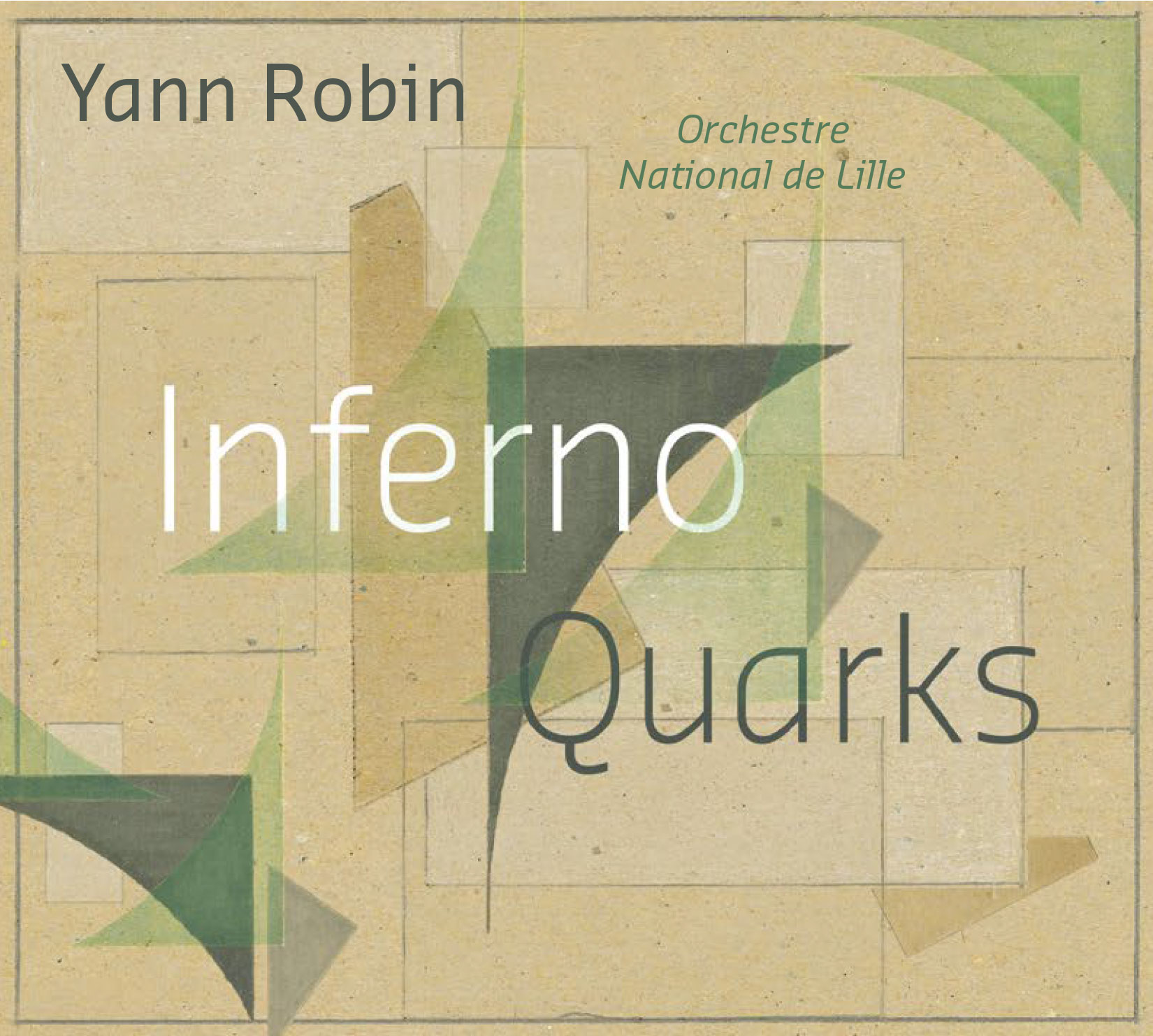
The seventh release from the CUICATL label, distributed by ECM Records and realized under the careful ear of Studios La Buissonne, unfolds like a descent staged in slow motion. It gathers two major works by French composer Yann Robin, not as paired opposites but as adjoining chambers within the same cavern, each carved by pressure, time, and an almost obsessive attention to sound as material that resists obedience.
Inferno for large orchestra and lectronics (2012/15), extends the molten logic of Robin’s earlier Vulcano into a broader and more perilous terrain. Where its predecessor seethed and erupted, Inferno opens the earth itself, widening the aperture to accommodate a full symphonic body and an electronic presence that behaves less like an accompaniment than a witness condemned to remain. The piece draws energy from volcanic force, from the grinding insistence of tectonic movement, but it also looks backward toward older cosmologies, toward the crater imagined as a mouth leading downward into realms where weight and consequence become absolute. Dante’s descent through the nine circles of Hell hovers here not as a story retold but as an organizing gravity, a philosophical excuse for sound to fall, to sink, to stretch itself into registers that feel less heard than endured.
From the outset, an oscillating electronic rhythm seeps upward from darkness, insisting on existence. It is tethered to the depths like a ferryman who has forgotten the surface, guiding others while remaining trapped in transit. Around it, the orchestra gathers in fragments. Flutes flicker briefly, offering half-phrases that seem to remember speech without fully recovering it. Other winds echo these gestures, voices reaching upward only to be pulled back by the mass below. The strings surge and recoil, animated by digital reactions, their undulations fueled by something restless and unnameable. They rise, they strain, and they fall back into place, condemned to repeat the same arc with minute variations, a ritual of motion without escape.
As the descent deepens, distorted impulses dart through the texture like fleeting hallucinations. They pass too quickly to be grasped, yet not so quickly that they leave no residue. The mind latches onto their outlines, assembling meaning where none is offered. Horns enter alongside radio signals, sharing air and intention without ever truly merging. They pass through narrow spaces, stiff and unyielding, only to warp once released, bending themselves into unfamiliar shapes as though testing the idea of survival beyond the threshold. A distant pulsing emerges, eerily reminiscent of a helicopter circling far above, a cruel reminder that time continues elsewhere, measured and indifferent. The balance of the piece begins to tilt. Timpani recede into silence while stillness itself becomes percussive. Out of this exchange rises a shrill, piercing song, demonic not in caricature but in its inevitability, spreading a thin carpet of resignation across the sound field. When the music finally withdraws, it does so gently, offering a softening that feels less like relief than a carefully staged illusion.
Quarks for cello and orchestra, composed in 2016, shifts the axis of inquiry without abandoning the underlying tension. Its inspiration lies not in physics as a system of laws but in the instability of language itself. Murray Gell-Mann’s decision to name the quark with a phoneme stripped of inherited meaning becomes the conceptual spark. Robin follows that gesture into sound, tracing how an idea becomes vibration, how vibration becomes articulation, and how articulation acquires the dangerous authority of a name.
The piece begins almost below perception. The cello stirs with grating gestures that refuse pitch, as if testing the edges of its own body. These sounds feel private, internal, the murmur of a language not yet agreed upon. Gradually, a chittering vocabulary forms, its units stitched into larger phrases by the orchestra. But coherence is never allowed to settle. Each structure is dismantled, recycled, pasted back together like fragments in a scrapbook whose chronology has been deliberately erased. Snippets of history drift through, human and otherwise, and with them comes a persistent unease. For all its orchestral breadth, the work remains fiercely intimate. The cello’s relentless friction keeps the listener tethered to its interior life, to the sensation of an instrument pushing against the limits of its own coherence.
Listening becomes a form of inhabitation. The ear does not observe the cello from a distance but moves inside it, sharing its insistence. It ceases to function as a soloist in the traditional sense. In its highest squeals, animal and raw, something elemental surfaces: an echo of creation itself, a human attempt to mirror the authority of the divine by assigning boundaries where none naturally exist.
Taken together, these works do not offer answers so much as conditions. They place the listener in situations where descent and emergence are concurrent states. What lingers after the final vibrations fade is not the memory of specific gestures but a quieter unease. If meaning arises only when we impose it, and if naming is always an act of power, then listening becomes an ethical move. To hear without conquering, to remain attentive without demanding resolution, may be the closest we come to understanding a world that does not require our comprehension in order to continue.

