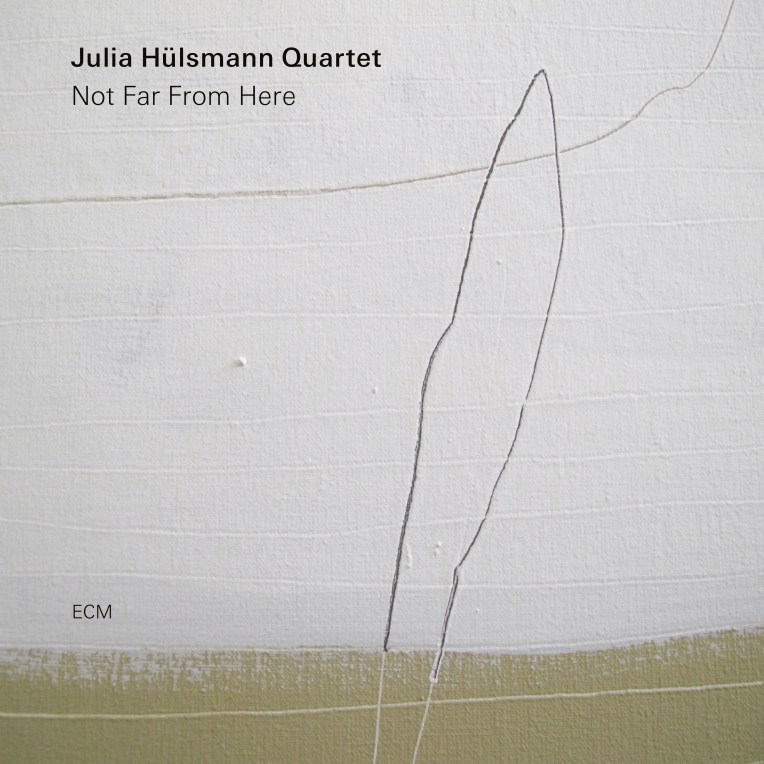
Uli Kempendorff tenor saxophone Julia Hülsmann piano Marc Muellbauer double bass Heinrich Köbberling drums
Recorded March 2019, Studios La Buissonne, Pernes-les-Fontaines
Engineer: Gérard de Haro
Mastering: Nicolas Baillard
Produced by Thomas Herr
Release date: November 1, 2019
Fans of pianist Julia Hülsmann’s work will find familiar flavors enhanced by the unique spice of tenor saxophonist Uli Kempendorff being added to her long-running ensemble. He’s most vividly showcased on “Le Mistral,” one of two tunes contributed by bassist Marc Muellbauer. What begins with a quiet stirring develops into a freely interlocking sound—one honed by years of experience and held together by the band’s open-ended circuitry.
The poetry of Kempendorff’s playing is forthcoming, and the same holds true of his writing, even as “Einschub” is harmonized enigmatically. Most of the composing credits, though, go to Hülsmann. From the opening caress of “The Art Of Failing” to the masterful “No Game,” she treats every instrument as a vital ligament of the same appendage, pointing and flexing to the rhythms of emotional desire. With the tenderness of morning light gaining slow but steady purchase on the corner of a bedroom window, she follows a natural order of things.
Drummer Heinrich Köbberling throws a couple of his own coins into the proverbial fountain, including “Colibri 65,” which furthers the bandleader’s apparent mission of summoning placid, distinct airs.
The set is upheld by two versions of “This Is Not America,” a song written by David Bowie in collaboration with Pat Metheny and Lyle Mays. With broken nostalgia, it winds a melodic tangle from which escape is an easy but deeply unattractive option.
(This review originally appeared in the February 2020 issue of DownBeat magazine.)
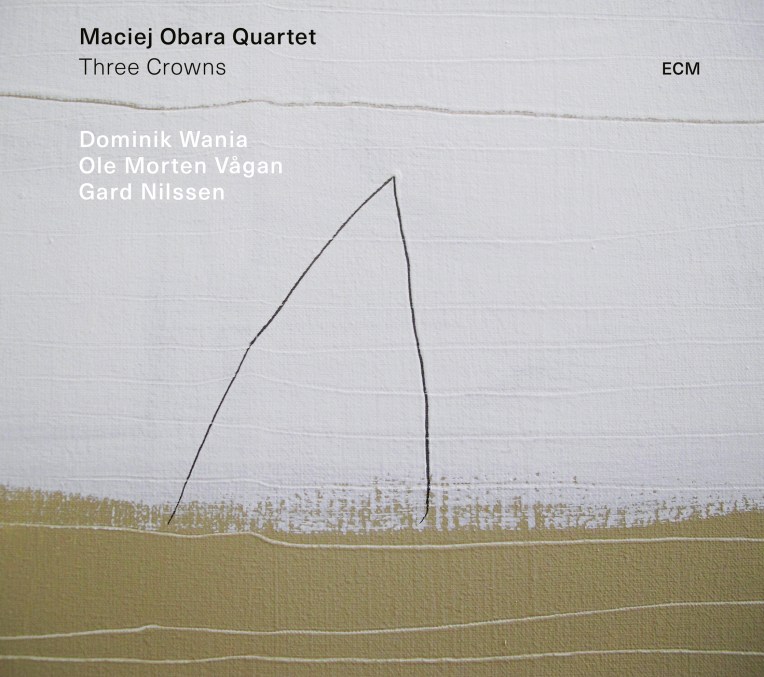
Maciej Obara alto saxophone Dominik Wania piano Ole Morten Vågan double bass Gard Nilssen drums
Recorded March 2019, Studios La Buissonne, Pernes-les-Fontaines
Engineer: Gérard de Haro
Mastering: Nicolas Baillard
Produced by Steve Lake
Release date: October 25, 2019
After their 2017 ECM debut, Unloved, Polish saxophonist Maciej Obara and his quartet make their return with Three Crowns. In addition to six new tunes from the bandleader, the album features improvisational renderings of music by one of the most significant composers of the 20th century: Henryk Mikołaj Górecki (1933–2010). Though Górecki’s work has been subjected to improvisational treatments before, these renditions bear special distinction for being sanctioned by his family, whom Obara came to know while living in Katowice, where the composer once was based. The first Górecki interpretation, “Three Pieces In Old Style,” is so beautifully reimagined that it sounds as if it’s emanating from another world. Pianist Dominik Wania opens in a deeply respectful mood, allowing Obara’s incisive tone to keen overhead, while bassist Ole Morten Vågan and drummer Gard Nilssen roam a rain-kissed landscape below.
“Blue Skies For Andy” is among the stronger Obara originals—not only for its melodic strength but also its patience. It has a classic sound that feels warm to the ears, as precise as it is free. Other highlights range from the savvy urbanism of “Smoggy People,” notable for Wania’s postmodern swing, to the more geometric “Glow,” which recalls the tightly knotted compositions of fellow altoist Tim Berne. Obara’s bandmates grow in real time, though nowhere so maturely as on “Mr. S,” an homage to trumpeter Tomasz Stańko that rolls in on a wave of melancholy and sunshine in equal measure. Like the title track, it’s flexible and always attached to something pure and knowable. There is no mystery here. Only life.
(This article originally appeared in the January 2020 issue of DownBeat magazine.)
In 2010, I embarked on a life-changing journey through the entire ECM catalogue. Five years later, I reached synchronicity when I reviewed every album on the ECM, ECM New Series, and JAPO imprints. In the wake of that milestone, my attentions were pulled in many different directions, as I was simultaneously raising a new family, earning a Ph.D., teaching, publishing as both author and translator, sharpening my skills as a traveling music journalist and photographer, and pivoting into newfound spiritual awakenings. Consequently, my ability to keep step with ECM’s unflagging release schedule—which now averages one new album per week—waned in the light of these and other commitments. And so, imagine my (lack of) surprise when, upon deciding to resume this project in earnest, I realized that I had fallen behind by about 200 albums. On this, the 14th day of November 2019, I can humbly say that synchronicity has been restored. Whether by coincidence or unconscious design, just as my final “catch-up” release in 2015 was Keith Jarrett’s Creation, this time around it happens to be Jarrett’s Munich 2016, released only two weeks ago. The significance will hardly be lost on you, my dear readers. And how fortuitous, too, that I should arrive at this point in the heart of ECM’s 50th anniversary. Going forward, I aim to be your go-to source for the most up-to-date reviews and will be unveiling a few surprises, so stay tuned. The extent of my gratitude may just be bigger than the influence of the label to which I offer it. My deepest thanks to you for continuing to share it with me.
Keith Jarrett piano
Recorded live July 16, 2016
at Philharmonic Hall, Munich
Producer: Keith Jarrett
Engineer: Martin Pearson
Mastering: Christoph Stickel
Executive producer: Manfred Eicher
Release date: November 1, 2019
The more I listen to Keith Jarrett’s improvised concerts, the more I shy away from the adjective “solo” to describe them. Not because I live under a delusion that it isn’t just him translating energies that 99.99 percent of us could only hope to detect, but because each iteration of this asymptotic journey at the piano reminds me of the ghost of yet another former self who goes on playing in an alternate reality even after he lifts his hands and takes a bow amid the applause of this one.
Throughout this two-disc recording, which documents a July 16th performance in the city and year of its title, Jarrett unveils 12 numbered sculptures of possibility, each more freestanding than the last. Not that the path between them is linear. What begins in Part I—the set’s longest, just shy of 14 minutes—as a many-tentacled deep sea creature has by Part III already morphed into a landbound shepherd. The latter’s hymnal qualities light a gospel fire in the underground railroad lantern of Part IV before dissolving into the child’s dream that is Part V.
Part VI marks another change of face, uniting questions of mountains above with answers of valleys below. The contortions of Parts VII, IX, and XII are ages between, giving way to meditations in which un-pressed keys speak as truthfully as their contacted neighbors. Few are so profound in this regard as Part XI, of which a certain air of finality is only as permanent as the wind on which it’s written. It whispers as an antidote to the shouting match that has become our lives.
In light of all this, we get a trinity of shades in Jarrett’s choice of encores. In “Answer Me, My Love,” he embraces the past as if it were a dying future. In “It’s A Lonesome Old Town,” he embraces the present as if it were the only hope of peace. And in “Somewhere Over The Rainbow,” he lets go of all three states of mind, knowing that honesty of expression is the only wave we can catch to keep him visible as he follows one horizon in search of the next.
Kit Downes piano, organ Tom Challenger tenor saxophone Lucy Railton cello Stian Westerhus guitar Sebastian Rochford drums
Recorded November 2018
at St. Paul’s Hall, University of Huddersfield
and St. John the Baptist, Snape
Engineer: Alex Bonney
Produced by Sun Chung
Release date: October 25, 2019
Following his 2018 ECM headliner debut, Obsidian, Kit Downes returns at the organ (and piano), this time among friends, including saxophonist Tom Challenger (heard for a spell on Obsidian), cellist Lucy Railton, and drummer Sebastian Rochford. The latter is heard prominently in the concluding “Blackeye,” a piece cowritten by Downes and Challenger. Its thicker brushstrokes fill a rather different sort of canvas than the ones preceding, albeit touched by the same palette.
“Sculptor” opens with Challenger’s bare tone, a kiss of sun on the morning glory of piano that then imbues the scene with its color. Also lurking is guitarist Stian Westerhus, a new addition to the Downes nexus who is rightly described by Steve Lake in his liner notes as, at times, a “near-subliminal participant.” Twinkling like starlight in “Bodes,” his guitar emotes under tension of utterly non-invasive strings. The latter tune is the album’s masterstroke: a fully narrative journey from cradle to grave that catches as many life experiences as it can before passing them on like an inheritance in faith of continuation.
Comforting about Downes as composer is his underlying sense of open-endedness. Titles such as “Pinwheel” and “Sunflower” suggest interconnections just beyond their titular surfaces—not only in Railton’s liquid threading, but also in their ability to turn melody into substance (if not the other way around). “Circinus” and “Twin” make sense of the organ as if it were a text to be interpreted in humility. Both elicit an undeniably cosmic feel, strangely rendered in textures of flesh and soil.
The only piece not by Downes is “M7.” Composed by his wife, bassist and vocalist Ruth Goller, this organ solo centers its energies in sustained pedal points while spreading open the periphery as one might a pair of hands. In its cradle, the entire album’s heart dents a pillow woven from old maps and cartographic sketches, each drawing closer to an undiscovered country but never quite reaching it. Content to float wherever the current may lead, it closes its eyes and redraws its path in the language of a dream, where the only songs that matter are those without words.
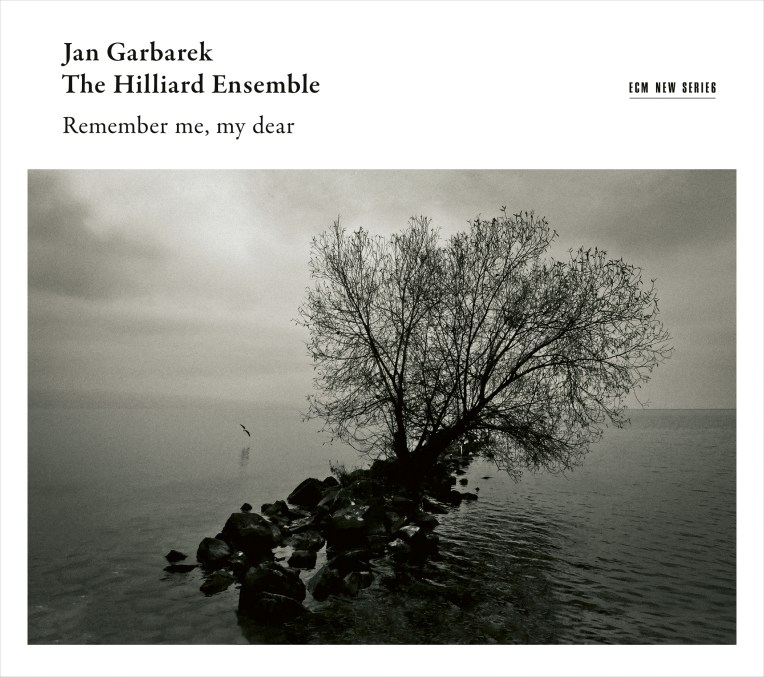
The Hilliard Ensemble
David James countertenor Rogers Covey-Crump tenor Steven Harrold tenor Gordon Jones baritone Jan Garbarek soprano saxophone
Concert recording, October 2014
Chiesa della Collegiata dei SS. Pietro e Stefano,
Bellinzona (Switzerland)
In the series “Tra jazz e nuove musiche”
by Paolo Keller for RSI Rete Due
Tonmeister: Michael Rast
Engineer: Lara Persia
Mixed at Auditorio Stelio Molo RSI, Lugano
by Manfred Eicher and Michael Rast
Produced by Manfred Eicher
Release date: October 18, 2019
When the Hilliard Ensemble and saxophonist Jan Garbarek first recorded for ECM in 1993, they opened as many—if not more—forces than they joined. It was a collaboration not only between each other, but also between them and engineer Peter Laenger, the Austrian monastery of St. Gerold, and producer Manfred Eicher, whose vision was so attuned to the possibility of it all that he would seem to have heard it in his head before those five breaths intertwined in reality. Twenty-five years after the release of their self-titled debut, the Officium project resurfaces with this document of their final performance in 2014.
The roots of this program’s oldest branches may be traced to the soil of past albums. In the opening “Ov zarmanali,” a hymn of Christ’s baptism by Komitas that was likewise our doorway into Officium Novum, Garbarek’s keening soprano is unmistakable in shape and color. In this setting he plays with the decay of notes, sharing more with sitar virtuosos than other reed players and taking into account every incidental effect as physical material for expression. It is the Hilliards, then, who enter into his delineation—not the other way around—and who plow a field just as ancient in preparation of a hybrid crop unlike any other. This progression is reversed in “Procurans odium,” one among a handful of anonymous medieval pieces that finds its seeds, split with time, restored in the nourishment of resuscitation. Garbarek’s role is nevertheless fully dimensional, drawing out from within rather than applying from without. Other unattributable turns, such as the wondrously ambient “Procedentum sponsum” and more lilting “Dostoino est,” speak to the power of memory. And in the “Sanctus,” not heard since their debut, we find a folding inward rather than expansion of concept.
Beyond the category of performer, Garbarek’s contributions fall under composer and arranger, finding solace all the same in this sanctuary. In the latter vein is “Allting finns,” wherein his exploratory nature is particularly evident, as one can feel Garbarek roaming the church in search of stone and warmth, while his setting of the Passamaquoddy poem “We are the stars” draws an unbreakable thread from one corner of the earth to another, likewise itinerant in spirit.
From the liturgical, as in the light-through-stained-glass effect of Nikolai N. Kedrov’s “Litany,” to the repentant shading of Guillaume le Rouge’s “Se je fayz deuil” (gazing back to Mnemosyne), the vocal nature of Garbarek’s saxophone and the reed-like qualities of the Hilliards have perhaps never been so dimensionally interchangeable. For even when the saxophone is absent, as in a most intimate rendition of Arvo Pärt’s “Most Holy Mother of God,” its soul lingers—a dream upon waking. The effect is such that, even when turning the brittle pages of more familiar material, like the “Alleluia nativitas” of Pérotin or the “O ignis spiritus” of Hildegard von Bingen, we are welcomed in the spirit of newness. And so, in the 16th-century Scottish folk song we find more than a title, but a poignant reminder that our minds are at once the tenderest and most robust vessels for honoring the past. For how can we not remember the impact this quintet has made on modern music, and the love with which listeners will continue to fill its crater for ages to come?
Avishai Cohen trumpet Yonathan Avishai piano
Recorded September 2018, Auditorio Stelio Molo RSI, Lugano
Engineer: Stefano Amerio
Produced by Manfred Eicher
Release date: September 6, 2019
Although trumpeter Avishai Cohen and pianist Yonathan Avishai have known each other and played together since they were teenagers in Tel Aviv, this is their first recording as a duo. The title refers to an offhand comment made by producer Manfred Eicher, who during the recording of Avishai’s Joys And Solitudes remarked, “Avishai [Cohen] should play this room.” The duo session documented here happened just a few days later, only now in the Auditorio Stelio Molo RSI at Lugano in place of Studios La Buissonne. And play the room they do. Not only in the sense of liberating a delightful mix of standards and original contributions to the modern songbook, but also because, like seasoned thespians, they inhabit their narrative roles with full physical commitment.
The set’s door is pushed open by said original contributions, starting with “The Opening” by Cohen, which seems to flower into audibility of its own volition to be heard. Piano and trumpet communicate so deeply, even when not playing at once, resulting in one of the more evocative beginnings to grace an ECM program quite some time. Avishai’s “Two Lines” is an equally introspective, if darker, companion, by whose gestures are activated shared memories. Cohen here is especially broad of emotional brush and paints with the abandon of a child.
John Coltrane’s “Crescent” kicks off the album’s airborne remainder, cycling through its own self-awareness and in that process attaching feather upon feather in anticipation of flight. Cohen rises and sets like the stars, while Avishai navigates by their movement. The effect is such that when Duke Ellington’s “Azalea” cracks open the scene like an egg of dawn, its classic sounds feel not so much reborn as reawakened. As in Ornette Coleman’s “Dee Dee” and Stevie Wonder’s “Sir Duke,” they approach the evergreen as an opportunity for pruning instead of replanting.
Whether in the comforting shades of “Ralph’s New Blues” (Milt Jackson) or the gorgeously rendering of “Kofifi Blue” (Abdullah Ibrahim), Cohen and Avishai stay true to form because they understand the form of truth. In their hands, and by the spatial allowances of Eicher and engineer Stefano Amerio, these tunes resonate with nothing more than what they were meant to be. All of which makes inclusion of “Shir Eres (Lullaby)” by Sasha Argov (1914-1995) poignant beyond measure. Not only because it’s an emotional touchstone in the hearts of the musicians, but also because it pulls the sky like a blanket over our ears, that we might better hear the sounds of our own heartbeats. Thus, Playing The Room is the sonic equivalent of the “moon illusion”—when our closest satellite appears bigger on the horizon than it does in the sky due to its visual proximity to earthbound objects. Once risen, however, it tells us just how far we’ve come, and how much infinitely farther we have to go.
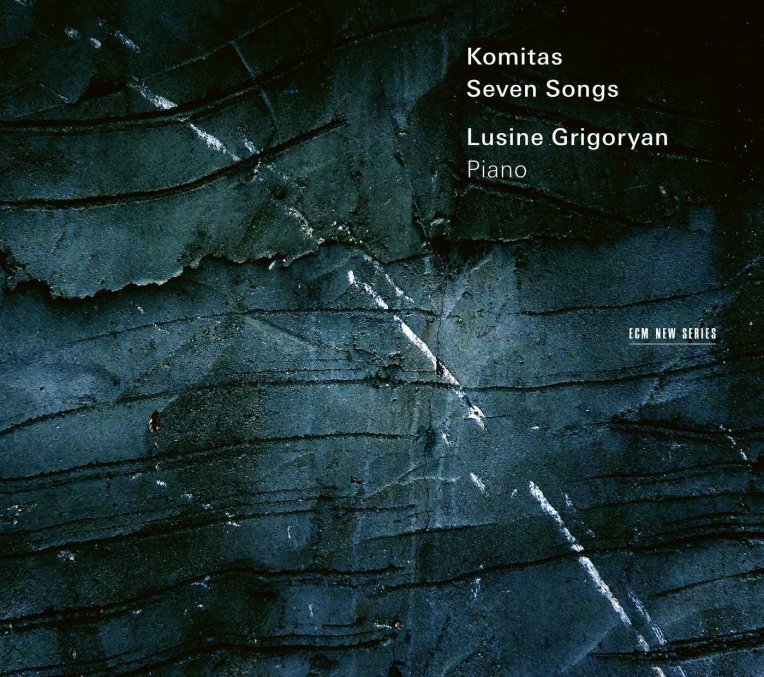
Lusine Grigoryan piano
Recorded February 2015, Auditorio Stelio Molo RSI, Lugano
Engineer: Markus Heiland
Produced by Manfred Eicher
Release date: September 22, 2017
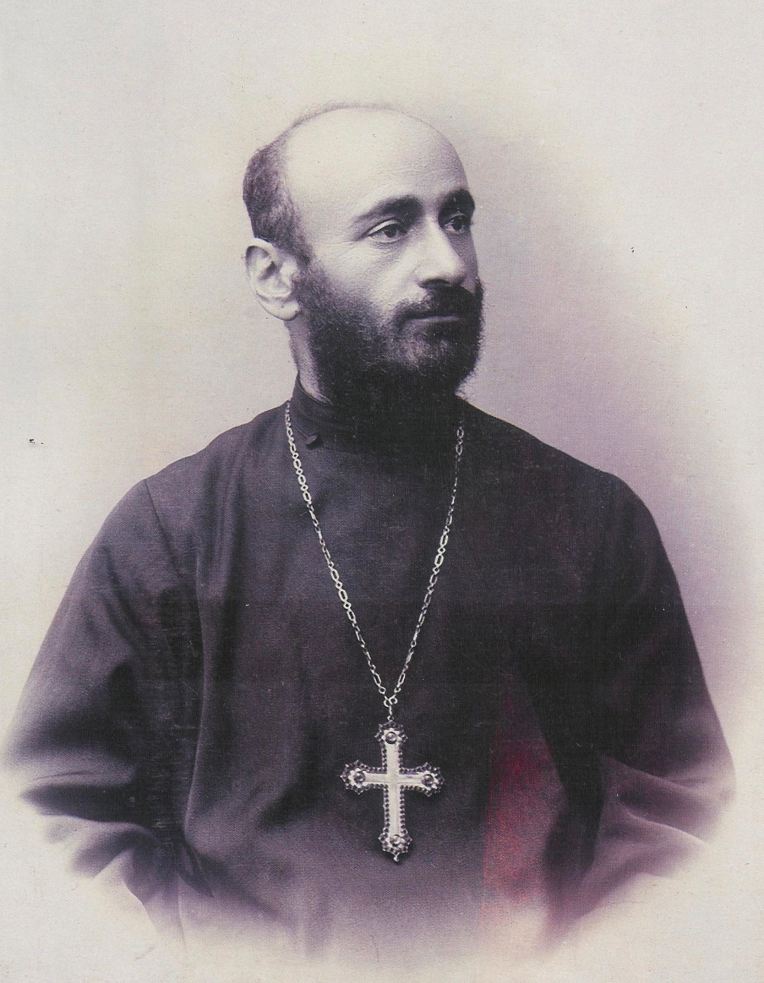
Armenian pianist Lusine Grigoryan makes her ECM debut with a program of music by her homeland’s most respected composer: Komitas Vardapet (1869-1935). Seven Songs is a companion to the Gurdjieff Ensemble’s Komitas, led by her husband Levon Eskenian, and was recorded during the same 2015 sessions. Where that previously issued album expanded upon the sonorities of Komitas’s piano music, here we encounter said sonorities nakedly. In each are shades of traditional instruments and dances, motifs regarded beyond time yet grounded in the familiar by their immediacy of offering.
Komitas was intensely interested in Armenian folk music, which he collected, studied, and arranged throughout his life. If not for the efforts of Grigoryan and likeminded artists, his music might remain sequestered in Armenia without ever transcending its borders. As Paul Griffiths writes in his booklet essay, “His is a torn page waiting to be sewn back into music history.” The eponymous heptad of 1911 is a veritable notebook of ideas, each the memory of a fleeting moment, dutifully bound at Grigoryan’s fingertips. Like an ancient soul seeking solace in modern sprawl, where physical contact—once the glue of the human volume—has now dissolved in a landscape of storm-blown leaves. Komitas-via-Grigoryan’s interpretations of innocence and sin, perfection and corruption, death and life are all here for us to examine. Their happiest moments, such as the last (titled “The water comes from the mountaintop”), are also its briefest, and speak of the honesty with which Komitas viewed the world around him. The latter’s geological inevitability is, like the music itself, indicative of his earthly pilgrimage and points to a perennial theme of landscape echoed in the painterly Toghik from 1915 and even in the twelve Pieces for Children (1910-15). Nowhere so vividly, however, as in Msho Shoror. Inspired by the mountainous region of Sasun, its rocky qualities indeed require deft footwork—or, in this case, handwork—to navigate. The shoror, or “sway dance,” is a navigation unto itself, every step woven into what the composer called an “ancestral” experience. Whether vigorous or reflective, each of its seven variations is spiritual in nature, reflecting upon the relationship between flesh and fate, and the connective tissue of experience between them.
The Seven Dances further nuance this sense of bodies in space and time. Komitas calls upon the performer to evoke timbral qualities of particular instruments, such as the daf and duduk. Grigoryan renders these with intimate attention to detail, deeply aware of the flow within them. The second of these dances, of Yerevan extraction, is a standout for its delicate pointillism. Likewise the fifth of Vagharshapat. Heard against the somber reflection of the final shoror, they remind us that vigor means nothing without the stillness awaiting its exhaustion.
Because this music feels at once so near and so distant, I conducted an email interview with Grigoryan, who kindly offered her own reflections…
Tyran Grillo: Can you tell me, in your own words, what Komitas means both to you and to Armenians in general?
Lusine Grigoryan: For me, Komitas is first and foremost a marvelous composer. His compositions are extremely valuable and give pianists the opportunity to discover and express their performing peculiarities. This music forces you to think, endlessly: its character can change from one bar to the next. In addition, it requires you to evoke Armenian traditional instruments through the piano. Komitas helps the performer with his meticulous indications (the approach of Baroque music to folk imagery has been a big help in this regard). For me, and for the Armenian people, Komitas is the founder of our national music. He preserved and defined what Armenian music is, setting the foundation for our approach to composition. The reflection of sacred music in his piano repertoire is more obvious in “Msho Shoror” (Shoror of Mush), a dance in which 300 pilgrims would take part at the Monastery of Saint Karapet in Mush. In the first part, the zurna and the drum would sound the call and gather the dancers, then a large circle would be formed and the prayer would start. This is a significant part of the cycle and has motifs that have been passed down orally for generations, going back to pagan times, as expressed in the leitmotif of the sun in Komitas’s “Pieces for Children.” We come across this theme also in our church hymns and in Armenian national music more broadly.
TG: I believe the music of Komitas has a uniquely timeless quality. Do you agree? If so, where do you think that quality comes from?
LG: Yes, Komitas’s music truly has a timeless quality to it. Listeners are frequently confused and think he is a contemporary composer. I believe this has to do with his minimal approach, his ornaments and motifs, all of which have their origin in folk music. It is also a manifestation of how powerful Komitas’s thinking as a composer is, of how he is able to transport a simple song to a classical instrument—the piano—while preserving its genuine rustic condition.
TG: How did you prepare yourself for this recording?
LG: The recording was done in parallel to that of the Komitas CD recorded for ECM by the Gurdjieff Ensemble. I sometimes would take part in their rehearsals and practice sessions. I would listen to how national instruments resounded and search for ways to achieve those sounds through the piano, because Komitas often indicates “in the style of tar,” “in the style of dap,” “in the style of nay,” and so on. Despite being an ethnic Armenian, what I had pictured as the performance style of these instruments was not always accurate. So taking part in the rehearsal and practice sessions of the ensemble was very informative. As a matter of fact, it was Manfred Eicher who advised me to do this and he who insisted that the recordings be carried out in tandem.
TG: How much do you know about Komitas as a person, and does your knowledge of his social and spiritual beliefs help inform the way you play his music?
LG: Komitas was a very down-to-earth, straightforward man with an immediate and uncomplicated personality, but at the same time deep and sensible; much like his music. He gave a lot of thought to these pieces before writing them down. He worked on them extensively, often producing many versions of the same piece. The more I play his music, the more I discover.
TG: If you could ask Komitas one question, what would it be?
LG: I would be reluctant to ask a question. But I know that he had a clear view of the Armenian school of composing, that he had started to work on his opera Anush, was composing string quartets, and thinking about the symphonic genre. But because his creative life was cut short, he wasn’t able to bring these projects to fruition. I would love to know: Had he had the time to lay the foundations, what direction would our composers have taken? Armenian composers have tended to write more in the European mode, using folk themes only occasionally. Maybe in Tigran Mansurian’s music we can find can find something more attuned to that cultural spirit. I am very much interested in this question.
My latest review for All About Jazz is of the recent “ECM Records at 50” performance at Lincoln Center in New York City. Click the image below to read the full article.





 Between Sound and Space: ECM Records and Beyond