Ana Reyes: The House in the Pines (Book Review)

It was as if they had opened a valve and all the pain, fear, and anger of those days had issued from their chests and rolled onto the street, rising into a terrible shout to the thick black clouds above.
–Isabel Allende, The House of the Spirits

Trauma wears a coat of iron. It trips into the body when one least expects it, wrapping itself on the way down in a protective layer so soundproof that it becomes unknowable even to the self. With time, however, its minor key drifts within earshot, begging for the major strains of a token anthem known as “Moving On.” Such prefab resolutions to the pain we carry inside feel intensely tailored to individual circumstances until we realize they bear the scars of ancestors whose breath still hangs heavy in the air. Although their voices are lost to the burial ground of history, we continue to exhume them in the hopes of putting their bones back together. But without the flesh to connect them, they fall into piles of dust the moment we let go.

When destruction befalls an entire race of people, even before the word “genocide” enters our collective vocabulary, its wickedness thrives in the shadow of our unwillingness to accept it. And yet, something lingers, a sundial’s shadow following the same slow arc across a stone marked by the positions of celestial bodies. Except now the stone is a page, its shadow the ink it has absorbed to convey stories of ourselves. This is the essence of literature. And so, let us begin to imagine that one page becomes ten, that ten becomes hundreds, and that a cover and a name whorl into shape. The leaves part, and the light angles itself just so, hinting at what is to transpire.

An Outward Look

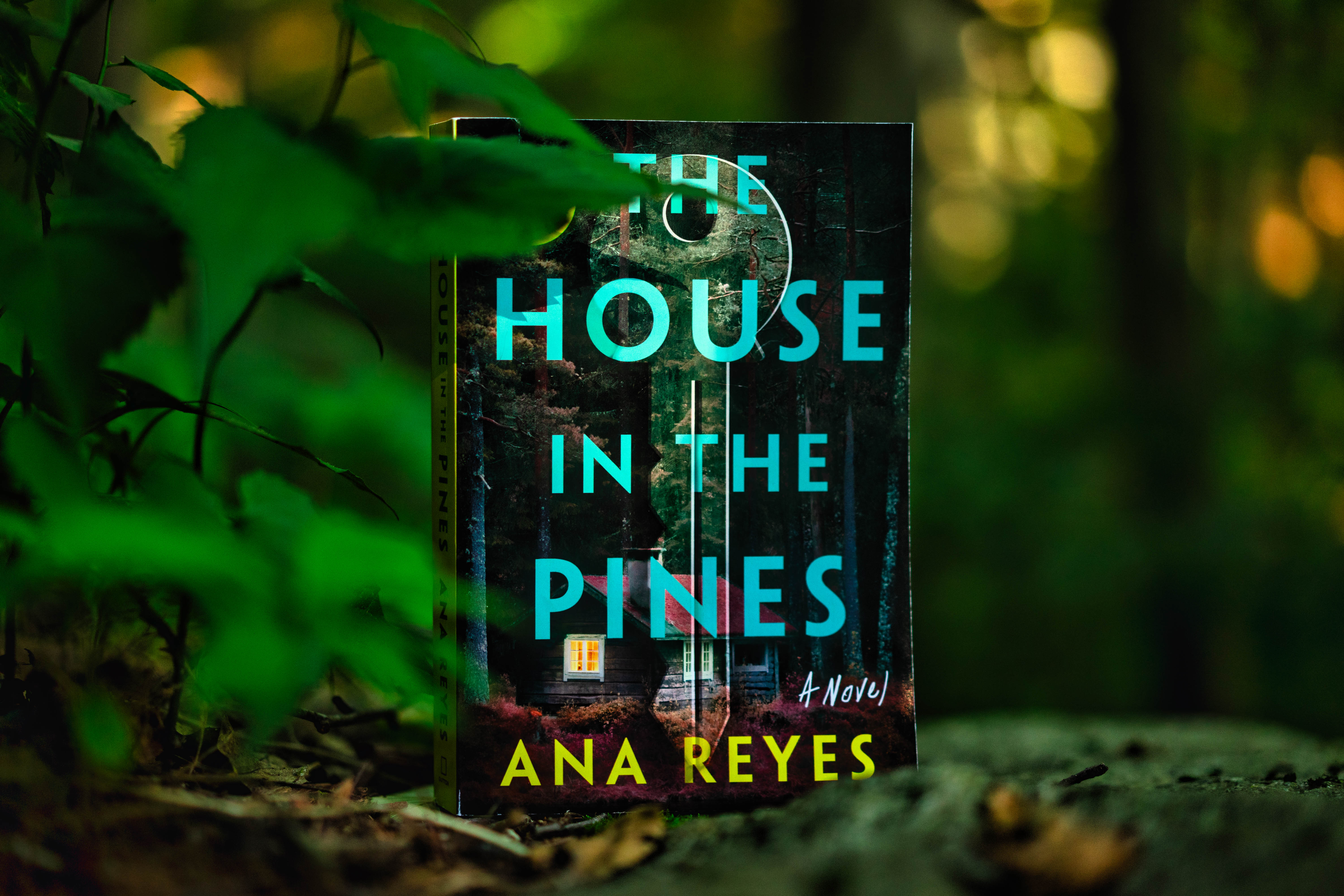
“Deep in the woods, there is a house that’s easy to miss.” So begins The House in the Pines, the debut novel from Ana Reyes. Like the titular house, itself a major character whose lungs inhale the emotions of her protagonists and antagonists and exhale the distillations of their overlapping traumas with the depth of a fireplace in its capacity for memory, she holds the key. Thus, Reyes points to a core construction not only of her conceit but also of fiction as a contract between author and reader. In building these things one element at a time, she clues us in on her piecing together of personalities and the world they inhabit.

Our guide, once removed from omniscience, is Maya, a 25-year-old graduate of BU who works at a gardening center while her partner, Dan, pushes his way through law school. As a couple, they are typical and atypical. The former in the sense that they want what most people in love want (to make a home together, find meaning in each other, and build a future to replace the past), the latter insofar as Dan’s unabashed honesty—a rarity in her lived experience—is a mirror she has yet to find elsewhere. Its reflection at once repels and attracts her, illuminating vices that may or may not be within her control. For the time being, things are relatively stable—that is, until she encounters a mysterious piece of security camera footage online in which a young woman drops dead inexplicably. Disturbing in and of itself, if not unusual in viral fare, what grabs Maya’s attention is the man in the video, Frank Bellamy, an ex whose face might have remained subconscious had not its unmistakable features courted her memories from the screen.

Even before this interruption, Maya has been papering over the cracks. Like an eggshell, the structural integrity of her life relies on equal pressure applied to opposite ends. Any maldistribution thereof means she is at risk of breaking. Wracked by sleepless nights, she “could easily draw from memory the shape of every water stain on the ceiling,” indicating a dichotomy of comfort and monotony stemming from the same source. Through flashbacks, we witness her friendship with Aubrey, who also happened to die in Frank’s presence seven years ago.

A further scan of the surface of things reveals other details amiss. Maya’s struggle with antidepressants is clarified early on, as is her insistence that Frank is somehow responsible for the death of Aubrey and the girl in the video. That no one believes her encourages a cycle of doubt that keeps one foot on the hamster wheel of justification. If we are going to trust Maya, we must first seek the evidence cobwebbed in the darkest recesses of her mind.

She returns to her hometown hoping to learn more about this second death and the enigmatic Frank, whose involvement, she maintains, is more than coincidental. She has set herself on a path toward a truth that even she might not be prepared to wield as her own. The rest is for you to discover.

An Inward Look

One sign of any honest work of literature is not how well you understand it but how well it understands you. In this respect, The House in the Pines succeeds with hard-won beauty through two disparate yet intertwined internal mechanisms.

The first is an unfinished novel by Maya’s father, a latter-day victim of Guatemala’s Silent Holocaust, whose typed manuscript is a leitmotif in her life. It also brings her and Frank together, as her intent reading of it pings his interest. After striking up a conversation, they embark on a relationship as intense as it is cut short by Aubrey’s untimely death. Beyond this nominal mystery, the violence of Maya’s family history looms as the central horror of this novel, the outer skin of which serves as a canvas for the tattoos of its denouement.

Here, storytelling is a catalyst and repository for struggle. Through regular references to children’s books, literary classics, and Greek mythology (over which Maya and Dan bond after her skip in the record of life with Frank), Reyes gives us at least two out of three combination lock numbers for the emotional baggage Maya carries at any given moment. Suffice it to say that death has always been her stage set, whether in the aunt she never knew or the grandmother whose funeral brings her to Guatemala and puts the father’s pages in her hands.

The other psychological trigger is the cabin itself, which Frank has lovingly crafted as a haven away from a troubled (and troubling) childhood, which becomes clearer as Maya’s current investigation unfolds. In this respect, the cabin is a storehouse of memory, if only because it is the missing link in the emotional evolutions of those its presence has affected.

The centrality of its forested location further confirms the thriller narrative as a coping strategy. As Reyes puts it, “Maya’s life was divided into a Before and After” the turning point of her best friend’s sudden expiration. Any subsequent grief opens a void to be filled by words other than hers. All the while, Maya struggles with the dilemma that many victims face: to protect her own words by holding them all inside or risk others’ perversions by turning them into a story.

Either way, writing fixes memories in time, reminding us that things happened. This is why, for me, The House in the Pines is ultimately about books as objects of intimacy and vulnerability. Read it that way, and it may just hand you a key far more liberating than the one its title cross-hatches. 

The Fragrance of Fiction

It’s not often a novel gets its own fragrance, but that’s precisely what Gold & Palms Atelier set out to change with Deep Woods. Directly inspired by The House in the Pines, it combines the innocence and foreboding of the forest in a robust pyramid that will surely immerse the multisensory reader.

In its top notes of smoke and fir needle, one feels the vestiges of human activity as if encountering a once-inhabited place long since abandoned. The whiff of ashes is a sign of life, while the greenery gives us a sense of nature’s quiet indifference. The middle notes of sandalwood and cardamom lend a sense of distant times and places, perhaps even of an unrequited love. One can easily read Maya and Frank into their dance, vacillating between harmony and separation. Finally, the base notes of oud, vanilla amber, and (most prominently) tree sap indicate a mystery among the trunks and their receding lines.

While pine is no stranger to the world of perfumery, among the bottles I’ve put a nose on, Deep Woods reminds me most of Mriga from the niche brand Prin (a pungent blend of conifer resins, sandalwood, and oud), minus the animalic edge of deer musk. The softer tones of Gold & Palms Atelier’s take on this constellation make for a more wearable experience, such that you can almost feel yourself blending into the wood, losing all sense of time…

Not only is this the fragrance of fiction; it is also the fiction of fragrance to transport us to places that exist only in our minds. The overlap here is profound enough to add layers to a novel intent on peeling them. Still, there is hope because we have an anchor to hold on to. Scents may fade, but the memories of which they are spun continue to flex until we drop from view.

Special Announcement!

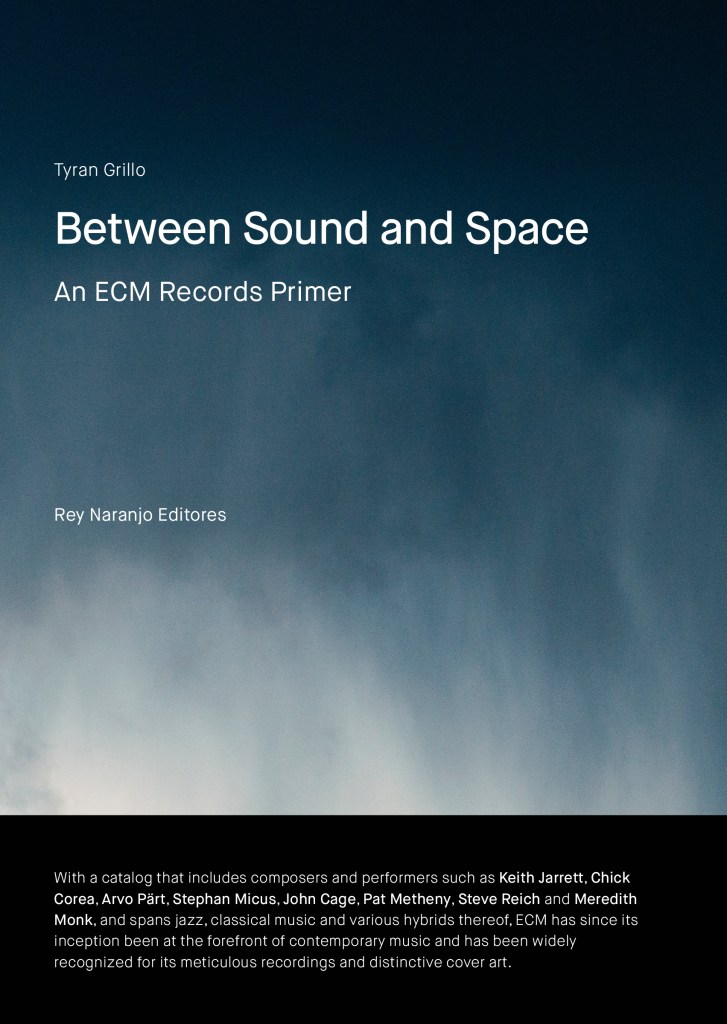
I am thrilled to announce that my book, Between Sound and Space: An ECM Records Primer, is at last available on Amazon! Those of you who have followed me for any portion of this journey know how much love, time, and care I’ve put into this project, and I hope the book, like the blog after which it was named, will lead listeners to many discoveries and hidden gems in the label’s ever-deepening catalogue. Click on the cover below to order yours while they last, and thank you, as always, for reading.

Interview with Phil Freeman

I recently conducted an interview with music critic and author Phil Freeman for All About Jazz. Freeman has some of the sharpest ears out there—and a way with words to hone them. Interested readers shouldn’t hesitate to pick up his latest book, Ugly Beauty, which hit shelves last year. Click on the cover below to read some of my thoughts on the book and our conversation about it.

Keith Jarrett: A Biography

The late Ian Carr’s Keith Jarrett: The Man and His Music long stood as the most complete portrait of its subject, who turns 76 this month. Being a product of 1991, however, the book begged a companion this side of the second millennium. In 2015, German music editor and biographer Wolfgang Sandner answered that call. Five years later, Jarrett’s youngest brother Chris, who lives and teaches in Germany, offered this superbly rendered, expanded and updated translation into English. The result, Keith Jarrett: A Biography, retreads some of the pianist’s formative milestones while stringing through them artful observations, interpretations and connections. 

We find ourselves transported back to Jarrett’s upbringing in Allentown, Pennsylvania, where Sandner credits Jarrett’s mother for not putting her son on the pedestal that has separated so many young prodigies from the possibility of a normal childhood. This may be one reason why his genius was able to flourish so organically—untainted by the bane of expectation, he built a career on transcending it. 

We sit in the audience during his first solo recital at the age of seven—a mélange of classical and original compositions—waiting for the moment when jazz will enter the soundtrack of his past. We cling to the wall like proverbial flies as, in a mere five-year span, he joins forces with Art Blakey, Charles Lloyd and Miles Davis. Jarrett’s tenure with the latter, who convinces him to join after multiple overtures, goes largely unrecorded and survives only through anecdote. By the time Jarrett parts ways with the Miles, it’s 1971, just two years after the founding of ECM Records by producer Manfred Eicher, with whom Jarrett will forge a lasting relationship. Said relationship yields albums—80 between 1971-2020—that were made to exist, just as they exist to have documented a pianist who “had not really become a soloist—he had actually always been one” (pg. 88). 

Jarrett’s “musical syntax” is as recognizable as it is challenging to distill in words. Whether in his traversals of the Great American Songbook with bassist Gary Peacock and drummer Jack DeJohnette or his recording of J.S. Bach’s The Well-Tempered Clavier (of which he characteristically remarked, “I was actually refusing more than I was giving”), the mosaic we think we know has revealed tile after unprecedented tile. 

All of which serves to validate Sandner’s decision to view jazz through a hypermodern lens, framing its latter-day developments as a recalibration of space among the rubble of the Second World War. And there, in the middle of it all, Jarrett spans the ocean like a bridge between the forward march of Americanism and the traumatic retrogression of the continent. This may be why Sandner concedes in his foreword: “Most of all, though, this music should be heard.” For a musician of Jarrett’s caliber, the best biography remains the discography.

(This article originally appeared in the May 2021 issue of The New York City Jazz Record, a full PDF of which is available here.)

New Book of Interest!

For those who have an interest in the legalities of the popular music industry, look no further than this indispensible book on the Music Modernization Act (MMA), one of the most important pieces of copyright legislation to be passed in the last century. I was honored to serve as editor for this project, which I saw from inception to completion, and know the author, E. Maxwell, to be unparalleled in his passion for making the MMA palatable to lay audiences. In these times of social isolation, when the very concept of live performance has been drastically altered, it’s more imperative than ever to fight for what songwriters are owed in light of all the behind-the-scenes efforts they put into creating music that defines culture and history while marking time like breadcrumbs along a trail.

The book may be ordered directly from Amazon here.

ECM Book Now Available Worldwide!

I am thrilled to announce that my book, Between Sound and Space: An ECM Records Primer, is now officially available for purchase!

Colombian publisher Rey Naranjo and I spent years putting this together, and we truly believe it will enrich the experiences of all ECM listeners. Get yours now while you can, as it is destined to become a collector’s item.

Click the picture below to be redirected to the publisher’s website, where you’ll find more information, including a book trailer, and a link to order via PayPal. The price is set at $40, which includes shipping to anywhere in the world.

Looking forward to your thoughts on this labor of love.

Cover copy